“What you do in life echoes in eternity” is a sentence from the “Gladiator” movie (2000). It is often misattributed to Emperor Marcus Aurelius, but it fits well with the Stoic views popular in Roman times. It is also a good way to describe how children not born today will not reproduce in the future. So, you shouldn’t be impressed by the large number of people alive today, because decline is built into the current demographic structure. We humans, are fragile things, quickly swept away by the winds of the future (another sentence that could well be misattributed to Marcus Aurelius).
What you do today, echoes in the future
I am always surprised by how difficult it is to pass information that’s not structured as yes/no, black/white, or good/bad. This is especially true when dealing with overpopulation.
Plenty of people are fully convinced that the human population is too large and that, as a consequence, we need to have fewer children, none if possible. But another fraction is convinced of the opposite: we don’t have enough children; we need more; otherwise, dark and dire things will occur, including the extinction of humankind.
Both are right, and both are wrong at the same time. The issue is nuanced. Population is not just about absolute numbers or declining natality. It depends on both, and it changes with time according to Marcus Aurelius’ (misattributed) quote, “What you do in life echoes in the future.”
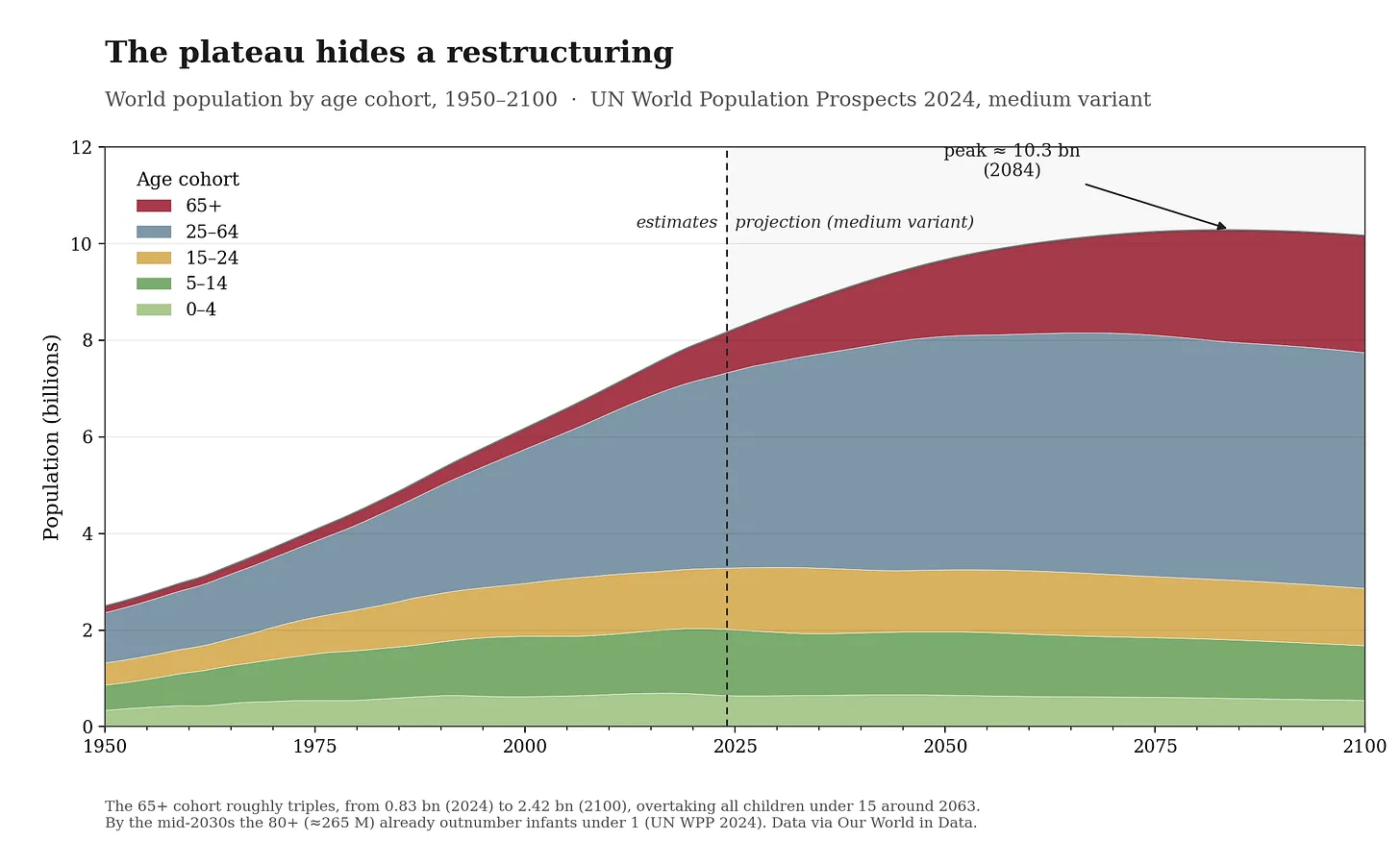
Click on the image to enlarge.
Take a look at this graph. It summarizes the situation in a single image. You see how, according to the UN models, the human population is destined to keep growing up to the mid-2080s, to levels higher than 10 billion people, and then remain approximately constant.
But look at the differently colored bands in the graph: all the growth from 2050 onward is generated by the increasing cohort of people over 65. It is a boom of the elderly, not a boom of all the age groups.
In fact, “peak child” has already occurred and is followed by a clear declining trend.
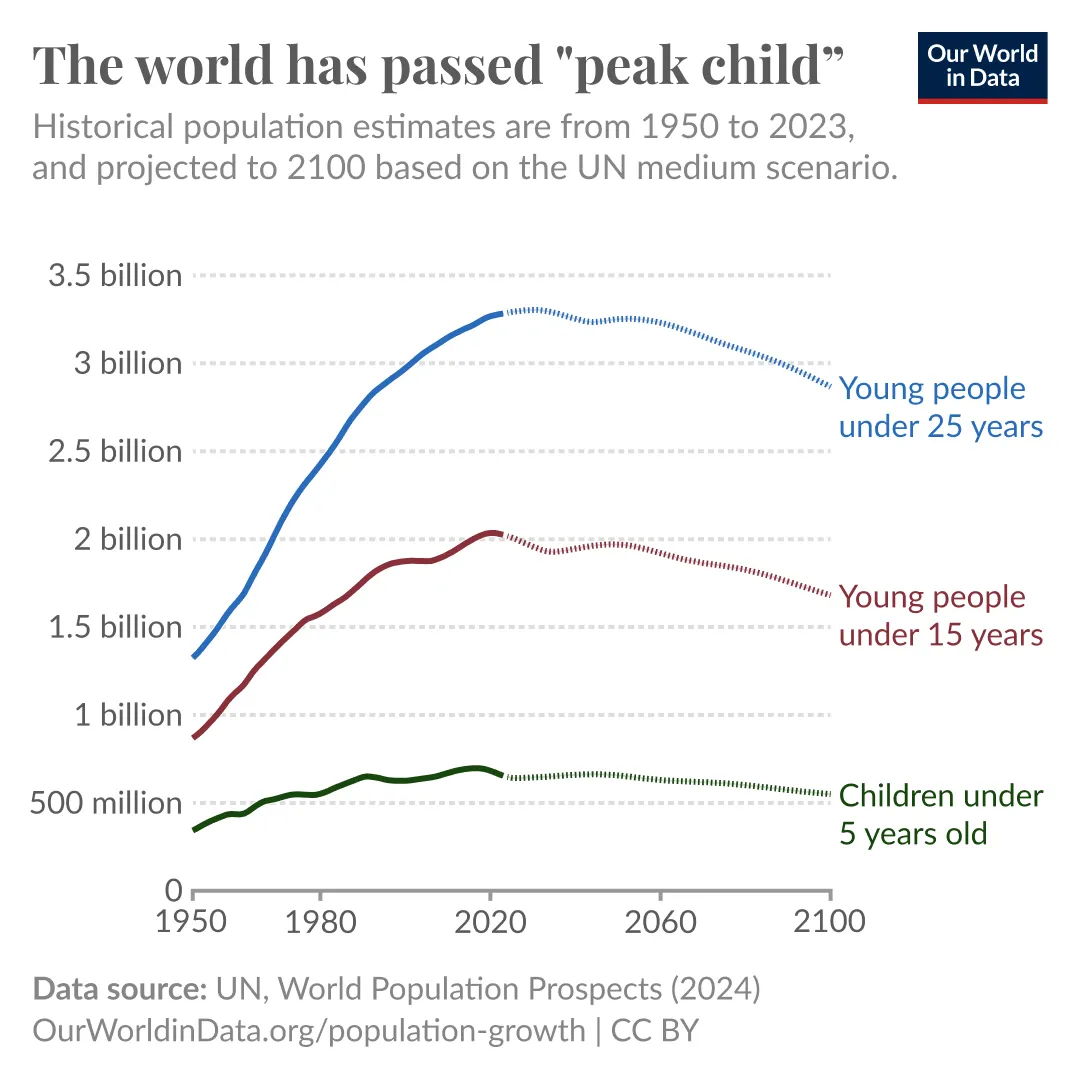
Click on the image to enlarge.
Peak child has happened recently and will soon happen for older cohorts. Its effects are going to be seen in the future. The cohorts that are born today are smaller and smaller, and with fewer and fewer people reproducing, it is unavoidable that, at some time, the human population will stop growing.
But don’t be fooled by the large numbers you see in the UN extrapolations. The simple cohort mechanism of demographic studies hides a much more drastic effect. The elderly are more vulnerable in a society weakened by the combined effects of pollution, global warming, ecosystem disruption, and a few more, and they are easily mowed down when exposed to threats such as malnutrition, germs, heat waves, and more. As you can read in my book,The End of Population Growth, history shows that when a population starts declining, it declines fast. It is one more case of the Seneca Effect at play.
Last week, I was chatting about population with a colleague at a scientific conference. He asked me, “Don’t you think the elderly will be a big problem in the future?” I said, “Not at all.” He looked perplexed for no more than one second. Then he nodded. And that was the end of the conversation.