1. Introduction
Societies often hold the ingredients of wellbeing without securing wellbeing itself. Knowledge, skill, social relationships, technology and ecological resources exist in abundance, yet they are not reliably converted into secure livelihoods, health, trust or sustainable wellbeing. A qualified person may stay unemployed because the qualification is not recognised. Research may accumulate with no institutional route to application. Care may sustain households and labour markets while going unrecorded in the accounts that decide reward and investment. In each case the capacity is present. What is missing is the institutional arrangement through which it becomes socially effective.
Political economy has explained value through production, exchange, institutional incentives, capability and market valuation, but these traditions give a fragmented account of this conversion. Production can generate an output that has no legitimacy, finance or adoption. Exchange assumes claims that institutions have already recognised and protected. The question that joins them, what institutional conditions must hold for existing capacities to be converted into flourishing, is still under-theorised.
This article takes up that question directly. It develops Institutional Value Conversion (IVC) as a framework that specifies the institutional conditions conversion requires and the transformations needed to meet them. The contribution is not another general theory of post-sovereign order. It is a narrower and more demanding claim about what institutions must actually do differently. Flourishing is understood, following Sen (1999), as what people are substantively able to be and do.
2. From capacity to flourishing: the conversion problem
Value must be separated from valuation and price. Value here is the capacity of a person, relationship, practice, body of knowledge, technology or ecosystem to contribute to human or systemic flourishing. Valuation is the institutional judgement through which that capacity is recognised, classified and ranked. Price is one monetary expression produced within a particular exchange system. Keeping the three apart stops flourishing from collapsing into market value, and it makes institutional valuation visibly political, because valuation decides whose contribution counts.
Institutional Value Conversion is the process through which institutions turn latent capacity into socially effective value. Three sources set its foundation without enlarging it. Sen (1999) fixes the normative end: what finally matters is substantive capability, not income. North (1990) shows that institutions structure the incentives, opportunities and outcomes through which similar resources yield different results. Pistor (2019) shows that legal and institutional arrangements decide which claims become recognised, protected and durable, so that productive contribution and retained value are not the same thing.
These foundations point to a sequence rather than a list. Conversion has to pass through five distinct institutional problems. A capacity must first become visible, then be mobilised, made durable, connected to meaningful access and benefit, and reproduced for the future. Recognition, coordination, protection, allocation and regeneration each address one of these problems. They are offered not as the only institutional conditions imaginable, but as the ones a capacity has to pass through to become a socially effective outcome. The structure is therefore simple. Capacity, institutional conversion and flourishing-enabling outcomes form a single sequence, and the rest of the article examines the middle stage: the conditions it must satisfy, and what must change within institutions to satisfy them.
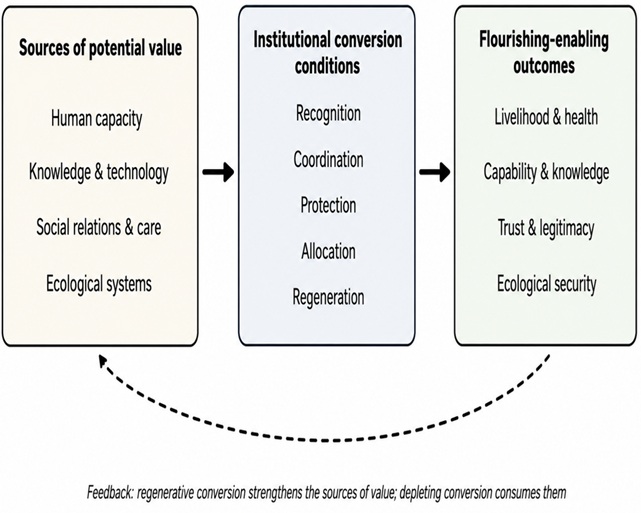
Figure 1. The conversion architecture: five institutional conditions and the
regenerative feedback loop. Click on the image to enlarge.
|
3. Five institutional conditions and the transformations they require
Each condition performs one function in the conversion sequence and fails in a characteristic way when it is absent. The necessary point in each case is the institutional function, not any single policy. The particular actions below are ways of meeting that function; which of them fit depends on context. Read together, the failure modes describe pathological conversion, where institutions produce recognised outputs while weakening the foundations those outputs draw on.
3.1 Recognition
Institutions must be able to identify socially valuable capacities and attach actionable rights, opportunities or resources to that recognition. That is the necessary condition. Without it, capacity is excluded: informal knowledge ignored, foreign credentials discounted, care treated as a private obligation. Recognition does real work only when it changes access to rights, resources and support, rather than offering symbolic acknowledgement. Institutions can meet the condition in several ways, among them portable qualifications, recognition of informal and experiential skill, the appearance of unpaid care in public accounts, and participatory standing for affected communities in decisions about what counts (Addati et al., 2022).
3.2 Coordination
Institutions must provide pathways through which recognised capacity can reach socially productive use, or it stays idle. Coordination fails in two ways: capacity that is acknowledged but never mobilised, and coordination that is efficient but aimed at extraction. Effective conversion needs coordination around socially valuable ends, not organisational efficiency alone. The usual mechanisms are education-to-employment systems, research-translation institutions, and mission-oriented public agencies that direct finance towards identified social needs rather than only correcting market failure (Mazzucato, 2024).
3.3 Protection
Institutions must stop the conversion process from destroying or dispossessing the capacity it depends on. Protection gives selected forms of value continuity through contract, property, standards and regulation. Without it, capacity is turned into wealth while the people and systems producing it are depleted. The mechanisms include enforceable labour standards, portable social protection, accessible dispute resolution, safeguards over personal data, competition rules where concentrated control creates dependency, and environmental limits. Law makes some claims durable and others fragile (Pistor, 2019), and private platforms increasingly perform protective and governing functi/ons once left to states (Rahman & Thelen, 2019).
3.4 Allocation
Institutions must provide meaningful access to the resources conversion requires and to the benefits it generates. Where access is highly unequal, recognition and protection are not enough. Allocation fails when it preserves formal rights while access is concentrated, so that those who contribute to value are shut out of its benefits and costs are shifted onto weaker groups. The claim is not for equal outcomes but for access: wider reach to finance, education, health, technology and infrastructure, and a closer link between contribution and a share in the value produced (Ritala et al., 2021).
3.5 Regeneration
Institutions must preserve or strengthen the human, social and ecological capacities that future conversion will need. Regeneration goes beyond reproducing present arrangements. It asks whether current activity restores or erodes its own foundations. Its failure is depletion: present output improved by consuming future human or ecological capacity. The mechanisms include sustained investment in education and care, the development rather than exhaustion of workers, the upkeep of institutional trust and knowledge systems, and economic rules that respect ecological limits (Hahn & Tampe, 2021; Rockström et al., 2023).
4. Necessary conditions and a minimally complete institutional architecture
The five are joint conditions, not a menu from which institutions pick. Their interdependence shows in the failures already named. Recognition without coordination leaves capacity acknowledged but unused. Coordination without protection turns mobilisation into exploitation, as capacity is converted while its source is depleted. Protection without allocation preserves durable rights over opportunities that stay out of reach. Allocation without regeneration improves present wellbeing while eroding the basis of future capacity. Regeneration without recognition and participation becomes technocratic stewardship rather than a human-centred process. No condition performs the function of another, each is necessary within the conversion process.
Completeness must be claimed carefully. The five conditions form a minimally complete institutional architecture for conversion because each addresses a distinct institutional problem between latent capacity and socially effective outcomes: visibility, mobilisation, durability, access and future reproduction. Completeness here is a claim about the institutional layer, not about flourishing as a whole. Agency, relationships, culture and circumstance sit outside that layer, so the architecture can be in place and flourishing still not follow. Their joint presence does not make flourishing inevitable; their systematic absence constrains the conditions under which it can occur. The five conditions are therefore individually necessary within the conversion framework and jointly constitute a minimally complete institutional architecture. Completeness is limited to what institutions can supply towards flourishing; it does not imply that flourishing will follow.
This gives the framework its negative test. Conversion is pathological when institutions produce recognised outputs while one or more of the conditions fails, for instance strong coordination and protection alongside weak distribution and regeneration. Fraser’s (2022) critique of contemporary capitalism illustrates this pattern, describing an economic order that depends upon care, democratic legitimacy and ecological stability while simultaneously placing those foundations under pressure. The architecture is judged by whether the conditions hold together, not by how much output it produces.
5. From Institutional Conditions to Institutional Diagnosis
The framework can also be used diagnostically to identify where institutional conversion fails and what kind of transformation is required. Reform should begin not with a preferred policy instrument, but with the specific point at which an existing capacity ceases to become socially effective. Where skills, knowledge or care remain unrecognised, the institutional problem is recognition. Where recognised capacities are not connected to employment, finance or application, the problem shifts to coordination. This reflects Mazzucato’s (2024) argument that institutions can shape the direction of economic activity rather than merely respond to market failure.
Where capacity is mobilised but contributors become insecure, dispossessed or depleted, the deficit lies in protection. Pistor (2019) demonstrates how legal and institutional arrangements determine which claims become durable and enforceable, making protection central to who ultimately retains value. Allocation becomes the problem where recognised and protected contributions generate benefits that remain concentrated or inaccessible. Regeneration becomes the relevant test where present gains weaken the human, social or ecological resources on which future conversion depends. IVC therefore provides a bounded diagnostic question: which conversion condition is failing, through what institutional arrangement, and what transformation would restore that function without weakening another condition? This approach makes institutional reform problem-specific rather than an abstract commitment to institutional improvement.
6. Conclusion
Human flourishing depends not simply on holding resources, knowledge, skills or technology, but on the institutional conditions through which these capacities become socially effective. This article has argued that five such conditions are each individually necessary: recognition, coordination, protection, allocation and regeneration. Together they form a minimally complete institutional architecture for conversion, one that enables flourishing without guaranteeing it, since much that shapes flourishing lies outside the institutional layer. Each condition carries out a distinct movement from latent capacity to a socially effective outcome, and the failure of any one describes a recognisable form of pathological conversion, where recognised output hides a weakened foundation.
Institutional quality should therefore be judged not by how much value an economy produces, but by whether its institutions recognise the capacities before them, connect them with opportunity, protect those who generate value, distribute access and benefit fairly, and preserve the foundations on which future conversion depends. That is a narrower claim than a general theory of institutional order, and a more demanding one, because it specifies what institutions must actually do.
References
Addati, L., Cattaneo, U., & Pozzan, E. (2022). Care at work: Investing in care leave and services for a more gender equal world of work. International Labour Organization.
Fraser, N. (2022). Cannibal capitalism: How our system is devouring democracy, care, and the planet, and what we can do about it. Verso.
Hahn, T., & Tampe, M. (2021). Strategies for regenerative business. Strategic Organization, 19(3), 456–477.
Mazzucato, M. (2024). Governing the economics of the common good: From correcting market failures to shaping collective goals. Journal of Economic Policy Reform, 27(1), 1–24.
North, D. C. (1990). Institutions, institutional change and economic performance. Cambridge University Press.
Pistor, K. (2019). The code of capital: How the law creates wealth and inequality. Princeton University Press.
Rahman, K. S., & Thelen, K. (2019). The rise of the platform business model and the transformation of twenty-first-century capitalism. Politics & Society, 47(2), 177–204.
Ritala, P., Albareda, L., & Bocken, N. (2021). Value creation and appropriation in economic, social, and environmental domains: Recognising and resolving the institutionalised asymmetries. Journal of Cleaner Production, 290, 125796.
Rockström, J., Gupta, J., Qin, D., Lade, S. J., … Zhang, X. (2023). Safe and just Earth system boundaries. Nature, 619, 102–111.
Sen, A. (1999). Development as freedom. Oxford University Press.
ABOUT THE AUTHOR
Oluwatobi Opekanmi Alaka is a Nigerian UK-based writer, business philosopher, and independent researcher whose work focuses on political philosophy, governance, business ethics, and African development. He is the founder of Post-Sovereignty Theory, a framework that rethinks democratic legitimacy, institutional design, and economic systems through the concepts of co-authorship and moral agency. He holds a postgraduate degree from De Montfort University, United Kingdom, and serves as the Chief Executive Officer of Tobros Security & Facilities Management. His research explores post-sovereignty democracy, capitalism, decolonial governance, and institutional reform. Through his writing and scholarship, he seeks to contribute to global conversations on ethical governance, sustainable development, and the future of political and economic thought.
|