I – INTRODUCTION
Miniatures of Evolution (MoE) is the name I gave to a transformative learning intervention designed to foster wise action during the ecological crisis. MoE started as a series of five webinars that I prototyped for over a year (2024–25). Since then, the series has expanded to seven sessions, incorporating tools from Joanna Macy’s framework, known as “WTR – The Work That Reconnects” (Macy, 2021).
Before going into more details, I need to clarify a play on words that serves as a common thread throughout the curriculum: we can become 'miniatures' of evolution by holding our own 'mini-theory' of evolution—one where we express our personal take on its driving force. Also, my experience with my own mini theory demonstrates that “becoming evolution” by holding a theory about evolution is only possible when the ‘aboutness’ of that theory melts away. This dissolution, in turn, can only occur if we choose a specific natural context in which to test our hypothesis, while simultaneously suspending judgment regarding any prior truth of the theory.
It is at this point that personal belief can become first-person science, a term that I have used in Galanti, 2024 and Galanti, 2026A. A theory that reaches this stage has worked for months as a self-fulfilling prophecy that leaves behind a regulating principle for wise action. In turn, a regulating principle for wise action at a personal level has the potential to become a survival strategy for the human species. In the context of "the great unraveling," the utilization of at least one of these strategies serves as a fundamental prerequisite for survival.
II – NEED ANALYSIS
The ecological crisis and climate change are undoubtedly crises of a development model that aims at infinite growth on a finite planet. But they are also crises of a broader scope, which affects our being in the world as humans and our self-attribution of wisdom. Our Sapiens abilities are failing, as they are no longer sufficient to solve the problems that we have created by pushing our growth against the limits of the planet.
But what if we stretched the boundaries of our language, to set ourselves in dialogue with our non-human ancestors and accepted their guidance in understanding what evolution is all about? What if, akin to St. Francis conversing with birds, we sought advice from our non-human ancestors on how to fortify intergenerational bonds in times of adversity? The answers might form the foundations of our theories, and these premises—tested in real-world situations—could serve as the first draft of a survival strategy to hand down to our descendants.
MoE is meant for you if,
1) You resonate with this fragment of Empedocles, a Greek philosopher of the 5th century BC:
"For once I was a boy and a girl and a shrub and a bird
and a mute fish that darts out of the sea",
2) You are willing to “walk the talk” of regeneration and sustainability by going deeper into their implications, rejecting the illusion that nature “thrives” without cost or suffering,
3) You do not assume that “humanism” is synonymous with “anthropocentrism”.
III – TRANSFORMATIVE LEARNING
MoE as a Transformative Learning Intervention (TLI) aims to develop:
• Sustainability, understood as a relational quality achievable only through degrowth-driven regeneration,
• Shift from “outer" development goals to evolutionary steps for society and culture,
• Attention to and recognition of the occurrence of meaning (truth) in human feelings,
• Organismic (bodily) wisdom and appreciation of other-than-human life forms, of deep time and indigenous knowledge,
• An appreciation of the difference between “ecological conversion” (Langer, 1994) and ecological transition (the first happens subliminally and “in no time”, opening the way to the second, a conscious process with a time duration),
• An understanding of how projecting on nature human-only activities and practices can lead to anthropocentrism disguised by science,
• A crossing of first-person experiencing and third-person science, evidenced by the skill to enter and exit metaphorical language and thus suspend judgement about our own creations,
• Cross-contextual sense making, non-binary critical thinking (beyond silos thinking and simplistic either/or dichotomies), applied to the construction of “mini-theories of evolution” using LTL, the Language of the Tree of Life, an application of TAE (Thinking at the Edge) by Eugene T. Gendlin (2004),
• Curiosity, courage, and congruence to reclaim epistemic independence, move beyond performative language, and restore nature in partnership with local communities, thereby operationalizing transformative insights.
IV - COURSE DESCRIPTION
First webinar
1. Getting to know each other
2 Feeling as “emotion”: Joanna Macy’s truth mandala with its four symbols
3 Panoramic view of the course: “sustainable development of life” as an Aristotelian concept,
Second webinar
1. Feeling of the interconnected crises,
2. Creative Focusing to get a map of felt sense, an emerging deep need, and a gesture of care for the deep need,
3. From the gesture, an action step can develop!
Third webinar
1. Introduction to LTL (Language of Tree of Life) and discussion on critical thinking as represented by the non-binary axiom “Evolution is not progress and not non-progress”,
2. Shaping your first premise as an incomplete gesture responding to a deep need
3. Increase of entropy in isolated systems and arrow of time,
4. Collective reading of a poem by W. Szymborska.
Fourth webinar
1. A critique of both Darwin and Margulis: projecting cultural practices (Darwin) or dramatic versions of “mating” (Margulis) onto nature does not change culture (Darwin) or does not change science (Margulis),
2. A third approach from Gendlin, 2018: controlling the projection through vague, inclusive, phenomenological language, i.e. project onto nature something that humans do, but also plants and animals do (symbolic proto behavior), so that “one of them could be us,”
3. Videos and readings on extraordinary facts in nature (to help with forming the theoretical premises for the Tree of Life).
4. Mimesis exercise 1: Definition of the word “endosymbiosis” after acting in a script as cyanobacteria and eucaryotic cells.
Fifth webinar
1. Putting together theoretical premises (from scientific facts or evolutionary theories) and experiential ones,
2. Derivation of your first new term from the “abductive” process,
3. Final touches to the communal Tree of Life.
Sixth webinar
1. Is reducing the carbon footprint for everyone? The model from the “Low Carbon Lifestyles Wheel”,
2. Interactive Focusing Format for dyadic, empathic storytelling,
3. Repetition of the Truth Mandala with old and new symbols (please bring along a new symbol for your feeling, if you feel differently about the crisis).
Seventh webinar
1 Discussion on the concept “good-enough ancestors”. What do they do? What do they leave behind? Literal and metaphorical “composting”.
2 Mimesis exercise 2, with us performing as young and/or old salmon having to swim upstream or being too tired to continue swimming.
3 Closing processes as ancestors speaking with a member of the group playing the role of descendant.
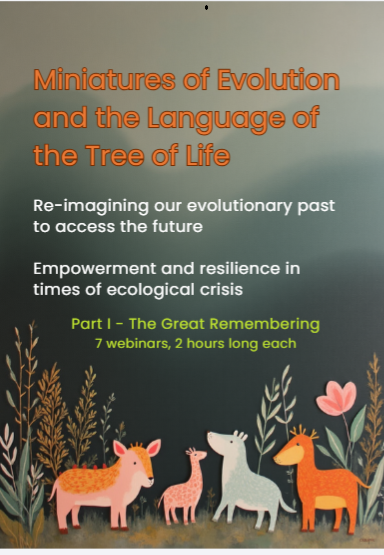
The intervention is fully described in the Brochure, where we say “to avoid commodifying a method we offer in a spirit of service, the course is offered free of charge to those who, due to age, structural conditions, or values, find themselves on the margins of the capitalist system or would like to wisely escape it as soon as possible.” You can take advantage of this offer and fill out the registration form in the brochure to secure your spot in the upcoming course.
REFERENCES
Galanti, M.E. (2024). First-Person Sustainability as Hermeneutics for Action Steps. XXV World Congress of Philosophy.
Galanti, M. E. (2026A). The cyanobacterium that I would therefore like to be. Stultiferanavis.It.
Galanti, M. E. (2026B). Holding and letting come. Synchronicity and recursive learning. Stultiferanavis.It.
Gendlin, E. T. (2004). Introduction to thinking at the edge. The Folio, 19(1), 1–8.
Gendlin, E. T. (2018). A process model. Northwestern University Press.
Langer, A. (1994). We Will Only Attain Ecological Conversion When It Becomes Socially Desirable. Speech Held at the Talks from Toblach/Dobbiaco, 10 September 1994.
Macy, J. (2021). World as lover, World as self: 30th Anniversary Edition (S. Kaza, Ed.). Parallax Press.
ABOUT THE AUTHOR
Maria Emanuela Galanti (Meg) is a Focusing Teacher based in Rome, Italy. She is a Counselor (Person-centered approach) with an MA in Philosophy from SUNY/Buffalo, and a Laurea in Philosophy from Sapienza, Rome. She has also studied Developmental Psychology. She is an ecologist, a member of the International Degrowth Network and activist with Greenpeace and GARN. To tackle the ecological crisis, she has devised “Miniatures of evolution” to bring inspiration to the necessary paradigm shifts and (re)connect human beings to nature. She uses inspirations coming from her personal theory of evolution to write “Lullabies from Mother Earth” for her grandson Lorenzo.
|
|Back to Title|
LINK TO THE CURRENT ISSUE
LINK TO THE HOME PAGE