The Psychopathic Selection Hypothesis: A Visual Introduction
Greg M. Elliott
This article was originally published on Greg Elliott's Substack, 15 August 2026
REPUBLISHED WITH PERMISSION
Illustration provided by the author. Click on the image to enlarge.
Summary of the Psychopathic Selection Hypothesis
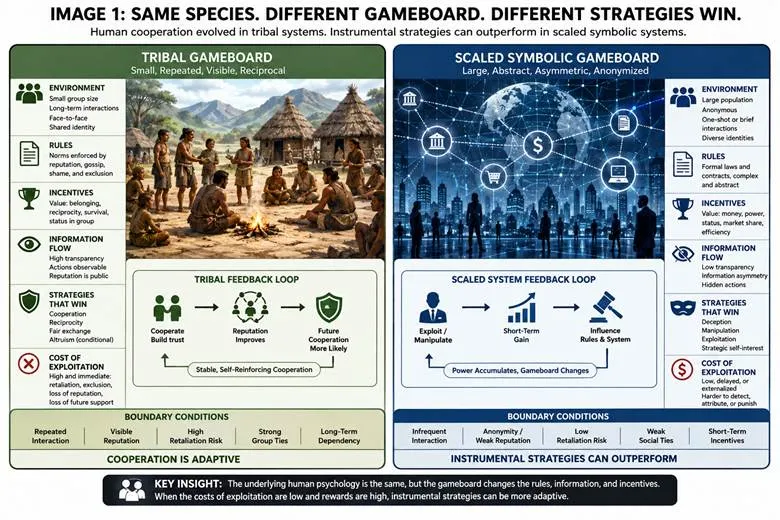
1. Same Species. Different Gameboard. Different Strategies Win.
Human cooperation evolved under conditions of repeated interaction, reputation and visible consequences. Scaled symbolic systems alter those boundary conditions, potentially changing the relative fitness of reciprocal and instrumental strategies.
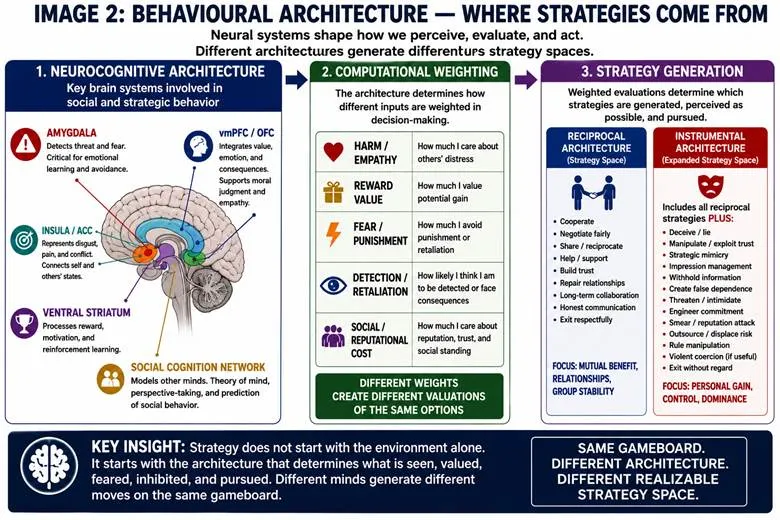
2. Behavioural Architecture: Where Strategies Come From
Different minds do not necessarily enter the same game with the same realizable strategies. This section introduces behavioural architecture and asks how neurocognitive differences can change the strategies an actor can generate, value and execute.
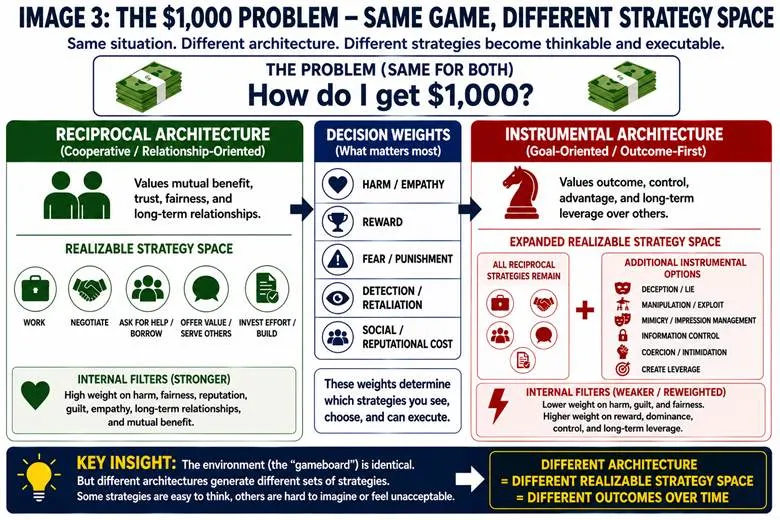
3. The $1,000 Problem: Same Game, Different Strategy Space
A simple thought experiment contrasts reciprocal and instrumental actors facing exactly the same objective. The example shows how identical external conditions can generate radically different strategy spaces.
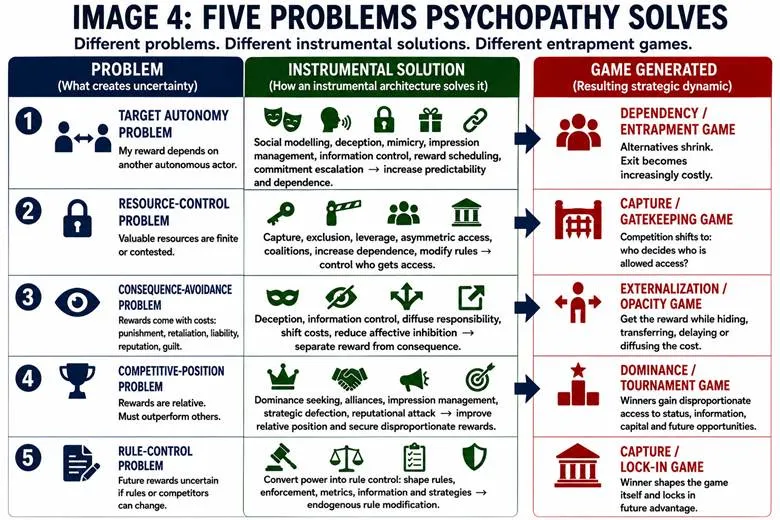
4. What Problems Might Psychopathy Solve?
Rather than treating psychopathic traits as a list of characteristics, PSH asks what strategic problems those traits might help solve. Five problem classes are explored: Target Autonomy, Resource Control, Consequence Avoidance, Competitive Position and Rule Control.
5. How Games Actually Emerge
Games are not simply given to human beings. Repeated strategies can generate them. This section follows the sequence from behavioural architecture to strategy, relational state change, strategy space change and eventually stable game structures.
6. How Instrumental Games Become Mirrored in Institutions
Entrapment, gatekeeping, externalization, tournament and lock in dynamics can reappear at institutional scale. The argument is not that institutions literally possess minds, but that they can reproduce the same computational transformations of information, dependency, alternatives and payoff.
7. A Concrete Example: How an Entrapment Game Is Generated
The Target Autonomy Problem is followed from beginning to end: modelling another actor, altering their decision environment, increasing dependency, raising exit costs and compressing alternatives until continued participation becomes locally rational despite its costs.
8. A Second Example: How the Resource Control Game Is Generated
Resource competition can evolve into something more powerful than ownership. Repeated capture creates leverage. Leverage can create dependency and gatekeeping power. Sufficient power can eventually allow successful actors to influence the rules governing future access.
9. Why the Same Games Reappear at Institutional Scale
Businesses, governments, creditors, employers and platforms repeatedly face analogous problems of uncertainty, coordination and behavioural prediction. PSH asks whether those problems are solved through reciprocal mechanisms based on mutual benefit or instrumental mechanisms based on dependency, constrained alternatives and concentrated exit costs.
10. How Interpersonal Strategies Become Institutional Technologies
Social modelling can become analytics and surveillance. Information control can become algorithmic filtering. Dependency can become debt or platform lock in. Rule modification can become lobbying or regulatory capture. The implementation changes while the computational function can survive.
11. Why Symbolic Selection Preserves These Games
Selection enters explicitly here. When instrumental solutions repeatedly generate greater symbolic fitness, successful actors acquire resources and influence, their strategies spread, competitors adapt or disappear, and eventually the winners can acquire the capacity to modify the gameboard itself.
12. Institutional Mirroring
Winning behavioural logic can become encoded into rules, incentives, metrics, technologies and governance. Eventually the original actor is no longer required to reproduce the behaviour: the actor can disappear while the game remains.
13. Institutions Become Evolutionary Fields
Once the products of previous selection become embedded in institutional architecture, future actors inherit them as part of their adaptive environment. Institutions therefore become more than places where selection occurs. They become repositories of previous selection that impose new boundary conditions on what comes next.
14. The Recursive Logic of Symbolic Selection
The pieces are brought together into a single evolutionary loop: gameboard → architecture → strategy → emergent game → differential fitness → power → institutionalization → modified gameboard → new selection. Symbolic selection becomes recursive because selection progressively modifies the environment performing future selection.
The Larger Question
PSH ultimately asks something broader than whether psychopaths obtain positions of power. It asks: What kinds of games do different minds generate, and what happens when the games that win become the environments selecting everybody who comes next?
The Psychopathic Selection Hypothesis
The Psychopathic Selection Hypothesis begins with a simple evolutionary question: what happens when human competition increasingly occurs inside symbolic systems of our own creation? Markets, corporations, financial systems, governments, bureaucracies and technological platforms are not simply organizations. They are gameboards containing rules, incentives, information, constraints and definitions of success.
Once these systems mediate access to resources, status, employment, protection and opportunity, they become adaptive environments in their own right. PSH asks what behavioural strategies become fit inside these environments, and what happens when the strategies that win acquire enough power to change the gameboard itself.
1. Same Species. Different Gameboard. Different Strategies Win.
Human cooperation evolved under boundary conditions very different from those found in many scaled institutions. In small, persistent groups, interaction repeated, reputation mattered, harm remained visible, and exploitation could provoke retaliation, exclusion or coalitionary resistance. Under those conditions, reciprocity could be highly adaptive because today’s defection threatened tomorrow’s relationships.
Scaled symbolic systems can weaken many of those constraints. Feedback can become delayed, attribution weaker, consequences externalized, information asymmetric and rewards highly concentrated. PSH does not argue that instrumental strategies always win. It argues that changing the boundary conditions changes their relative cost, and therefore their relative fitness. Under some symbolic conditions, architectures capable of externalizing cost, avoiding detection, reducing retaliation and concentrating reward can outperform reciprocal alternatives.
Image 1. Click on the image to enlarge.
2. Behavioural Architecture: Where Strategies Come From
Standard game theory usually gives players a set of available strategies and asks which one they will choose. PSH moves one step upstream: where do the strategies come from? Different minds may perceive, generate, value and inhibit different possible actions even when facing the same external game.
A behavioural architecture is the computational organization of perception, prediction, affective constraint, social modelling, reward evaluation, learning, planning and action selection. Psychopathy provides an empirically studied architecture in which affective inhibition, reward weighting, punishment sensitivity, fear and instrumental social reasoning may differ from more reciprocal profiles. The important claim is not that one brain region “causes deception,” but that neurocognitive architecture influences which strategies are psychologically available and executable.
Image 2. Click on the image to enlarge.
3. The $1,000 Problem: Same Game, Different Strategy Space
Imagine two people face exactly the same problem: acquire $1,000. A strongly reciprocal actor might generate work, trade, negotiation, transparent borrowing or asking for help. An instrumental actor may generate all of those options as well, but may also readily consider deception, exploiting trust, manipulation, intimidation or creating leverage over another person.
The external gameboard is the same. The realizable strategy space is not. A reciprocal architecture may assign significant internal cost to betrayal, harm and damaged relationships. An instrumental architecture may experience some of those constraints less strongly while weighting reward, dominance or control more heavily. PSH therefore treats behavioural architecture as a generator of realizable strategy spaces rather than assuming every player begins with an identical internal menu.
Image 3. Click on the image to enlarge.
4. What Problems Might Psychopathy Solve?
Psychopathy becomes evolutionarily interesting when we stop asking only what traits it contains and ask a different question: what strategic problems might those traits help solve? The formal paper explicitly defines one: the Target Autonomy Problem, and provides the architecture from which several related problem classes can be proposed. These additional categories are extensions of the framework rather than separately proven theorems.
Target Autonomy Problem
The problem: My future reward depends on another autonomous actor. That person can change their mind, refuse, leave, retaliate or pursue an objective that conflicts with mine. Their autonomy therefore creates uncertainty in my future payoff.
How an instrumental architecture may solve it: Social modelling identifies what the target values and fears. Strategic deception alters beliefs. Mimicry and impression management increase trust. Information control shapes what the target knows. Reward scheduling reinforces behaviour. Commitment escalation and alternative suppression increase the cost of leaving. The objective is not necessarily direct coercion. It is increasing behavioural predictability.
Game produced: a dependency, compliance or entrapment game. Through repeated interaction, the target becomes increasingly dependent, alternatives shrink and exit becomes progressively more costly.
Resource-Control Problem
The problem: Valuable resources, money, land, labour, information, status, infrastructure, customers or institutional access, are finite or contested. Future payoff therefore depends partly on who controls access to them.
How an instrumental architecture may solve it: Capture, exclusion, leverage, dominance and asymmetric access can outperform sharing when the gameboard rewards control. Coalitions increase bargaining power. Competitors can be excluded. Dependence on the controlled resource can be increased. Eventually the actor may modify the rules governing future access.
Game produced: a capture or gatekeeping game. Competition shifts from who obtains the resource? toward who determines who is allowed to obtain it?
Consequence-Avoidance Problem
The problem: Instrumental reward acquisition often produces costs: punishment, retaliation, legal liability, reputational damage, harm to others or internal emotional inhibition. The strategic problem is therefore not simply obtaining reward, but separating reward from consequence.
How an instrumental architecture may solve it: Deception obscures attribution. Information control reduces detection. Responsibility can be diffused. Costs can be shifted outside the actor’s decision boundary. Reduced fear or affective inhibition may also reduce the internal cost of executing strategies reciprocal actors hesitate to use.
Game produced: an externalization or opacity game. Success increasingly depends on acquiring the reward while transferring, delaying, hiding or diffusing the cost.
Competitive-Position Problem
The problem: Many symbolic rewards are relative. Promotion, political influence, market share, institutional power and status depend not merely on doing well, but on outperforming others.
How an instrumental architecture may solve it: Dominance seeking, aggressive reward pursuit, impression management, strategic alliances, opportunistic defection and reputational attack can improve relative position. A reciprocal actor may preserve relationships or fairness even when doing so reduces competitive advantage.
Game produced: a dominance or tournament game. Winners receive increasingly disproportionate access to status, information, capital and future opportunity.
Rule-Control Problem
The problem: Even after winning, future rewards remain uncertain if competitors can re-enter or the rules can change. The most powerful strategic solution is therefore to alter the structure of future competition.
How an instrumental architecture may solve it: Accumulated money, influence, coalition power or institutional authority can be converted into control over rules, enforcement, metrics, information or permissible strategies. The mathematical paper calls this endogenous rule modification: present advantage becomes future structural advantage.
Game produced: a capture or lock-in game. The winner no longer merely performs better inside the game; the winner increasingly shapes the game itself.
Image 4. Click on the image to enlarge.
5. How Games Actually Emerge
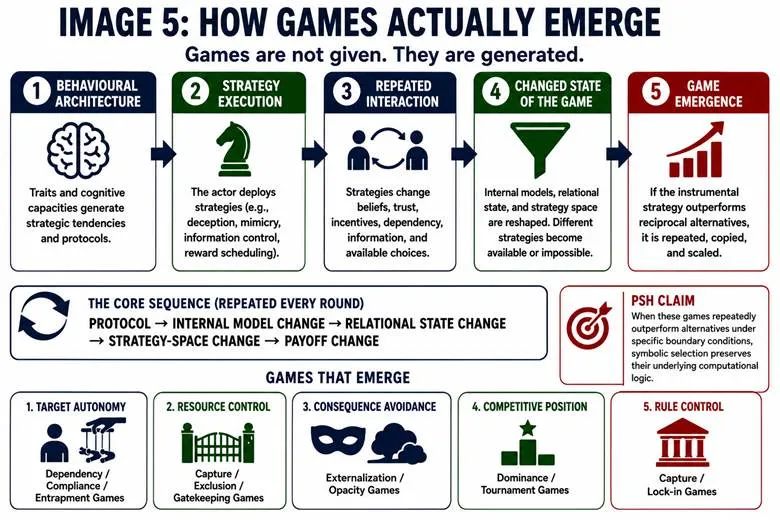
Games are not simply given to us. They emerge through repeated strategic interaction. Behavioural architectures generate strategies. Those strategies change beliefs, trust, incentives, dependency, information and available choices. Those changed states then determine what strategies remain possible in the next round.
If an instrumental strategy repeatedly outperforms a reciprocal alternative under particular boundary conditions, the actor deploying it receives greater symbolic payoff. That strategy can then be repeated, copied or scaled. Over time, what began as a behaviour becomes a stable relationship structure. The mathematical sequence is: protocol → internal-model change → relational-state change → strategy-space change → payoff change.
This produces recognizable game families:
Target Autonomy → dependency / compliance / entrapment games Resource Control → capture / exclusion / gatekeeping games Consequence Avoidance → externalization / opacity games Competitive Position → dominance / tournament games Rule Control → capture / lock-in games
The critical PSH claim is that when these games repeatedly outperform alternatives, symbolic selection can preserve their underlying computational logic.
Image 5. Click on the image to enlarge.
6. How Instrumental Games Become Mirrored in Institutions
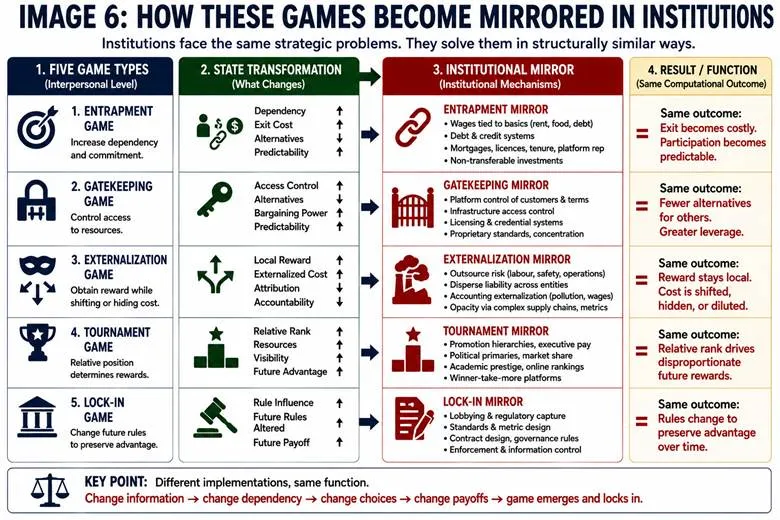
The next transition is crucial. Institutions do not have brains, emotions or intentions. But they repeatedly encounter functionally similar strategic problems, and they can develop mechanisms that solve those problems in structurally similar ways.
The institutional mirror is therefore not a psychological metaphor. It is a claim about functional isomorphism: if an institutional mechanism performs the same transformation, changing information, dependency, constraints, strategy space and payoff, then the implementation may differ while the underlying computational function remains similar. The formal paper explicitly maps interpersonal protocols onto institutional mechanisms.
The Institutional Mirror of the Entrapment Game
At the interpersonal level, an instrumental actor may increase dependency and commitment until exit becomes prohibitively costly. Institutionally, the same state transition appears whenever participation in a system becomes progressively tied to necessities, accumulated obligations or non-transferable investments.
A wage can become part of an entrapment structure when loss of employment threatens immediate access to rent, food, insurance or debt service. Debt can do the same when default triggers legal enforcement, credit destruction or asset loss. Mortgages, pensions, professional licences, tenure tracks or platform reputation can increase switching costs because prior investment becomes difficult to transfer elsewhere. These mechanisms are not inherently exploitative; they become PSH-relevant when the system’s objective diverges from the dependent actor’s welfare while dependency ↑, exit cost ↑, alternatives ↓ and behavioural predictability ↑.
The institution has therefore solved the same computational problem as the interpersonal manipulator: how do I make future participation of targets more predictable in order to stabilize asymmetric reward acquisition?
The Institutional Mirror of the Gatekeeping Game
At the interpersonal level, resource capture becomes strategically more powerful when possession of the resource also gives the actor influence over who else can access it. Institutionally, the same transition occurs when ownership or control is converted into gatekeeping power.
A platform can control access to customers while also setting the terms under which sellers reach them. A dominant infrastructure owner can charge for access to a network that competitors cannot easily reproduce. Credential systems can determine who is legally or professionally allowed to enter a field. Proprietary standards can make complementary products dependent on one firm’s technology. Market concentration can reduce the number of realistic buyers, sellers or employers available to other actors. These mechanisms shrink the alternatives in the surrounding strategy space, which is exactly the formal role of alternative suppression.
The gatekeeping game is therefore not simply “one actor has more resources.” It is:
resource control → control over access → fewer alternatives for others → higher bargaining leverage → greater ability to dictate terms.
The resource has become part of the gameboard.
The Institutional Mirror of the Externalization Game
This one needs to be very concrete.
At the interpersonal level, consequence avoidance means obtaining the benefit of an action while reducing exposure to its cost. Institutionally, the analogous mechanism is to make the actor receiving the payoff different from the actor carrying the downside.
Outsourcing risk means moving a risky activity to another firm, contractor, worker or jurisdiction so that the originating institution still receives economic benefit while another actor bears more of the operational, employment, safety or environmental exposure. For example, a firm may rely heavily on contract labour rather than employees: it receives the productive output, while employment volatility, benefits obligations or some safety responsibilities may be shifted outward.
Dispersed liability means organizing responsibility across multiple legal entities, contractors, subsidiaries or contractual relationships so that no single actor bears the full consequence of failure. The material harm still exists, but accountability is fragmented.
Accounting externalization means that a cost materially produced by an activity does not enter the metric being optimized. Pollution may damage a river without appearing as an equivalent deduction from operating profit. Low wages may increase social-support costs borne elsewhere. A supply chain may create environmental or labour harms that do not appear in the price paid by the final consumer.
Opacity strengthens the game because incomplete information makes attribution harder. Complex supply chains, proprietary reporting, selective disclosure or misleading metrics can make it difficult for outside actors to connect the final reward to the underlying consequence.
The computational structure is:
reward remains local → cost is transferred outward → attribution weakens → retaliation/punishment falls → net payoff rises.
That is why externalization can be selected. It is not merely “being irresponsible.” It is a strategy that changes who carries which term in the payoff equation.
The Institutional Mirror of the Tournament Game
At the interpersonal level, a dominance game emerges when relative position matters more than absolute sufficiency. Institutionally, tournament structures arise whenever rank determines access to disproportionately larger future rewards.
Consider a promotion hierarchy. Two managers may both perform well, but only one receives the senior role. That role brings more pay, information, influence, hiring authority and visibility. The winner now begins the next round from a stronger position. The same logic can operate in executive compensation, political primaries, market-share competition, academic prestige systems, online rankings or winner-take-more platforms.
What matters technically is cumulative advantage. Relative success today changes tomorrow’s payoff landscape:
rank ↑ → resources ↑ → visibility ↑ → network access ↑ → future probability of winning ↑
Once rewards are highly concentrated, strategies that increase relative position, impression management, coalition building, aggressive self-promotion, reputational attack or opportunistic defection, may generate greater fitness than strategies optimized primarily for group harmony.
So the institutional mirror is not simply “competition.” It is a game in which winning changes the state variables governing the next competition.
The Institutional Mirror of the Lock-In Game
At the interpersonal level, rule control means using current leverage to alter future terms. Institutionally, this becomes explicit when successful actors gain influence over the rules, metrics, standards or enforcement systems governing future competition.
Lobbying can change legal constraints. Regulatory capture can influence how a sector is supervised. Standards control can define which technologies qualify for participation. Metric design can determine what counts as organizational success. Contract design can shift bargaining power. Governance rules can determine who is allowed to make future decisions.
If the new rules disproportionately preserve the conditions under which the incumbent already succeeds, the selection environment becomes recursive. The winner has not merely received the prize.
The winner has modified the next game.
Image 6. Click on the image to enlarge.
7. A Concrete Example: How an Entrapment Game Is Generated
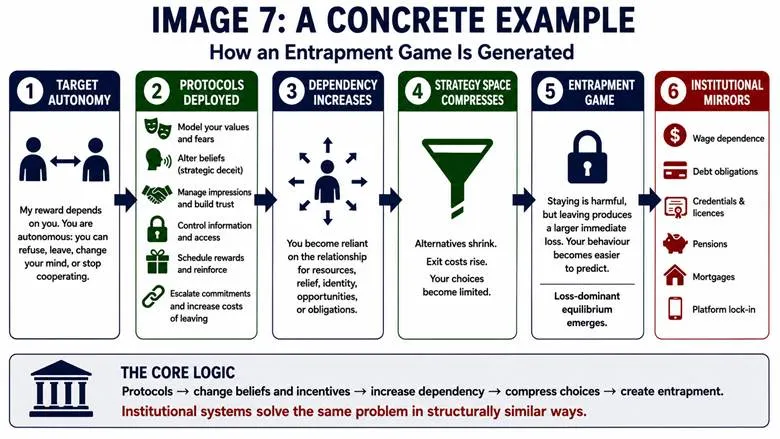
Suppose my future reward depends upon you. You are autonomous: you can refuse, leave, change your mind or stop cooperating. One solution is reciprocal cooperation, maintain enough mutual benefit that you voluntarily continue participating.
An instrumental solution is different. I can model your preferences, alter your beliefs, manage impressions, control information, schedule rewards and escalate commitments. Those interventions modify your internal model and the relational state between us. Dependency increases. Exit costs rise. Alternatives shrink. Your behaviour becomes easier to predict. Eventually the interaction can stabilize as an entrapment game in which remaining is harmful but leaving produces a larger immediate loss.
Institutionally, this same logic can appear in wage dependence, debt obligations, credentials, pensions, mortgages or platform lock-in when leaving creates sufficiently concentrated immediate losses that continued participation remains the locally rational response.
Image 7. Click on the image to enlarge.
8. A Second Example: How the Resource-Control Game Is Generated
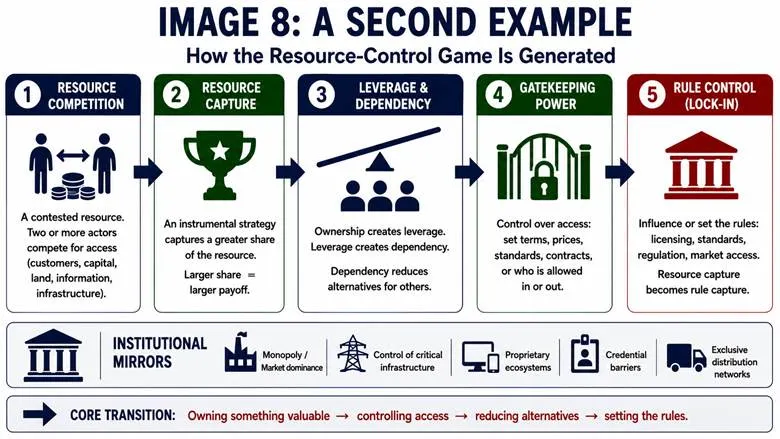
Imagine a contested resource. Initially the problem is simply access: two actors want the same customers, capital, land, information or infrastructure. An instrumental strategy that captures a greater share receives a larger payoff.
But repeated success changes the game. Resource ownership creates leverage. Leverage can create dependency. Dependency reduces alternatives. Sufficiently successful actors may then influence licensing, standards, market access, contracts or regulation. Resource capture becomes rule capture.
Institutionally, this logic can appear through monopoly, control of critical infrastructure, proprietary ecosystems, credential barriers or exclusive distribution networks. The strategic transition is from owning something valuable to controlling the pathways through which everybody else must reach it.
Image 8. Click on the image to enlarge.
9. Why the Same Games Reappear at Institutional Scale
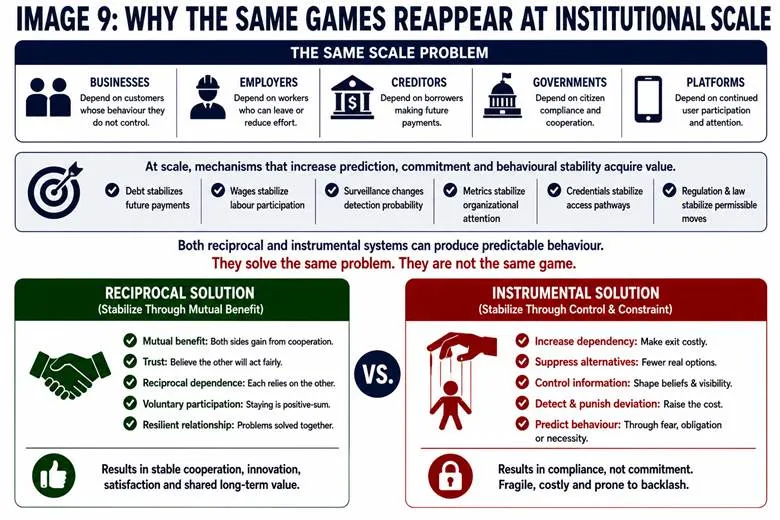
Symbolic systems repeatedly encounter analogous strategic problems. A business depends on customers whose behaviour it does not control. An employer depends on workers who can leave or reduce effort. A creditor depends on borrowers making future payments. Governments depend upon some degree of citizen compliance. Platforms depend upon continued user participation.
At scale, mechanisms that increase prediction, commitment and behavioural stability therefore acquire value. Debt stabilizes future payment behaviour. Wages stabilize labour participation. Surveillance changes detection probability. Metrics stabilize organizational attention. Credentials stabilize access pathways. Regulation and law stabilize permissible moves. The formal paper identifies these directly as institutional solutions to recurring uncertainty and coordination problems.
The PSH question is which version of the solution gets selected. A reciprocal system can stabilize behaviour through mutual benefit, trust and reciprocal dependence. An instrumental system can stabilize behaviour by concentrating the costs of deviation, suppressing alternatives or increasing dependency. Both may produce predictable behaviour. They are not the same game.
Image 9. Click on the image to enlarge.
10. How Interpersonal Strategies Become Institutional Technologies
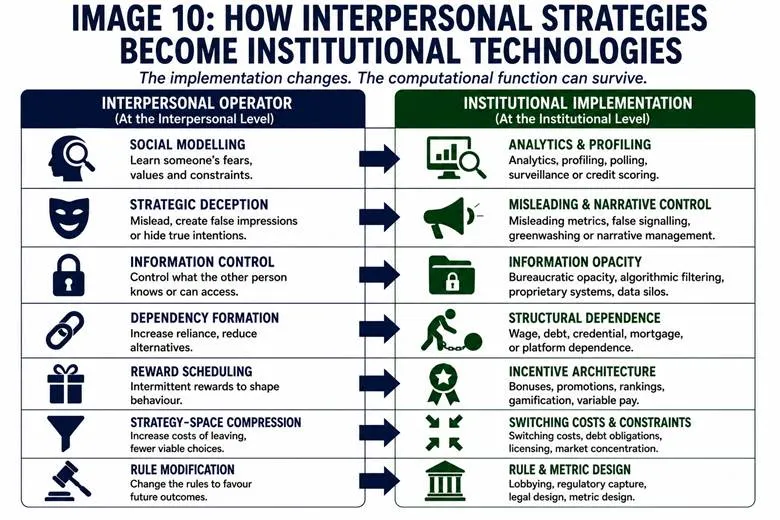
At the interpersonal level, social modelling means learning someone’s fears, values and constraints. Institutionally it becomes analytics, profiling, polling, surveillance or credit scoring. Strategic deception becomes misleading metrics, false signalling, greenwashing or narrative management. Information control becomes bureaucratic opacity, algorithmic filtering or proprietary systems.
Dependency formation becomes wage, debt, credential or platform dependence. Reward scheduling becomes bonuses, promotions, rankings and gamification. Strategy-space compression becomes switching costs, debt obligations, licensing and market concentration. Rule modification becomes lobbying, regulatory capture, legal design and metric design. The implementation changes. The computational function can survive.
Image 10. Click on the image to enlarge.
11. Why Symbolic Selection Preserves These Games
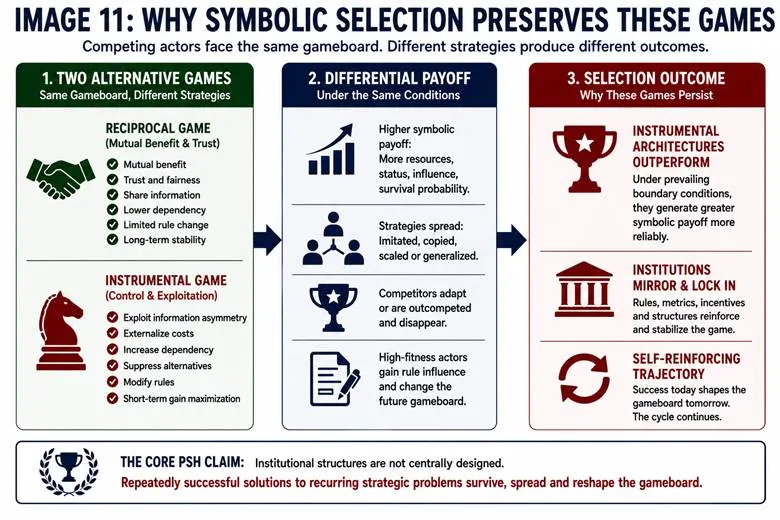
Now selection enters explicitly. Imagine competing actors, firms or institutions facing the same gameboard. One preserves reciprocal constraints even when doing so lowers immediate payoff. Another more readily externalizes cost, exploits information asymmetry, increases dependency or modifies rules.
If the instrumental architecture repeatedly generates greater symbolic payoff under the prevailing boundary conditions, it gains resources, status, influence or survival probability. Its strategies spread. Competitors imitate them or disappear. In the formal simulation, high-fitness actors gain rule influence, and rule influence changes the future gameboard.
This is why PSH is fundamentally a selection argument. The claim is not that somebody centrally designs every institutional structure. Repeatedly successful solutions can survive because they solve recurring problems more effectively under the governing payoff conditions.
Image 11. Click on the image to enlarge.
12. Institutional Mirroring
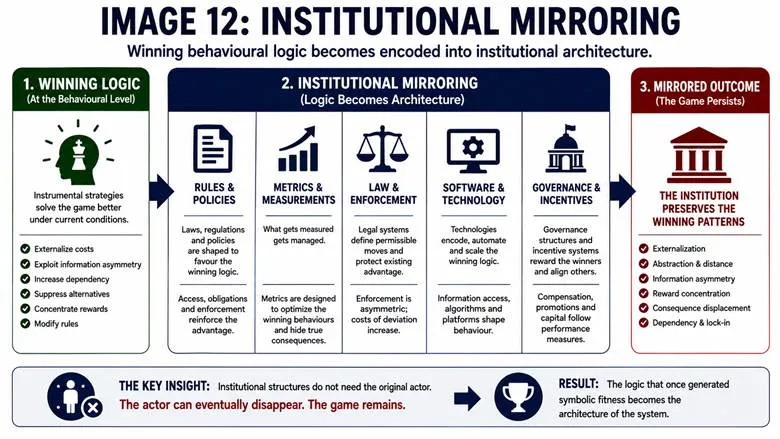
Once successful actors acquire sufficient influence, winning behavioural logic can become encoded into institutional architecture. Rules change. Compensation changes. Metrics change. Technologies change. Information access changes. Objective functions become formalized.
This is institutional mirroring. The institution does not literally become psychopathic. Rather, institutional structures can preserve patterns of externalization, abstraction, information asymmetry, reward concentration and consequence displacement that resemble the computational logic that previously generated high symbolic fitness.
The actor can eventually disappear.
The game remains.
Image 12. Click on the image to enlarge.
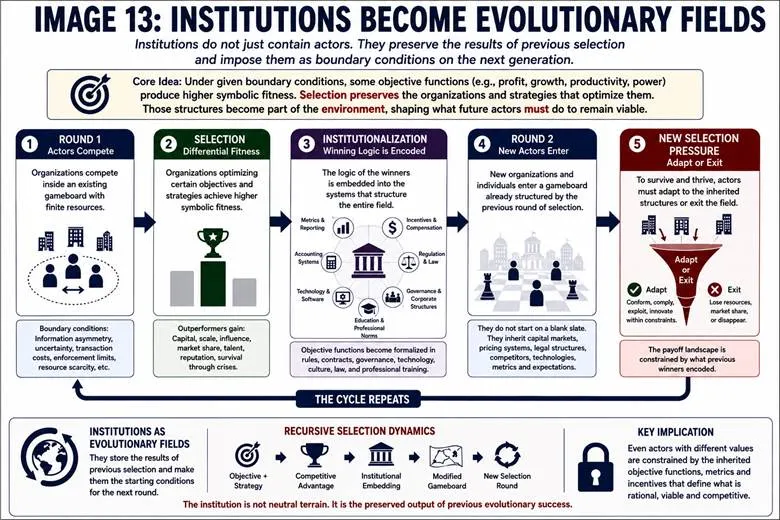
13. Institutions Become Evolutionary Fields
At this point, symbolic selection becomes recursive. Imagine organizations competing inside a market where access to capital, survival and expansion depend heavily on profitability and growth. Organizations that optimize those variables more effectively can acquire more capital, expand, purchase competitors, attract talent and survive downturns. Organizations that systematically sacrifice those objectives may lose market share, lose financing or disappear. Selection is therefore acting not only on individual strategies, but on organizational architectures and the objective functions they successfully optimize.
But the winners don’t simply survive. Their logic becomes embedded in the environment itself. Profit appears in accounting systems. Growth appears in investor expectations. Performance targets enter compensation systems. Financial returns influence capital allocation. These objectives become encoded into governance, metrics, contracts, regulation, software and organizational routines. What was previously something an actor optimized becomes part of the gameboard determining what future actors must optimize to remain viable.
That is the transition I mean when I say institutions become evolutionary fields. A new company doesn’t enter an empty environment and freely decide what constitutes success. It inherits capital markets, competitors, labour markets, accounting rules, legal structures, technologies and performance expectations produced by previous rounds of symbolic selection. Even genuinely prosocial actors may therefore find themselves executing strategies they would not independently choose because the surrounding gameboard changes the payoff associated with alternative behaviour.
So the recursive sequence is:
Objective function produces competitive advantage → higher-fitness organizations expand → their operating logic becomes institutionalized → institutional structures reshape the payoff landscape → future actors adapt to that landscape → selection continues.
And that’s the deeper point: symbolic systems begin to behave like evolutionary environments.
The institution doesn’t merely contain actors undergoing selection.
The institution preserves the results of previous selection and imposes them as boundary conditions on the next generation of actors.
Image 13. Click on the image to enlarge.
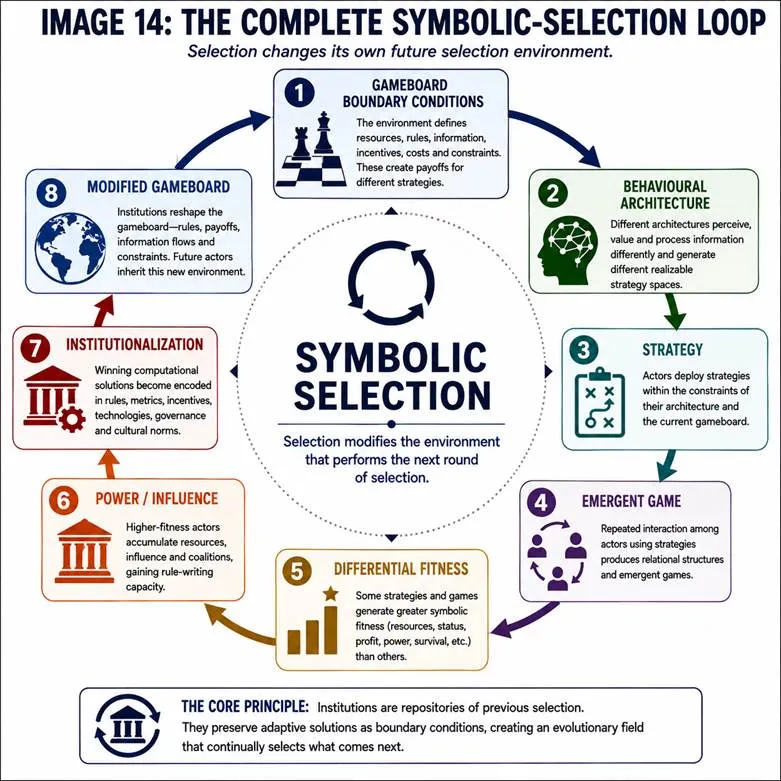
14. The Recursive Logic of Symbolic Selection
The complete process can now be stated as one evolutionary loop:
Gameboard boundary conditions → create different costs and rewards for different strategies → behavioural architectures generate different realizable strategy spaces → strategies solve recurring problems → repeated strategic interaction generates games → some strategies and game structures produce greater symbolic fitness → higher-fitness actors accumulate resources, influence and rule-writing capacity → successful computational solutions become institutionalized in rules, metrics, incentives, technologies and governance → those structures modify the gameboard itself → future actors inherit a different payoff landscape → selection begins again under the modified boundary conditions.
This is what makes symbolic selection recursive. Institutions do not merely contain actors competing for symbolic rewards. They can preserve the outcomes of previous selection in their architecture. What worked in one round can become a rule, incentive, metric, technology or constraint in the next.
The result is a feedback process:
gameboard → architecture → strategy → game → differential fitness → institutionalization → modified gameboard → new selection.
The crucial point is that selection changes its own future selection environment. Successful actors do not merely adapt to the gameboard. Under some conditions, they acquire enough influence to modify it. Those modifications then become boundary conditions confronting actors who come later.
So institutions become something more than passive arenas of competition.
They become repositories of previous symbolic selection, and evolutionary fields that continuously select what comes next.
Image 14. Click on the image to enlarge.
The Larger Question
PSH therefore makes a more specific claim than “psychopaths rise to power” or “institutions behave badly.”
It asks whether particular symbolic boundary conditions alter the relative fitness of different behavioural architectures; whether those architectures generate systematically different solutions to recurring strategic problems; whether repeated solutions generate different kinds of games; whether successful games become instantiated at institutional scale; and whether institutions then preserve the behavioural logic that produced their success.
The deeper evolutionary question is:
What kinds of games do different minds generate, and what happens when the games that win become the environments selecting everybody who comes next?
Greg Michael Elliott is a systems theorist, pure and applied mathematician, and technology strategist whose work explores the relationship between human psychology, institutions, and civilizational evolution. He is the author of The Psychopathic Selection Hypothesis, an interdisciplinary framework that integrates game theory, behavioural economics, psychology, neuroscience, systems theory, and evolutionary theory to examine how modern symbolic institutions can unintentionally select for psychologically exploitative behavioural strategies.
Professionally, Greg works in industrial artificial intelligence and digital twins, developing advanced modelling, optimization, and AI solutions for critical infrastructure across the energy sector. His background includes mathematical physics, financial engineering, machine learning, and complex systems (Model Based Systems Engineering in particular).
His current research focuses on understanding how dependency formation, loss-dominant equilibria, and institutional incentives interact to shape large-scale social outcomes. More recently, his work has begun exploring possible pathways for designing institutions that promote cooperation, resilience, and long-term human flourishing.