I’ve been involved in a number of webinars and list-serve discussions recently in which certain questions come up repeatedly—points requiring clarification about me and how I see the world, about nature and spirituality and about reality itself. Since my personal ‘worldview’ informs both my Substack presence and how I answer such questions, I thought it might be worth laying out some of my responses here.
Where we’re at: Prospects for—and barriers to—moving on
“Our confidence that our conceptual mythologies are accurately mapping the real world is itself a source of civilizational risk because this confidence makes it inevitable that we do more of what’s failing, as the alternative—recognizing our conceptual models and mythologies are self-serving rationalizations that substitute artifice for realistic appraisals—is conceptually and emotionally impossible.” (Charles Hugh Smith).
The above quote describes the historical juncture at which we find ourselves. Modern techno-industrial (MTI) society’s prevailing growth-addicted cultural narrative (described at the end of Part One), is objectively absurd. However, despite decades of accumulating evidence that we are on track to potential eco-catastrophe and cultural implosion, the fantastical imaginary of mainstream culture has proved “conceptually and emotionally impossible” to abandon. Powerful economic and political elites and generally entrenched MTI sensibilities, both fortified by irrational hubris, constitute formidable barriers to timely cultural evolution.
Intransigence seems to be MTI society’s only ‘forward’ gear. Copious data on the human eco-predicament have proved insufficient to drive even crucial, if narrowly focused, policy objectives—on global heating, for example—let alone catalyze a civilizational transformation. Collapse scenarios and strategies to avoid implosion have been around formally at least since the 1972 publication of Limits to Growth but have had no significant effect on the trajectory of MTI culture. Even the well-known, moderate, but at least explicitly contractionist degrowth ‘movement’ has gained little mainstream traction after several decades. All of which shows that better education, scientific debate and public discussion (i.e., ‘social learning’) have so far proved insufficient to catalyze significant change––and, in any case, would require decades.[1] Indeed, I am not aware of any theory of orderly social change that could rise to the challenge in the time we likely have available.
This is regrettable. Many scientists, other anxious analysts and well-informed popular writers have told us exactly ‘WHAT’ needs to be done to make progress on Thomas Berry’s Great Work, for example, (see Part One) or other ways of ‘saving the world’
But as I see things, the crucial question is: ‘HOW’? HOW do we catalyze the needed radical cognitive transformation in a world of self-interested, growth-addicted competitive nations that are fractiously divided by socially-constructed political, economic and religious narratives none of which ‘map well’ to either social or biophysical reality? By what means might we motivate today’s self-absorbed, individualistic upper and middle classes to agree to an 80% reduction in energy and material consumption and embark, in solidarity with everyone else, on an unprecedented journey of voluntary simplicity, a journey that brings humanity more equitably into a mutually enhancing relationship with the Earth community?
This last is not just a rhetorical question. In fact, precisely the opposite is taking place. As Naomi Klein and Astra Taylor show, the “...do-gooder discourse among the powerful is giving way to open expressions of disdain for the idea that we owe each other anything by right of our shared humanity.” Moreover, our “…right-wing leaders and their rich allies are not just taking advantage of catastrophes, shock-doctrine and disaster-capitalism style, but simultaneously provoking and planning for them” as they take shelter in their gated communities, fortified bunkers and hoped-for “freedom cities”. The rest of humanity and the natural world are to be sloughed off like soiled rags into the landfill of history.
Some have speculated that only widespread civil unrest—out-and-out insurrection—would waken MTI governing elites to the need for a radical cultural paradigm shift. But is open revolt a practical option? How likely are millions of ordinary people to take up pitchforks and march in the streets? Everyone entangled in the abstracted meshwork of MTI culture is dependent on maintaining some variation of the status quo to provide jobs, income, and essential services, i.e., access to the necessities of life. Revolution is potentially catastrophic. Most people would rather risk what they see as the mere possibility of future collapse than suffer the certain, immediate personal costs associated with the chaos of insurrection. So it is that even well-informed citizens mostly hunker down and do nothing, often drugged by hopium that ‘things will turn out alright.’
They always do, right?
We are in a cultural trap, a potentially fatal cognitive parallel universe of our own making.
Natural correctives
Which is why, barring a nuclear WW-III, the modern human enterprise—including the brotherhood of psychopathic billionaires—is arguably more likely to be brought down by Gaia’s revenge than by cultural upheaval. MTI culture’s much vaunted ‘human ingenuity’ has managed, for two short centuries, to keep nature’s negative feedback on excess population and economic growth at bay, but with increasing pressure on natural systems the defensive techno-dam is breaking. We are already experiencing accelerating climate chaos, wide-spread pollution events,[2] dramatic biodiversity loss, energy and resource shortages, agricultural failures, local food shortages, more disease outbreaks/pandemics, widespread civic unrest, a surge of (unwelcomed) climate and eco-migrants, geopolitical instability, including war, and a rising death toll from all the above.
Attentive citizens realize that these early signs of impending implosion are in play; they are the stuff of even main-stream news-casts. Whether the ‘great simplification’ will accelerate or proceed in waves, will be slow and relatively manageable (over a century or more) or rapid and chaotic (within the next couple of decades) is dependent on so many variables that prediction is difficult and unwise. What does seem certain is that MTI culture/civilization is past its ‘best before’ date and has begun its (likely painful) long descent.
But what about mainstream solutions? Take the energy ‘transition’, for example (Yes, please do!)
Webinar participants often argue that technology is becoming available to resolve the meta-crisis. The problem here is that most contemporary efforts to address our unfolding eco-social predicament come from the self-referencing, autopoietic logic of exceptionalist MTI civilization—this is a pernicious cognitive trap. The main result of such efforts is to exacerbate (or at least not really address) the core issues. None illustrates this dilemma better than the delusional mainstream response to global warming/climate change.
To begin with, isolating climate change from its many co-symptoms of overshoot reveals our simplistic, reductionist, singular cause-effect mode of thinking about what is really a massively complex issue, OVERSHOOT, which is itself the result of gross cultural dysfunction. Predictably, MTI ignores, or is ignorant of, overshoot and its own complicity in producing it. [3]
Second, the approach MTI culture has adopted toward climate change is (again, predictably) entirely technological—wind and solar electricity, hydrogen power, EVs, AI, carbon capture and storage etc., all of which are, at some stage, fossil fuel-dependent. In other words, ‘the system’ approves of any techno-approach that involves massive capital investment and economic growth, including the promise of jobs and tax revenue—and, need I mention, the opportunity for profit? All of which is little more than an upgraded status quo or business-as-usual-by-alternative-means.
The result? Consider that the United Nations Framework Convention on Climate change dates from 1992. After thirty-four years of efforts to reduce atmospheric carbon dioxide levels the MTI way, atmospheric concentrations are at an all time high and rising, carbon emissions have increased ~72%, from 22 billion metric tons to 38 billion metric tons annually, temperature records are being set almost everywhere (people are dying), ‘extreme’ heatwaves and other weather events are now commonplace and we are about to experience a super-El Nino. Meanwhile, despite the multi-billions spent on alternative green energy (electricity, actually) and spectacular growth, wind and solar power combined provide MTI societies with only ~17% of their electricity but, since electricity is only ~22% of total energy, this amounts to just ~3.7% of final energy consumption. The world remains >80% fossil fuel (FF) dependent—up to 85% by some measures—the same proportion as in 1992.
The reality is that, despite the promotional hype, the alleged energy transition is barely underway. Each new source of energy historically generally adds to existing supplies. We are using more traditional biomass today—wood and animal dung—than in 1800; climate-wrecking fossil fuels remain dominant. According to historian Jean-Baptiste Fressoz, there is no energy transition and there never has been.
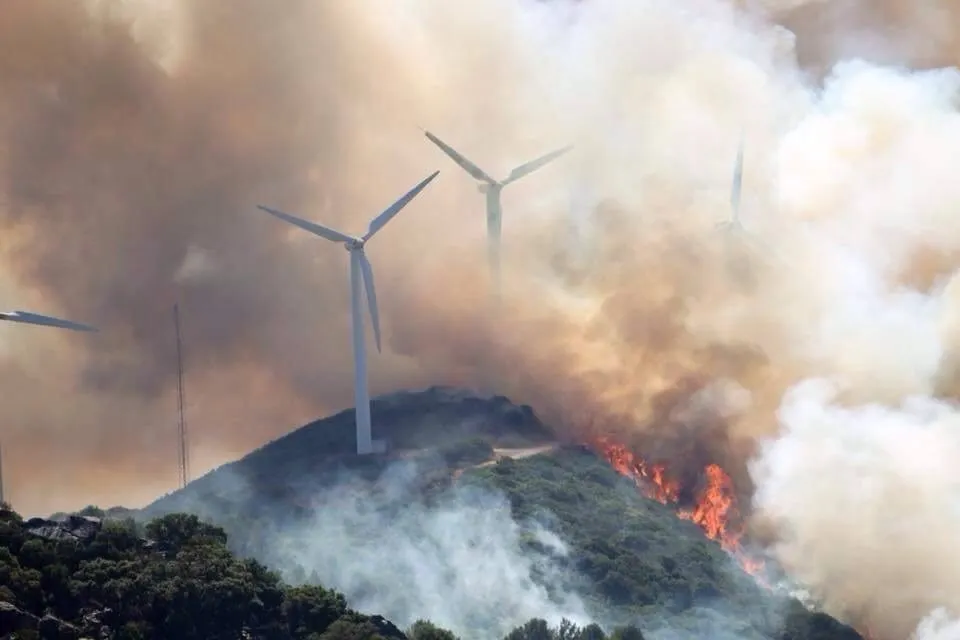
Meanwhile the Earth is being subjected to the ravages of the accelerated fossil fuel-dependent mining, refining, transportation, manufacturing, installation and maintenance activities associated with ‘going green’. We are doing no better when it comes to halting biodiversity loss, reversing tropical deforestation, conserving essential aquafers, containing wildfires, slowing the growth of ocean dead zones/terrestrial deserts, reducing chemical contamination of everything, preventing a potential methane ‘burp’, etc., etc,
In case it’s still not clear, the MTI approach to problems generated by technology and growth addition generally demands massive investment, yet additional energy (mostly FF) use, continuing material growth and accelerating eco-damage on a finite planet. Culturally self-referencing reductionist solutions exacerbate the problems they were intended to solve.
The obvious question, then, is “WHAT then, should we do?
In these circumstances, the wise action for ordinary people might be to shift personal efforts from trying to salvage the MTI status quo to preparing to adapt to the emerging reality. Society needs to wean itself actively from fossil fuels and shrink the scope and scale of economic activity and populations until compatible with the regenerative capacities of the ecosphere. Informed elders can teach, persuade and otherwise lead the way to becoming socially adept, ecologically adapted humans; young people in particular should be steeped in the essence of human ecology—both theory and practice—and in learning the basic social and technical skills associated with agro-ecology, permaculture, bioregionalism and related land-based philosophies, and with simple manufacturing (of basic tools, cloth, clothes, shoes and other essentials); ideally communities should self-organize to develop the means to re-localize basic agriculture and essential economic activities and to ensure that the latter are mutually supportive enterprises in relational harmony with local ecosystems. Bioregionalism (or eco-regionalism) is one of the best articulated models available for spatial reorganization into sustainable settlement patterns.
(There’s too much here to discuss at length including the impediments associated with access to productive land, existing property rights, regulatory barriers, institutional lethargy, etc.—i.e., the organizational architecture of MTI societies—and, increasingly, the self-centred exclusionary belligerence of scofflaw billionaires, including US President Trump. Remember, too, the need to maintain the functional integrity of society as long as possible during any significant transition, an imperative that will be made the more difficult by popular ignorance, inevitable disagreement and likely violent resistance.)
In an ideal world, it would be crucially important to establish realistic field trials—demonstration projects and experiments involving significant numbers of people—in promising alternative ways of doing and being in a low-energy world. Shifting values through argument and education may eventually help to change behaviour, but there is evidence that behavioural change (even if forced by circumstance) often comes first. Change a person’s behaviour and compatible values and beliefs will follow. Importantly, repeating successful experiences can re-wire even our paleolithic brains to adapt to, and subsequently promote, the long-term behavioural patterns necessary for survival in an ecologically constrained world.
There are many supportive literatures (including that on eco- or bioregionalism) that provide abundant useful guidance on WHAT we should be doing but, for all the potential, we are still left with the nagging question:
Faced with social upheaval and impending eco-disaster, HOW best do we pre-emptively catalyze radical behavioural change in people and whole societies whose cognitive maps are wedded to a maladaptive way of being on Earth?
Cognitive limitations
Which brings me to comment once again on the constraints to human agency. Consider Robert Heinlein’s sage advice from his 1973 novel, Time Enough for Love:
“Never attempt to teach a pig to sing; it wastes your time and annoys the pig.”
This directive underscores that the scope for potential action is always inherently limited—you cannot train your pet pig to sing a lullaby, your goldfish cannot learn to fly, no matter how well instructed. In this vein, I have argued elsewhere that humans are cognitively obsolete for life in our contemporary world, that we cannot reliably comprehend complexity or adequately process systemic, growth-induced, long-horizon threats for example. Like pigs crooning cradle songs, it simply isn’t in us to do so.
Some argue that, if this is true, it closes down most of the space where deliberate collective response could take hold at civilizational scale. True enough, but the key words here are ‘civilizational scale’. In describing ‘the human maladaptation syndrome’ I made the case that the possibility for effective human agency may be context-specific. For example, much unifying group behaviour that prevailed under the simple small-scale spatial and social conditions under which humans evolved becomes impossible in large-scale civilizations and institutions. The latter breed precisely the kind of individual neuroses and cultural pathologies we see with the rise of rigid hierarchy, religious extremism, egregious inequality, necrocapitalism and ‘end-times fascism’.
Arguably, then, relatively homogenous small-scale communities have a better chance of developing coherent and effective responses to the great unravelling than do larger societies (particularly MTI-like civilizations). This is why small bioregional communities that manage to live ‘in place’ compatibly with their local ecosystems would have a leg-up in the quest for survival. What there is of human agency is released creatively at the scale of spatial and social organization in which we evolved and to which we are naturally adapted. It is at this truly human scale that cultural collapse might actually be managed in ways that minimize inevitable suffering.
It is doubtful whether large cities can even survive the 21st Century.
So, that’s it. As requested, in these two essays I’ve tried to clarify where I’m coming from, where I think we are and where some few of us may yet manage to go.
Of course, we are still left with the ultimate question: Can modern humans break from the historic pattern?
Do you think we have it in us to imagine and realize an economically adequate, socially just, steady-state eco-civilization that thrives within the biophysical means of nature?
References
[1] And is becoming increasingly derailed in this ‘post-truth’ era by the deliberate propagation of misinformation, fake news and related babble through popular media. Do we really want a society shaped by lies, ignorance and stupidity?
[2] Such as the toxic air quality that enveloped eastern North America, including such major cities as Chicago, Toronto, Montreal, New York, Boston, Washington, etc., in mid-July, resulting from drought- and heat dome-induced wildfires blazing in Canada and Minnesota.
[3] Let me be clear that I think global heating is potentially catastrophic problem. My argument here is that our present reductionist approach is not ‘solving’ the problem because it ignores both its immediate and distal causes: overshoot and gross cultural dysfunction.
ABOUT THE AUTHOR
William E. Rees is a population ecologist and ecological economist. He is Professor Emeritus and former Director of the University of British Columbia's School of Community and Regional Planning; a founding member and former President of the Canadian Society for Ecological Economics; a founding Director of the One Earth Initiative; and a Fellow of the Post-Carbon Institute. Professor Rees' research focuses on the biophysical requirements for sustainability and the policy implications of global ecological trends. He is perhaps best known as the originator, and co-developer with his graduate students, of Ecological Footprint Analysis (EFA). EFA shows that the human enterprise is already in ecological 'overshoot' and that we would need 4.4 Earth-like planets to support just the present world population at Canadian material standards. Such findings led to a special focus on cities as particularly vulnerable components of the human ecosystem and on psycho-cognitive barriers to ecologically rational behavior and policy. Professor Rees has authored hundreds of peer-reviewed and popular articles on these and related topics.
|
|Back to Title|
LINK TO THE CURRENT ISSUE
LINK TO THE HOME PAGE