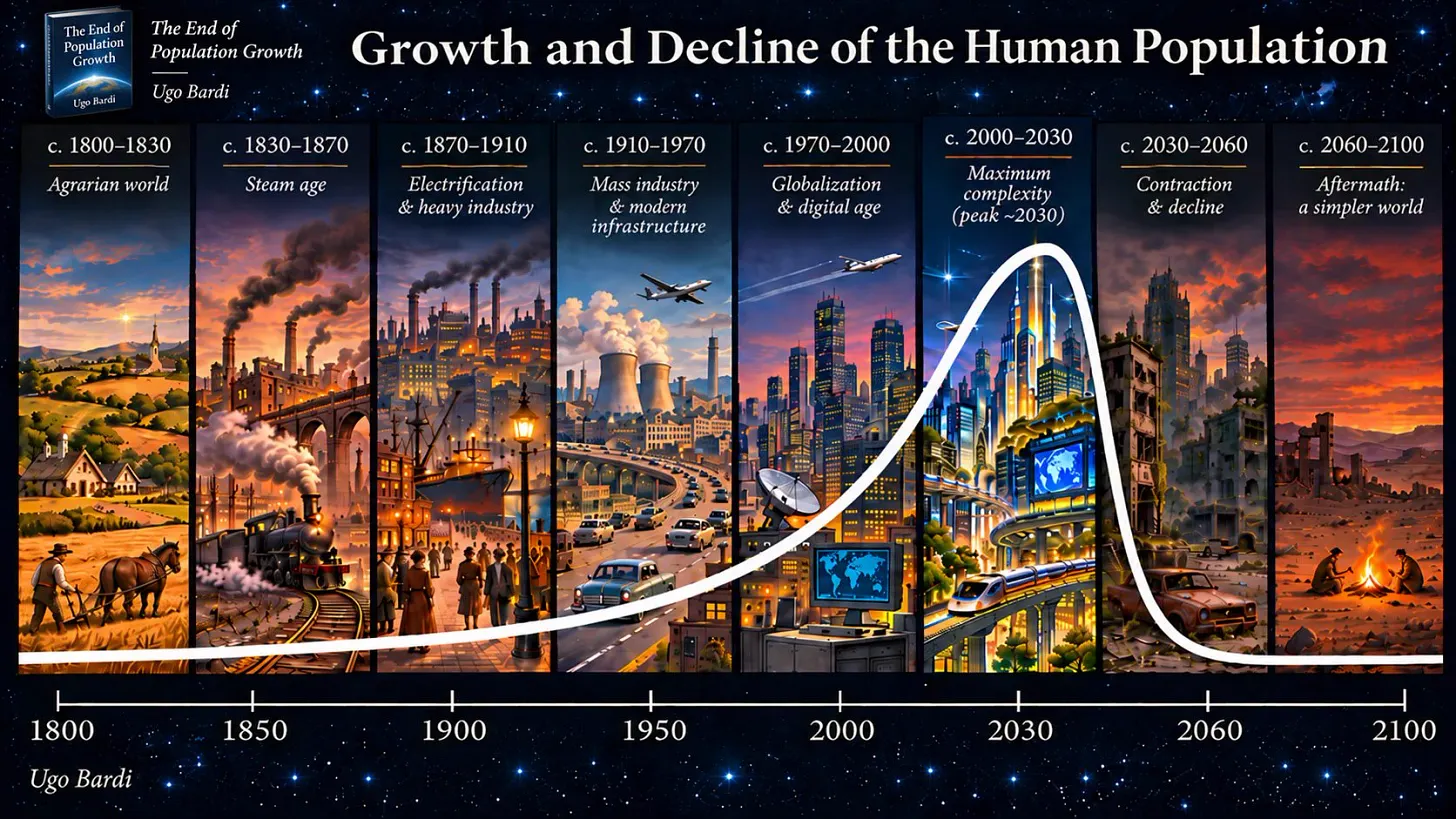
The “Living Earth” blog has been silent for a couple of weeks. Sorry about that; I was on a tour of meetings and conferences. I learned a lot of things, and let me show you just one: a model that I built overnight while at the Complexity Science Hub meeting on Doomsday.
It is the latest version of the Seneca theory of growth and decline, updated on the basis of Von Foerster’s growth curve proposed in 1960 and updated in 2025 by Viktor Yakovenko.
See the result above. It is not yet a quantitative fit, just an approximate calculation. But I think it is a starting point for something that really gets at the heart of the matter. The curve’s growth phase is not just exponential. It is hyperexponential! It is a new version of the Seneca Effect. The ordinary one is “Growth is sluggish, but ruin is rapid.” The new one is:
When growth is rapid, ruin is even more rapid.
You can see the pulse even better if we enlarge the x-axis to the beginning of agriculture.
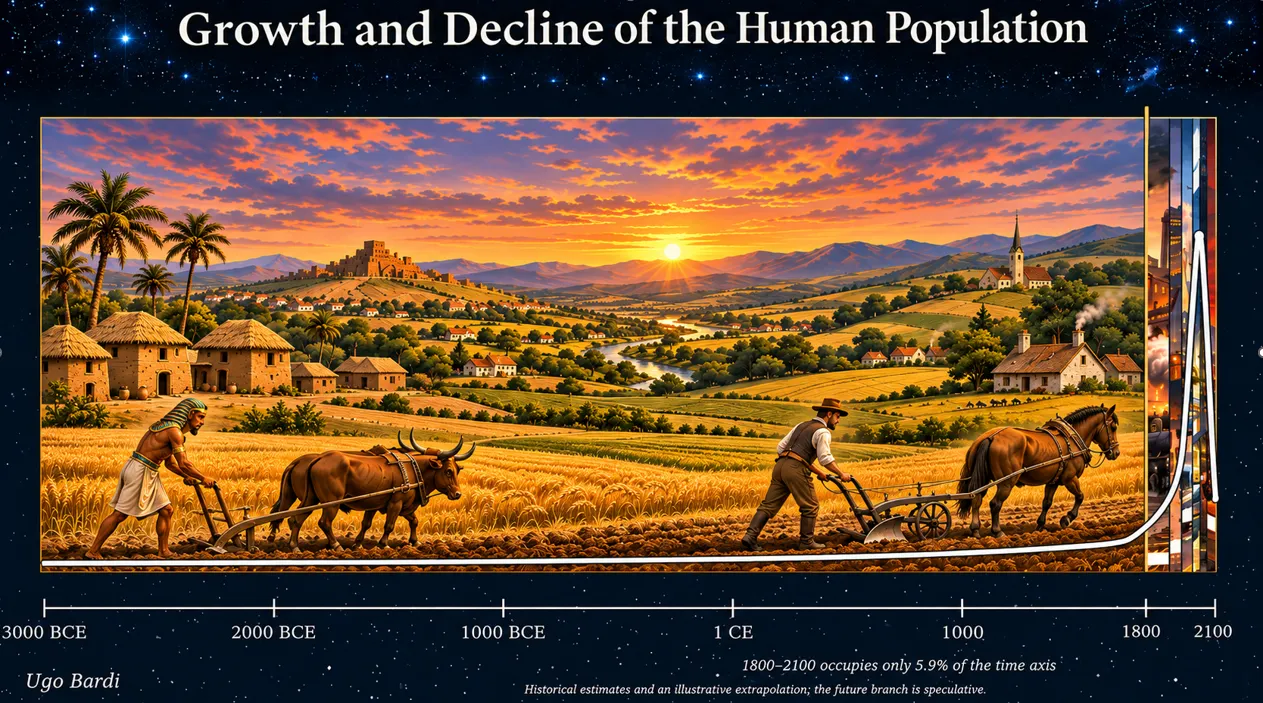
Illustration provided by the author. Click on the image to enlarge.
You see the pulse? It is fantastic, unbelievable, anomalous. We could go back more into the past, and we would find very few of these pulses. The earliest one we know of may be the great Cambrian explosion, some 500 million years ago — although perhaps the great oxygenation event of 2.4 to 2.1 billion years ago was another case. Others are detectable, although less sharp. These pulses often have a fractal structure, created by smaller pulses.
These bursts of hyperexponential growth are the way evolutionary growth works. They are all metabolic revolutions and populatio is a proxy for metabolism at the species level. When a species (or any complex system, according to Prigogine’s theory) learns how to exploit a resource better, then it experiences this explosive growth.
As a result, the resource is exploited much faster, and the final result is a spectacular collapse. Then, usually, there comes a rebound, but it takes a long time. In our case, probably at least as long as the growth phase lasted: a few hundreds of thousands of years to get back to where we started.
And that’s how the universe works!
By the same author:
Global Population: Acceleration and Collapse