Trump, the elections, and misplaced optimism about the future
Many people in the US are very happy right now because the voting gave a clear signal of displeasure to Mr. Trump. This is the least that the American people could do toward a person who committed several war crimes, directly caused the death of a large number of civilians, or indirectly favored their deaths. But there is little to be happy about. 65 million Americans voted against Trump mainly because he had caused an increase in fuel prices. And he is still free and able to continue killing people, even using nukes if so he fancies.
The Power of the President
The problem is deep, and it has to do with the enormous power that a US president has. He is the only one who can decide the use of nuclear weapons, on anyone, anywhere, at any time. No statute limits it, and the United States has never declared a “no first use” policy. Congress has no power to stop a nuclear strike. Once the order is authenticated, land-based missiles can leave their silos in under ten minutes, and there is no way to recall them.
More than once, Trump has threatened Iran with nuclear annihilation. I am sure that there will be people who would approve that because it would reduce fuel prices by opening the Strait of Hormuz and removing a few tens of millions of people from the market. So, imagine Trump decides to nuke Tehran as a demonstration of power. A nuclear warhead dropped onto a city of ten million people would kill millions of them, and that would be legal under any American law. The only possible brake would be military officers refusing to obey an inhuman order. Would they do it, at three in the morning, with minutes to decide?
The irony is that the system was born to prevent exactly this kind of folly. On 10 August 1945, the day after Nagasaki, Harry Truman ordered that no more atomic bombs be used without his express authorization. He later refused to give the military custody of the weapons, saying he did not want “some dashing lieutenant colonel” deciding when to use one. Truman feared a mad general, and he found one when he refused the request by General Douglas MacArthur to use nuclear weapons against the Chinese army fighting in North Korea. The world today would be much different if he had authorized that. But Truman never imagined the mad general could sit in the Oval Office.
There are bills ready to fix this, such as the Markey–Lieu Restricting First Use of Nuclear Weapons Act, which would require a declaration of war by Congress before any first strike. The new Democratic Congress could pass it. But Trump has already reminded everyone: “I have total veto power.” And the democrats don’t have the numbers to override his veto. The one feedback loop that could repair the system runs through the man it is meant to restrain.
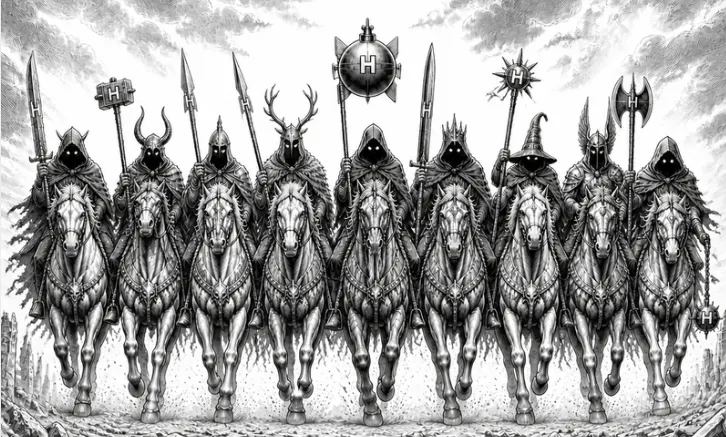
The nine knights of the apocalypse
Trump is not an exception. There are nine states possessing nuclear weapons in the world: Britain, China, France, India, Israel, North Korea, Russia, Pakistan, the US. The decision process that could lead to a nuclear strike is always unclear, sometimes secret. Of these, only China and India have officially embraced a “no first strike” policy.
India has possibly the sanest policy (as much as it can be so defined). The Prime Minister alone doesn’t have the authority to launch a nuclear strike. Only the Political Council has the authority to do that. China, too, wraps the decision in a collective procedure, although the power is concentrated in one man. In Russia, the keys appear to be controlled by a small number of people, but it is not clear if the president can authorize a strike alone. In the United States, the issue can be debated in public, but the keys are with a single person. France makes it a point of pride: deterrence, in the Gaullist view, is credible only if a single person decides. It is the same for North Korea. Britain leaves it to handwritten letters in a submarine safe, destroyed unopened when a new prime minister takes office. Israel denies having the weapons at all, so the rules are unknown and can’t even be debated. In Pakistan, the 27th Amendment, passed in November 2025, created a Commander of the National Strategic Command who, alone, can decide and is endowed with lifelong legal immunity.
How did we survive so far?
Miraculously, in the 80 years after the destruction of Hiroshima and Nagasaki, no nuclear war has erupted. One thing that keeps some of the knights relatively quiet is their different power. The leaders of small states understand that if they started a nuclear war, they would be quickly wiped out by one of the superpowers. The real problem is a systemic one. The probability of a leader being mad enough to start a war is not zero, and there is always the possibility of a mistake or an accident.
The trend is in the wrong direction. Launch-on-warning, built to fire before enemy warheads arrive, is spreading. Then, there is a dangerous idea developing. Nuclear war has gone back to being an abstraction, a “tactical option” in military planning. Societies forget the lessons of catastrophe on roughly the time scale of a human life.
Suppose that the risk of nuclear war is 1% per year. Over 70 years, it gives about a 50% chance: a coin toss over one human lifetime. This is the logic of the Seneca Effect: for a long time, nothing happens. Then, collapse comes all at once.
Democracy as a solution?
We created a democratic system in which you get what you voted for, irreversibly. There is no return policy like when you buy something in a store. You cannot “unvote” a president before his term comes to an end.
Removing Trump before the end of his term is difficult to the point of being nearly impossible. It takes impeachment by the House and conviction by two-thirds of the Senate, 67 votes. Despite the Dem victory, the numbers are not there. The 25th Amendment is even harder: it needs the vice president and a majority of the cabinet, and then two-thirds of both chambers if the president objects. Democracy is simply powerless against a president who refuses to step down.
It is typical: democracies tend to evolve (or maybe “unevolve”) into dictatorships. It has happened many times in history: think of some of the harshest dictators of recent history: Mussolini, Hitler, and others. They were brought to power in elections that most historians consider to have been fair. The problem was that, once elected, they maneuvered in such a way that they couldn’t be unseated anymore.
Old and disgruntled leaders, possibly affected by senile dementia, are among the most dangerous things in the world. They tend to make reckless decisions that create immense disasters. The examples in history are many. Think of Napoleon, who ordered the invasion of Russia in 1812. Think of Mussolini, who, during the Greek campaign that started in 1940, ordered the Italian Air Force to “destroy all Greek cities with more than 10,000 inhabitants.” Imagine that they had nuclear weapons. Or, better, don’t even try to imagine such a thing.
And now? On 3 November, American voters sent a clear dislike signal to their president. So the feedback loop that should be a feature of democracy worked, but slowly, partly, and ineffectively. Could it generate some restraint in Trump’s reckless behavior? We may hope it will. Yet, the nine knights of the apocalypse keep galloping. And let’s say nothing about catastrophes that could be even worse than a nuclear war, such as the collapse of the ecosystem, which were completely ignored during these elections.
This post was prepared with the support of Claude Opus 5.5.
By the same author:
The End of Population Growth: Reaching Humankind's Planetary Limits