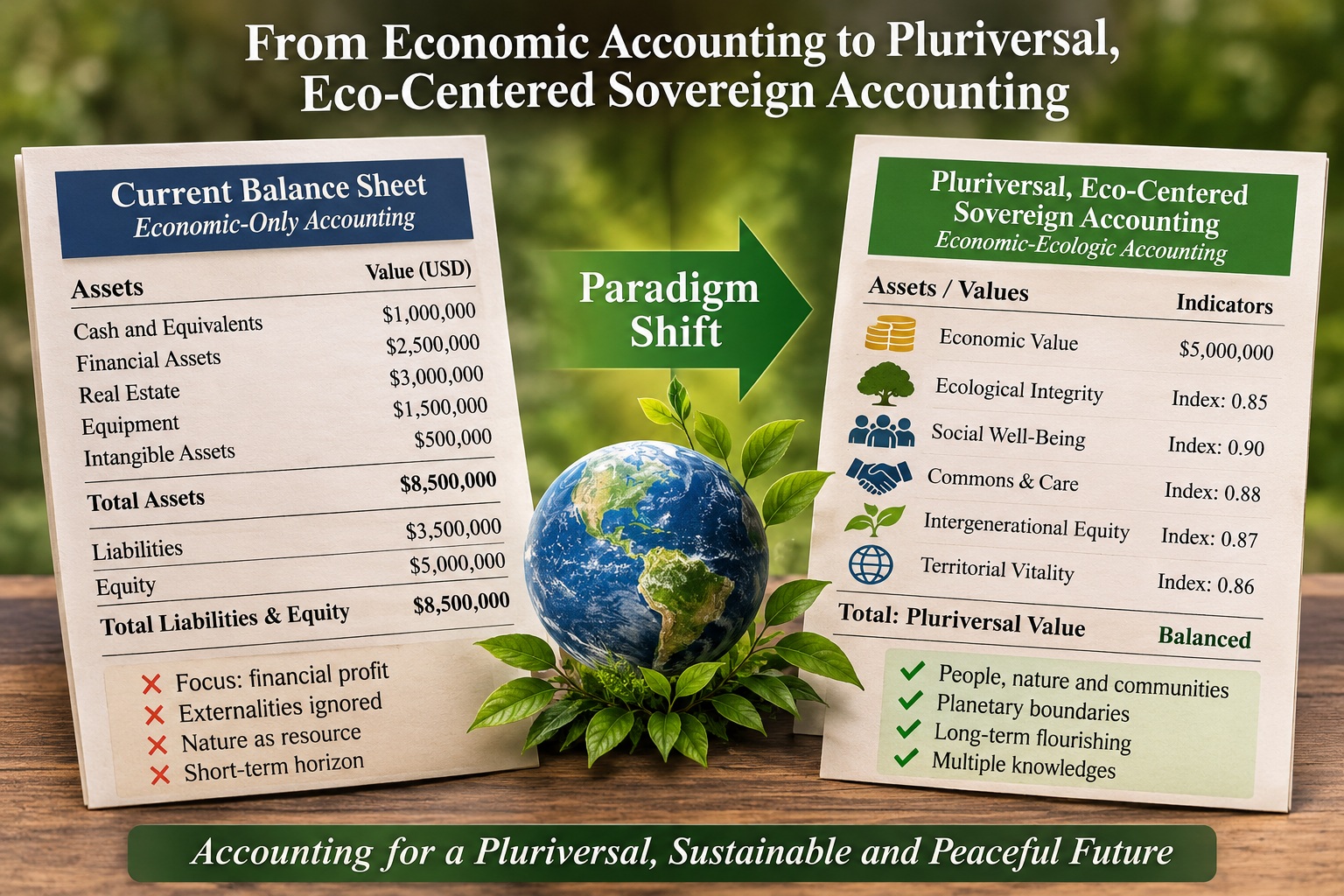
From accounting for accumulation to accounting for the conditions of life:
making ecological dependencies and collective responsibilities visible.
Illustration provided by the author. Click on the image to enlarge.
I. Seeing: The Code That Organizes the Future
This article is a sequel to “Who Will Code the Next Era? Accounting, Post-Growth, and the Struggle for Epistemic Sovereignty” (González Santos, 2026), published in Mother Pelican. In that article, “Sovereign Code” was defined as “a framework for recovering collective capacity to define, measure, validate, and govern value under ecological limits.” The categories embedded in current accounting systems mirror an expansionist and extractivist mindset: they privilege accumulation and financial return while rendering many conditions of life invisible or external. Following the seeing–judging–acting pattern, the earlier argument proposed extending action to include new accounting codes that recognize planetary boundaries and value natural systems rather than merely designating them as “externalities.” This sequel develops the narrative, ethical, and pluriversal foundations of that proposal.
Contemporary accounting is not a passive mirror of the economy. As an infrastructure of classification, measurement, and accountability, it participates in determining what appears as an asset, liability, cost, return, or externality. It therefore contributes to producing futures that seem financially rational and to excluding others from institutional decision-making (González Santos, 2024, 2026).
As argued in the article published in Mother Pelican, the growth imperative is reproduced through this infrastructure: profitability, comparability, efficiency, and material expansion operate as criteria of success, while care, ecosystem integrity, territorial memory, and community capacities commonly remain peripheral (González Santos, 2026). The ecological crisis is therefore also a crisis of representation and of authority to decide what counts.
In this perspective, accounting does not merely describe organizations and economies. It participates in producing subjects, territorial hierarchies, and possible futures. The issue is not that measurement exists, but that dominant measurement often conceals its historical conditions, interests, and exclusions (Foucault, 1975/2003, 1976/2007).
II. Judging: Meaning, Spirit, and the Good Life
Post-growth narratives shift the question from “how can we grow more?” to “how can we live well within just limits?” Sufficiency, repair, care, commons, liberated time, and regeneration name a prosperity that does not equate fulfilment with accumulation (D’Alisa et al., 2015; Kallis, 2018; Latouche, 2009). This is neither an aestheticization of scarcity nor a moralization of poverty; it is a challenge to an abundance built on destroying the conditions of life.
Spirituality is used here in a broad, not necessarily confessional sense: it concerns desire, belonging, responsibility, and meaning. The crisis of growth is also a crisis of moral imagination. A transition expressed only as technical constraint will remain vulnerable; it must make desirable a life richer in relationships, health, knowledge, care, and participation even while it becomes less materially and energetically intensive (Escobar, 2014; Gudynas, 2011).
III. Judging: Power, Technology, and Communication
Foucault makes it possible to read accounting as an apparatus of power/knowledge (the French term is dispositif). Standards, indicators, audits, and accounts do not simply describe organizations: they order visibility, normalize conduct, and produce subjects accountable to particular metrics (Foucault, 1975/2003, 1976/2007). Critical accounting arises precisely from the need to interrogate this apparent neutrality.
Heidegger adds an ontological warning. Under Gestell (enframing), modern technology reveals the world as Bestand: standing-reserve, or a stock of resources made available for ordering, storage, and optimization. Accounting can reinforce this enframing when it translates territories, bodies, and life cycles into exploitable reserves or revenue flows. The critique does not call for abandoning technique, but for subordinating it to forms of dwelling that do not reduce living beings to resources (Heidegger, 1954/1994).
Habermas contributes the principle that validity claims must be open to public discussion. Accounting categories cannot appear as technical truths immune to contestation; they must be deliberated, justified, and scrutinized by those who bear their consequences (Habermas, 1968/1982, 1981/1987; González Santos, 1997).
Latin American critiques broaden this horizon. González Santos (1997) situates accounting as a space for critical reflection; Gracia López (2004, 2007) reinscribes it within political economy and relations of control; and Wallerstein (1995) helps explain that these disputes take place within a hierarchical world-economy marked by structural inequality between center and periphery. Accounting is not external to power: it participates in its organization and reproduction.
IV. Judging: Coloniality, Pluriverse, and Ancestral Knowledge
The preceding critiques are indispensable, but insufficient if they fail to interrogate the coloniality that turned a historically local European experience into a universal rule of knowledge. Quijano (2000) identifies coloniality of power as a matrix linking racial, economic, and epistemic hierarchies. Within this matrix, certain forms of knowledge are authorized as rational, scientific, and universal, while others—including ancestral and community-based knowledges—are relegated to the realm of the mythical, the irrational, or the primitive.
Against the claim of a single world, Mignolo (2011) advances the pluriverse: not indifferent relativism, but the dignified and conflictual coexistence of multiple worlds, rationalities, and relations. Every claim to universality emerges from a particular locus of enunciation; accounting criteria therefore cannot be treated as placeless truths, but must be examined in relation to the positions from which they are formulated (Mignolo, 2011; Mignolo & Walsh, 2018). The genealogy of the pluriverse also draws on Zapatista thought. Escobar (2018, 2020) develops this critique of the modern pretension to reduce the world to one world.
Drawing on Grosfoguel’s (2016) distinction among economic, epistemic, and ontological extractivism, this article proposes that financial accounting can participate in these processes when its categories subordinate territories, knowledges, and ways of life to financial valorization.
This distinction is decisive for the Sovereign Code. It is not enough to recognize the material plundering of nature if the knowledges that enable life to be understood and protected continue to be extracted, classified, and subordinated to categories external to the communities that produce them. Nor is it enough to incorporate social or environmental indicators if the underlying ontology continues to treat land, water, care, and memory as resources available for valorization. Sovereign accounting must therefore question simultaneously the economic, epistemic, and ontological forms of extraction that sustain the growth order (Grosfoguel, 2016; González Santos, 2024, 2026).
Dussel (1998) relocates ethics in the exteriority of the Other. A valid decision must answer to those excluded, harmed, or made victims by the prevailing order. In accounting terms, this means asking who bears the costs of growth, whose territories are treated as expendable, and which future generations are discounted before they can appear as subjects of responsibility.
Decolonial approaches to knowledge also require a transformation of the institutions that authorize it. Decolonization does not mean adding Indigenous content to an otherwise unchanged curriculum; it requires questioning who teaches, who learns, and from where knowledge is authorized. Ancestral knowledge, often degraded within the colonial matrix as tradition or superstition, must be recognized as a situated authority and interlocutor, rather than treated as material to be folklorized (Escobar, 2018, 2020).
The Universidad Intercultural Amawtay Wasi (2004) proposes sumak kawsay (Kichwa for “good living” or buen vivir) as an alternative horizon for thinking about life, education, and knowledge. From this perspective, territorial vitality cannot be defined exclusively through financial indicators or impact metrics; it requires situated categories that recognize reciprocity, territorial integrity, memory, care, and responsibility to future generations.
V. Judging: Critical Community and Epistemic Sovereignty
Critical accounting is also a collective practice of epistemic resistance. Through a critical reflexive ethnography, Kaidonis (2009, pp. 290–292) examines the epistemic community of the School of Accounting and Finance at the University of Wollongong, shaped by Michael Gaffikin’s vision and sustained through doctoral consortia. Debate and disagreement were part of this community’s intellectual life (p. 292), while teaching and research supervision extended its reach beyond research outputs (p. 294). Kaidonis also questions national research evaluation initiatives that may marginalize interdisciplinary critique and privilege commercially oriented knowledge (pp. 293–294). Her argument links the defence of community identity to hegemony, or its potential, while warning that shared discourse can exclude others and that openness may be suspended when the community feels threatened (pp. 291–293).
Quintero Castro’s proposal for a scientific research school in accounting can be read alongside this account without assuming a direct line of influence. His proposal connects a critical image of society and philosophical self-reflection with the formation of critical researchers and a sociohistorical understanding of accounting (Quintero Castro, 1996, pp. 24–26, 28–29). It also calls for empirical inquiry guided by hypotheses and appropriate methods, rather than a rejection of empirical research (Quintero Castro, 1996, p. 28). Read together, these contributions suggest a connection between the epistemological foundations of a critical school and the institutional conditions under which a community sustains its identity. For the Sovereign Code, this article proposes understanding a critical school through collective practices of teaching, research, and conversation, including the capacity to question managerial evaluation and normalization while protecting room for disagreement within the community.
This perspective finds a specific development in Latin American accounting research. Silva et al. (2022) argue that accounting has contributed to sustaining financial capitalism in the Global South through neocolonial languages and practices, and they propose a decolonial agenda based on non-extractive methods and participatory action research. Knowledge should not be extracted, classified, and translated from outside, but co-produced in dialogue with the situated experiences of those who bear the consequences of accounting decisions.
VI. Acting: The Sovereign Code and Post-Growth
The Sovereign Code develops this critique as an open research program with institutional implications, rather than a finished accounting model. It is not a matter of adding green indicators to unchanged financial accounting, but of subordinating calculation to peoples’ self-determination, the reproduction of life, and territorial integrity (González Santos, 2024, 2026). Its object is not financial value alone but systemic vitality: a territory’s capacity to sustain water, soils, biodiversity, care, memory, public infrastructure, and community ties.
This perspective moves from market truth to material truth; from shareholder value to the reproduction of life; from a residual state to strategic stewardship; and from discounting the future to intergenerational responsibility (González Santos, 2026). Here, material truth refers to the biophysical conditions and consequences that valuation must answer to, not to a single authority entitled to determine what every territory should value. The primary patrimony is not what can be liquidated with the greatest return, but what enables a community to continue existing as a community.
The narratives discussed in Section II become institutionally consequential when sufficiency, care, and regeneration change accounting obligations and decision criteria. The question is how these commitments alter what institutions must disclose, protect, and justify.
The spiritual dimension discussed in Section II is decisive here. A post-growth transition will not be durable if it transforms only policies and institutions without also transforming the moral imagination that sustains the desire to grow. Sobriety should not be presented as deprivation, but as liberation from the compulsion to accumulate; care should not be understood as weakness, but as the condition of possibility for common life; and finitude should not be seen as failure, but as the real framework within which a regenerative relation with the world becomes possible.
VII. Acting: Principles for Pluriversal Accounting Coding
The following principles are proposed to extend “acting” to “coding”:
Democratize accounting authority: affected communities must participate in defining value, evidentiary criteria, and accountability obligations.
Recognize care and commons as conditions of social reproduction rather than residuals external to the balance sheet.
Make visible ecological, historical, and intergenerational debts that present growth shifts onto peripheral territories and future generations.
Protect plural languages of valuation: money, but also reciprocity, territorial integrity, memory, dignity, and continuity of life.
Reorient accounting education from technical training toward a critical pedagogy that questions the ontological, political, and ethical consequences of every category.
Sustain critical epistemic communities capable of protecting plurality, reflexivity, and resistance against institutional normalization.
Consider a hypothetical watershed threatened by a profitable project. A sovereign accounting arrangement would report expected financial returns alongside water dependencies and territorial obligations, while recognizing the affected communities’ authority to identify losses that cannot be compensated in money. Coding would change both what enters the account and how that account informs the decision.
Pluriversal accounting must also address the relation between territorial specificity and planetary interdependence. Some sustainability conditions are local or regional: watershed integrity, soil fertility, customary tenure, local food systems, and community care arrangements. Others are global or transboundary: climate change, ocean pollution, plastics, biodiversity loss, and the crossing of planetary boundaries. A pluriversal architecture should therefore connect, rather than collapse, different accounting scales. It would combine a common layer of globally relevant physical accounts and thresholds with locally governed accounts whose categories, meanings, and valuation practices emerge from the territories concerned. Common thresholds would establish obligations of coordination; they would not prescribe a single ontology of value.
This architecture would not seek to calculate a single “pluriversal GDP” by adding unlike local measures. GDP is a monetary measure of market production, not a comprehensive measure of welfare or ecological integrity. Its alternatives should therefore remain plural and function-specific: indicators of material and energy throughput, access to essential services, health, time use, unpaid care, distribution, and subjective and collective well-being can be presented in a dashboard rather than compressed into one monetary aggregate. At the global level, aggregation should be limited to indicators with sufficiently stable definitions and comparable units, while disaggregated territorial accounts preserve differences that cannot be meaningfully summed.
The same principle applies to the Ecological Footprint. A global account can track comparable pressures—such as greenhouse-gas emissions, material footprint, land-use change, freshwater use, and biodiversity loss—against scientifically established limits. Yet no single footprint measure can fully represent the ecological relations of every territory. Watershed accounts, community biodiversity registers, soil and land accounts, and locally defined measures of ecological reciprocity should remain visible as distinct accounts. Integration should mean coordinated interpretation of interdependent pressures, not the erasure of local meanings through a universal conversion factor.
Such an architecture could provide an accounting infrastructure for political ecology by making visible how ecological burdens, benefits, decision-making powers, and historical responsibilities are distributed. It would not replace political ecology as a field of inquiry; it could strengthen its empirical and institutional capacities. Subsidiarity would assign decisions to the most appropriate level while requiring coordination where effects cross territorial boundaries. Peace and solidarity would be fostered not by assuming consensus, but by making asymmetries, ecological debts, and competing claims publicly visible and negotiable. Sustainability would then become a matter of maintaining the conditions of life across scales and generations, rather than maximizing a single aggregate.
VIII. Closing
The question of who will code the next era cannot be answered by a new technological platform or an isolated reform of standards. It is resolved through struggles over the narratives that orient desire, the practices that recognize interdependence, and the institutions that decide what deserves protection (González Santos, 2026). The Sovereign Code proposes that accounting cease to be a grammar of liquidation and become a practice of memory, care, and responsibility.
The task is not to replace one accounting universal with another. It is to leave behind the monoverse that imposes a single measure of value and open a pluriversal architecture of decision in which ancestral knowledge, democratic deliberation, and material evidence can converge in defense of life. Epistemic sovereignty, in this sense, is the collective capacity to name what matters, decide what is protected, and answer for the futures made possible.
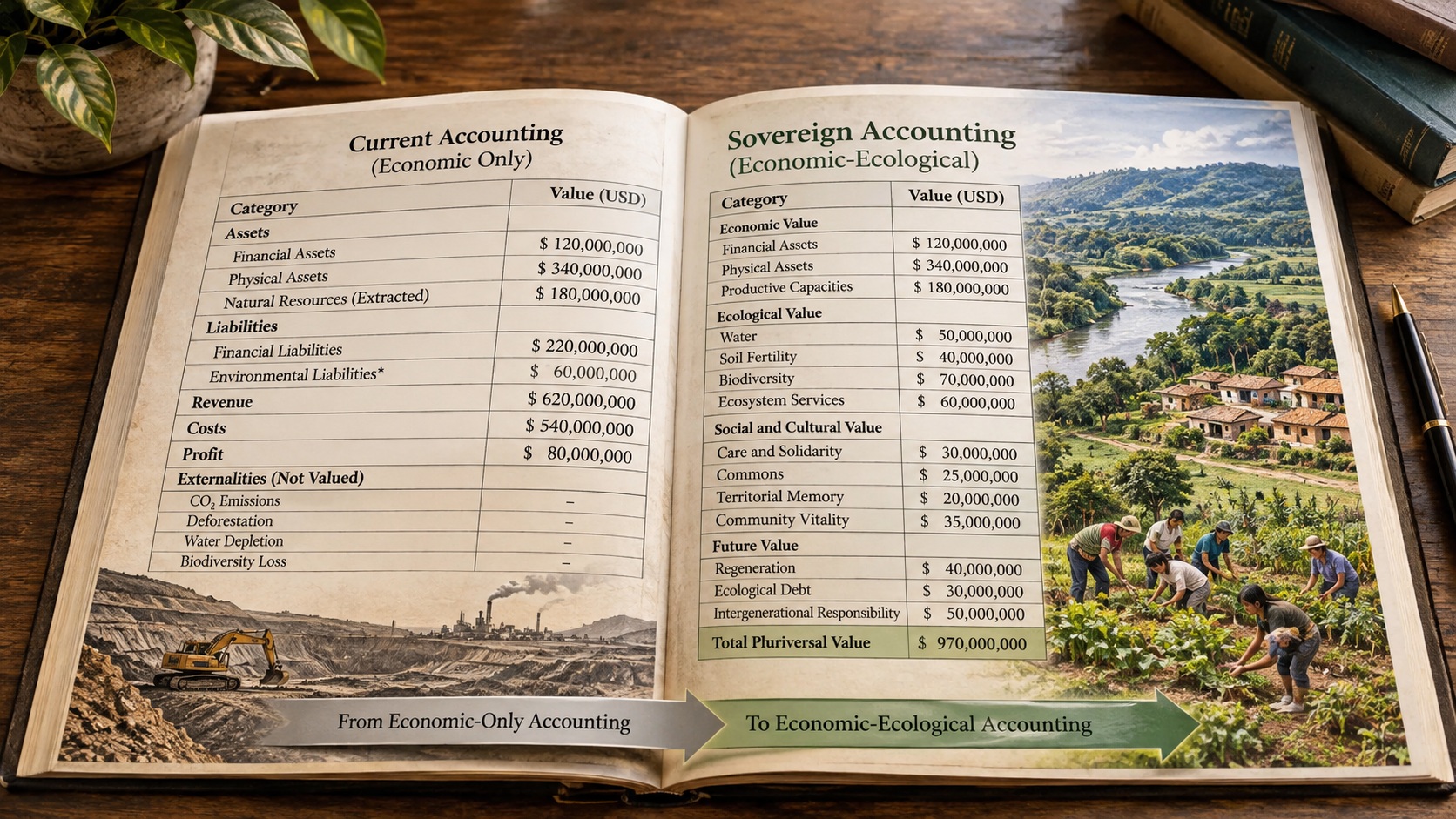
From accounting for accumulation to accounting for the conditions of life:
making ecological dependencies and collective responsibilities visible.
Illustration provided by the author. Click on the image to enlarge.
References
D’Alisa, G., Demaria, F., & Kallis, G. (Eds.). (2015). Degrowth: A vocabulary for a new era. Routledge.
Dussel, E. (1998). Ética de la liberación en la edad de la globalización y de la exclusión. Trotta.
Escobar, A. (2014). Sentipensar con la tierra: Nuevas lecturas sobre desarrollo, territorio y diferencia. Ediciones UNAULA.
Escobar, A. (2018). Designs for the pluriverse: Radical interdependence, autonomy, and the making of worlds. Duke University Press.
Escobar, A. (2020). Pluriversal politics: The real and the possible. Duke University Press.
Foucault, M. (2003). Vigilar y castigar: Nacimiento de la prisión. Siglo XXI. (Original work published 1975).
Foucault, M. (2007). Historia de la sexualidad 1: La voluntad de saber. Siglo XXI. (Original work published 1976).
Gracia López, É. (2004). Control, contabilidad y sociedad. Un asunto para repensar. Lúmina, 5, 237–251.
Gracia López, É. (2007). Economía política y contabilidad. Un asunto para repensar en el marco de las ciencias sociales. Lúmina, 8, 156–171.
González Santos, L. A. (1997). Teoría crítica y contabilidad: Un espacio de reflexión. Innovar, 10, 93–109.
González Santos, L. A. (2024). Gobernanza contable y soberanía epistémica: Una crítica al orden monista [Preprint]. Zenodo.
González Santos, L. A. (2026). Who will code the next era? Accounting, post-growth, and the struggle for epistemic sovereignty. Mother Pelican: A Journal of Solidarity and Sustainability, 22(10).
Grosfoguel, R. (2016). Del “extractivismo económico” al “extractivismo epistémico” y “extractivismo ontológico”: Una forma destructiva de conocer, ser y estar en el mundo. Tabula Rasa, 24, 123–143.
Gudynas, E. (2011). Buen vivir: Germinando alternativas al desarrollo. América Latina en Movimiento, 462, 1–20.
Habermas, J. (1982). Conocimiento e interés. Taurus. (Original work published 1968).
Habermas, J. (1987). Teoría de la acción comunicativa (Vols. 1–2). Taurus. (Original work published 1981).
Heidegger, M. (1994). Conferencias y artículos. Ediciones del Serbal. (Original work published 1954).
Kaidonis, M. A. (2009). Critical accounting as an epistemic community: Hegemony, resistance and identity. Accounting Forum, 33(4), 290–297.
Kallis, G. (2018). Degrowth. Agenda Publishing.
Latouche, S. (2009). La apuesta por el decrecimiento: ¿Cómo salir del imaginario dominante? Icaria.
Mignolo, W. D. (2011). The darker side of Western modernity: Global futures, decolonial options. Duke University Press.
Mignolo, W. D., & Walsh, C. E. (2018). On decoloniality: Concepts, analytics, praxis. Duke University Press.
Quijano, A. (2000). Colonialidad del poder, eurocentrismo y América Latina. In E. Lander (Ed.), La colonialidad del saber: Eurocentrismo y ciencias sociales (pp. 201–246). CLACSO.
Quintero Castro, H. (1996). Hacia una escuela de investigación científica en la contabilidad. Lúmina, 1, 22–30.
Silva, C. M., Sauerbronn, F. F., & Thiollent, M. (2022). Decolonial studies, non-extractive methods, and participatory action research in accounting. Revista de Administração Contemporânea, 26(4), e210014.
Universidad Intercultural Amawtay Wasi. (2004). Sumak yachaypi, alli kawsaypipash yachakuna: Aprender en la sabiduría y el buen vivir. Amawtay Wasi; UNESCO.
Wallerstein, I. (1995). After liberalism. New Press.
ABOUT THE AUTHOR
Luis Antonio González Santos is Associate Professor of Public Administration and Accounting, Faculty of Economic Sciences, National University of Colombia, and director of the Accounting Observatory. His research focuses on critical accounting, environmental governance, and sustainability, with an emphasis on the genealogical method. He has contributed to international debates on education for sustainability and socio-ecological transitions.
|