There is much noise in the media these days about trade, particularly global-scale exchange. Trade is a contributing factor to every country’s economic well-being. The Russo-Ukraine war and the US/Israel war on Iran have disrupted world trade in fossil energy, fertilizer, ammonia, sulphur and other crucial commodities, raising global prices for almost everything and threatening virtually every country’s economy and security, some more than others.
It’s hardly surprising then, that trade policy can deliberately be used as an economic and political weapon. US President Trump, mistaking his nation’s trade deficit with its northern neighbour as evidence that Canada is ripping the US off, recently launched a trade and tariff war between the two nations. The effect has not only damaged both economies, but also ruptured a centuries-long, trusting relationship between two neighbours that famously share the world’s longest undefended border.
Why the preoccupation with trade?
Trade is a universal human activity and always has been. Archaeologists have traced ancient two-way trade routes for valuable physical materials such as flint, obsidian (volcanic glass), marine shells and copper, or for manufactured goods such as pottery, silk and essential oils (scents) among far-flung tribal groups and communities. Youngsters today still trade hockey, baseball and Pokémon cards, sometimes face-to-face in the school-yard, but increasingly at organized community events. Modern nations are into trade big time—the total value of global trade reached ~$35 trillion in 2025, an increase >7% over the previous year; merchandise trade exceeded $26 trillion and commercial services about $8.8 trillion.
Normally, all trading partners benefit from free exchange—otherwise, why do it? The school-boy with two leopard frogs but no salamanders would be delighted to exchange one of his frogs for a red-backed salamander from a friend who has several of the latter but wants to diversify his amphibian collection. Both are happier after the trade.
True, international trade is a bit more complex. There are many competing variations on trade theory to explain patterns of global exchange as they have actually developed.
One common explanatory thread explores variations on David Ricardo’s theory (~1817) of comparative advantage. Comparative advantage exemplifies economists’ preoccupation with ‘efficiency’, defined as the allocation of resources in ways that maximize societal well-being. But since economists generally equate ‘well-being’ with material consumption, this requires maximizing productive efficiency, i.e., maximizing the money value of produced goods and services at the lowest possible cost of inputs and waste.
Everybody’s a winner
With this framing, consider the possibilities available in a simple two-country world. Assume country, ‘Uno,’ can produce two essential renewable commodities, ‘a’ and ‘b’, but is more efficient at producing ‘a’ than ‘b’. In Ricardo’s simple formulation, this means that less labour is required to produce a unit of ‘a’ than an equivalent unit of ‘b’. In other words, for every unit of ‘b’ produced, Uno’s labour could have produced 1+x units of ‘a’ instead. In this example, ‘x’ represents the ‘opportunity cost’ (a loss) to Uno of producing a unit of ‘b’ instead of a unit of ‘a’. Economists say that Uno has a comparative advantage in producing product ‘a’
Another country, ‘Duo’, can also produce both goods, but Duo is more efficient at producing both ‘a’ and ‘b’ than is Uno and is more efficient at producing good ‘b’ than good ‘a’. We say that Duo has an absolute advantage over Uno in producing both goods (lower labour costs per unit output) and also a comparative advantage in producing ‘b.’
It turns out that if Uno and Duo are able to trade, then it is to their mutual material advantage if each exploits its comparative advantage, even when Duo holds a double absolute advantage over Uno. In these circumstances, Uno produces ‘a’ for both countries and trades with Duo who produces ‘b’ for both countries. Since both Uno and Duo are producing crucial commodities at their respective maximum efficiencies (no opportunity costs), more of both ‘a’ and ‘b’ are produced in total. Consequently, after some adjustment (in exchange rates, for example) an equilibrium is reached in which each country has more of both ‘a’ and ‘b’ to consume than would have been the case had each tried to be self-sufficient in both goods.
We’ve managed to maximize global production and consumption (GWP) and, in theory, increase everyone’s material well-being. Which explains economists’ priority focus on efficiency.
What’s not to like?
The ‘not-to-like’ part begins when we look a little deeper at a good thing.
Neoliberal economics argues that we could maximize growth with a single, integrated global economy and essentially free trade among nations. To illustrate the rationale and consequences, let’s return to our simplified world of Uno and Duo. Each country can produce two essential, renewable, non-substitutable resources, ‘a’ and ‘b’; initially, there is no exchange between nations (Figure 1).
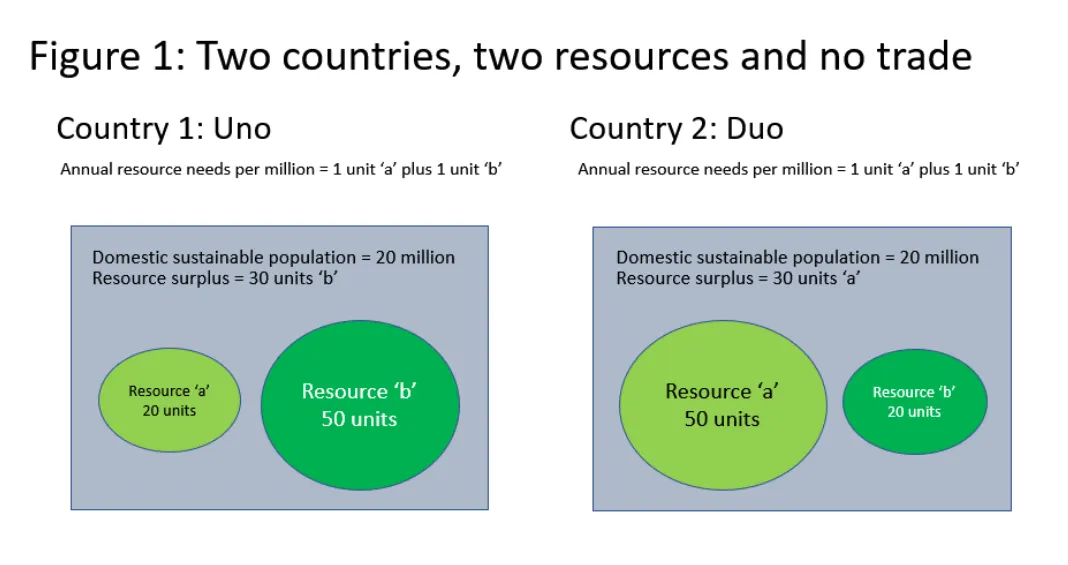
Illustration provided by the author. Click on the image to enlarge.
Assume that:
Also assume that the minimum requirement per million people for ‘a’ and ‘b’ is one unit of each resource per year. It follows that:
Uno’s carrying capacity is 20 million people, set by the limited production of resource ‘a’ This leaves a potential surplus of 30 units of resource ‘b’
Duo’s carrying capacity is also 20 million people, this time set by the limited production of resource ‘b’ This leaves a potential surplus of 30 units of resource ‘a’.
Note that global carrying capacity (CC) is 40 million people. However, this global system is potentially resilient in the face of disaster. Each country is at its domestic carrying capacity,[1] but there is a potential global surplus of 30 units ‘a’ and 30 units ‘b’. We might think of these as tradable buffers in the case of emergency (e.g., when global heating dramatically reduces productivity). Nevertheless, many economists would consider unused potential or actual surpluses to be wasted resources since they do not contribute to GDP/GWP. In short, there is much room for growth.
Now consider a fully globalized world (Figure 2). Following an international free trade agreement, the economies of these two countries have effectively been integrated to take advantage of the efficiencies offered by trade and to use previously ‘wasted’ resources.
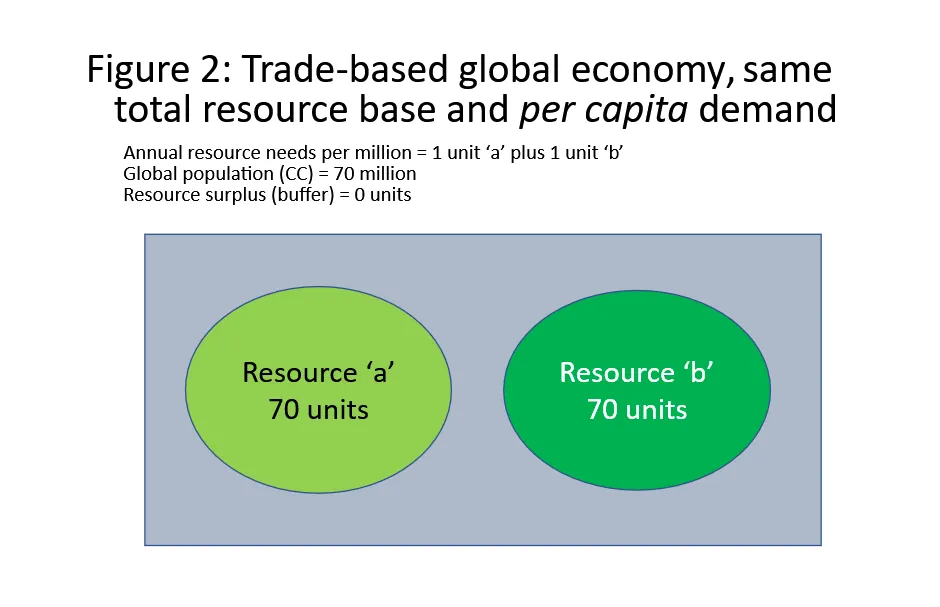
Illustration provided by the author. Click on the image to enlarge.
In these circumstances, the global population—and global carrying capacity—balloons to 70 million people set by realizing the combined production of resources, ‘a’ and ‘b’. This is 75% higher than when the national economies were isolated. However, with 35 million people each, both Uno and Duo are now dangerously overpopulated at 75% above their respective domestic carrying capacities and each is dependent on the other for survival.Here’s the thing. Our model growth-oriented global system implicitly assumes a world of reliable constancy—no negative changes in productivity, international relationships or the biophysical environment. However, because they are pressing up against global carrying capacity, both nations are vulnerable to reality, i.e., the potential for broken supply lines, trade disputes, energy shortages, climate chaos, etc., etc., and, in the absence of global surpluses, there is no fall-back position when things go South.
How does free trade ‘efficiency’ feel now?
Bottom line: Our fully integrated, highly efficient, consumption-maximizing world economic system crushes up against global carrying capacity. It is brittle, vulnerable and has no tradable resource buffers for emergencies. Any major perturbation (geological, political or ecological) could lead to the implosion of both countries, i.e., collapse of the entire global system.
That’s the major ‘what’s not to like.’ But wait, there’s more! Read Part Two.
Note
[1] Carrying capacity (maximum sustainable population) is determined by that essential resource in least supply.
ABOUT THE AUTHOR
William E. Rees is a population ecologist and ecological economist. He is Professor Emeritus and former Director of the University of British Columbia's School of Community and Regional Planning; a founding member and former President of the Canadian Society for Ecological Economics; a founding Director of the One Earth Initiative; and a Fellow of the Post-Carbon Institute. Professor Rees' research focuses on the biophysical requirements for sustainability and the policy implications of global ecological trends. He is perhaps best known as the originator, and co-developer with his graduate students, of Ecological Footprint Analysis (EFA). EFA shows that the human enterprise is already in ecological 'overshoot' and that we would need 4.4 Earth-like planets to support just the present world population at Canadian material standards. Such findings led to a special focus on cities as particularly vulnerable components of the human ecosystem and on psycho-cognitive barriers to ecologically rational behavior and policy. Professor Rees has authored hundreds of peer-reviewed and popular articles on these and related topics.
|
|Back to Title|
LINK TO THE CURRENT ISSUE
LINK TO THE HOME PAGE