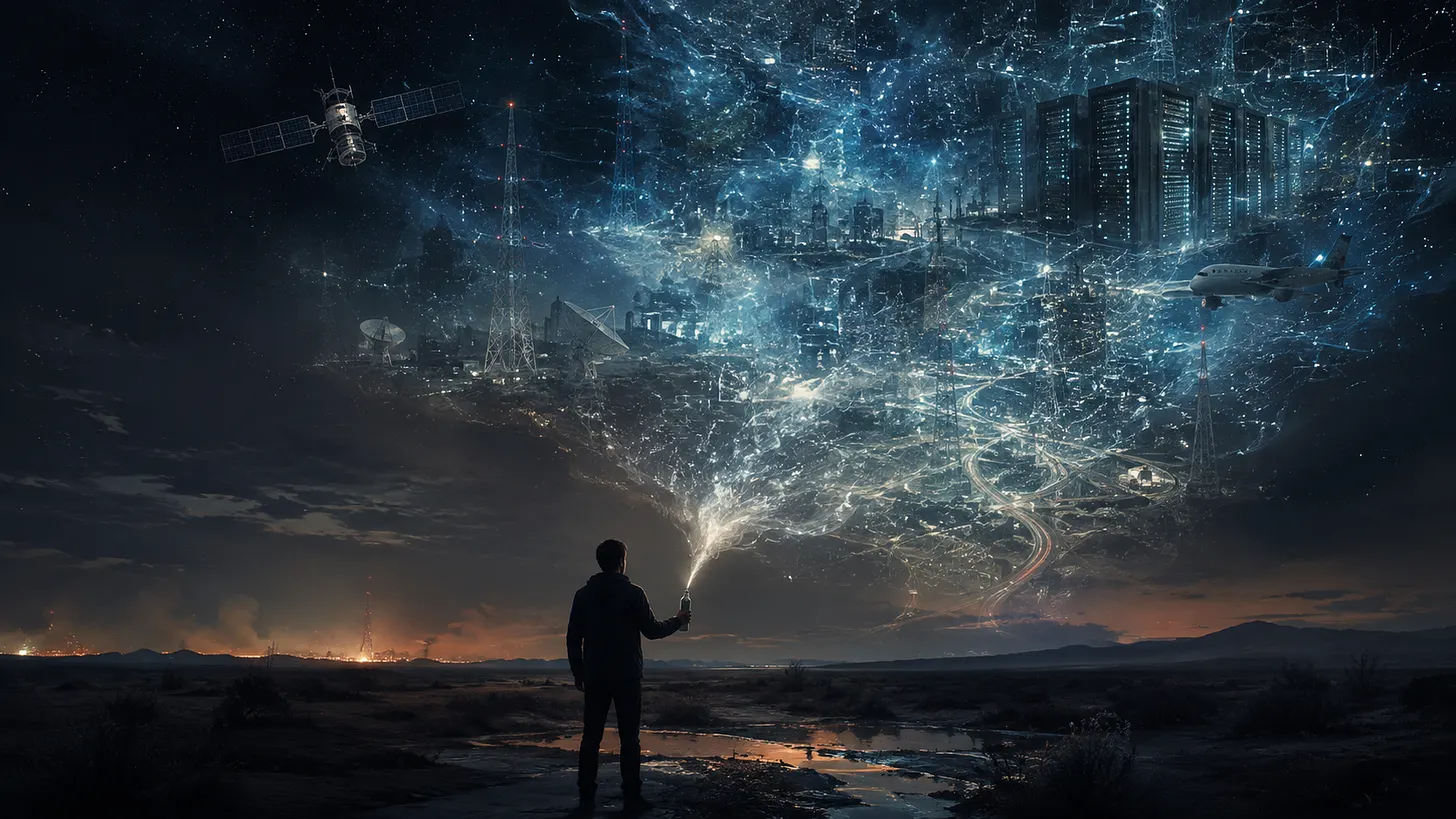
The bottle is tiny. The consequences being unleashed on the planet are enormous.
The Animal Holding the Bottle
I use artificial intelligence almost every day.
It helps me research, organize ideas, test arguments, find weaknesses, edit prose, and move from a half-formed thought to something coherent much faster than I could on my own. It has opened a chapter in my life I did not expect to have.
And I often wish it had never been invented. I feel the same way about smartphones. And computers. And cable television. And color television. And automobiles. If I keep going backward through history, the list becomes absurdly long.
That does not mean I believe every one of these inventions was a mistake. It means something more complicated. Each gave us capabilities we did not previously possess. Each solved problems. Each created pleasures, efficiencies, freedoms, and possibilities that people quickly came to regard as indispensable.
Each also changed us. Not necessarily because the technology altered our biology, but because it altered the world in which our biology operates.
I grew up without most of the technologies that now structure daily life. It is impossible to compare happiness across different periods of a life with any precision. A child, a young adult, a middle-aged person, and an older person inhabit different worlds even when the technology around them remains unchanged.
But I cannot look backward and conclude that I was obviously less happy before computers, smartphones, streaming video, instant communication, and the permanent availability of nearly everything. I was simply living a different life. That life is gone.
And there is no going back.
The Genie Problem
We often talk about technology as though invention remains a reversible decision. Should artificial intelligence exist? Should social media exist? Should genetically engineered organisms exist? Should nuclear weapons exist?
Those can be meaningful ethical questions before a technology is developed. Afterward, the question changes. Knowledge that already exists cannot simply be voted out of existence. Once knowledge exists, it becomes extraordinarily difficult to erase.
A person can refuse to use a smartphone. A family can throw away its television. A writer can refuse to use artificial intelligence. A country can ban a particular technology. But none of those actions causes the underlying knowledge to disappear. The genie has already left the bottle.
This is the part of technological debates that people often avoid. We prefer to argue about what humanity ought to do while quietly assuming that humanity still possesses the option of returning to an earlier state. Usually, it does not.
An automobile is not just an object. Once automobiles become widespread, cities reorganize around them. Roads expand. Homes move farther from workplaces. Stores move farther from homes. Public transportation changes. Landscapes are fragmented. Oil becomes strategically important. Entire industries arise. Expectations change.
Eventually, choosing not to own a car does not restore the world that existed before cars. It merely makes you a person without a car in a world built for them.
The same thing happened with computers. Then the internet. Then smartphones. Now artificial intelligence. The technology itself is only the beginning. The world reorganizes around it. And once that happens, individual abstinence is not the same thing as reversal.
The Other Genie
But technology is only half the problem. There is another genie we cannot put back in the bottle. Ourselves.
Human beings are fond of imagining that our most troubling behaviors are departures from what humans really are. The cruel person is not representative. The greedy person is defective. The demagogue is an aberration. The tribalist is primitive. The person accumulating wealth far beyond any conceivable need has somehow lost touch with normal human values.
Perhaps. But after watching the same behaviors recur across societies, political systems, religions, economies, technologies, and centuries, another possibility becomes difficult to ignore. This may simply be part of us.
Evolution did not produce an organism designed to manage a technological civilization. It produced an organism that survived. Our ancestors sought food, mates, security, territory, allies, status, and opportunities. They protected relatives. They cooperated. They competed. They deceived. They shared. They hoarded. They took risks. They feared strangers. They followed charismatic individuals. They punished cheaters. They exploited openings when those openings appeared.
Those tendencies were not bugs in the system. They were the system.
Natural selection did not ask whether a behavioral trait would be useful when its descendants eventually controlled nuclear weapons, global financial markets, industrial agriculture, biotechnology, fossil fuels, social media, and artificial intelligence.
It only asked whether that trait helped its bearers reproduce in the environments in which it evolved. And for most of our evolutionary history, the consequences of human decisions were constrained by geography, energy, population size, and technology.
A charismatic fool could ruin a village. A violent leader could devastate a region. A clever hunter could overexploit an animal population. A group could burn a landscape. But there were limits to the speed and scale at which damage could spread. We have spent thousands of years removing those limits.
A Paleolithic Animal With Planetary Tools
That may be the defining problem of modern civilization. Our technological capabilities have changed almost beyond recognition. The animal using them has changed comparatively little. A human brain that evolved in small social groups can now communicate instantaneously with billions of other human brains.
A species that once altered landscapes with fire and stone tools can redirect rivers, level mountains, empty oceans, modify genomes, alter the atmosphere, and destroy cities in minutes. Individuals seeking status can now accumulate fortunes larger than the economies of countries. People seeking attention can reach millions of strangers before breakfast. Propaganda that once required printing presses and distribution networks can now cross continents in seconds.
A malicious actor no longer needs an army. Increasingly, the actor may need only knowledge. Artificial intelligence intensifies this asymmetry. It can amplify intelligence without amplifying wisdom. It can expand capability without expanding restraint. It can make research faster without making consequences easier to understand. It can improve persuasion without improving truth. It can increase the reach of both the person trying to solve a problem and the person trying to exploit one.
This is why arguments about whether AI is good or bad seem inadequate. Is fire good or bad? Language? Agriculture? The automobile? The answer depends on who is using it, for what purpose, under what circumstances, and with what consequences.
The more important question is whether the animal using the technology possesses the behavioral machinery required to restrain itself once the technology provides an advantage.
History does not offer much reassurance.
This Is Who We Are
Perhaps one of the hardest things human beings ever have to accept is that the people surrounding us are not exceptions to humanity. They are humanity. The generous person is human. So is the exploiter. The scientist working for decades to understand a species is human. So is the person destroying its habitat for short-term gain.
The person risking a life to save a stranger is human. So is the person profiting from someone else’s desperation. The careful thinker is human. The conspiracy theorist is human. The leader capable of extraordinary courage is human. So is the demagogue.
We repeatedly divide humanity into those behaving as humans should and those somehow failing to qualify. But evolution has never produced a single human temperament or a single morally preferred human way of living.
Humans evolved as omnivores. What we choose to eat today may reflect ethical commitments, cultural traditions, or personal preferences, but those choices do not change our evolutionary history.
Evolution did not make us what we believe we ought to be. It made us what survived.
Civilization has always depended on taking that inherited behavioral repertoire and deciding which parts to encourage, which to restrain, and which to transcend. Laws constrain violence. Norms constrain selfishness. Science constrains intuition. Democratic institutions constrain concentrations of power. Regulations constrain exploitation. Education attempts to expand the horizon over which people understand consequences.
None eliminates the underlying behavior. They merely place boundaries around it.
Pretending the Genie Is Still Inside
There is a comforting fantasy embedded in many modern debates. If a technology is dangerous, we can simply choose not to use it. If social media damages society, leave social media. If smartphones degrade attention, turn them off. If artificial intelligence threatens writing, refuse to use it.
At an individual level, some of those decisions may be wise. At a civilizational level, that response misunderstands the problem. Once a technology confers a significant advantage, someone will use it. If one company refuses, another may not. If one country restrains itself, another may not. If one researcher refuses a powerful method, another may use it. If one political movement declines a persuasive tool, its opponent may embrace it.
This creates one of the oldest evolutionary dynamics imaginable. Competition. The very mechanism that produced us now operates through the technologies we produce. A technology does not have to be universally desirable to become nearly impossible to abandon. It merely has to provide an advantage to those willing to use it.
I understand that dynamic personally. Much of my life has been spent trying to protect wildlife and wildlands from people seeking to exploit them. I have watched those interests use every available tool—political, economic, technological, and rhetorical—to gain an advantage, obscure environmental costs, and shape public perception. I have therefore used every tool available to me that I thought could help protect all things wild.
I may wish some of those tools had never existed. But once they do, refusing to use them does not make them disappear. It merely gives the advantage to someone who will. That is why the genie metaphor matters. We can regulate the genie. We can constrain it. We can decide where it is allowed to operate. We can try to anticipate what it might do.
But pretending that the bottle is still sealed does nothing. The knowledge exists. The incentives exist. And the animal holding the bottle exists too.
The World Before
I sometimes think about the world before automobiles. Not because I imagine it was idyllic. It was not. People died younger. Travel was difficult. Medical care was primitive. Communication was slow. Poverty was widespread. Life could be physically exhausting and brutally unfair.
But landscapes were quieter. Distances mattered. Night was darker. Human activity moved at a different speed.
Then the automobile arrived, and within a few generations much of the world was rebuilt around it. We gained mobility. We lost something too.
The same is true of almost every transformative technology. We rarely make clean exchanges. We trade one set of possibilities for another. The difficulty is that the benefits usually arrive immediately and individually, while many of the costs arrive slowly and collectively.
The first automobile owner gains mobility. The fragmented habitat appears decades later. The first smartphone user gains instant communication. The transformed attention economy emerges afterward. The first social media account reconnects old friends. The machinery for industrialized misinformation comes later.
An artificial intelligence system may help someone write an essay. What follows from billions of people using increasingly capable systems is something no one knows. That uncertainty is not an argument for pretending the technology does not exist. It is an argument for understanding the animal that will use it.
The Animal Holding the Bottle
Maybe that is where our attention should have been all along. We devote enormous effort to imagining better technologies. We devote much less to confronting the evolutionary creature that will control them. We assume intelligence will produce wisdom. It does not. We assume knowledge will produce restraint. It does not.
We assume recognizing a danger means humanity will avoid it. History repeatedly demonstrates otherwise. None of this means restraint is impossible.
Humans also evolved cooperation, empathy, reciprocity, foresight, and extraordinary capacities for collective action. Those are part of us too. But they are not guaranteed to prevail simply because the consequences of failure become larger.
That may be the central problem of the technological age. Every generation inherits a more powerful set of tools than the generation before it. But every generation receives essentially the same animal.
We cannot uninvent ourselves. We cannot uninvent what we already know. And we cannot return to the world that existed before either one.
The genie is out of the bottle.
ABOUT THE AUTHOR
Lyle Lewis is an ecologist and writer exploring deep time, human behavior, and the Sixth Mass Extinction. Essays cut through comforting myths to show how plastics, climate, biodiversity loss and other crises intertwine.
|
|Back to Title|
LINK TO THE CURRENT ISSUE
LINK TO THE HOME PAGE