|
Mother Pelican
A Journal of Solidarity and Sustainability
Vol. 22, No. 11, November 2026
Luis T. Gutiérrez, Editor
|
|
|
|

|
|
|
The Influence of Psychopaths:
Why Humans Are Better Than We Think
Nate Hagens
This article was originally published by
The Great Simplification, 20 October 2026
REPUBLISHED WITH PERMISSION
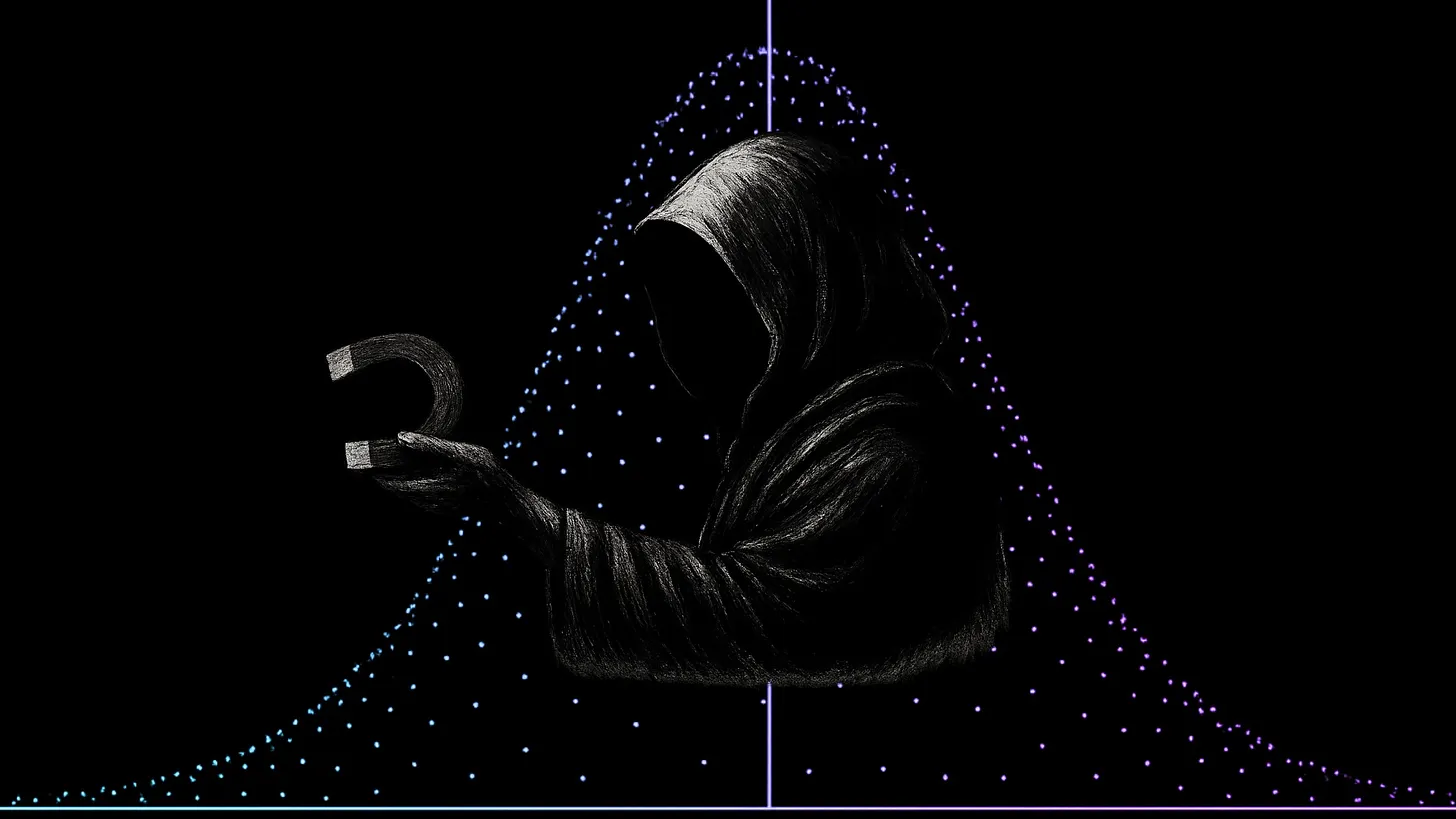
The mean and median humans, and the predators. Illustration provided by the author.
Click on the image to enlarge.
|
I’ve learned a lot about psychopathy this past year, especially through a podcast with Luke Kemp, as well as the Reality Roundtable with Reid Meloy and Nancy McWilliams on dark triad traits. Most recently, my interest was renewed by my interview with Greg Elliott about his Psychopathic Selection Hypothesis. Earlier this fall, in Turning the Dials Back on Psychopathy, I built on Greg’s work to describe the seven dials that determine whether cheating pays in a society. That episode rests on the analysis below, so I’d like to revisit it for those of you who might have missed it.If you’re like me – and if you follow this channel, you probably are, at least in some ways – you might experience a great deal of cognitive dissonance. Especially looking at your friends, your own values, your community, your feelings, and the things you care about … and contrasting it with the headlines of our crazy, polarized, dystopian, functional/dysfunctional world. It’s clear that there is a delta between who we are as individual humans and how we’re expressing ourselves as a global species. So today I want to talk about the median human, the mean human, and the predators in our society. On its surface, my thesis is a little depressing. But just underneath, I actually find it to be quite hopeful. I’m going to start with some definitions, give a little background and setup to my thesis, and then offer some brief conclusions on the logic underpinning the economic Superorganism we all live within.
Defining Psychopathy (And Other Terms)
Illustration provided by the author. Click on the image to enlarge.
Okay, starting with a few definitions. On Wikipedia, “psychopathy” is defined as a personality construct characterized by impaired empathy and remorse, persistent antisocial behavior, as well as bold, disinhibited, and egocentric traits. These traits are often masked by superficial charm and immunity to stress, which create an outward appearance of normalcy.
Another definition I want to share is “predator,” which is an organism that preys on and eats other animals. Adding a big old asterisk there, since this channel is known for its wide-boundary perspective. We think of predators as a bad thing with respect to human-on-human predation – which I’ll be talking about here – but in a wide-boundary ecological sense, everyone watching this podcast is a predator. Humans are apex predators, at least writ large and historically. But today we’re talking about intraspecies predation. The last definitional term is median versus mean. The median is the exact middle of a distribution of people or things. The mean, also known as the average, is the sum of all values divided by the number of values – in this case, people.
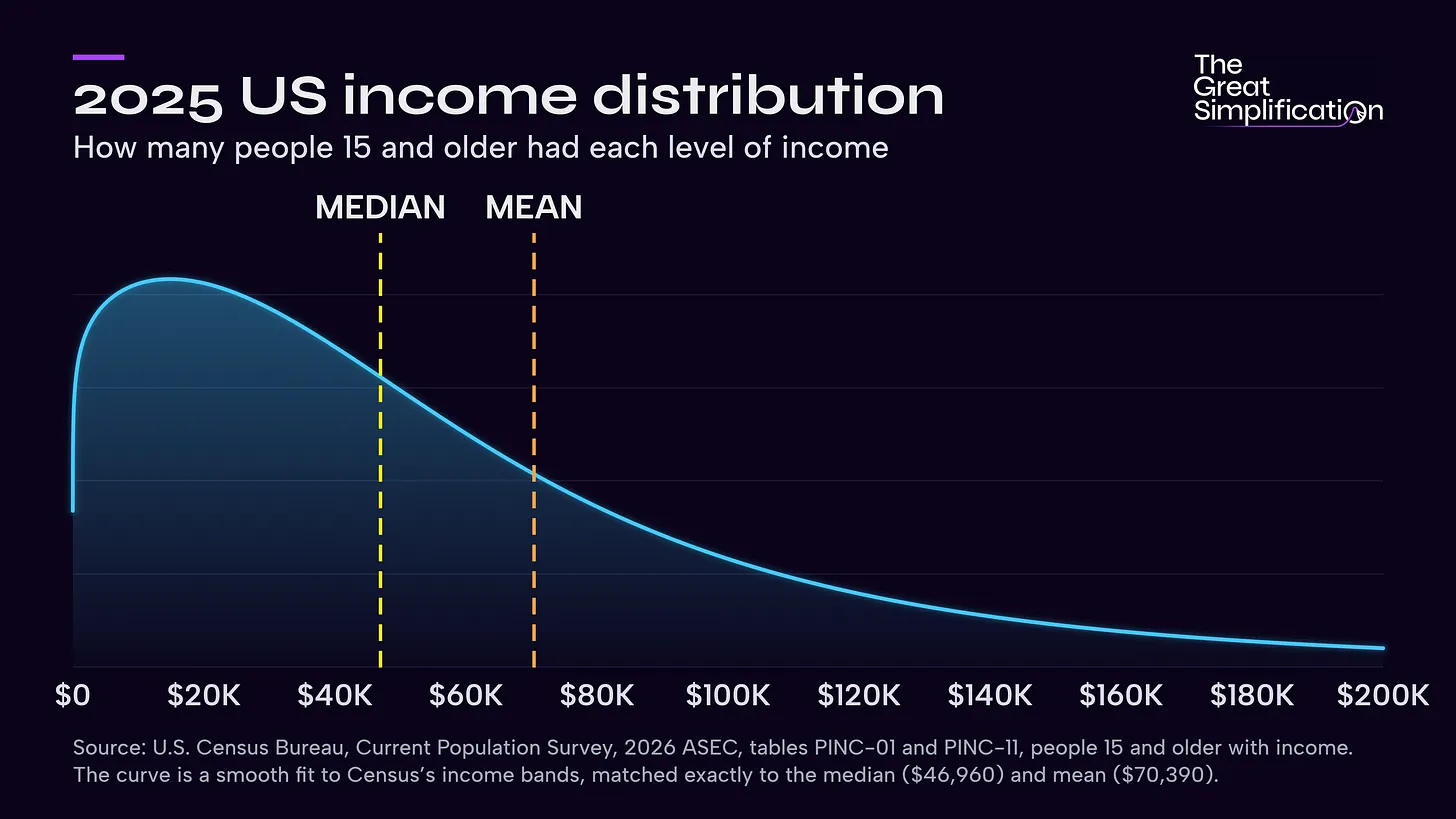
Graph showcasing the distribution of income levels in the United States,
while demonstrating the difference between the median and mean.
Illustration provided by the author. Click on the image to enlarge.
Let’s talk about income as an example. In 2025, the median income in the United States was around $45,000, and the mean (or the average) was $70,000. The median says that half the people made more than 45K and half the people made less than 45K. The mean ends up being much higher because a few outliers making $10 million or $100 million per year skewed the distribution and stretched the tails of the graph. I see this same tail stretching in our behavioral characteristics as a society.
Multilevel Selection Theory and Antisocial Behavior
I want to provide some background and setup from the cradle of life in Tanzania. The Olduvai Gorge offers a glimpse into the ancestral environments that shaped early humans. Homo sapiens evolved in small bands of hunter-gatherers, and recent biological research highlights the importance of both competition and cooperation in the selection of traits that survived this time period. This reflects multilevel selection, where traits are shaped by selection acting at both individual and group levels.
A famous example that we’ve talked about before – including when David Sloan Wilson, one of the originators of the concept, was on the show – is when a popular egg producer in the United States hired evolutionary biologists to figure out how to increase the number of eggs laid per cage. In their experiment, they selected the hens that laid the most eggs and put them together in a cage under the assumption that they would collectively lay more eggs. They did get more eggs from a couple of chickens, but the average egg production actually went down. What they had really done in trying to select for productivity was select for aggression. In another version of that experiment, the researchers combined chickens with cooperative traits in the same cage, and the egg production per cage went up. Switching birds, I can provide another game theory example through the hawk-dove model. Hawks will outcompete doves individually for a resource. But because doves are more prosocial (more cooperative and conflict-averse), a group of doves will often outcompete a group of hawks. This helps explain why both competition and cooperation were hardwired into us during our ancestral times. With respect to antisocial traits in humans, like psychopathy, I’ve learned that around one percent of adult males and one-fifth of one percent of adult females are clinical psychopaths. This comes out to around 30 million clinical psychopaths alive today. Many, many more people have traits that lean psychopathic or dark triad, but at subclinical levels. For roughly 300,000 years, in the bands and villages of our ancestors, cheating usually did not pay. You would see the same people again and again each day. If you did something bad, everyone could see what you did and that you were responsible; consequences arrived quickly. Callous and high-risk strategies were checked by reputation, exclusion, and sometimes banishment. I’ve talked about the birth of the economic Superorganism occurring ten to twelve thousand years ago, because humans switched to agriculture, and thus created a storable surplus. Luke Kemp taught me it wasn’t only storability that was important; it was also lootability. Once things could be stolen and hoarded, the rules of the game changed, and the hawkish choice of taking other people’s surplus started to pay, for psychopaths and very aggressive humans alike. From there, these psychopathic individuals had the option to hire warriors, shamans, accountants, and others, creating a system of dependence around them. This hierarchy provided the roots for the growth of the economic Superorganism.
The Psychopathic Magnet
Thirty million is a staggering number, but the headcount is the smaller issue. What I’m really interested in is the concentration of these actors and the incentives that follow. Because I suspect that if those 30 million clinical psychopaths disappeared from the world tomorrow, the behavior of our economic system would change less than we’d like. I wish my podcast with Reid and Nancy could have been three hours, because I had a ton of questions to ask them. Instead, I’ve done some research about what typically happens when you drop one psychopathic actor into a group of humans. I’m going to outline those and then share what I think has happened in aggregate. The first thing that happens when a psychopathic actor is dropped into a group is the unraveling of cooperation. Humans are great imitators, meaning most people give as long as others give. In biology, this is called conditional cooperation. When cheating becomes visible and goes unpunished, we pull back from this conditional cooperation. Effort, generosity, altruism, and honesty ratchet down because a visible free rider or rule breaker disincentivizes prosocial behavior, and then group contributions slide over time. This is a well-replicated pattern in public goods experiments. The second thing is that trust falls and costs go up. When trust drops, people substitute reciprocal altruism for contracts, surveillance, and watching their own backs, which raises transaction and coordination costs in the whole system. Elinor Ostrom’s Nobel Prize-winning work in ecological economics shows that communities need monitoring and fair sanctioning in order to keep cooperation afloat. In effect, this means that cooperation survives where behavior stays visible and accountable. When those weaken, the free rider problem worsens.
The third thing is drifting norms via the “bad apple” dynamic. A single persistently negative member in a group can degrade morale, distract attention, and reduce performance – the same way the bad apple spoils the entire barrel. Another related phenomenon is the way misconduct can spread by example. Seeing an in-group member cheat and get away with it increases others’ willingness to bend the rules and steer toward the competition dynamic of our behavioral repertoire and away from cooperation and trust. Furthermore, if the person who cheated gains authority – which is happening repeatedly in our current global economic system – the harms intensify. When psychopaths are in leadership positions, supervision becomes abusive. This has been linked to lower employee well-being, higher burnout, and more conflict. The toxic triangle helps explain how destructive leaders, including those high in dark triad traits, flourish when followers are susceptible within a conducive environment. The last thing that happens, which is something I’m kind of familiar with, is punisher fatigue and moral injury. A few fair-minded sheriffs step up to confront the bad behavior of actors, but when they get little support from everyone else, they burn out and eventually disengage. We can see this happening in real time: the group loses its antibodies against the aggressive chicken.
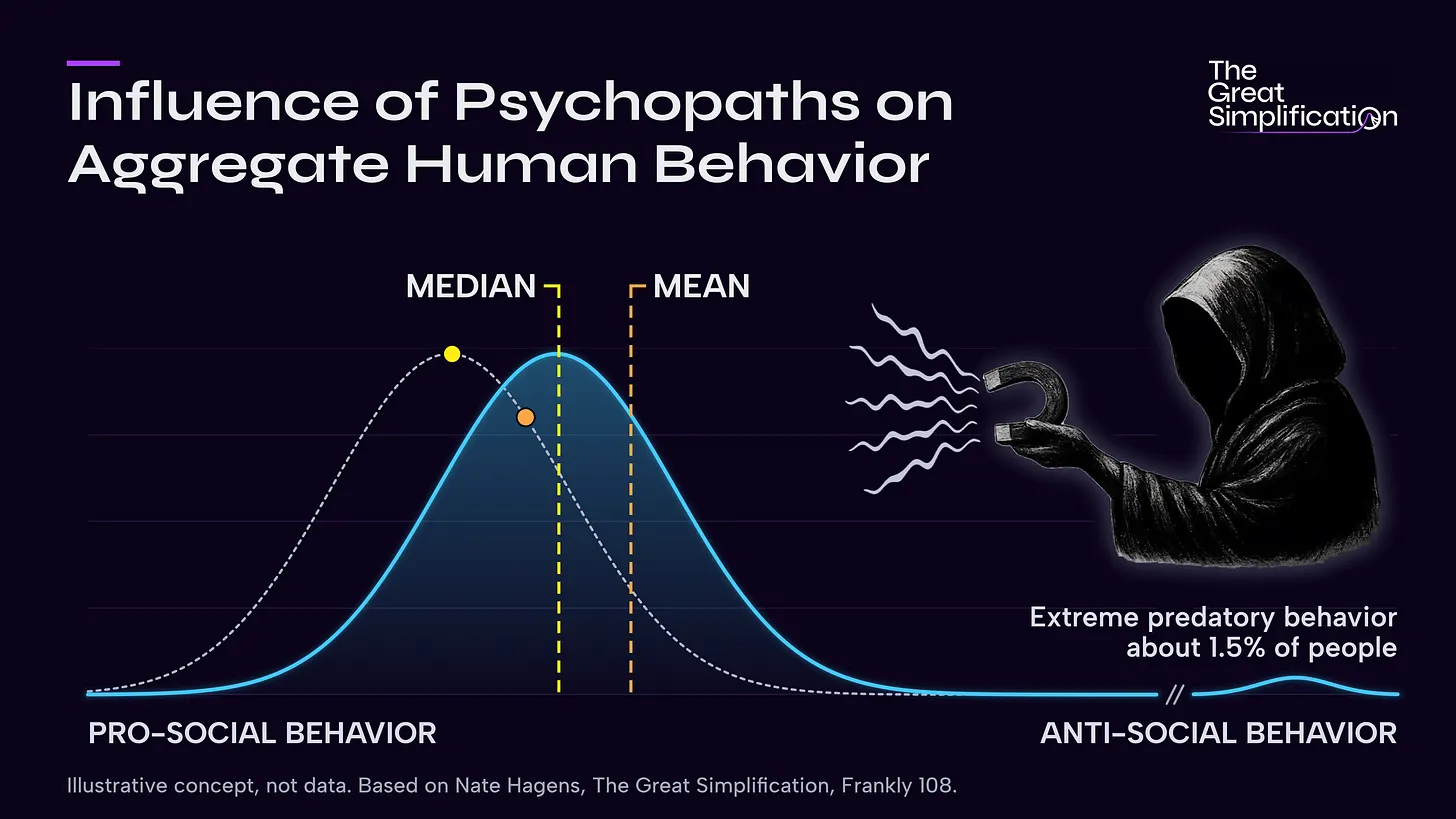
Two things happen when you add psychopaths to a healthy group of humans:
the average behavioral traits shift as outcomes becomes more antisocial due
to the psychopaths' influence, which causes decent people to adapt to new
conditions with fewer contributions and less trust.
Illustration provided by the author. Click on the image to enlarge.
So when you add a persistent predator to a healthy group of humans, two things happen: The average behavioral traits shift because outcomes are pulled by the tail. Then the median/midpoint slides toward less pro-social behavior because decent people adapt to new conditions with less trust, more guarding, and fewer contributions.
This is happening now, all around us.
The Behaviors of the Tail
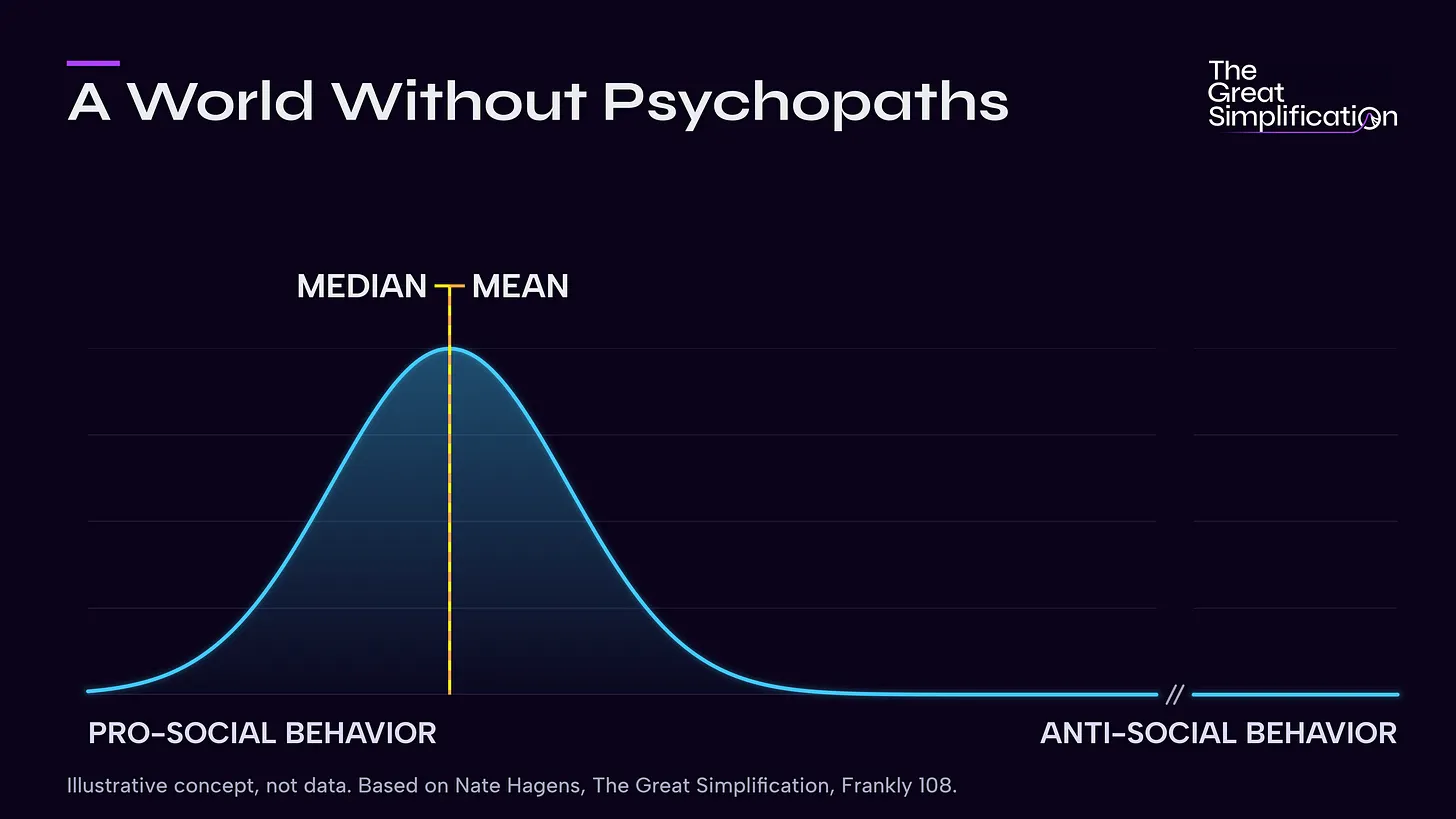
In large numbers, humans tend to form a distribution that clusters more toward the
prosocial side. Illustration provided by the author. Click on the image to enlarge.
Humans are not angels, nor are we devils. But in large numbers, our personalities and traits form a distribution, and most people cluster around reciprocity and fairness within it. Last night, I was driving home and forgot I had my brights on, and someone flashed their own brights at me. I will never know who that person was. This interaction is an example of these shared social agreements, showing that we generally trust and are kind to other people. But there’s a thin tail of psychopaths within our modern population, because predatory expertise was once an asset within our evolutionary bottleneck. Some evolutionary theories suggest that traits associated with psychopathy, such as low empathy, fearlessness, and aggression, may have offered advantages – for example, intimidating rivals, exploiting others for resources, or pursuing short-term mating opportunities. In small populations, this tendency was managed. Now, as the population has exploded, there remains this thin tail of our modern population that is comfortable with deception, less empathetic, and ruthlessly reward-seeking – but our ability to keep them in check is significantly handicapped. This small group has had an enormous impact on our structures, incentives, and social organization. The good news is that our baseline as human individuals is better than our current cultural headlines might suggest. The norm for most people is still reciprocity. I was in Helsinki a few years ago, and I left my wallet (which had several hundred dollars, plus my passport and credit cards in it) at a chicken sandwich shop in a giant mall full of people. Someone from that restaurant tracked me down in the shopping mall and got it back to me. I think about that a lot when it comes to reflecting on humanity and our cultural patterns. We are still prosocial humans – who coach youth sports teams, help clean up after storms, and turn our brights off when we see a car coming. The median behavioral traits of humanity have not vanished; they’ve just been outcompeted by structures that amplify the behaviors of the tail. The discovery of fossil energy has produced a global economic Superorganism with ultrasocial hierarchies, short time horizons, and a hunger for status. We now have a large number of humans who store surplus food, and one percent of us are clinical psychopaths with low empathy and dark triad traits. If even a small minority behave as psychopaths, selection and amplification give them outsized influence at key chokepoints in our social systems, including finance, media, politics, security, and large tech platforms (because moral, emotional, and novel content spreads faster there). We’re beginning to learn how falsehood outruns truth, and how small numbers of manipulators can enormously tilt public narratives and policy agendas away from the median human’s prosocial values. What this ends up looking like over time is… something like today’s world. A small percentage of psychopaths in a modern world of porous and open borders, where behavior, money, and technology can diffuse, ends up shifting both the median and mean behavior away from the values most of us really hold. Human behavioral traits did not change overnight, or even over centuries. The context did: scale, energy surplus, and speed of iterations shifted what has been selected for and amplified. So what should we do about all this? I don’t have all the answers. But awareness of this dynamic is the first step. I think non-psychopaths perceive a fuller picture of reality, because psychopaths miss most things that require emotional empathy, kindness, and collaborative care. A psychopath’s closest relationships will often turn transactional. At best, they understand love as an important part of the transaction, but at worst, they see it as a weakness. In my opinion, this is the Achilles’ heel of psychopaths and provides an opening for some sort of prosocial future to emerge. One caveat I have added since I first made this argument: empathy is a sense organ, and it only gives us an advantage when we can see what the bad actors are doing. If we lose visibility, we lose this sense. If non-psychopaths who are engaged in the more-than-human predicament truly understand this, maybe it will open up new possibilities for how we think about the future.
Pull the Mean Back Toward Decency
When I first recorded this, I left responses for another episode. That episode became Turning the Dials Back on Psychopathy, and the brief suggestions below were the seeds of it. We’re not going to remove the predatory psychopaths in our society. That’s adaptive – it’s pretty much part of who we are. What we can do is turn the dials back, one at a time, so that the median can pull the mean back toward decency.I would love to hear your thoughts on how we might do that, as I’m learning myself and pulling away the layers of the Superorganism onion. Here are a few of my brief suggestions: Shorten the feedback loops and raise the costs of lying. Fast, proportionate, and very public consequences for deception in industries like finance, media, and governance. Among other things, this would require audit trails, transparent rules, and arrangements that support truth-seeking and the median human’s values. Select at the right level. Design institutions that reward team-level performance and long-horizon stewardship as opposed to individual quarterly wins. We start valuing the best cage of hens as opposed to the best individual hens. Reframe status. We can’t remove status drives from who we are, because they’re part of our evolutionary heritage. We can point the drives at traits that are in service of life and resilience. We can celebrate people who maintain systems, teach skills, reduce fragility, and have prosocial demeanors. Humans are always going to chase status, so we need to change cultural ideals toward ones that our civilization and the biosphere need. Increase transparency. We need to reduce opacity in the highest-impact areas, because invisibility to the public is an invitation to predators. The plumbing of the banking system, algorithms on our social media platforms, and critical infrastructure risks have to be more visible, so that psychopathic and dark triad strategies are less effective. Build coalitions of sanity. This might look like local transpartisan groups that practice reciprocity, sharing of skills, and defending common resources. This is maintenance of our best human habitat and our own mental health. It means asking ourselves, “What is the human version of more eggs per cage?” Watch who writes the rules. Concentrated wealth can buy the rules of the game, and that is the escape hatch for every other dial. At the local level, the rules are still written by whoever shows up, so show up: school boards, town councils, co-op boards, watershed districts.
I started out as a peak oil guy, and now I’m talking about psychopathy and chickens. But I keep delving deeper and deeper into what’s driving us as humans, what’s happening in our system, and how we might find some pathways that are better than the default. There is a huge difference between who we are as individuals and how our aggregate culture expresses itself in the world. It may seem like where we’ve landed was inevitable. Maybe it was, maybe not. But being aware of this and integrating it into our model of reality, in my opinion, is a necessary first step toward more benign futures. Perhaps the most important question isn’t who we are as humans. Maybe it’s a question of who we are today as humans, in 2026, doing what we’re doing and knowing what we know. Thanks for reading my initial reflections and thesis regarding the psychopathic economic Superorganism.
ABOUT THE AUTHOR
Nate Hagens is the Co-founder and Director of The Institute for the Study of Energy and Our Future (ISEOF). Formerly in the finance industry at Lehman Brothers and Salomon Brothers, since 2003 Nate has shifted his focus to understanding the interrelationships between energy, environment, and finance and the implication this synthesis has for human futures. Allied with leading ecologists, energy experts, politicians, and systems thinkers, ISEOF assembles roadmaps for understanding how human societies might adapt to lower-throughput lifestyles. Nate also moderates the podcast The Great Simplification, on "illuminating the path for future generations, navigating uncertainty through understanding. and building a resilient future together."
|
|Back to Title|
LINK TO THE CURRENT ISSUE
LINK TO THE HOME PAGE
|
|
|
|
"What's past is prologue."
William Shakespeare (1564-1616)
|
|
Page 21
|
|
|