I’ve recently been thinking a lot about
psychopathy and its influence on both modern human culture and the biosphere. Greg Elliott recently joined me on the podcast for a deep dive on his Psychopathic Selection Hypothesis (PSH), and last year Reid Meloy and Nancy McWilliams came on to discuss dark triad traits in modern society. Following that episode, I created a Frankly on why humans are better than we think – basically pointing out that 99% of us are generally prosocial and kind, but we live in a system that selects for and rewards predatory behavior.Greg’s episode merged unexpectedly with my logic of a metabolic Superorganism in that he likened our economic system itself to psychopathic expressions – though he used the term “instrumental” as opposed to “psychopathic” with respect to institutions and behaviors. So once again, this week’s content serves as a follow-up to share my thoughts and integrations of Greg’s episode and thesis. Let’s get started.
A Quick Game Theory Primer
We haven’t really covered game theory on this platform thoroughly, so I want to give a quick primer for anyone who missed Greg’s episode.
A game at its simplest is made up of players, choices, and payoffs. We can look at our everyday lives in this framework: each day we face interactions with other people, and we have to make choices on what to do within those interactions. A “strategy” is a way of playing the game. The core idea from Greg’s framework on game theory is that which strategy wins or loses is mostly not decided by the players of the game but rather by the rules of the game … even though the players usually get rewarded or blamed for it. This central claim is a theory of evolution before it’s a theory of psychopathy. You take the same humans, you change the conditions of the game, and suddenly different strategies start to win.
Greg points out seven conditions that held true during our crucible years, but have since been flipped “the other way” by scale, energy surplus, and abstraction. He uses a term from math and physics, “boundary conditions,” to refer to the settings of a system that decide what can happen inside it. Today, I want to parse these boundary conditions into seven dials.
The short version of everything Greg and I talked about is basically this: for 300,000 years, cheating didn’t pay, but in today’s economic system, it does. Seven dials were flipped in our system, and I’ll go through them one at a time. At the end we’ll explore some uncomfortable questions together.
Dial One: Will I See You Again?
The first dial has to do with repeated interactions.
Picture two restaurants: a mom-and-pop diner in a small town and a flashy restaurant on a busy highway. Same business, probably similar kinds of humans working in the kitchen, but the key difference between them is that the people working at the diner will likely see their customers again in the near future. The place on the interstate highway typically never sees the same customer twice. Which restaurant do you think would get away with continually serving an average meal at a high price?
The small-town diner – which honestly probably has better food with lower prices – doesn’t have better or worse people involved. It’s just playing a different game. So what the first dial asks is:
“Will I see you again?”
In ancestral times, the answer was, “Yes, I’ll see you later today for dinner...” Or when we hunt, when we care for each other’s children, when we play practical jokes, when we huddle around the campfire tonight and tell stories. Every tribal interaction was one move in a lifelong game that had thousands of moves. The strategy of tit for tat only works when there is a next round of interaction, because only then might the person you helped reciprocate. But what if the dial turned off the repeated iteration setting, and you know you’ll probably never see that person again?
Fast forward to today and the dial has turned more toward isolated, one-off interactions. Our economic system rarely has consistent repeated interactions. Most of what we do in our normal daily lives, at least in the Global North, is with people we might never see again: the customer service representative, the internet form we fill out, and the like.
Greg told the story of his broker years, and I lived a similar story in the Chicago currency pits. My job was to extract the maximum spread from a client I would probably never meet, and I was taught the questions to ask in order to figure out how much I could get away with. On the podcast with Greg I blurted out, “They’re teaching psychopathy!” But now I see that they were really just teaching the game. Simply put, the strategies that manipulate and take advantage of others in round one never get punished in round two…because there is no round two. The psychopathic instrumental strategy never fails and it costs less and less.
From the wide-boundary perspective of the Great Simplification, cheap energy is largely responsible for this dial being flipped, because cheap energy gives us a social reputational mulligan – it’s been the get-out-of-jail-free card. If you burn your relationships, you just fly somewhere else and start over. In the tribal setting, the next round of interactions was guaranteed by close physical proximity. Now the way our life repeats is mostly a function of how cheap it is to leave – and leaving has been very cheap on the upslope of the Carbon Pulse.
So how do we turn this dial back? In the episode, Greg mentioned moving toward smaller, more tightly coupled communities, like cooperatives, where you have repeated interactions with the same people. I would add spending your money where people know your name – the local mechanic and farmer – as opposed to those platforms or corporations built for one-off strangers. Another good place to start is by joining things that require regular attendance: a league or institution based around repeated, scheduled meetings. Lastly, I would suggest staying put on purpose. Put down your roots where you already are and deepen them.
Dial Two: Can Everyone See What I Did?
The second dial is all about visibility.
Do you remember the one-way mirrors in interrogation rooms on police drama shows? Someone’s watching from the other side, but you can’t see them when you look at the window; you can only see your reflection. In today’s world, it’s worth asking which side of that mirror we live on. So dial two asks:“Can everyone see what I did?”
Back in our tribal setting, when we lived with 50 to 150 people and there were fewer walls, if you hoarded something, someone noticed. If you lollygagged on a hunt, someone saw it. Reputation mattered and was visible – doing good for the tribe increased your status, and causing harm led to consequences.
Today, the Carbon Pulse has not only brought social interaction mulligans, but also extremes of visibility and invisibility. The system sees everything about you: your purchases, your location, your internet searches, and even how long you hesitated over something before you clicked to buy it. But the people and entities that move things like our rent and our savings often operate through shell companies, fancy structures, and closed-door meetings with people that, for the most part, we can never know the names of.
There are rare occasions in our system when someone forces visibility, and it becomes a huge deal. Greg mentioned the Panama Papers, which I think is a good example. The system reacts like the body rejecting a splinter, but it’s often the person who blew the whistle who ends up being punished.
So in effect, individuals and social groups can’t punish what they can’t see … and the current game makes it hard for us to actually see bad actors.
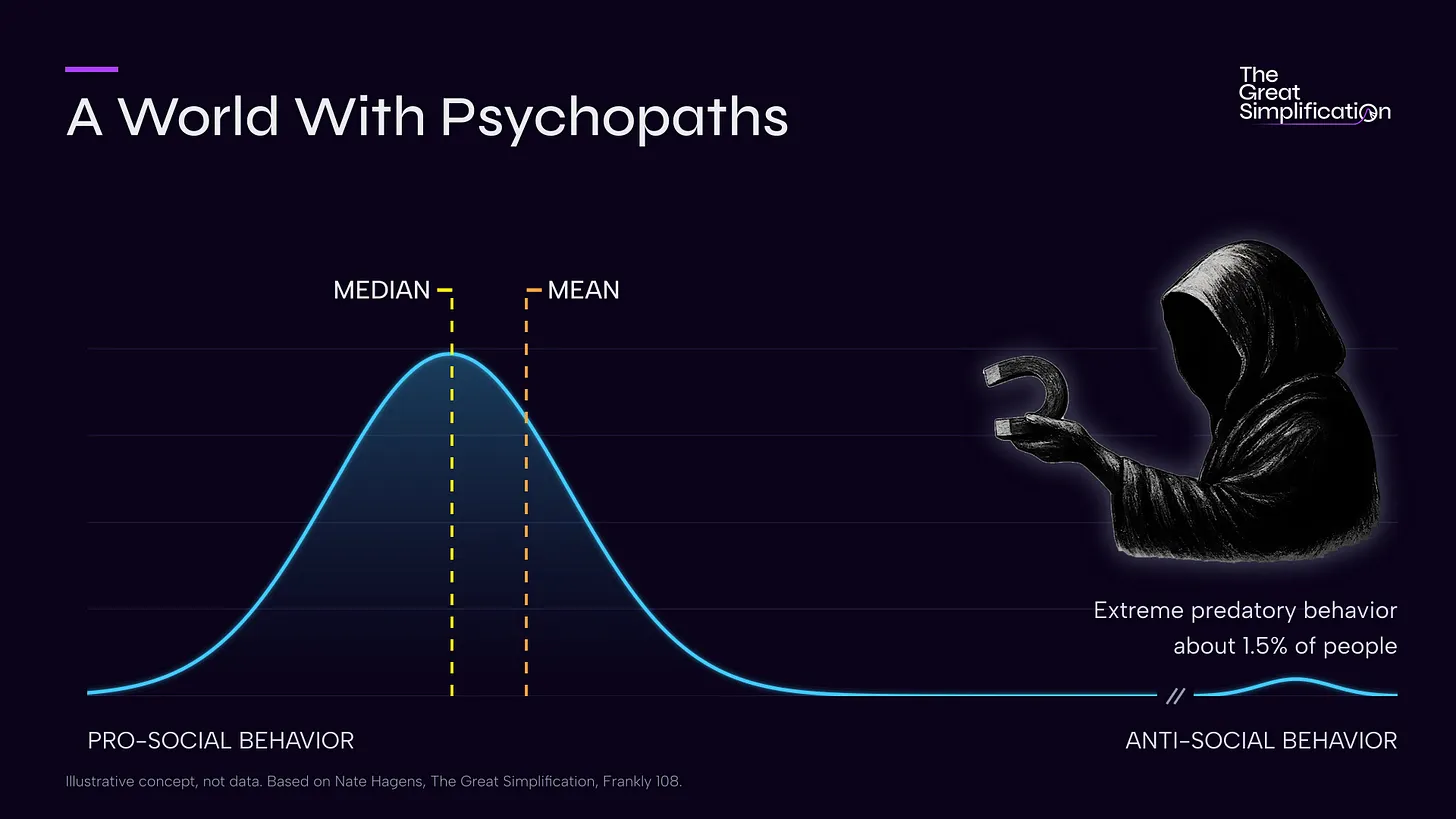
Illustration provided by the author. Click on the image to enlarge.
To use the “humans and humanity” language from The Influence of Psychopaths Frankly, the “extreme tail” among us is safe in our society because the median human can’t find them, let alone identify them. In that Frankly, I said that non-psychopaths have an advantage because empathy operates as a sense organ that lets us see more of reality. When the visibility dial is turned on, we can no longer see the psychopaths in our society and lose this advantage.So how do we turn this dial back? Greg’s primary remedy was to increase transparency and attribution at the level of elites, which I think is a grand idea. But that direction – more transparency at the top rather than more surveillance of everyone else – is the exact opposite of current trends. Which is probably also true for most of the recommendations on this list. So fund and support people that are forcing visibility upward – investigative journalists and whistleblowers and the like. Fully open the books in anything you run, whether it’s a nonprofit, a co-op, or a budget for a town. Transparency can start in the institutions that you are already a part of and grow outwards from there.
Dial Three: Does the Harm Have a Name?
Okay, the third dial. I want you to imagine you come back to your car in a parking lot, and there’s a dent in the door that wasn’t there before. There are two versions of this scenario. In version one, there’s a note under your wiper with a name, a phone number, and an apology with an acknowledgement of responsibility. In version two, there’s no note. This second version conjures a completely different feeling than the first one, right? So dial three asks:
“Does the harm have a name on it?”
Back in the plains of Africa, if you took my food, I knew the names and faces of all the suspects that could have done it. If we were attacked, there were only so many neighboring tribes or animals that it could be. Today this strong attribution is hard to find, as it’s now filtered through technology, hierarchy, bureaucracy, and the internet. Our lifestyles in the Global North might feel comfortable, but the convoluted six-continent supply chain means that we don’t really understand the human lives thousands of miles away that are affected by that same comfort. We don’t know which river was poisoned by which corporation, and we don’t know who mined the cobalt that’s in the phone we use daily.
Corporations that externalize all the harms in our world outcompete the companies that include the externalities. So those costs are still absorbed by the atmosphere, by communities, and by unborn generations. The harm hasn’t disappeared, but the name responsible for it has. And harm that doesn’t have attribution ends up costing nothing to the people doing the harm.
So how do we crank this dial back? Related to the last suggestions, we try to shrink the world from which we buy and consume. Food with a farmer’s name on it means there’s someone on the other side taking responsibility for it at a local scale. Structurally and systemically you can implement true cost accounting, which I worked on twenty years ago at the Gund Institute for Ecological Economics. Full cost pricing is really technically impossible inside the current system, but I think repricing is coming anyway, as physics is going to do it for us. So we might as well strive to get closer to incorporating the true cost of inputs.
Dial Four: When Does the Bill Arrive?
The fourth dial has to do with delay. Let’s think back to the restaurants I outlined in the beginning, and imagine that the bill doesn’t arrive for fifty years after you’re finished eating. It actually ends up arriving at your grandchildren’s table instead of yours. Dial four is asking:“When does the bill arrive?”
If you slacked off on a hunt back in hunter-gatherer times while your companions worked hard for gazelle tenderloins, you wouldn’t eat that night. Probably no romp in the bushes for you either. But in today’s world, the immediate feedback that our ancestors experienced has morphed into a system with significant delays in the consequences of one’s actions, as real costs are diffused across geography, social bodies, and future generations. On top of that, debt allows us to access and utilize resources earlier. I’ll have a lot to say on debt in the near future, so stay tuned.
The thing is, we do everything without realizing or feeling that there will be less in the future. So complex climate systems mean the effects of our waste on the biosphere won’t fully hit for decades or centuries. Ultimately, a bill that arrives late enough ends up arriving to somebody else. When feedback is delayed like this, it’s an equation for disaster: short time horizons, plus a hunger for status, plus low empathy all become extremely adaptive. We’re seeing this in real time.
I’ve talked about steep discount rates within individuals and society for 20 years, which describe how much value we place on the present versus the future. This fourth dial dictates how steep we can allow those rates to get, and our current system values now above all. The future cost isn’t considered. And it feels like this is actually accelerating.
So how do we dial this one back? This dial is actually different from the others, as it will gradually turn back on its own. As followers of this platform are aware, those bills that we mailed to the future – the carbon, the debt, the depleted aquifers, the inequality – are all starting to arrive now.
So my advice, and the advice Greg shared on our episode, is to shorten feedback loops in your own life. Measure the things you depend on – soil, local relationships, energy, water – because these bills are coming either way. You might as well know what’s in them. A boring recommendation, I know. But on this dial and on many of the others, boring is kind of the point.
Dial Five: Do We Need Each Other?
Okay, dial five. The topic of this one is mutual dependence.
A hundred years ago, where I live, farmers couldn’t harvest alone. Entire neighborhoods would share a single threshing machine, and it moved from farm to farm. Their grain got harvested because the neighbors showed up, and the neighbors’ got harvested because they showed up. Eventually, cheap diesel at scale brought every farm its own combine and machinery, and nobody needed anybody else. So dial five:
“Do we need each other in both directions?”
In ancestral times, the answer to this was unequivocally yes. Pretty much nobody in the tribe was replaceable. The hunter needed the gatherer, who needed the healer, who needed the person that knew where the water would be in a dry year, and they all needed the shaman and the storyteller. Dependence ran in all directions.
Today, for the vast majority of us, dependence runs one way. We need the job, but the job doesn’t need us. Greg gave an example of the man who’d worked for 25 years at a company but was laid off, even though his wife got cancer, he had two kids, a mortgage, and car payments. There are many stories like this. None of them enter the calculus of the Superorganism, because on the spreadsheet, he’s a headcount. If eliminating his position improves the number, they’re going to do that. Greg used the word “entrapment” for this, which is where one side’s dependency continues to increase and its strategy space shrinks. It makes leaving the relationship, the economic situation, the job, or the circumstance seem more costly than staying. This is quite a microcosm of our current global economy.
Fossil hydrocarbon energy slaves made humans replaceable. When we have a system like ours today, where we’re approaching 20 terawatts and machines do most of the work, the leverage of any one human starts to approach zero. The tribe needed you because there were limited people and survival depended on the unit – on everyone contributing. The Superorganism doesn’t need you or me because there’s a machine and a queue of people behind us, and soon there will probably be armies of robots and cognitive slaves in the form of large language models. (I found the recent footage from the Chinese robotics testing where a robot beat Usain Bolt’s 100m world record to be quite scary.)
So how do we dial this one back? If entrapment is defined by what you believe you can’t afford to lose, then simplify first: beat the rush by lowering your own exit costs, creating more slack and less debt. Learn skills that are going to become needed by your community, where you live. Create increasingly more mutual aid and more structures that help it last. This might look like tool libraries or makerspaces or child care co-ops or time banks. Find out where you can decouple your survival and ability to thrive from the approval of any single institution.
Dial Six: Can Anyone Buy the Rules?
The sixth dial is about the rules of the game, and who has to play by them.
If you grew up like I did, you probably played driveway basketball or soccer with the neighbor kid who owned the ball. Somehow, he was also always the one who called the fouls. As kids, we didn’t feel like we could overrule him, because the argument would end with the ball going home with him. In applying this to the world today, I picture the driveway to be like the economy. Dial six asks:
“Can anyone buy the rules?”
Before the Agricultural Revolution, no one could own the rules. Nobody could store enough food or arm enough people to own the game. Anthropological research shows things like ridicule, ostracism, coalitionary punishment, and in the extreme case, execution. So rough equality of force was the guarantee more than any shared value was.
One of the biggest learnings for me in Greg’s podcast was that, in tribal systems, it was extremely difficult to rewrite the rules. But in what he calls “today’s symbolic systems,” winners of the game – those who are able to accumulate large sums of money and the power that’s associated with it – do have the ability to rewrite the rules or upend the game board. As we are seeing today, at sufficient concentration, the chips begin buying pieces of the game board itself. You can acquire your competitors, you can own the entire vertical and horizontal supply chain and all the infrastructure. You can purchase information and data, you can influence regulation, and you can survive symbolic losses that would bankrupt any individual, non-psychopathic human.
The winners write the rules, and then the rules eventually protect the winners. There’s been a lot of media on this in the last few years that I’ve kind of hand-waved away, but now I’m interested in learning about it, because the ancient punishment capacity that we evolved with is completely gone. You can’t banish someone who owns the entire town.
Notice the importance of dial six. Every suggestion on how to dial down the others I’ve outlined is, in the end, a rule that somebody would have to write and enforce. So dial six is kind of the escape hatch for all the others. But right now, I’m increasingly seeing this dial as locked from the other side. I have two thoughts related to this. First is that nobody at any level of wealth can rewrite the laws of thermodynamics or ecology. Those are rule books that chips cannot buy, and they are soon going to be asserting themselves for everyone. Second, I want to mention something called “punisher fatigue,” which is where the “sheriffs” doing social policing burn out. After hearing Greg, I realized that punisher fatigue doesn’t happen because of any lack of nerve or constitution for going after the people rewriting the rules. It happens because the sheriffs don’t own the jail anymore.
So, how do we dial this one down? The scope at this dial unfortunately moves beyond us as individuals because no amount of shopping differently or not using so-and-so product changes who writes the rules. So this dial is locked, and presents a central obstacle in the unfolding more-than-human predicament.
What’s left to do still matters a great deal, though. Showing up to the school board, the town council, or your co-op meeting is going to matter more, not less, as big institutions consolidate. Because small boards are some of the only places left where you can be in the room where the rules are being written. These are the places where we can start to rebuild the old tribal safeguards back into the bylaws through things like term limits, rotating leadership, checking back on decisions to make sure things are working as they should, and caps on how much power any one person can hold.
This isn’t a new concept to our society. I learned recently that as elites fought over the scraps of the Western Roman Empire, the commons re-emerged in small pockets called monasteries where small boards, co-ops, written rules, elected leadership, and purposefully created mutual dependence carried cultural things like literacy, agriculture, and beer-making through what was a global 500-year contraction. There are other historical examples of this elsewhere.
Dial Seven: Is the Number Real?
Okay, dial seven. Have you ever driven a vehicle that had a broken gas gauge? The needle says you have half a tank, but it said the same thing a few days ago. The needle is not the gasoline – you can tap on the glass to move the needle closer to full, but that doesn’t put any more gas in the tank. So dial seven asks:
“Is the number a fair proxy for the thing?”
Back in the day of our ancestors, fitness was measured directly in their daily lives. You hunted, found food, defended yourself, and solved problems together with the tribe. Daily life was 100% real. Today, our survival is routed through symbols. There are so many abstractions like markets, GDP, legal systems, algorithms, and other human-created game boards between our actions, behaviors, fitness (a.k.a. our well-being), and life experience.
This was one of Greg’s main points. We live in an era where symbolic fitness is increasingly decoupled from actual fitness. The number moves differently than the thing it was meant to represent – actually often in the opposite direction of what it was meant to represent. We see this paradoxical example everywhere: GDP spikes after a storm destroys a coastal community, or fishery profits go up as they harvest the last cod. The numbers that measure success in our culture are disconnected from the physical reality and long-term consequences beneath. But our institutions and jobs are all shaped around making these symbolic numbers go up, and so all these functions and processes eventually harden into accounting principles and legal frameworks. So in 2026, the symbol is no longer a tool. It has now become the game board itself.
We still depend on the material world that our symbolic simulation sits on top of. Money is the symbol, but it’s energy, materials, and Earth’s ecosystems that are ultimately represented underneath. This is the dial that makes the other six possible. You can’t delay a consequence or anonymize damages or make dependence run one way without having some symbol that holds it in place. The symbol is the container: it is the way we write the rules that shape the rest of this story.
How to dial this one down? The hard part to swallow is that eight billion people cannot be fed without these symbols, and we cannot turn it back at scale without massive change and chaos. But there’s important hygiene we can participate in here, which is keeping the symbol as close to the physical reality as we can, at the smaller scales we have access to. So in your own life you could measure something real alongside the money: kilowatt-hours of energy, bushels, or the hours of work it takes to purchase something. You can also do things off the ledger entirely – barter, do favors, plan Saturday potlucks, invest in real reciprocal relationships. Just spend regular time in the ‘real,’ whether you’re growing or fixing or making something.
The Seven Dials Together
That was a lot, so where does this leave us?
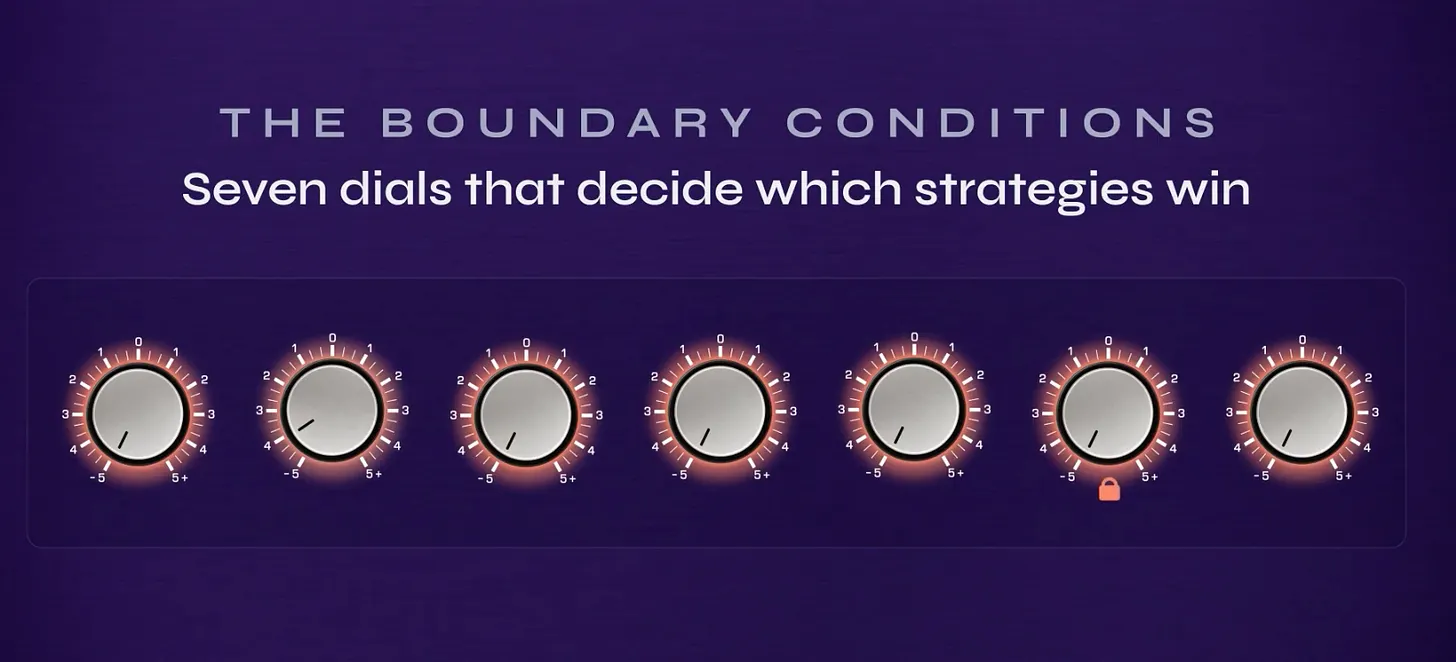
Illustration provided by the author. Click on the image to enlarge.
One of these seven dials being flipped from its ancestral setting would be a pain. Two would make for kind of a bad workplace. But all seven at once, held in place by a locked-up sixth, make for a global economic Superorganism. But at the same time, at the level of your street, town, bioregion, or community, these dials are often still set the tribal way. So many examples: you flash your brights to someone you’ve never met to let them know to turn their headlights on, you return the lost wallet, or you show up with a chicken casserole when someone is struggling. I think a lot of you can instantly recognize these actions as what we think of as “community.” But at the Superorganism scale, every one of those is flipped. That’s why you can feel like a decent person inside an indecent system. Because you are one.
That brings me to some questions that I want to leave you with:
Which of these dials is flipped in your life, in our situation today? And is it one that you could turn back, even partially, by hand?
Are the cooperation and reciprocity in your life of the genuine altruistic kind, or of the entrapped kind?
If the roughly thirty million clinical psychopaths in the world disappeared tomorrow, would any of these dials move?
In game theory, hawks beat doves one-on-one, while groups of doves beat groups of hawks. The coordination required between groups of doves has been switched off in our society at scale. Does the Great Simplification switch it back on? Or do we have to?
Can the good guys ever win? And if you come to believe the answer is no, can you still be a good person anyway? And if the answer to that is yes, why?
I learned a lot from this conversation with Greg Elliott, and I think it really helps explain the software of the Superorganism. Part of my theory of change is hoping the global Great Simplification community, who increasingly understands this stuff, is going to come up with emergent responses to all this where they live.
Much more to say on this – I hope it was helpful. I’m continuing to roll these ideas and questions around in my head.
By the same author:
The Human Predicament: What Would Change My Mind?
The Real Work: Four Things We Can't Afford to Get Wrong
ABOUT THE AUTHOR
Nate Hagens is the Co-founder and Director of The Institute for the Study of Energy and Our Future (ISEOF). Formerly in the finance industry at Lehman Brothers and Salomon Brothers, since 2003 Nate has shifted his focus to understanding the interrelationships between energy, environment, and finance and the implication this synthesis has for human futures. Allied with leading ecologists, energy experts, politicians, and systems thinkers, ISEOF assembles roadmaps for understanding how human societies might adapt to lower-throughput lifestyles. Nate also moderates the podcast The Great Simplification, on "illuminating the path for future generations, navigating uncertainty through understanding. and building a resilient future together."
|
|Back to Title|
LINK TO THE CURRENT ISSUE
LINK TO THE HOME PAGE