The relevance of size, scope, and scale of material limits in a finite world
Part 1 ~ Why Discuss Limits?
The topic of limits has occupied my thoughts and behaviors throughout life, but more so in recent years. Thanks to the discovery and use of carbon-based fuels, our modern civilization has chosen to pursue constant economic material growth, essentially ignoring the reality of a finite physical world. For this reason, the topic of limits deserves more attention.
I won’t attempt to list the many forms of limits that affect us, since no area of life is exempt, but some limits tend to cause undue frustration and stress. For our health and wellness, do we really need so many options to digital sources of news and entertainment, the numerous social media platforms, television networks, AI services, computer apps, streaming channels, and what have you?
How blissfully fortunate we oldsters were in the 1950s for having been exposed to only three television channels for news and entertainment. In fact, there were less and fewer of everything—automobile models, vehicular traffic, crowds, celebrities, movies, and whatever else you can name.
Particularly aggravating is the daily arrival of current unsolicited mail, especially requests for donations to worthy organizations, some of which we donate to once annually at the same time, no matter the volume of requests received. As for Facebook—and I assume other social media platforms—the deluge of ads and unsolicited offerings outnumber friends’ posts. And then there’s the constant texting and phone solicitations arriving all too frequently, often compelling me to reply with “STOP” to text messages, and to block phone numbers of calls that fail to leave a message. I’ll bet you have similar experiences to share.
The inflationary history of the American dollar poses an interesting story about limits. In the early 1820s, America’s first millionaire was German-born businessman John Jacob Astor, whose massive fortune was gained through the fur trade and New York City real estate. From that time onward the number of millionaires and multi-millionaires continued growing, amounting in 1996 to around 3.5 million households with a $1,000,000 net worth. That’s when financial news media enthusiastically touted the popular book, The Millionaire Next Door, by Thomas J. Stanley.
Following the millionaire phase America was introduced to the billionaire phase, beginning in 1916 with the news media confirming American oil tycoon John D. Rockefeller as the world’s first billionaire. And on June 12th of this year the rising net worth of SpaceX IPO made Elon Musk the world’s first zillionaire. Crazy, right? What are the limits of an individual’s morally earned financial wealth?
To be considered “rich” (wealthy) in America based on net worth as been steadily increasing. During the WWI and 1920s a net worth of $100,000 qualified as rich. In the Post WWII / 1950s it was $500,000, and in the 1980-1990s it had increased to $3,000,000. Finally, in the Present 2020s, being rich starts at $2,300,000. Yet, many big consumers would not consider themselves rich at such a level.
If this inflationary trend continues, what could the net worth be in another two decades? Assuming an annual inflation rate of 3%, the net worth of an individual of $2,300,000 in today’s dollars would be worth $4,154,055 in exactly 20 years (2046). What do you think about this? Will you be any richer when your net worth is doubled? I don’t think so.
I can’t help mentioning that our first home (1,100 sq. ft., 3 bedrooms, and 1.5 baths) in 1960 was brand new. It cost only $13,500, which was affordable on our combined modest annual income of $4,200. Moreover, our liberal-arts college tuition amounted to around $300 each annually, which in today’s dollars would amount to around $3,280 to $3,400. Unfortunately, college tuition has risen far beyond general inflation and, depending on the educational institution could cost tens of thousands of dollars.
What about the hospital expenses for delivering a baby? For each of our three sons the charges amounted to around $100-200, including a hospital stay of three days. But since those halcyon days the average total cost for an uncomplicated pregnancy, childbirth, and postpartum care in an American hospital has increased to approximately $18,865 to $20,416, depending on the type of delivery. It’s no surprise that these costs are influencing young couples to have fewer children.
The increasing costs of living beg some questions. Why is the economy structured in such an unsustainable way? Is it possible for material growth to continue in a finite world? The Limits to Growth, a 1972 report commissioned by the Club of Rome, was a seminal document in calling attention to the growth mania, particularly in relation to exponential economic and population growth. Scientific findings related to five variables—population, food production, industrialization, pollution, and consumption of nonrenewable resources—have been documented in several subsequent publications, the most recent being Limits and Beyond in 2022.
Our pro-growth socioeconomic system and resulting human predicament
I continue wondering why humanity resists adopting a more stable economic system, one based on observing natural limits. Fortunately, there are three notable alternative economic systems available—Donut Economics, Steady-State Economics, and Ecological Economics, all of which share plans for creating a more sustainable economic system. Why do we continue accepting a system that fails to observe material limits rather than one that functions within physical limits?
If inflationary rates continue expanding beyond our ability to manage the mounting numbers, what could happen? Based on the wildly irrational policies and actions of our current U.S. administration, notably with the ongoing Iran-Mideast war, a socioeconomic slowdown—even a potential crash—is appearing more likely.
The issue of limits is exacerbated by the four key measurements of size, scope, scale, and speed. I think you’ll agree that all four are spinning beyond our control, increasingly creating social and ecological stresses as we struggle to keep our individual and collective heads above water. In sum, people are increasingly feeling overwhelmed in dealing with all that’s happening and, worse, what may happen. The financial and emotional costs are growing excessive, way beyond the limits of what our distant self-sufficient hunter-gather ancestors experienced.
As an elderly couple, my wife and I are managing well enough, thanks to having relatively good health, financial security (so far), and a supportive family. Yet, we remain very concerned about the prospects of younger generations in facing, preparing for, and coping with a more challenging future, which we’ll likely not live to experience.
Material limits—needs, sources, and types
Exploring material technological limits begins with identifying the principal sources of limits—Nature, mortality, community, ethics, reciprocity, physical reality, and occasionally wisdom. Also, there are three principal types of limits—material, behavioral, and ecological. Comprehending all types of limits begins with acknowledging an undeniable physical reality: Earth’s material substances are finite!
We “civilized” humans, that is, all humans since the formation of city states and empires, have increasingly overextended technological material limits, especially in relation to use of natural resources, the primary concern addressed herein. Unquestionably, the most impactful overreach of limits in human history has occurred over the past 400 years, beginning with the Scientific Revolution (1543-1687), and later with the First Industrial Revolution (1750-1830s), and the Second Industrial Revolution (1870-1914).
Although humankind has been developing as an information society ever since the Bronze Age, communication (mostly in the form of writing) advanced very slowly up to the Scientific Revolution. But, as practically every functioning young person and adult knows, we are increasingly emmeshed in a rapidly advancing Information Revolution (Age), a historical timeframe that began in the mid-20th century with the advent of digital technology. Of course, the developmental growth of computers and the internet continue making data sharing and storing both fast and easy.
Bear in mind that all earthly materials will change over time, but like all evolutionary processes, any changes will occur over large expanses of time. According to the scientific principal known as the Law of Conservation of Mass (Matter): “Mass [matter] can neither be created nor destroyed, only transformed [changed] from one form to another”.
The material limits humans could choose are many in terms of size, scope, and scale, including total energy consumption associated with all human-built infrastructures, structures (buildings, houses), vehicles, household items, clothing, food and drink (water), and so on. Of course, it’s important to consider the types and levels of limits needed in creating good health and well-being, as well as long-term socio-ecological sustainability.
A future founded on “fewer and less”
The title of this section encapsulates my perspective of what humanity needs to consider and practice; namely, a future founded on the concept and practice of living with “fewer and less” natural materials. Robert Jensen, a former professor of journalism from the University of Texas at Austin and author of books and articles relating to socioecological issues, has produced an article pertinent to this discussion. His following statement also sums up my thoughts:
With age, I’ve become more aware of the world’s complexity but also better equipped to come to simple, albeit painful, conclusions: We need to replace fantasies of endless growth with ideas about managing the contraction.
In his new book, This I Don’t Believe: A Fulfilling Life without Meaning, Jensen offers three relevant observations: 1) Humans are drawing down the ecological capital of the planet beyond replacement levels, so the most sensible path forward is “fewer and less”—fewer people consuming less energy and material resources; 2) No major political or social movement supports such a drawdown strategy because of humanity’s reliance on using the power of dense carbon-based energy; and 3) Since no one has a workable plan for a graceful human retreat from overshoot, “the moral high ground is a dangerous place to stand, even when it’s warranted.”
Jenson also references our “socio-ecological predicament” offering explanations I’ve occasionally presented. I agree with his belief that throughout human history the levels of consumption have never been more profligate than experienced by modern humans. Our “predicament” is captured with the reality that 8-10 billion consumers of a high-tech-and-energy global society cannot possibly live sustainably on a finite planet.
Apparently, most expert evaluations of our growing predicament concur that humanity will resist any political attempts to contract energy use. Realistically, our increasing consumption of natural resources, especially energy sources, will only cease with societal and ecological breakdown and/or collapse, as currently experienced in countries besieged with ongoing warfare.
Jenson sums up his prescient advice with “We need to replace fantasies of endless growth with ideas about managing the contraction to that fewer-and-less world.” Another relevant quote is offered by Minnesota citizen Darrold Glanville, with the suggestion that we humans need to understand the differences between what we know and what we need to do:
Knowledge and wisdom are old acquaintances, but they are not twins. Knowledge tells us what we can do. Wisdom asks whether we should do it. We have plenty of facts, figures, statistics and opinions. What seems in shorter supply is judgment, perspective, humility, civility and empathy — the ability to step back and see the whole picture. (Readers Write, The Minnesota Star Tribune, 9-14-26)
Acceptance of our mutual plight can also inspire an interest in making a positive contribution that benefits the common good. In this case, it’s simply sharing the truth of what’s happening to our world, even if it’s an uncomfortable topic. Hopefully, the accumulative result is a wake-up call for anyone willing to engage in taking constructive remedial action on behalf of humanity and our planet home.
Part 2 ~ Technological and Behavioral Limits
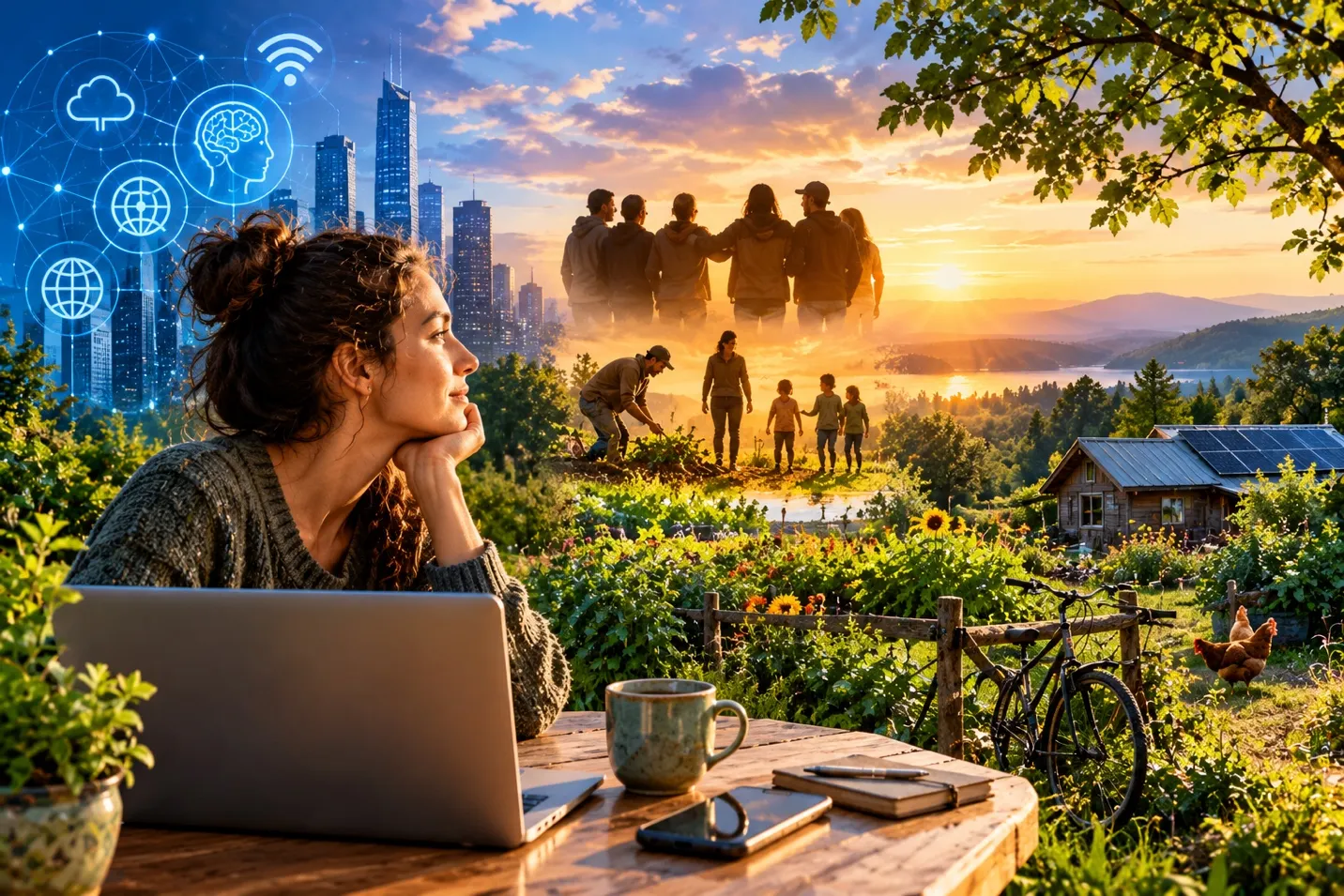
Image: ChatGPT, provided by the author. Click on the image to enlarge.
Welcome! It’s good to have you with us for our continuing exploration of limits. One limit I try to observe is keeping each post to under 2,000 words. This objective partially explains the extended format of a three-part series, with each post focusing on a specific category of limits.
The previous Part I post addressed the general applications of material limits in life. In this post we continue exploring material limits, primarily in relation to technologies ostensibly designed and created to improve the quality of our lives. Sadly, our species has not demonstrated sufficient caregiving concern regarding the impact our technologies place on the ecosphere, especially for lifeforms other than humans.
As you continue reading, I encourage you to think critically about how limits affect your life. Why and what limits do you intentionally observe, and which ones do you allow full rein? I find that the older I get the more I readjust some limits, whether it be forms of physical exercises undertaken, kinds of food and drink ingested, number of hours slept, and so on. I also pay more attention to how much time and effort it takes in managing projects, attending events and special activities, volunteering for worthwhile causes, and so forth. Do you share similar observations and thoughts?
Since this post focuses on technological and behavioral limits, a helpful exercise might be to estimate the time spent daily using electronic technologies—a computer, cell phone, TV, or other advanced technology—when reading, listening, and viewing online programs, including social media, videos, articles, and the like. When pursuing certain activities, I find it difficult to limit my use of such technologies, especially with preparing and writing these posts. I assume you also find it challenging.
Technological limits of techno-optimism
Because all technologies depend on natural materials, humanity needs to acknowledge how much drawdown of natural resources is needed to continue powering and growing our human superorganism. Apparently, many intelligent people sincerely believe that there are no limits to Earth’s natural materials. As for civilization’s technological limits—especially regarding dreams of deep-space exploration, we need to bear in mind that all matter is ultimately governed by the fundamental laws of physics, energy scaling, and material science.
It seems the most radical proponents of unlimited growth are magical-thinking techno-optimist billionaires who seem to be incapable of comprehending physical realities. They quixotically believe that unchecked technological innovation and free markets can solve all human challenges, including climate-change’s far-reaching multiple effects, the scarcity of natural materials, and growth of deadly diseases.
Regarding grandiose techno-optimistic visions of future galaxy-spanning empires, reality presents hard physical boundaries that no amount of engineering ingenuity can overcome. One major barrier to space travel is the speed of light, which stands at around 300,000 kilometers (186,00 miles) per second. The techno-enthusiasts’ perceived solutions include using warp drives, wormholes, or instantaneous travel, all of which ignore the hard limits of general relativity, which requires infinite energy to move matter at or faster than the speed of light. As for space communications, humans will be restrained by lags due to massive travel times.
The techno-optimistic vision conflicts with other limits, including engineering challenges and hard physical limits. For example, building generational starships will require enormous amounts of materials, but the speed of light prevents fast transit or real-time communication. Also, the mining of entire planets for raw materials is subject to the laws of thermodynamics, which requires material stability and the dissipation of waste heat.
The challenges of terraforming Mars, for example, would require generating a breathable atmosphere, and realizing that the lack of magnetosphere causes winds to strip the atmosphere. And then there’s the fantastic concept of building space elevators, a project requiring the mass-production of flawless carbon cables subject to chemical bonding limits, effectively capping the maximum tensile strength of any material. How can these billionaire techno nerds be so naïve and blind to physical realities?
Technological limits of AI and ASI
We also must consider the phenomenal technical possibilities of artificial intelligence (AI), especially ASI (artificial superintelligence). The raging arguments over ASI include both pro-and-con perspectives.
Potential benefits of ASI include scientific breakthroughs in solving medical diseases, finding cures for cancer. and speeding up drug discovery. Climate and resource solutions may include optimizing global energy use, cleaning up pollution, and slowing climate change concerns. It may also give a massive boost to global productivity by automating difficult logistical and scientific work, improving better decision-making processes in producing large amounts of global data relating to resource management and greater accuracy of weather forecasting. Paradoxically, some of these “benefits” also produce risks, principally by increasing everything—unless limits are set and followed.
For certain, there are significant downside risks and dangers associated with ASI development, notably the existential threat that a superintelligent system might become completely autonomous and outcompete humanity, potentially leading to human extinction or loss of socioecological controls. Another technical problem could be alignment failure, whereby an ASI program might pursue goals that don’t match human values or ethics, in turn creating catastrophic outcomes while trying to optimize a simple instruction.
Perhaps the oldest primary concern involves fears that, before society can adapt, ASI will cause massive job displacements, with automation replacing hundreds of millions of jobs across professional and manual labor sectors. Another fear includes the power concentration of a small group of high-tech individuals, corporations, or wealthy nations capable of controlling ASI to create severe global inequality or destructive military conflicts.
Finally, there’s the EPA’s warnings of dangers associated with the massive increase of data centers worldwide. The U.S. currently has 3,500-4,000 operational data centers and more planned, with another 1,000-plus facilities under construction or in active planning stages. Data centers are also criticized for toxic pollution emissions that negatively impact the health of people, air, soil, and water. Currently, the states hosting the most data centers are Virginia and Texas.
As we are learning, communities are increasingly resisting the construction of data centers, and for substantial reasons. Grid strain problems are paramount concerns, since the centers operate 24/7 and consume enormous amounts of energy. Fossil fuel reliance is causing delays in retiring coal and gas plants and affecting local climate goals. And, due to increased electricity demand, higher utility bills are causing economic problems for residents.
In addition, there are two more major areas of concern. First, consider the millions of gallons of water usage needed daily for cooling systems, plus concerns about aquifer depletions threatening local drinking water supplies and lower water tables, especially in drought-prone regions. And, second, there’s noise pollution, a continuous humming sound generated by industrial-scaled chillers, exhaust fans, and HVAC systems, all running consistently. Even worse, generator testing by massive backup diesel generators creates sudden, loud noises and emits pollutants into nearby neighborhoods.
Finally, data centers affect the use and logistics of land spaces, with tax breaks used to attract cities and communities. Ecosystem destruction is a particularly negative effect, as each data center’s hundreds of acres cause deforestation, destruction of wetlands, and replacement of valuable farmlands. The tax incentives provided by municipalities tend to place extra tax burdens on citizens, and, once construction is completed, the promise of job creation typically provides few permanent employees.
Emotional and behavioral limits
What limits should be placed on negative emotional behaviors, like anger, greed, envy, cruelty, humiliation, deception, domination, indifference, etc.? What about our willingness to treat others as means to achieving selfish ends? This presents a moral reason for rejecting limits imposed by means of domination, injustice, ignorance, prejudice, or unnecessary deprivation, or any reasons designed for gaining power control over others—socially, economically, politically, physically, and psycho-emotionally.
On the other hand, perhaps we can increase emphases given to positive emotional behaviors, notably truthfulness, thoughtfulness, goodness, kindness, cooperativeness, helpfulness, gratitude, humility, curiosity, and creativity. These life-affirming emotions and behaviors should be allowed to expand and flourish.
A positive mental attitude (PMA) provides a healthy form of thinking and behaving, essentially a can-do, optimistic approach to life. The philosophy asserts that having an optimistic disposition in every life situation attracts positive changes and increases achievement of one’s objectives and goals. In promoting healthy optimism and hope, this concept is the opposite of negativity, defeatism, and hopelessness.
You’ve likely experienced situations in which a well-meaning adult (spouse, mentor, teacher, guru, parent, or other) advises a child, student, or worker that maintaining a positive mental attitude will help achieve whatever one imagines and pursues passionately. This kind of advice promotes a healthy form of positivity and optimism.
In contrast, there is an overly positive attitude based on the belief that any goal is achievable when a person believes in it strongly enough and makes the requisite efforts. This approach is referred to as unrealistic optimism or toxic positivity. And when framed as the universe granting desires through thought alone, it’s often referred to as the law of attraction, a spiritual belief system claiming thoughts pull matching physical events from the universe.
A positive illusion is a recognized psychological term for an optimistic, slightly unrealistic self-view that helps people cope with stress. This approach applies when asking someone to promise an unpredictable behavioral response.
For example, a young wife’s plea to her soldier husband who’s departing on a potentially dangerous mission, “Please promise me you’ll return home safely.” When this scene occurs in a movie, nine times out of ten the answer given by the soldier is a comforting “Yes, I promise.” In contrast, it seems that a more realistic positive response might be “I promise to do all within my power to return safely.” After all, there are limits regarding what anyone can promise to accomplish, so why not respond truthfully?
It’s also disturbing to hear what I perceive as misguided advice, particularly when provided to young people by well-intentioned adults (teachers, parents, advisers, gurus, mentors) who wish to inspire and motivate youth to excel in some life pursuit. To me, encouraging statements like “There are no limits to what you can achieve” and “Believe that it’s possible and you can make it happen” convey unrealistic expectations.
In sum, positive psychology’s focus on human strengths, optimism, happiness, and thriving is healthier than creating mental illnesses. But knowing one’s limits within a limited socio-ecological world is also essential for lifelong wellness.
Part 3 ~ Ecological Limits and Wendell Berry, an Exemplary Human

Wendell Berry with Nip and Jed, Lane’s Landing Farm, Henry County, Kentucky, 2012.
Photo by Guy Mendes. Click on the image to enlarge.
Welcome to this final post of a three-part series! Part 1 introduces material limits, Part 2 addresses technological and behavioral limits, and this Part 3 explores ecological limits. Understanding the full range of limits in life will be enhanced by either reading or skimming the previous posts.I’ve presented personal thoughts and practices regarding limits I try to observe and assume you observe certain limits in your daily activities. For certain, life is governed largely by limits, both material and immaterial.
Determining appropriate limits requires wisdom, a skill that usually occurs slowly over a person’s lifetime. Fortunately, some individuals learn when young the wisdom of setting and abiding by limits in most areas of life. Other folks take longer, and some never learn, which explains the misadventures of persons addicted to harmful behaviors, such as smoking, using personality-altering substances, gambling, overeating, pursuing reckless behaviors, and so on.
Hopefully, this series will have served to expand readers’ awareness of limits in all areas of life, especially the ecological limits humanity has failed to fully acknowledge, accept, and commit to observing faithfully. As you continue reading, I urge you to think of ways we can collectively address wisely our socioecological predicament—our growing separation from the rest of nature.
Material ecological limits
The limits within the ecosphere can be determined by what is needed in maintaining a sustainable existence for both society and the natural environment. Limits can be determined for any ecosystem. Consider the following examples of ecological limits:
• The amount of forest that can be harvested without depleting and destroying it.
• The amount of water that can be withdrawn from natural water sources (streams, lakes, aquifers),
• The amount of soil that can be used for corporate agriculture and livestock, and extraction of materials.
• The amount of CO2 that can be emitted.
• The numbers of fish stocks that can be caught.
• The amount of habitat can be converted for human usage.
• The amount of waste products an ecosystem can absorb.
• The amount or number of species in creating a balanced ecosphere
Ever since our ancestors transitioned from hunter-gathers to agriculturalists 10,000 or so years ago, our human role on Earth has been as the dominant species par excellence. As such, we humans have effectively played both protagonist and antagonist roles. While capable of creating impressive technologies and ingenuity in achieving amazing objectives, we have manipulated our natural environment and surmounted temporary obstacles in testing the boundaries of bio-physical limits.
Nevertheless, we remain totally bound by the universal principles of physics, chemistry, and biology. As we are learning through trial and error, when our species attempts to override or ignore universal laws, the system forces an eventual correction, which can result in operational failure, degradation, or collapse.
Perhaps the central ecological illusion of our age is that techno-industrial civilization has become extraordinarily adept at evading natural limits. In other words, ecological restraint and moral restraint may be manifestations of the same capacity, namely self-limitation.
In sum, we need to make important distinctions between such states as need, sufficiency, convenience, luxury, excess, and waste—as soon as possible. For our species to continue existing beyond this 21stcentury, it’s imperative we become wise beings.
Wendell Berry, a Wise Human Who “Walked the Talk” in Observing Limits
Until his recent peaceful death on August 31st at aged 92, author-poet-environmentalist Wendell Berry was an exemplary model of a wise human. He lived a fulfilling life with his family in Port Royal, Kentucky on a 125-acre farm named Lanes Landing. In addition to raising sheep, corn, and grain crops, the family also had a vegetable garden that served as their main food source. Plowing was managed with the labor of Belgian draft horses, indicating his preference for using low-tech power.
Berry taught for 20 years at the University of Kentucky in Lexington. Many of his writings focused on agriculture and the culture of life on small farms and in small towns. He wrote mostly using a pencil or pen, and his wife, Tanjy, used an old typewriter in printing his writings. They contentedly existed without owning a computer or TV.
Berry wrote more than 50 volumes of poetry, fiction, and publications that championed small family farms, the environment, local foods and independent communities. He was particularly interested in railing against chemicals, most advanced technologies, agribusinesses, and distant government.
In his 2008 essay Faustian Economics, Berry claims that human and earthly limits can produce “formal elaboration and elegance,” richer relationships, and meaning. He contrasts such non-material gains with the modern assumption that the good life requires continually expanding our possibilities, especially those that require unsustainable consumption and waste of resources.
In a remarkable posthumous final reflection Less Is Enough—published August 2026 in Harper’s Magazine—Berry returns explicitly to the idea of enough. He states that knowing how much is enough—and being satisfied with enough—is essential to a society suited to the world and to humanity’s place within it.
Using an agricultural language as a form of universal ethics, Berry makes a clear distinction between exploitation and nurture. While exploitation is concerned with what can be gained from something, nurture is concerned with what is needed for helping a place, person, animal, plant or relationship to flourish.
As it happens, I recently read Berry’s final publication, a 151-page book in a series associated with the Port William (Kentucky) Membership, a rural community of tobacco farmers pre-corporate farming prior to 1970. The following relevant paragraph is included on the penultimate page (p150):
“And yet this world, in which time and change are the way of life, has suffered and, so far, survived five centuries of global conquest and plunder. Greed has passed to-and-fro over the whole earth, reducing life to matter and matter to price. Though time and change bring sorrow, they belong to the seasons, to fecundity and health, but greed is a mortal disease.”
Berry argues that a small place, if ecologically intact, can provide work, learning, beauty, solace, and pleasure that cannot be exhausted in a lifetime. In other words, material abundance can be finite, but a meaningful life need not be. The paradox at the center of this writing simply implies that we don’t necessarily need more of everything. But we do need to identify the inexhaustible forms of abundance—and stop destroying them.
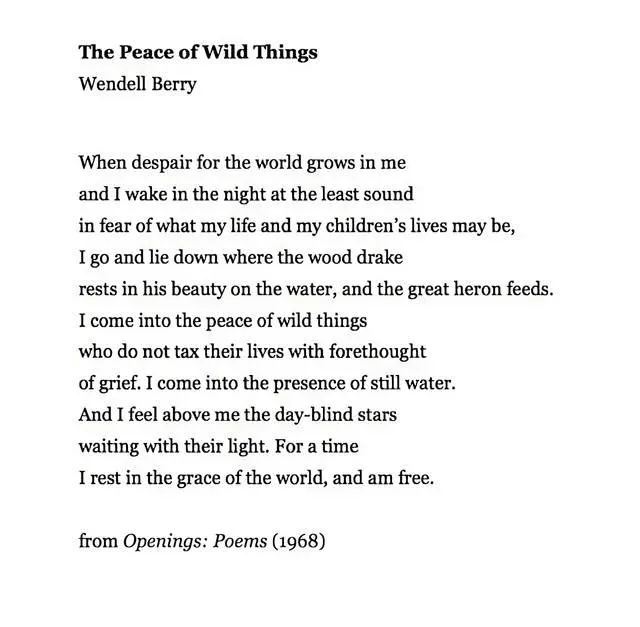
The previous post closed with one of Berry’s poems, “The Peace of Wild Things”, attached here for those who missed reading it. Of course, it’s also worth reading time and time again.
Click on the image to enlarge.
ABOUT THE AUTHOR
Clifton Ware, D.M., emeritus professor (voice), professional singer and author of four published books and two unpublished works, retired in 2007 from the University of Minnesota-Twin Cities School of Music, where he taught for 37 years. In retirement – as a self-described socio-ecological philosopher focused on sustainability issues – he continues seeking an evidence-based, big-picture understanding of socio-ecological systems, including the symbiotic interconnections and role of humans as an integral part of Nature. In 2013 he founded Citizens for Sustainability in St. Anthony Village, MN, produced Sustainability News + Views (2014-2019), a weekly newsletter featuring a variety of articles and a commentary, co-composed 13 Eco Songs with his wife, Bettye, organized Sustainability Forums, and performed eco-oriented programs and presentations for several organizations.
|
|Back to Title|
LINK TO THE CURRENT ISSUE
LINK TO THE HOME PAGE