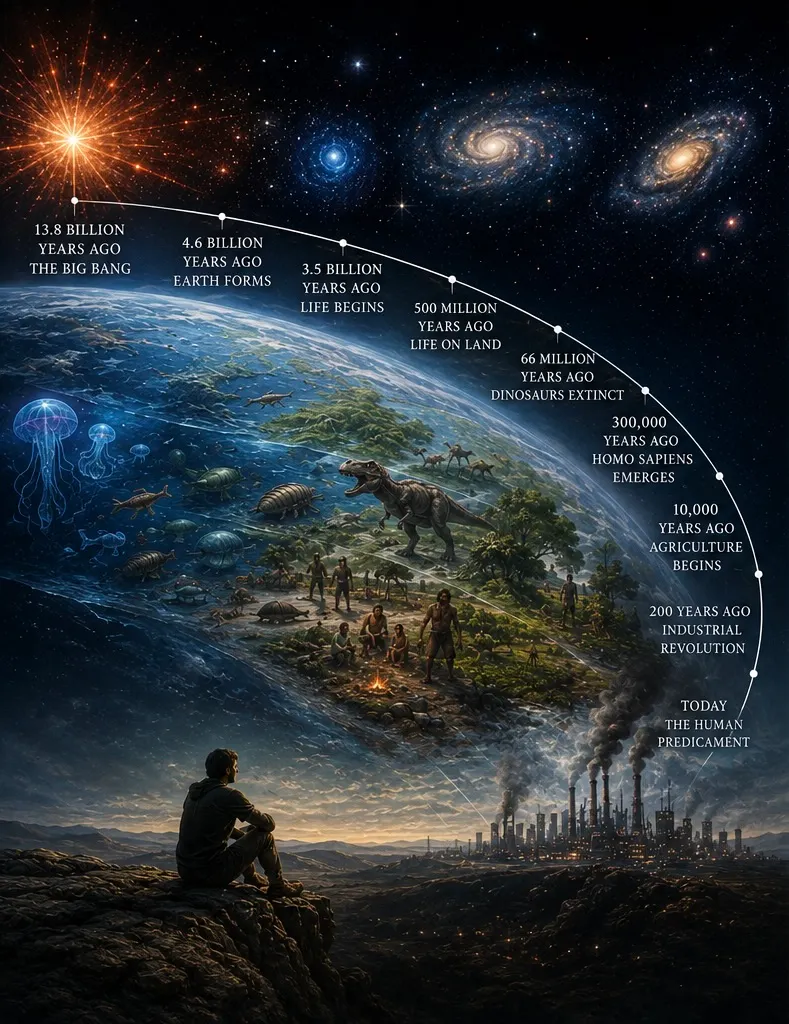
Exploring historical time, from the Big Bang to our present socioecological predicament
Part 1 ~ Evolutionary Origins
Do you wonder what life is all about, its meaning and purpose for our species on Earth—and in the Cosmos? Throughout my eight decades of life, I’ve sought answers to philosophical questions. Although I began undergraduate studies as a music major, I switched to philosophy in my junior year. Following graduation, however, marriage and career developments led me back to music.
As an unmarried couple in college Bettye and I served as the music team of a small Methodist church, she as organist and I as choir director. Continuing as a married couple we served a larger Methodist church for two years, she as organist and children’s choir director, and I as director of youth, the youth choir and adult choir.
For those two years following graduation, with part-time study I completed all requirements for a music major. From that time onward my career centered on teaching and performing vocal music, with Bettye as collaborating pianist/organist. Philosophy was no longer a major focus, but it continued informing my life and work.
Philosophical inquiry, for instance, influenced educational concepts and practices contained in textbooks I wrote about singing and teaching singing. Somewhat predictably, when retiring in 2007 my interests turned largely to philosophical issues, with a focus on societal and ecological relationships, specifically the role of humans within the natural world. The term socioecological philosopher seems appropriate in defining my current life interest.
This self-designation explains my preference for addressing complex issues, including the multiple crises raising grave concerns about societal and ecological degeneration. A series of crises are now thought of as a metacrisis, a multi-systemic breakdown shaped by the sociopolitical views, values, and institutional logics of modern culture that threaten the coherence of global civilization and the integrity of complex living systems.
How to unravel the causes and deleterious effects of the metacrisis is problematic because it’s too complex and complicated to be a problem. Appropriately, it’s referred to as our human predicament, which means there are no valid solutions, only responses needing urgent, constructive action and outcomes that need effective management.
From ongoing observations, it seems an increasing number of people worldwide are experiencing considerable angst about the near and long-term challenges facing humanity and the planet. Since I’ve been emersed in studying all crises for two decades, I’ve gradually developed techniques that seem to work in coping with the deluge of depressing gloom-and-doom news and depressing revelations, at least so far.
The idea of writing about this topic occurred to me in early August. I don’t recall the triggering effect, but whatever it was set my mind pondering the deeper mysteries of life. One “triggering effect” might have been my growing awareness regarding the amount of misplaced psycho-emotional energy we spend confirming our importance as the dominant earthly species. Our anthropocentric hubris seems to be blocking a deeper understanding of life, perhaps related to delusional thoughts and beliefs that produce harmful responses.
In more lucid moments I marvel that we take ourselves so seriously as a species. We seem especially susceptible to harboring morbid concepts about mortality and what happens to us when we die, even concerning what happens with our remains. We also wonder if our time on Earth will be remembered, perhaps even appreciated and honored.
The recent unexpected death of Dolly Parton, a beloved singer, songwriter, actress, businesswoman, and philanthropist, serves to remind us of what really matters in life. Widespread outpourings of sincere affection from both conservatives and progressives attest to Dolly’s status as an exceptional human being, one who lived according to life’s highest human qualities of Truth, Goodness, and Beauty. What an exemplary legacy of a life well lived for all to admire and emulate.
Evolutionary origins preceding the arrival of homo sapiens
Understanding our human predicament requires an understanding of our place within the scheme of universal time and space. As with any deep-thought exploration, the fundamental questions of when, how, where, and why are applicable here. This section offers a brief overview of our human origins on Spaceship Earth.
An earlier post—Deep Time and Our Evolutionary Origins-- addresses this topic, and you might find it worth reading. The rest of this section is an excerpt. Although there are a few theories about what existed before the material universe, the topic remains an ongoing mystery.
Tracing humankind’s pre-formative biophysical origins as a species requires a historical, deep-time perspective, reaching as far back in geological time as 13.8 billion years, with the occurrence of a colossal phenomenon astronomers refer to as the Big Bang. Emerging from an initial state of high density and temperature, the massive explosion sent matter hurling on a constantly expanding trajectory throughout space.
Over billions of years the expanding matter underwent changes that produced trillions of spatial bodies, including unfathomable numbers of stars and planets embedded within gigantic galaxies and planetary (solar) systems. While such vast numbers baffle our human minds, they also inspire awe and wonder, helping us understand and appreciate our tiny, yet unique place in the universal scheme of all that exists.
Around 4.5-billion years ago our treasured sun and planet’s solar system were formed out of gas and dust within our galaxy—the Milky Way. Over the duration of time wholly incomprehensible to us, the Earth was cool enough around 3.7-billion years ago for chemistry and physics to create conditional measures capable of self-replication, a process that allowed the simplest planetary forms of life to evolve.
Next, a simple and fascinating phenomenon developed: a process known as natural selection. In brief, the better-suited a lifeform was within its environment, the more it thrived and became situated in the community of life through the process of evolution. Our present time offers a snapshot of evolution’s progress, especially as evidenced with bacteria, the fastest replicating species. Evolution is an ongoing process, and most of the species on the planet today are simply momentary waypoints along a twisted and intertwined set of tracks.
The reality is that no key species lasts forever, including humans. Based on the accelerating rate of human-generated ecocide, some experts suspect our presence on Earth could be shorter than most people expect.
The evolutionary process that was set in motion 65-million years ago by a catastrophic global event inadvertently provided the long-term conditions for our arrival on planet Earth. Earth’s fifth global extinction, known today as the Cretaceous–Paleogene extinction event, was set in motion when a gigantic asteroid struck near Mexico’s Yucatan peninsula. The catastrophic explosive impact caused widespread destruction and the eventual extinction of most lifeforms, including the mighty dinosaurs.
Ironically, for humankind the catastrophe was a fortunate event. Over a lifespan of 60-million years following the asteroid strike, a drastically altered global biosphere provided appropriate conditions for the gradual evolution of large mammals around 20-million years ago. The evolution of mammals eventually produced our primate ancestors, notably chimpanzees and bonobos, with whom we share 98.8% DNA. (Actually, we share DNA with all lifeforms, including: 94% dogs; 90% cats; 80% cows; and 60% fruit flies and bananas.)
According to most anthropologists, our Genus Homo ancestors evolved over 2-million years ago with upright-walking Homo erectus. Our anatomically modern human ancestors evolved sometime between 200,000 and 300,000 years ago and began dispersing beyond Africa as early as 270,000 years ago. The ultimate survivors of several hominid species were Homo sapiens (wise humans) and a close-kin Neanderthal species that existed alongside humans in Eurasia 40,000 years ago.
We contemporary humans tend to overlook the first 290,000 years of our evolutionary past, an era when our paleolithic stone-age ancestors existed primarily as small bands and tribes of omnivorous hunter-fisher foragers deeply immersed in Nature. Throughout the evolutionary past early humans acquired a set of useful physical traits, particularly bipedalism, long legs, a large brain and body, minimal sexual differences, an omnivorous ability to eat meat and plants, and prolonged maturation periods.
Humanity’s historical timeframe on Earth
In company with similarly oriented individuals, I agree that our socio-ecological predicament is the result of our specie’s separation from the rest of Nature, a separation manifested with the growth of human population and civilizational complexity. As humans transitioned from hunter-gathers, the seeds of separation were planted with the agricultural revolution around 10,000 BCE. With the growth of human settlements and villages, land needed for growing crops and raising livestock replaced wild lands.
The second major separation came around 3,000 BCE, with the rise of cities, societies, and empires like Mesopotamia, China, and Mesoamerica, all of which required social control. Walled cities served to separate the human civilized world inside from the wild natural world outside the walls.
The third and most significant separation arrived with the scientific and industrial revolutions (1600s-1800s), with the discovery of fossil-fuel energy and redefinition of Nature as a mechanism to be dominated. As a result, populations left farming work to labor as managers of machines.
Throughout this great socio-ecological separation, civilization has increasingly relied on the use of taxation, population growth, material consumption, and the hierarchal power of socio-cultural, economic, educational, and political institutions to manage and control society. Religious institutions have been particularly influential in controlling people’s beliefs and behaviors.
For thousands of years the social component of cultural values, political, economic, and educational institutionalized systems have served to degrade ecological systems. It seems obvious to some folks that most of humanity is unknowingly addicted to serving a defective civilizational system illogically dedicated to pursuing constant material growth. Unfortunately, most people assume this is the only viable way for humans to live.
In contrast, a smaller portion of the global population, including some indigenous populations and a small percentage of persons (like me), is convinced that humanity is taking a dangerous path into an unknown, but likely very different future.
Concluding thoughts
As a basis for Part 2, I think sufficient background information has been provided for continuing our deep-time human story. We’ll pick up at our “present time” and continue with considering what may occur in our specie’s near-to-deep-future time. We’ll also consider some positive responses we can make in managing the angst generated by a plethora of negative news and experiences.
Among my go-to socioecological experts, Nate Hagens ranks at the top. I listen to his podcasts and Frankly commentaries, and read his writings. A recent Frankly podcast and subsequent Substack post provide a summary of interconnected crises we humans have perpetrated and must face head on. Listing them helps remind us why we need to take urgent constructive steps NOW, and on every day going forward.
1. Planetary Boundaries: Seven of nine planetary boundaries have been crossed, including: climate change; biosphere integrity (loss of genetic and functional diversity); land system change; freshwater use; biogeochemical flows; novel entities; and ocean acidification (which crossed the threshold recently). The two yet to be crossed are atmospheric aerosol loading (air pollution) and stratospheric ozone depletion.
2. Energy: Cheap, high-grade fossil-fuel sources are depleting, and are manipulated by electronic claims in the form of debt.
3. Wildlife: Populations have fallen seventy-three percent in the past 50 years.
4. Crisis anxieties: Increasingly people, especially young people, are feeling stressed, lonely, or addicted to supernormal stimuli provided by communication technologies.
5. Political and socio-cultural polarities: People are growing more separated and oppositional through tribal signaling contests, with the loudest and most abrasive tribe aiming to dominate the wiser or kinder tribe.
6. Artificial intelligence: The latest technological threat (and/or promise) is making everything happen faster, including risks.
7. Trust of institutions and others: All societal institutions are being questioned, including the media’s messaging. and trust of each other is draining away.
8. Meaning and purpose: Underlying everything is a meaning crisis, with many people intuitively sensing an incompatibility between the current socio-economic-political system’s trajectory, and whether (or not) we should continue participating.
9. Our Predicament: What’s becoming glaringly apparent is the realization we may not be able to solve the metacrisis because it’s a predicament, not a problem.
If this list doesn’t worry you, seek help. Any human who intentionally ignores, denies, or questions such scientific findings is effectively hindering efforts at making the types of changes needed in responding effectively to our collective socioecological predicament.
Although our far-distant ancestors faced severe challenges, they did so while living harmoniously within the natural world. For us modern folk, living in harmony with Nature will require seeking, finding, and doing whatever it takes to live within physical limits. Certainly, we cannot continue living as we are, especially those of us living in developed countries. The only sustainable path forward requires learning how to live peacefully, cooperatively, and collaboratively with all of Earth’s lifeforms and entities.
Please think on these things . . .
Clif (with Bettye Ware, reader/editor/partner)
Part 2 ~ Present Time
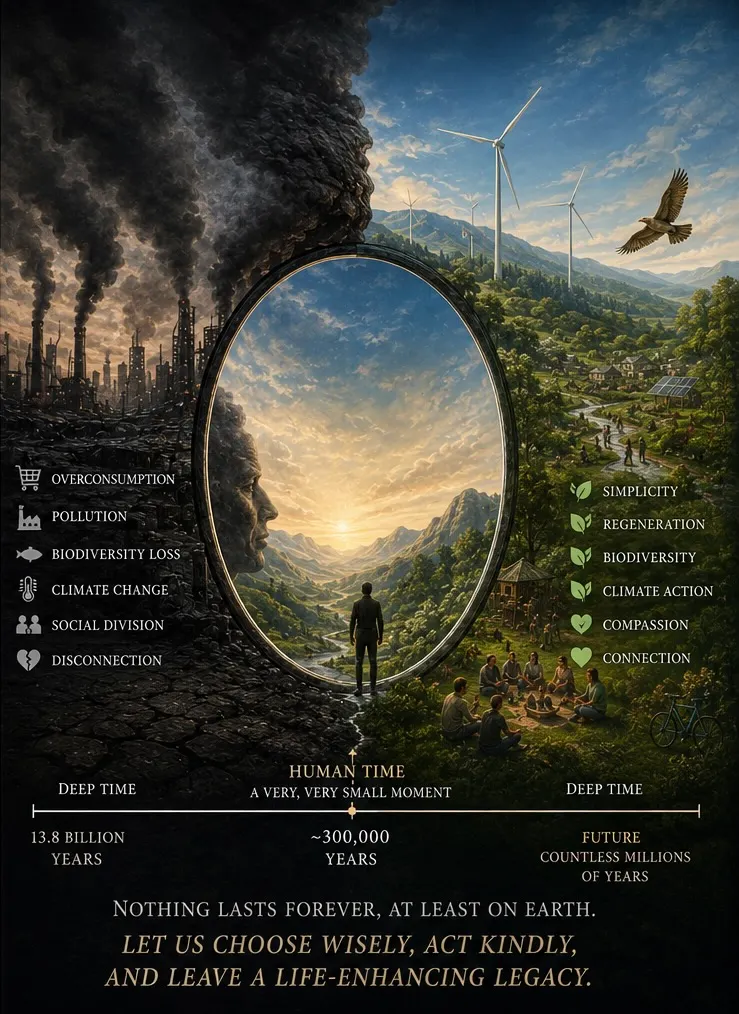
Image: ChatGPT, provided by the author. Click on the image to enlarge.
Welcome back! In the previous post (Part 1) we considered all that happened in the scope of time from the Big Bang to the evolution of our planet and (voila) our species. Time wise, we covered what occurred prior to humanity’s time on Earth up to the scientific and two industrial revolutions that developed within the scope of four centuries, c.1543 to c.1914.
In this Part 2 sequel the story continues, beginning in the early 20th century and continuing to this moving moment in time. In the following section I’ve taken some liberties in defining and explaining what I mean by “present time”, with information borrowed from an earlier post.
Our “present time” explained
When contemplating our human existence at this historical time, I realized that parameters are needed in defining what is meant by “present”, as applied herein. Present time could be discussed within several timeframes—the present epoch, century, decade, year, month, week, day, hour, minute, second, or millisecond. However, in terms of size, scope, and scale in this discussion, I suggest thinking of our present socioecological scenario as involving everything that occurs within a prescribed lifetime frame.
Generally, the phenomenon of time, or the “present moment”, or “now”, may be thought of as a linear-moving point connecting the past with the future and lasting only a few milliseconds, the equivalent of an eyeblink or spontaneous reaction to stimuli. One way of thinking about this is to recall a previous post featuring the integration of opposites, in this case the “present” representing the integration of past and future. Experienced Buddhist practitioners, for instance, claim to experience the phenomenal sensations of time slowing down or speeding up. They describe the past as memories, and the future as hopes, fears, and expectations. Therefore, only the present “now” is real.
For our mutual exploration, however, I suggest thinking of our socioecological system’s “present” in broader terms, in this case a time-period that encompasses all that has happened and is happening within the timeframe of all people alive today. Thus, if we consider that the oldest group of global citizens alive today peaks around 100 years of age, our “existential present” cohort of live humans ranges from post-WWI to the present. Anyone reading this essay after 2026 can simply adjust the 100-year timeframe forward as time progresses.
It so happens that prominent socioecologists consider this designated timeframe as a uniquely anthropocentric paradigm. This human-dominated period is also considered an anomaly in the annals of humanity, which explains why some experts describe modern civilization as a human superorganism.
Also known as the Information Age, this modern historical period has been highly influenced by the development of innovative digital technologies, including artificial intelligence (AI). In sum, it has been a time of unprecedented material growth and, consequently, has produced excessive material consumption and toxic-waste pollution.
Our present time within deep-space time
In terms of deep-space time, existence for us humans—and most existing lifeforms on Earth—can be measured in milliseconds. Consider this: for any conscious future beings existing 10-billion years from now, our existence on planet Earth will likely be either insignificant or unknown. In terms of present human time, however, our existence is extremely distinguished—a special-time bubble. We are deeply embedded in the only worldly existence we know and can imagine. It’s no wonder we struggle in making sense of all we encounter and cope with throughout our lives.
So, our time on Earth means everything to us, including the places, conditions, activities, and events we experience. For us, it’s all that is and presumably will be—forever. We simply cannot imagine humankind not existing. Neither can we fathom the likely prospect that our descendants will ultimately die off, the result of both natural evolutionary forces and our extensive ecological degradation.
On a more positive note, it’s also possible that long-term evolutionary processes might lead to adaptive biological changes enabling humans and many lifeforms to continue surviving in habitable areas for millions of years to come—but not forever. Regarding the future of Earth, scientific findings suggest that our planet is halfway through its life cycle. As our Sun grows brighter and hotter in the next 1 to 2.3 billion years, oceans will evaporate and plant photosynthesis will cease, making our Earth uninhabitable. In another 5 to 7.5 billion years the Sun’s core will run out of hydrogen fuel and expand into a red giant, causing oxygen levels to collapse and complex life to terminate.
If you find this scenario difficult to process, you’re not alone. Throughout my life, when pondering such profound thoughts, my mind seems to abruptly shut down, along with sensations of numbness and emptiness. This freeze-like response appears to be normal when facing a threatening situation from which one cannot fight or flee. For me, the only positive response for shaking off a sensation of “mental blankness” has been resuming life’s normal grounding routines.
In researching this psycho-emotional response, I learned that, when pondering humankind’s ultimate destiny, people commonly respond with existential and cosmic dread, grief, and nihilistic anxiety. Yet, such a profound realization can also inspire positive responses of awe, deep gratitude, and fuller existential awareness of purpose-motivated freedom and deep connections with all that exists.
Existential philosophers explain that, while humans might be able to occasionally view the horizon of cosmic reality, we have evolved as beings structurally prepared to live in life’s immediate foreground. This explanation helps us to better understand why we’re more capable of thinking and acting appropriately when dealing with short-term issues. And it also explains why we struggle when thinking about and managing long-term issues.
The meaning and purpose of human existence
Perhaps the principal concern we all share involves the meaning and purpose of life. For certain, I’ve found it a mystery worth exploring. The consensus of learned scholars across history suggests that life offers purposes we must create, discover, or realize ourselves, individually and collectively.
The main concepts include:
1) Existentialism, the act of seeking, choosing, and creating meaning and purpose, by coping with life’s hardship and accepting absurdity;
2) Virtue ethics, achieved through living a good life (eudaimonia) with courage, honesty, and kindness;
3) Eastern philosophies, like Buddhism’s teaching that clinging to desires causes suffering, and letting go leads to peace, as does Taoism’s teaching of living simply and harmoniously with the universe’s natural flow;
4) Utilitarianism’s concept of increasing happiness and reducing suffering for all living things, and helping society to function well by helping everyone in need;
5) Science, which serves to inform and help us understand that we are made of stardust, reflecting how the universe works, and how seeking knowledge about how the world functions helps our species protect conscious life. (For a deeper overview, refer to this link: Meaning of Life.)
I find some value in each of these views, as they collectively express the need for pursuing a well-balanced, composite philosophy of life. For me, I find the properties and values inherent in the Transcendental Triad: Truth, Goodness, and Beauty address this need. I’ve mentioned these three transcendental qualities in previous posts and may undertake a deeper study in coming months. For most folks, many aspects of life remain a mystery, a normal perspective.
In closing—the best technique for relieving angst
There’s not much more I can offer in addressing this issue at this time. But I can leave you with a technique that can help deal with existential dread, and possibly transition to producing existential integration. Yes, the technique is writing, a skill that continues evolving.
The faster and more complex life becomes, deep-thought writing is diminishing, while short-form messaging and use of AI for writing are increasing, along with shorter attention spans and multitasking. Active engagement in exploring profound concepts through writing can help take the angst out of anxiety. What might feel like a sudden, overwhelming threat can become a more familiar landscape to navigate, as these three explanations indicate:
• First, by turning terrifying brain freezes into structured words, sentences, and paragraphs, writing helps focus brain functioning and make a difficult concept manageable.
• Second, habitually and repeatedly exposing the mind to the reality of deep time and mortality through writing can create a safe space, in turn causing the nervous system to cease reacting negatively and calming down and gradually dissolving angst.
• Third, when accepting the reality of mortality, it’s possible to cease wasting emotional energy worrying about an unchangeable cosmic truth while gaining a profound sense of relief.
So, this is why writing can help anyone face reality more effectively. Journaling—the regular practice of writing down your thoughts, feelings, and daily experiences to process emotions and track personal growth—is highly recommended by many experts. Online searches reveal several good sources, including Journaling for Emotional Wellness, provided by the University of Rochester.
Finally, if you are deeply concerned about what lies ahead you might find it worthwhile to investigate Post-Doom and Deep Adaptation. Both perspectives replace fatalism’s paralyzing effects with the positive acts of meaning, agency, and active resistance.
Please do—and write away!
Clif (and Bettye Ware, reader/editor/partner)
P.S. With the recent death of Wendell Berry, widely extolled author, poet, and environmentalist, the following poem encapsulates the spirit intended with my two-part posts:
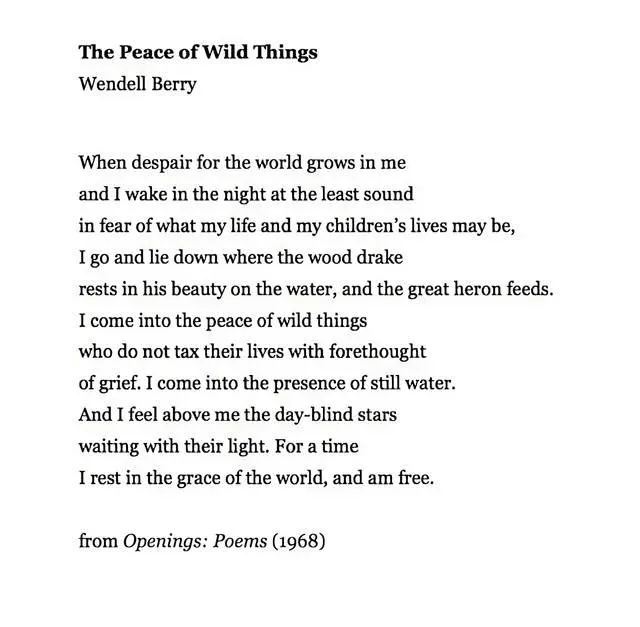
Click on the image to enlarge.
ABOUT THE AUTHOR
Clifton Ware, D.M., emeritus professor (voice), professional singer and author of four published books and two unpublished works, retired in 2007 from the University of Minnesota-Twin Cities School of Music, where he taught for 37 years. In retirement – as a self-described socio-ecological philosopher focused on sustainability issues – he continues seeking an evidence-based, big-picture understanding of socio-ecological systems, including the symbiotic interconnections and role of humans as an integral part of Nature. In 2013 he founded Citizens for Sustainability in St. Anthony Village, MN, produced Sustainability News + Views (2014-2019), a weekly newsletter featuring a variety of articles and a commentary, co-composed 13 Eco Songs with his wife, Bettye, organized Sustainability Forums, and performed eco-oriented programs and presentations for several organizations.
|
|Back to Title|
LINK TO THE CURRENT ISSUE
LINK TO THE HOME PAGE