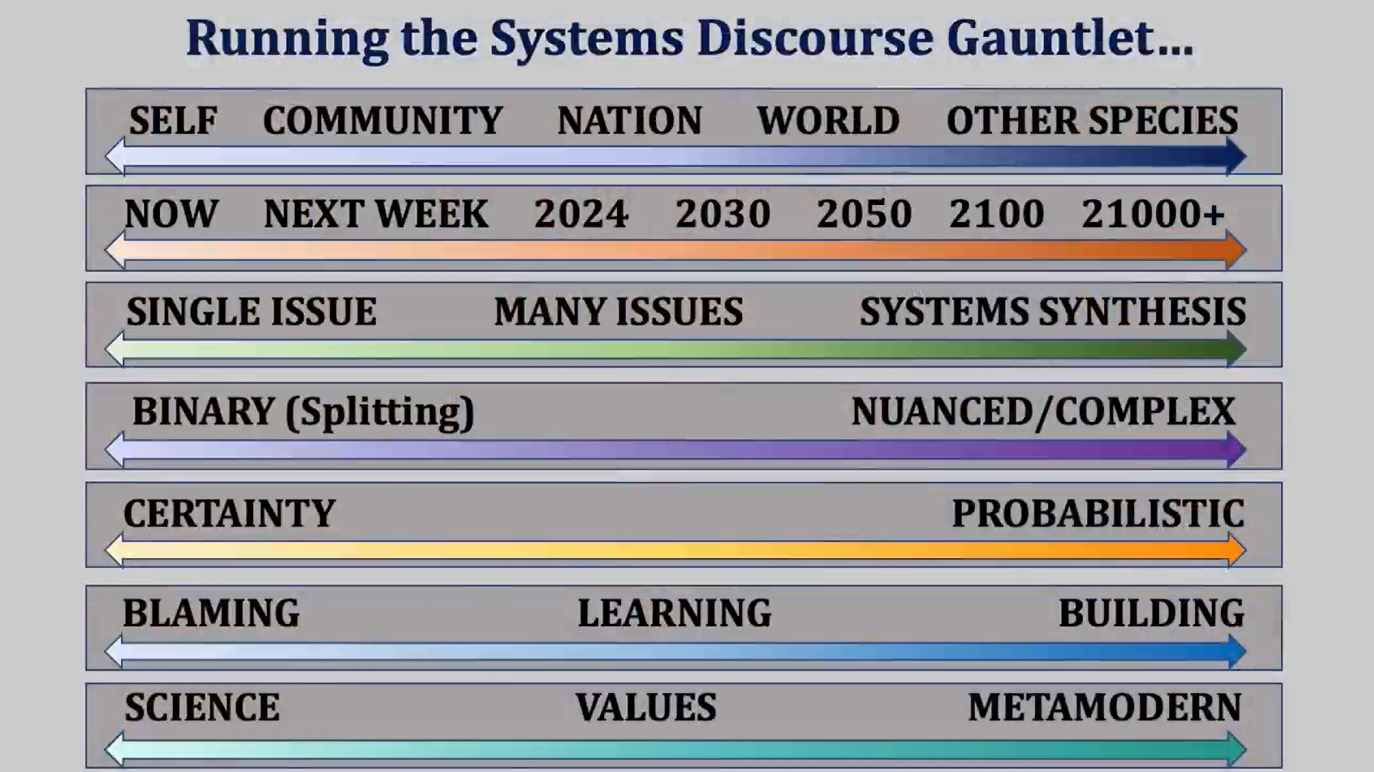
Greetings. I have a Frankly series planned that I want to release soon called “How Could I Be Wrong,” in which I plan to steelman all the core pieces of logic that comprise the thesis of The Great Simplification. But before that, there is a prequel that feels worth exploring: why all kinds of smart, thoughtful people point to vastly different issues as “the” fundamental crisis of our time.A while back, I did a Frankly on the mental filters that shape how information and facts get processed on the way in, including what we care about, our time horizons, and whether we think in binaries or in nuance. Today, I’d like to build on that and reflect on the explanations and worldviews themselves: the lenses that provide eight different answers to the question, “What is actually happening in the world right now, and why?”
All of these lenses are held by intelligent and sincere people who are looking at the same planet and socioeconomic system, yet coming to radically different conclusions. Of course, I also hold one of these as my primary lens, and it’s the last one. But rather than lining up seven strawmen and knocking them down one by one, I will answer the following two questions: “What is wrong with the world?” and “What would fix it?” from the perspective of people holding each of these lenses in hopes of better understanding their logic.
Let’s get started, beginning with the ones I hear most often in mainstream conversations and moving down to the less common lenses.
The Political Lens
Through this first lens, the world is coming apart because the wrong people are running it. In domestic terms, that means the “other” party (whichever one that is for you) is governing for its powerful donors rather than average citizens, hollowing out our institutions. On the world stage, this lens points toward the disintegration of the arrangement that has mostly held up since 1945, and towards its replacement: big, powerful countries doing whatever they want.
There’s a lot of truth here. Those who hold power get to make decisions that shape people’s everyday lives in big and small ways: who gets tariffed, who gets bombed, whose land floods first, or who gets a seawall.
“The other side screwed this up. We can vote our way back.”
The fix, through this lens, is to organize, turn out, take the majority, appoint judges, pass laws, and generally “win.” On the international side, the responses are to deter, arm up, make alliances, and rebuild the geopolitical arrangement. Through this lens, we face a solvable problem, and there’s always another election to fix it, which is part of why this perspective is appealing.
The Religious Lens
The second lens is the oldest one on this list, and the one held by the largest number of human beings alive: religion. I point this out because a lot of the discourse on this platform is really only happening inside a handful of wealthy secular countries.

The Laudato si' is the second encyclical of Pope Francis, wherein he calls on all people of the world to take "swift and unified global action" regarding global warming and environmental degradation. Click on the image to enlarge.
|
This lens comes in two flavors, and they point in very different directions. The first is stewardship: creation is a gift, dominion was always meant as responsibility rather than a license, and humanity has broken a trust. This version includes things like Laudato si’, the creation care evangelicals, and khalifa in Islam. In every one of these traditions, there are people who have been advocating for stewardship far longer than the environmental movement has even existed.
“It was given to us, and we were told to keep it, but we didn’t.”
This flavor’s fix is repentance and stewardship, which might sound abstract and soft until we look a little deeper. Every one of these spiritual traditions already contains voluntary restraint as a working practice: the Sabbath, Lent, Ramadan, asceticism, tithing, the whole idea of “enough.” These are thousand-year-old, functioning technologies for getting very large numbers of people to purposely consume less … which is exactly what degrowth advocates are trying to invent from scratch. Even jubilee is periodic debt forgiveness written directly into scripture. If you want to convince a few billion people to be happy with less, it’s probably smart to start with the traditions we already have.
The second religious flavor is harder for me to speak to, but I’ll try to do it justice. This flavor tells us that history has an author, that this story – our story – was always going to end, and that the entire project of engineering our way out of limits and mortality sits at the crossroads of arrogance and futility.
“You’re all very frightened. I’m not. This was always going to end, and it was never ours to save.”
This is the most action-suppressing belief on this list, but it remains difficult to dismiss because it offers a practical answer to despair. If you actually believe history has an author, then calm is a coherent response rather than a head in the sand. In my experience, many of the people in this camp seem steadier than most of those in mine.
The Class Lens
The class lens is held by an enormous, growing number of people who might not even use the word “class.” Through this lens, the economic machine works just fine, but it’s stopped working for “me.”
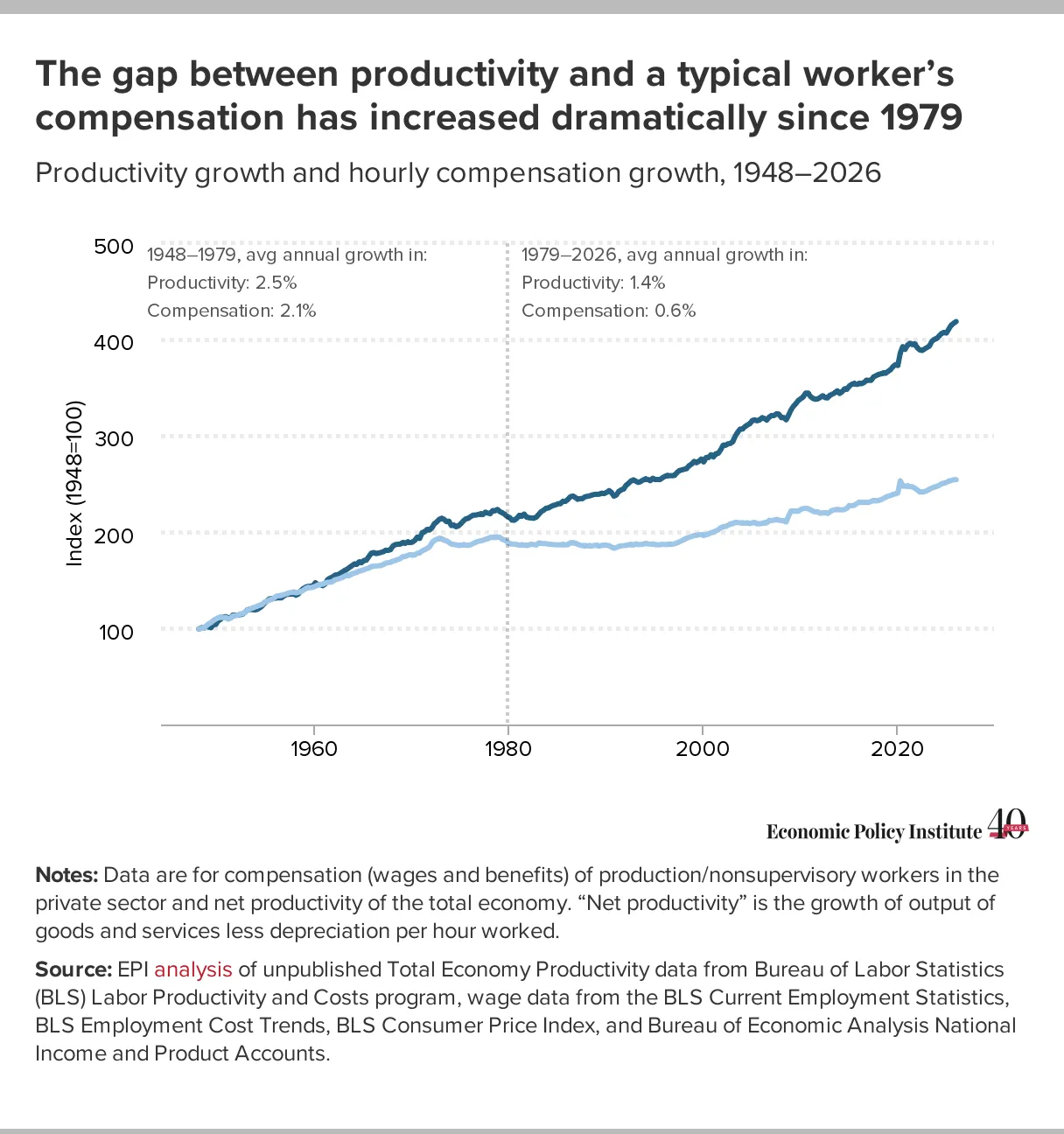
In the United States, productivity and wages tracked each other closely until the early 1970s, at which point they decoupled and have never gone back. A house that used to cost three times the median income now costs five times. The bottom half of American households own about two or three percent of the wealth. When somebody in that position is told that we all need to consume less, what they hear is that a bill is arriving from the people who are spending the most. Yet nobody in power is suggesting that the belt tightening should start at the top.
“I’m not confused about where the money went. In fact, I watched it go.”
The answer for people with this lens is redistribution. If we can’t “eat the rich,” then we can tax them, break up the concentration, get money out of politics, and rebuild the institutions that made the last century work for ordinary people. Physics isn’t a part of this story, because the abundance is right in front of our faces: parked in the marina and in the plane hangar. If we just go get it and bring it back down, it’ll be available to everyone.
The Technology Lens
The next lens has to do with technology. There are a lot of smart, well-meaning people who hold this view, and they have a track record the rest of us tend to skip past.
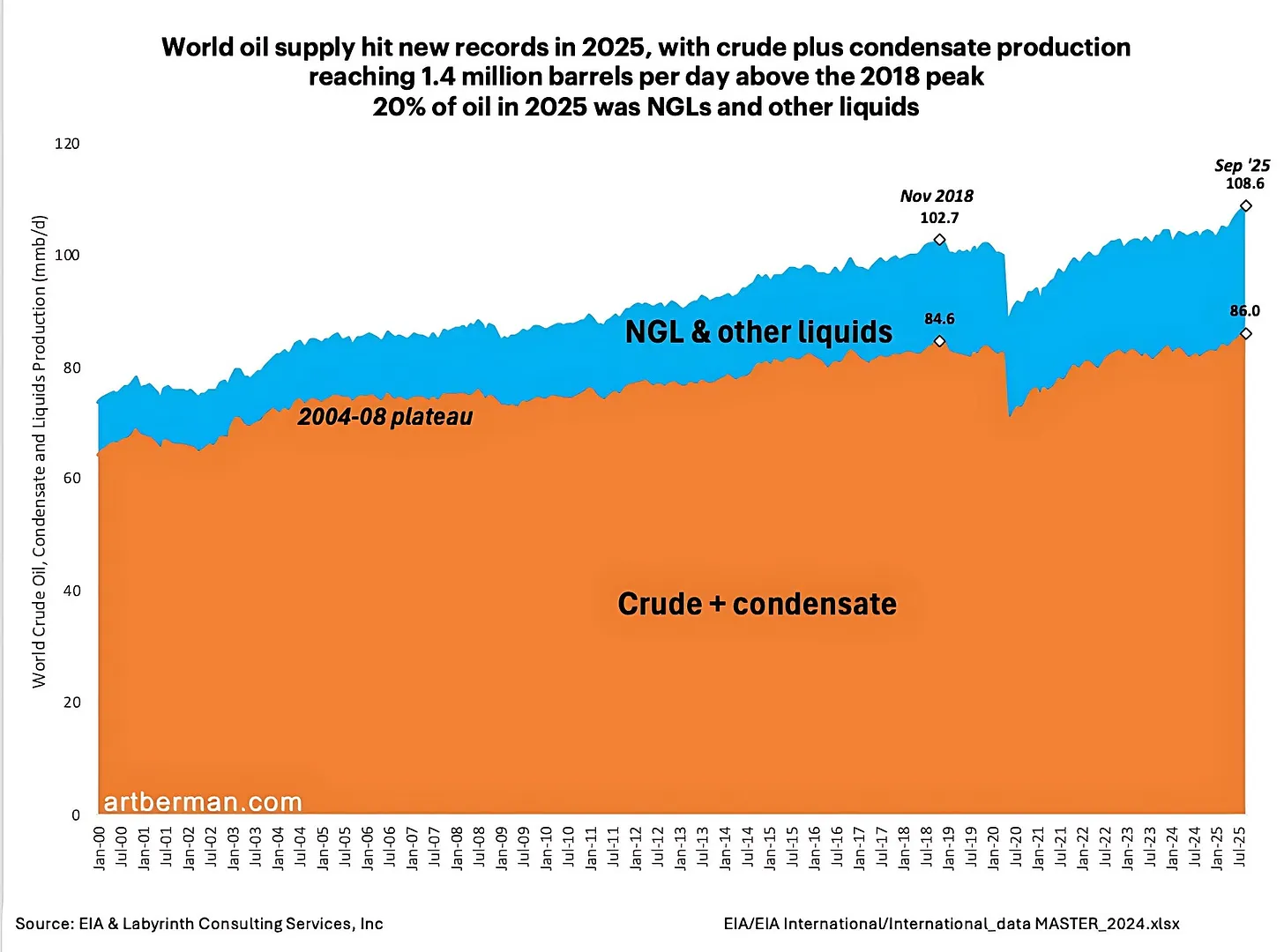
Peak oil extended from November 2018 to September 2025 due to shale and horizontal drilling.
Click on the image to enlarge.
|
The crux of this lens is the historic reality that every previous limit has been moved. Malthus was right about the arithmetic and wrong about the outcome, because Haber and Bosch showed up. Peak oil was right about conventional crude and wrong about total supply, because shale and horizontal drilling came on the field. In the 1980s, almost nobody forecast that solar costs would fall something like ninety-nine percent over the next four decades, including most of the people who were rooting for it.
So when a technologist hears the word “limits,” they’re hearing a word that has been more or less wrong every time it’s been used in their lifetime.
“You’ve been predicting the ceiling for two hundred years and we’ve gone through it every time. Why would I bet against the thing that has never lost?”
This is a fair question, and I don’t think those who advocate for restraint, like myself, answer it well enough. The fix from inside this lens is more of what’s already working, which is to continue innovating, building, and expanding our technology: reactors, batteries, robots, and more. France decarbonized most of its grid in about fifteen years in the seventies and eighties, but then the West mostly stopped building. A technologist will tell you that nothing physical stopped us: we just got scared. They see a very specific obstacle: objectors, regulators, the local permitting process, and, to be fair, a good number of viewers of this platform.
There’s also a moral argument underneath this one that’s stronger than critics usually admit:
“Every single person who’s told the world’s poor to settle for less has had electricity while saying it.”
The Community Lens
The fifth lens is community and meaning, which in some ways is what’s left of the religion lens after the belief goes.
This lens doesn’t say the claims of religion aren’t true. It says we needed them, we took them apart anyway, and now we’ve replaced them with nothing. We disenchanted the world. We dismantled the churches, the rituals, the extended families, and the sense that any of this is sacred. We handed people a screen instead, and now there are more of us than ever living alone and dying of despair in the middle of unprecedented material abundance.
“You’re describing a civilization that lost its soul and calling it an energy problem.”
There’s no policy fix here, or at least I can’t imagine one. Instead, there are practices: reconnection, ritual, community, service, embodiment, awe. These are far older than any of us, and they circle around something I don’t fully understand. My whole approach is to keep asking what’s underneath, to keep going until I hit something that holds, whether we believe in it or not.
This lens says that habits like mine might be part of the problem, and that looking for the machinery is how we got lost in the first place.
The Animist Lens
I’m calling the next one the animist lens, and it’s probably the door most of you reading this actually entered through.
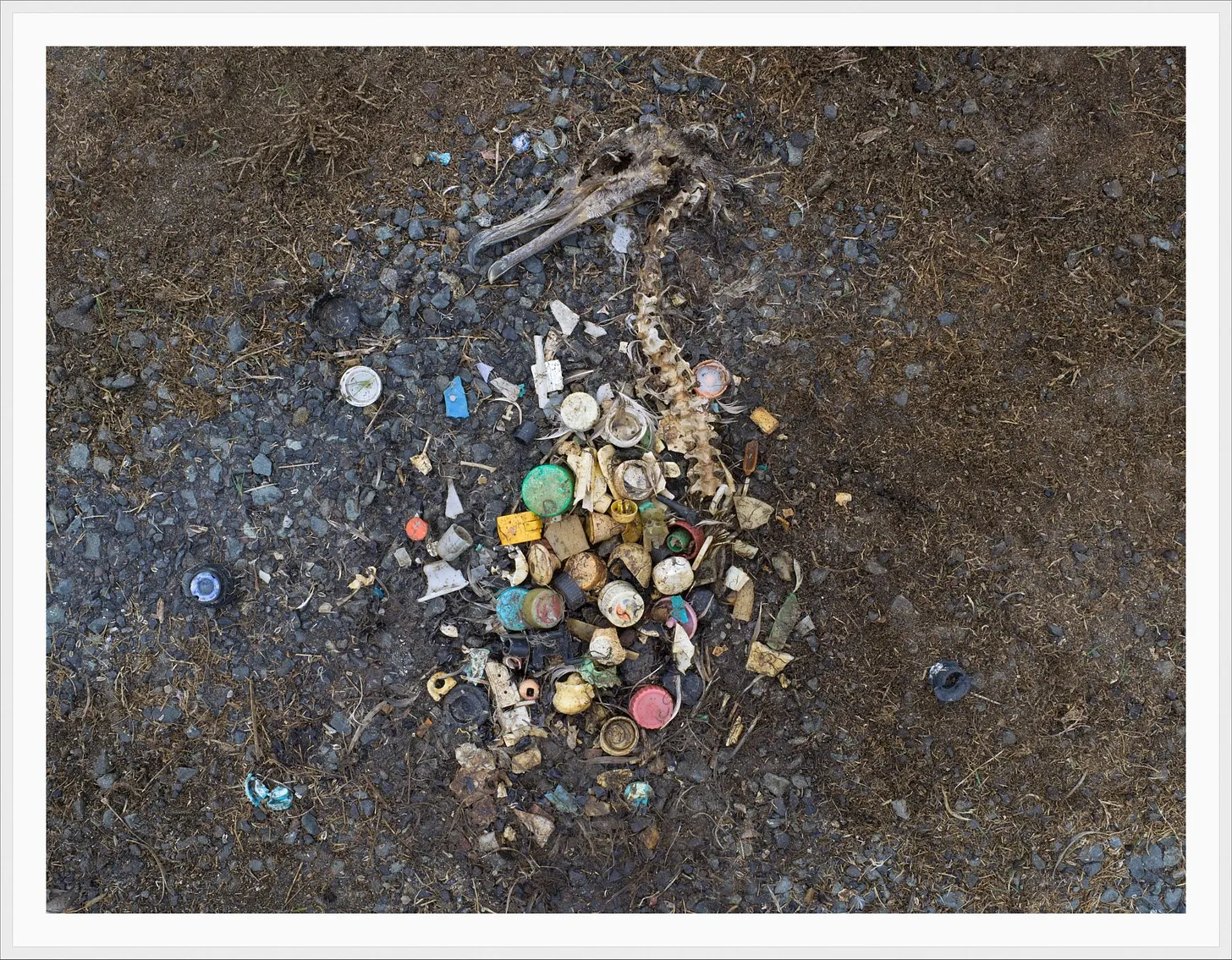
Photo by Chris Jordan. Unaltered stomach contents of a Laysan albatross fledgling,
Midway Island, 2011.
Click on the image to enlarge.
|
Somebody sees the whale on the beach, or the elephant with its face cut off, or the albatross opened up with bottle caps and a lighter in its stomach, or thousands of shark fins with the sharks sliced from them … and something turns inside them. The unit of concern here is a creature, one who was alive and now is not, and who never had a say in any of this.
In its deeper, older form, this lens says the rest of the natural world has always been our kin, the nieces and nephews and cousins that almost every culture before modernity recognized. Forgetting this truth is the wound sitting underneath all other wounds. The core principles here echo ancient concepts such as Wetiko, the old Algonquin word for the sickness of taking more than you need.
“That was a living creature; don’t tell me what it was worth.”
For this lens, the solution is to witness and protect: stop this specific harm, defend this herd, save this bay. At scale, this means extending rights and standing to the more-than-human world, and refusing to let any of it get turned into an accounting exercise.
In the past, I’ve been sharp about the sharing of dead animals on social media and what might be underneath it. But I came to this work through this door too. I think most of you did. After all, nobody arrives at thermodynamics first. Usually, you see a being dead for reasons it shouldn’t be … and the charts come later. The order of events doesn’t make that feeling any less true.
The Overshoot Lens
Overshoot is the next lens, and it’s where I suspect a lot of the readers here currently sit.
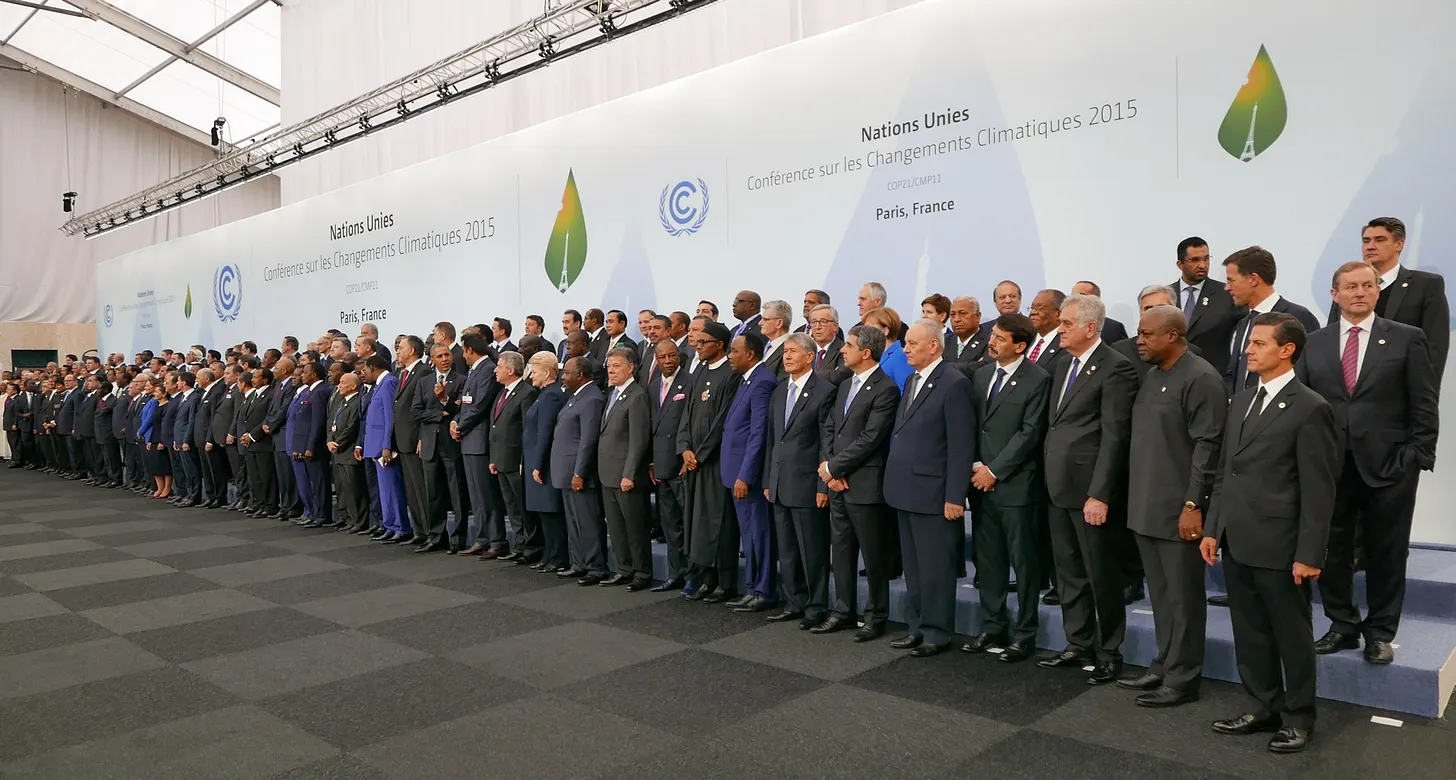
COP21 participants at the adoption of the Paris Agreement. Photo by Presidencia
de la República Mexicana.
Click on the image to enlarge.
|
Let’s start with what this perspective argues against. For thirty years, the environmental conversation got compressed into a single target centered around just one gas. There’s good reason for this, as it’s the only issue that’s gotten genuine institutional traction. There are treaties, agencies, and trillions of dollars in motion because someone turned a sprawling planetary mess into a single metric that a finance minister could act on. Perhaps not-so-coincidentally, it’s also the only green framing fully compatible with the technology lens, and the only one where the response to the crisis is to build more things and grow the economy while doing it. This is probably why it’s the framework that won. It never asks anybody to do less, which means it’s something everybody can adopt.
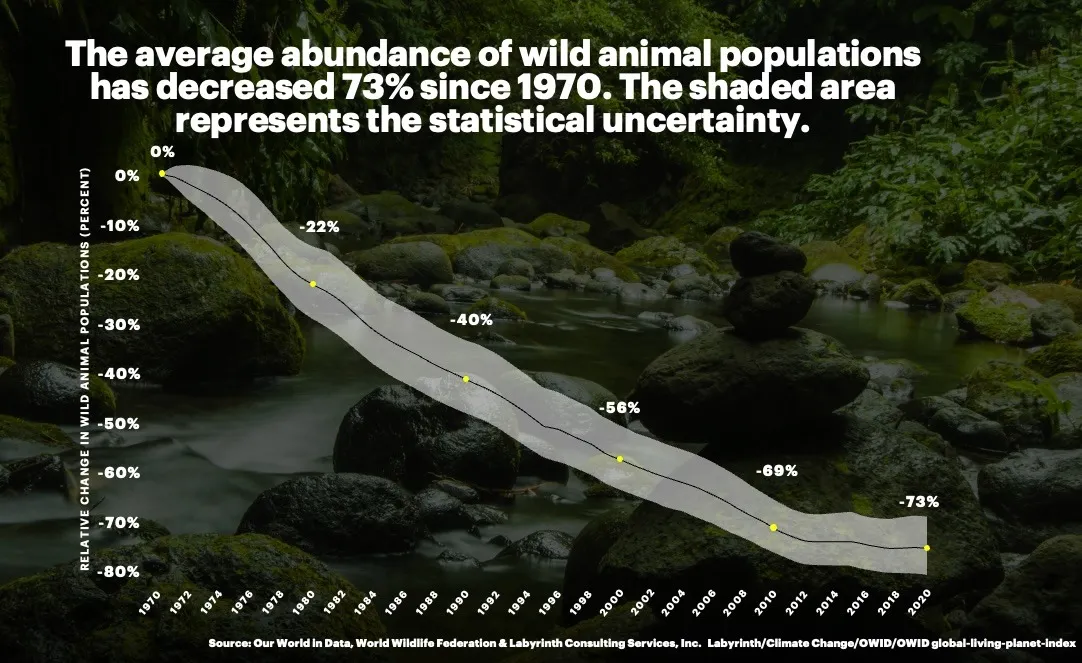
Decrease in wild animal populations since 1970. Click on the image to enlarge.
|
The overshoot lens takes a different stance. It says climate is but one symptom of a much larger predicament, and that treating it as the whole thing has been a mistake. We’ve lost roughly seventy percent of the populations of wild animals, birds, fish, and amphibians since 1970. Insects are declining one to two percent each year. One million out of eight million species on this planet are at risk of extinction. On top of this, there are novel entities (plastics, PFAS, and endocrine disruptors), a whole chemistry we invented and released without checking the risks. None of that is a carbon problem, and none of it gets solved by “better batteries.”
“There is nothing wrong with the technology. There are just too many of us consuming too much.”
So the fix here is less. Fewer of us over time, less throughput, degrowth, contraction, and a smaller footprint pressed onto a finite planet.
This lens sits close enough to the next that people often conflate them, so I’d like to draw the line between them. Overshoot is a story about the waste, but what follows is a story about the fuel.
The Thermodynamic Lens
Every lens preceding this one is a story about how we’re using the surplus. Who gets it, who took it, whether we were faithful with it, what it’s doing to the air and the water and the animals, or whether it’s making us happy. None of them are stories about where the surplus came from, or how long it lasts. That’s what this thermodynamic lens aims to add.
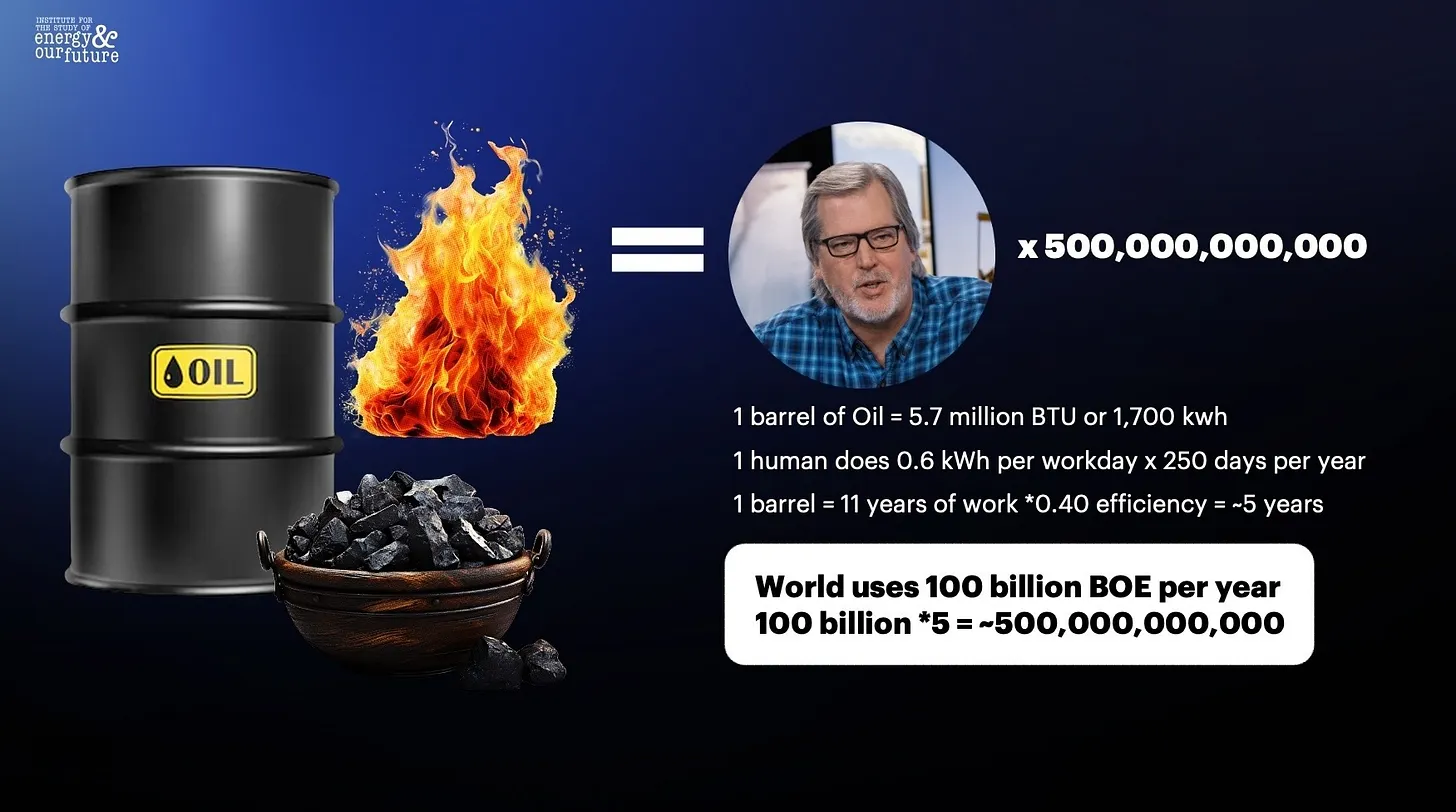
Nate's calculations on how much human labor is contained in a barrel of oil.
Click on the image to enlarge.
|
,p.
A barrel of oil does something like five years of physical human work. We burn roughly a hundred billion barrels of oil equivalent a year across coal, oil, and gas. Multiply those together, and we have roughly five hundred billion human labor equivalents working alongside a five-billion-strong workforce of actual people. This surplus is the primary driver of our current largesse, despite rarely being mentioned. It’s a one-time inheritance of buried sunlight that took tens of millions of years to form, and we’re spending it within a few human generations: the Carbon Pulse.Nobody says this on a stage, yet plenty of people know it. The reason it goes unsaid is that this sentence has no acceptable ending. If you say it out loud, you’re saying the standard of living most of us grew up with was never a policy achievement and isn’t a permanent feature of the world. It lays bare that no election or reset or invention adds joules to a depleting stock, and that our nineteen-terawatt global economy is more likely to see a future throughput of fifteen than twenty-five.
I’d give you the quote for this one, but you’ve been hearing it from me for four years.
While I can periodically adopt the previous seven viewpoints, this thermodynamic lens grounds most of my thinking. My assessment is that it’s the floor the other perspectives are standing on: the story of where the surplus comes from. Overshoot, meanwhile, is the ceiling above us: the story of what the planet can absorb.
A Villain and a Task
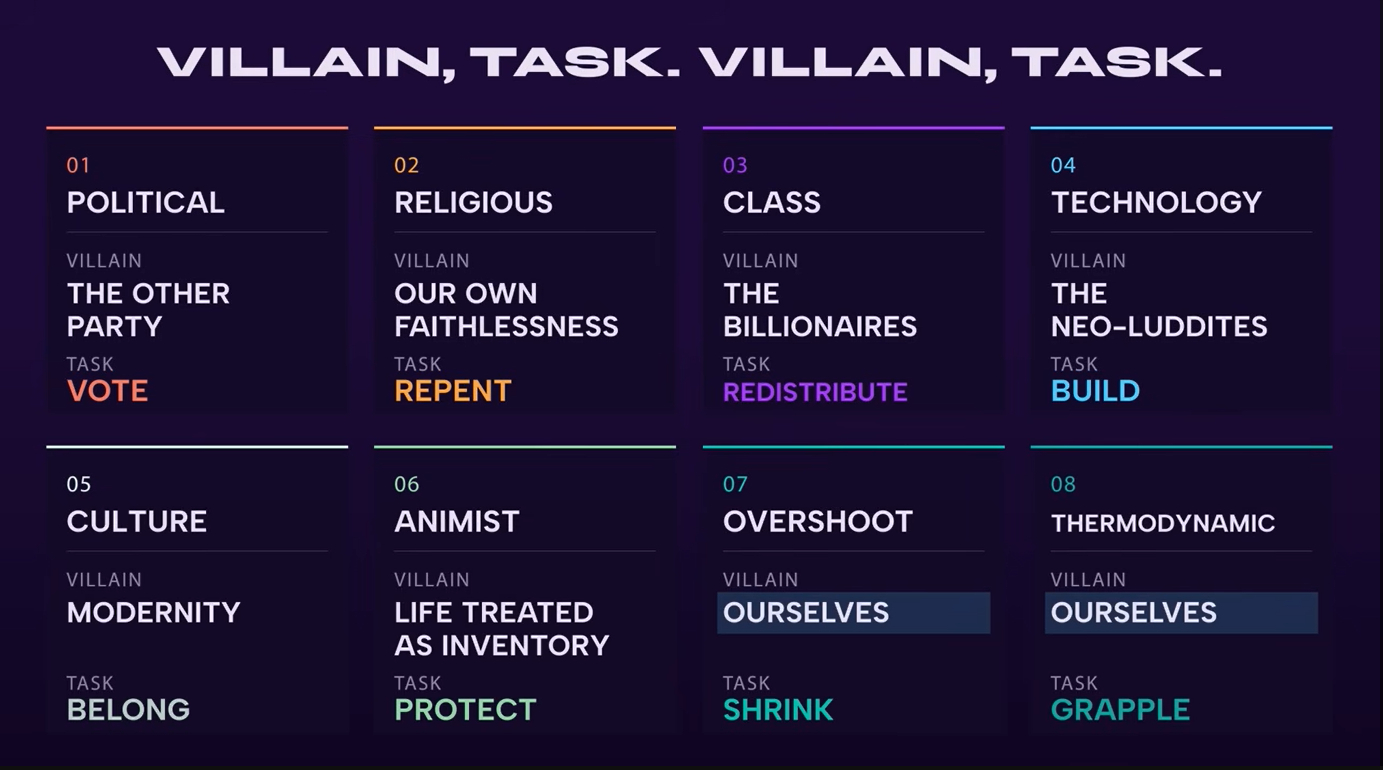
The thing I noticed putting this together is that every lens hands us a villain and a task.
The political lens gives you the other party and a vote.
Religion gives you our own faithlessness and a way to atone.
Class gives you the billionaires and a redistribution.
Technology gives you the neo-Luddites and something to build.
Community gives you modernity and something to belong to.
The animist lens gives you the poacher and a creature to save.
Villain, task. Villain, task. And I think people choose their lens at least partly based on which of those two they can live with.
However, both overshoot and thermodynamics give us … ourselves, the shrinkage of our material lives, and the task of grappling with how we’ve used our one-time energy inheritance. There’s really nobody specific to blame. Nobody sat down and decided to build a civilization on a one-time energy inheritance. It happened through billions of small decisions, and unlike the money in the class story, there’s no pile of it sitting somewhere that we can go take back. There’s no task either: no single thing you can do in the near future that significantly alters the trajectory, which is a large part of why this perspective continues to lose most arguments, and I’ve had a front-row seat to that frustration.
In my previous Frankly on 5D chess, I suggested that from a high enough vantage, you stop asking who the villain is. While I still think that’s right, I also continue to underestimate how hard that is to do, because all these villains are intertwined with their accompanying explanations. So if you give up the villain, you’re giving up the story that helped you make sense of things in the first place.
So I’m not going to finish by telling you which of these perspectives is right. You know which one I hold and why. Instead, I’d like to put these in relation to each other. The first six all have pieces that are right and pieces that are wrong. But all six of them sit inside the floor and the ceiling of the last two, and that’s actually where any agency we have exists. Politics, money, technology, faith, meaning, how we treat other creatures: those are the places we can still change things. Not by much, and certainly not alone, but they’re the places where anything changes at all. What gets lots of folks into trouble is forgetting that all six are operating inside the boundaries of ecological overshoot and thermodynamics.
This gives us something to be on the lookout for. The test I’d suggest going forward is whether a given response makes sense in more than one lens at a time, because anything that only works inside a single lens is going to fail. The things that have staying power or ‘robustness’ (to use Olivier Hamant‘s term) hold across lenses. They’re the responses that could directionally work for someone focused on social class, and a regular churchgoer, and somebody who just wants their grandkids to see a whale in the ocean.
I don’t expect anybody to switch lenses, as I am unlikely to switch mine. But I think being aware that there are at least seven other lenses in the room is a helpful foundation for the conversations ahead. Those conversations include the ones with guests on this platform.
I can’t hold all eight of these at once. Nobody can. What I can do is remember the other seven are out there when I’m talking with others I might not agree with. Ultimately, there’s a floor and a ceiling, and everything we’re arguing about is happening in the room between them.
Thanks for reading. More to come soon.
By the same author:
Watch With Both Eyes Open:
The Beauty and the Horror of Our Moment
When Truth Becomes Hazardous:
Navigating Information Through the Metacrisis
Unordinary Interventions:
How to Plant Seeds for a Better Future
ABOUT THE AUTHOR
Nate Hagens is the Co-founder and Director of The Institute for the Study of Energy and Our Future (ISEOF). Formerly in the finance industry at Lehman Brothers and Salomon Brothers, since 2003 Nate has shifted his focus to understanding the interrelationships between energy, environment, and finance and the implication this synthesis has for human futures. Allied with leading ecologists, energy experts, politicians, and systems thinkers, ISEOF assembles roadmaps for understanding how human societies might adapt to lower-throughput lifestyles. Nate also moderates the podcast The Great Simplification, on "illuminating the path for future generations, navigating uncertainty through understanding. and building a resilient future together."
|
|Back to Title|
LINK TO THE CURRENT ISSUE
LINK TO THE HOME PAGE