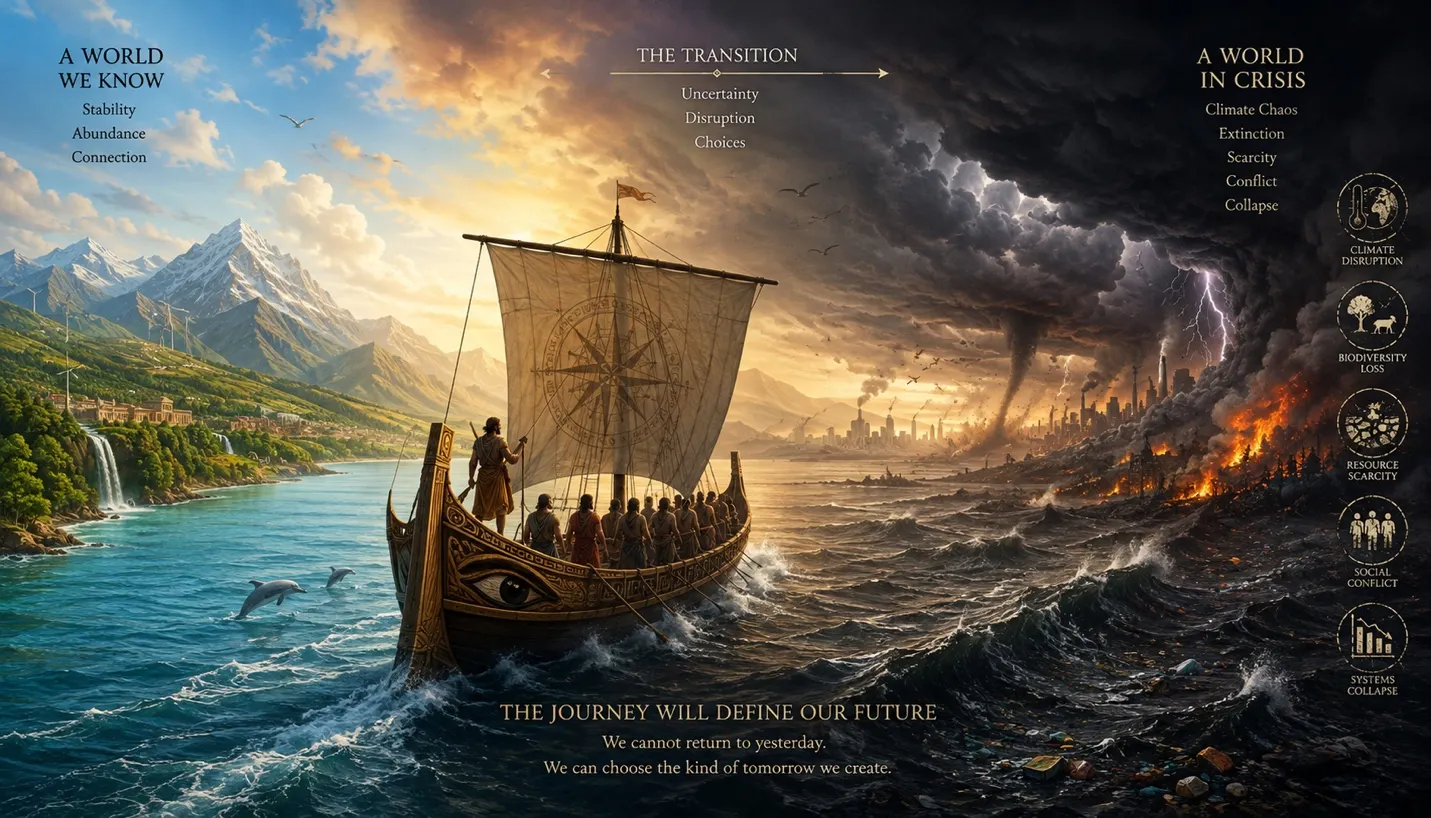
The fate of civilization and the ecosphere should the metacrisis turn catastrophic
The previous post (Part 1) focused on the catastrophic loss of human life due to a lethal viral pandemic. Efforts taken by The Last Ship’s heroic captain, crew, and two virologists result in the creation of an effective vaccine that helps stop the pandemic’s carnage. But after that critical problem is remedied, there emerge dark-triad personalities (narcissistic, Machiavellian, psychopathic) intent on gaining world power to advance their personal ideological ends. They succeed in spreading socio-political mayhem that keeps the USS Nathan James destroyer’s crew vigilantly active in thwarting their ominous deeds.
I see The Last Ship as a fortified, defensible community of highly capable adult men and women. The officers, crew, and scientists represent a variety of high-tech and practical expertise, all united in a common mission to survive and rebuild a more sustainable society.
Understanding this second post will be easier for anyone having read the previous Post 1. Briefly, The Last Ship TV series storyline centers on responding to a major pandemic crisis, followed by deadly conflicts with would-be political strongmen seeking global power.
What I missed in the series was the complete disregard of any ecological concerns, notably the wanton militant destruction and death not only affecting people and society but also the natural environment. So, in addition to social issues, this post aims to address the ecological oversight.
The Last Ship’s narrative compared with Star Wars and Odyssey
A principal concept covered earlier was the basic thematic content The Last Ship shares with two similar narratives. A modern similarly themed work is found in the perennially popular Star Wars movies and television series. But the closest thematic story is with the ancient epic poem Odyssey by Homer.
In comparing similarities and differences between the three narratives, consider these similar points. In The Last Ship humanity’s technological civilization has been tragically interrupted by a pandemic, with survival as the main objective. In Star Trek humanity has overcome many of its historical technical limitations, and the goal is to explore an expanding universe. Finally, in Odyssey a single human (Odysseus) is challenged with negotiating safe passage through a dangerous world and eventually discovering the deep meaning of arriving “home”.
In sum, rather than thinking of The Last Ship simply as a military-apocalyptic television series, its true value might be viewing it as a contemporary myth. In this case, since the world that once was assumed permanent has vanished, the myth becomes about humanity’s striving to make its way safely back home. It seems reasonable to assume that, given the developing societal and ecological disintegration planetary lifeforms are experiencing, our world—as experienced over the past 100-plus years—will never be the same again. The cheerless reality is that each day going forward will likely be the best on Earth for generations and perhaps centuries to come.
The Last Ship reimagined according to socioecological concerns
As I expressed in Post 1, my main criticism of The Last Ship (TLS) narrative is the noticeable absence of any obvious ecological concerns. I realize that providers of commercial entertainment productions feel obligated to address the general public’s interest and taste, especially works featuring exciting action plots. Catering to the common desire for the “good guys” to defeat the “bad guys” presents a desirable ending. Generally, people enjoy a story in which Good (moral forces) overpowers Evil (destructive forces).
When viewing most episodes, the amount of ecological harm inflicted by warfare is not acknowledged. Depending on the storyline, the amount of attention given to military action may seem warranted, but the damage is typically directed at opposing humans and societies. In vicious warring scenes numerous people may be wounded and killed, plus many structures, war machinery, and equipment rendered useless. In TLS several war ships are badly damaged and sunk, effectively causing extensive harm to ocean ecosystems.
All wars represent massive extractions of natural resources, all of which must be transported, processed, produced, and used. The overall outcome results in more destruction and pollution. Particularly harmful are the wide dispersals of toxic chemicals into the air, water, soil, and all lifeforms, in extreme cases globally. As with all war stories, the general message portrayed serves as a simple reminder made famous by American Civil War general William Tecumseh Sherman: “War is Hell”!
Current wars’ effects on society and the ecosphere
Anyone actively involved in current wars will agree that “war is hell”, as is the case with the oppositional forces fighting in the Russia-Ukraine and the U.S-Israel-Iran conflicts. Both wars continue inflicting profound devastation that includes burning through energy reserves, causing trillions of dollars in market disruptions, driving massive refugee crises, and inflicting severe ecospheric harms. Sadly, it seems that wars will continue destroying societal infrastructures and structures, accelerating greenhouse gas emissions (and climate change), toxifying agricultural systems, and severely straining international public health and food networks.
Also staggering are estimates of what it will take to repair, rebuild, and recondition life amidst the turmoil caused by war and results of climate change, including the costs associated with homeless migrants, the healing of wounded people, the mourning of lost family members and friends. The reconstruction of everything in the aftermath of war zones will require years, perhaps generations of recovery for both humans and the ecosphere.
With the U.S-Israel-Iran conflict, particularly, ecosystems are being degraded by a large human presence in a region of the world where the effects of climate change are ubiquitous. The increasing temperatures, droughts, degraded arable lands, and fading water sources bode badly for the region’s large population and their homelands.
Regarding the U.S.’s financial costs of the U.S-Israel-Iran war, a factsheet found online reports that “direct military spending by the U.S. government for the conflict with Iran has reached $37.5 billion, with broader domestic economic impacts—including inflated energy and borrowing costs—pushing total cumulative costs past $130 billion to $150 billion. No formal official reparations have been levied or paid by the U.S. government”.
Concerning the U.S. naval blockade of the Strait of Hormuz, the direct military outlays of $37.5 billion were spent on operations, maintenance, and military pay through September. Moreover, a daily standard U.S. Navy presence for each Carrier Strike Group (CSG) in the region is a baseline operational cost of $6 million to $8 million.
We must also bear in mind that the war’s consumer energy burdens have cost U.S. consumers more than $87 billion in extra expenses for gasoline and diesel fuels. For the average American household, the conflict has cost more than $1,100-$1,400 in combined energy, grocery, airfare, and borrowing expenses.
Regrettably, this is how our government spends our taxes—and without congressional approval!
What do we know?
One thing we’ve learned so far is that a pandemic could be only one wave in a much larger succession of disturbances. What would it take to Imagine additional natural disturbances to The Last Ship’s world of woes—from accelerating climate disruptions to droughts and freshwater shortages, crop failures, ocean warming and acidification, biodiversity loss, habitat destruction, and social disintegration, including mass migrations, socio-political fragmentation, and breakdown of institutions and governance?
As multiple ecological crises become unstable and require a wide range of variable responses, the narrative changes dramatically. No wonder such a story has yet to be told. It simply presents an overwhelming scope of problems to cope with effectively. When multiple crises converge, it becomes apparent that the ecosphere has been the primary missing protagonist in most narratives. Making Nature the protagonist is a much harder story to tell, write, or present in a limited visual format—unless it becomes an extended series spanning many years.
One major lesson gained from understanding the size, scope, scale, and speed of bio-ecological degradation is that all ecologically related crises—climate change, biodiversity loss, soil degradation and habitat destruction—are the consequences of the way civilization has been operating. This realization introduces a profound narrative reversal. Humanity isn’t merely the victim of the catastrophe, but also a principal contributor of the conditions causing ecological breakdown. This makes the conventional heroic narrative much less satisfactory, and much harder to rectify, as it’s impossible to defeat, shoot, or negotiate our way to effective responses.
What should we do?
What’s really needed is for humanity to achieve wisdom and humility, by acknowledging the practical need to set and honor limits. And, most of all, to cooperate and collaborate with fellow humans and other beings in creating a sustainable existence.
A principal issue deserving deep thought and honest discussion is the unreasonably controversial overpopulation issue. Although there are unpleasant socio-political and economic downsides to a declining global population, a lower population would benefit the ecosphere. The key question needing a plausible response Is this: What could happen to society and the planet if billions of human consumers suddenly disappear due to a major catastrophe, as occurred with the pandemic in The Last Ship story—or nuclear war?
For certain, modern civilization’s complexity will not be able to manage the level of horrific conditions resulting from a major global catastrophe. A recent Crazy Town podcast points out that, as societies continue growing complex, they also grow more fragile. The reasons are many, including humanity’s dependent expectations that the global economy will always have access to ample energy, functioning power-grids, successful manufacturing capabilities, sufficient food and water sources, and especially dependable global supply chains. As The Last Ship story illustrates, society is not sufficiently equipped to cope effectively with a devastating global catastrophe.
On the other hand, a lower world population could set in motion consequential opportunities for both society and the ecosphere. For certain, a smaller population would require reduced throughput of nonrenewable natural resources, specifically carbon-based fuels. Resulting lower energy usage would automatically lower levels of greenhouse gas emissions and pollution.
Moreover, less construction would be needed, particularly for housing, since survivors would have access to previously lived-in facilities. Plentiful materials—clothing, tools, equipment, furniture, vehicles, and most items—would be available for salvaging and reusing. Reductions in livestock would improve food and water supplies, and with more arable and grazing land available, small family farms could replace inhumane corporate feedlots with producing organically grown crops.
In sum, with a smaller human population, consumption of limited resources would decline substantially as demand decreases, in turn reducing extraction of natural materials, water scarcity, and agricultural pressure to produce food. Consequently, as CO2 emissions decline, habitats recover and wildlife returns, and the climate could stabilize, creating a transitional opportunity for civilization to exist harmoniously with the rest of Nature.
Undoubtably, a population collapse would be horrific in terms of human deaths, suffering, and trauma. Yet, the social advantages of lower birthrates and a stable, sustainable population could also provide more opportunities for reforming all aspects of society, especially social, economic, political, and educational institutions.
Creating a comprehensive socioecological system based on true equality and equity (for all lifeforms) will not be easy, but it will be essential if humanity is to continue existing. What’s crucially needed is for humanity to decide that, to survive and possibly flourish, it will be necessary to set hard limits on consumption and waste. Giving Nature a chance to regenerate will require our designating at least half of the Earth as wilderness areas, with minimal human intrusion.
Wrap up
In one sense, “returning “home” could mean honoring the natural state we humans shared with the rest of the natural world prior to 12,000 years ago. Ever since transitioning from hunter-gathers and settling into farming communities, we’ve increasingly considered ourselves the dominant species, especially so within the past 200 or so years, beginning in the 18th century with the Industrial Revolution.
Now, back to Odyssey. The most profound analogy of The Last Ship, Star Trek, and Odyssey isn’t that all three stories feature ships, but rather the idea of homecoming. The even deeper meaning of Odyssey is that Odysseus cannot simply return to the world he left. And neither can we.
If humanity ever faces a genuine planetary crisis, we may discover there is no going back to the twentieth-century version of “normal.” As discussed above, the future may require a different conception of home. For humanity, Earth is our home. We cannot build a sustainable future thinking of our planet as a resource for civilization without thinking of humanity as a participant within Earth’s web of life.
This concept would include civilization as a part of a much larger human tradition that imagines itself in the aftermath of a global catastrophe. Beginning with Odyssey, this basic concept surfaces over time in The Epic of Gilgamesh, The Divine Comedy, The War of the Worlds, On the Beach, Star Trek, and contemporary climate-fiction and post-apocalyptic narratives.
Each generation invents its own version of the journey because each generation is asking: What happens to us when the world we thought we understood disappears? Perhaps The Last Ship’s main theme may not be in presenting a pandemic-ravaged future, or an example of the future we should expect. Instead, it provides a provocative presentation of future mythology—a modern Odyssey that gets us partway through the journey and leaves us to imagine what kind of world we ought to build when we finally arrive home.
Based on what we’re all experiencing these days, it seems we’re getting closer to returning home each day. For certain, the time needed to prepare for what’s to come begins here and now.
I hope you agree . . .
Clif (with Bettye Ware, reader/editor/partner)
P.S. Check out the following depictions of 12 catastrophic events. Notice that the most likely ones are at the end.
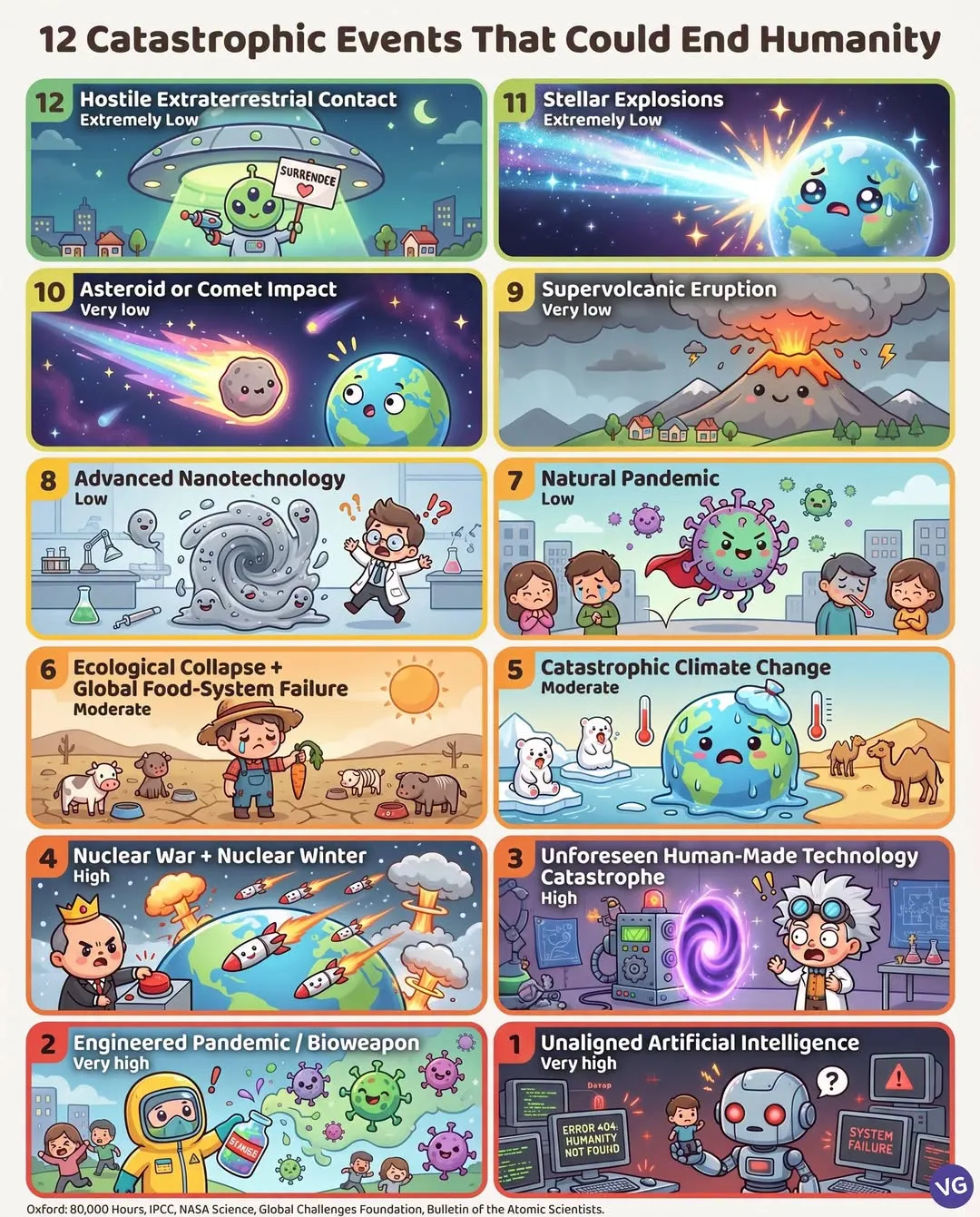
Image: VGrafts on Facebook. Click on the image to enlarge.
By the same author:
Earth Overshoot Day 2026—July 30th
ABOUT THE AUTHOR
Clifton Ware, D.M., emeritus professor (voice), professional singer and author of four published books and two unpublished works, retired in 2007 from the University of Minnesota-Twin Cities School of Music, where he taught for 37 years. In retirement – as a self-described socio-ecological philosopher focused on sustainability issues – he continues seeking an evidence-based, big-picture understanding of socio-ecological systems, including the symbiotic interconnections and role of humans as an integral part of Nature. In 2013 he founded Citizens for Sustainability in St. Anthony Village, MN, produced Sustainability News + Views (2014-2019), a weekly newsletter featuring a variety of articles and a commentary, co-composed 13 Eco Songs with his wife, Bettye, organized Sustainability Forums, and performed eco-oriented programs and presentations for several organizations.
|
|Back to Title|
LINK TO THE CURRENT ISSUE
LINK TO THE HOME PAGE