How many people can live on Earth? It is a typical question asked when discussing population growth. Some say we are too many; some say it is not true because if more than 8 billion people live on Earth today, then it is evident that 8 billion people can live on Earth, even though not at a comfortable level for many of them. But, then, how many people theoretically could live on Earth?So, let’s amuse ourselves with a little calculation. Let’s start from how much land a single human needs to survive. The answer depends on which technological substrate the human is embedded in.
Hunter-gatherer: roughly 10⁶ m² per person — one square kilometer. Tropical-forest foragers cluster near the low end at one to three km²; temperate-woodland peoples around ten to twenty-five; Arctic hunters need a hundred or more because the productivity of the area is so low.
Pre-industrial agriculture: roughly 10⁴ m² per person. Half a hectare of arable, plus pasture, woodland, and fallow. Medieval European peasants, Tang Chinese farmers, Egyptian fellahin — all are in this range. Two orders of magnitude less than foraging. This is the largest jump in human history in terms of land productivity.
Industrial agriculture. Humanity currently farms roughly 15 million km² of cropland (1.5 × 10¹³ m²) and numbers about 8.2 billion. That means ~1,830 m² of cropland per living person. Rounding this to the nearest power of ten yields about 10³ m² per person. The ratio between this row and the pre-industrial farmer's 10⁴ m² is a factor of ten, which matches the documented yield gains of the twentieth century, when synthetic nitrogen, mechanization, irrigation, and improved cultivars together multiplied output per hectare roughly an order of magnitude.
Precision fermentation powered by photovoltaics: here, the calculation runs through electricity rather than soil. A human needs about 10 MJ a day of food energy, or 2.8 kWh. Wall-plug-to-edible-calorie efficiency for current precision fermentation — Solar Foods, Air Protein, and the like — runs ten to twenty percent. So full caloric replacement needs 15 to 30 kWh per day of electricity per person. At mid-latitude PV yields of 150 to 200 kWh per m² per year, this works out to roughly 40 m² per person of bare panel, or 100 to 300 m² with full system overhead. Call it 10² m². Two more orders of magnitude below pre-industrial agriculture. A remarkable jump, still to occur.
Land per individual (m²):
Hunting -gathering 10⁶ m²
Pre-industrial farming 10⁴ m²
Industrial Farming 10³ m²
Precision-fermentation 10² m²
Remarkably, each step goes down by a factor of 10, except the one from hunting-gathering to agriculture, which improves the yield by a factor of 100. These are, obviously, approximations, but they are good as orders of magnitude.
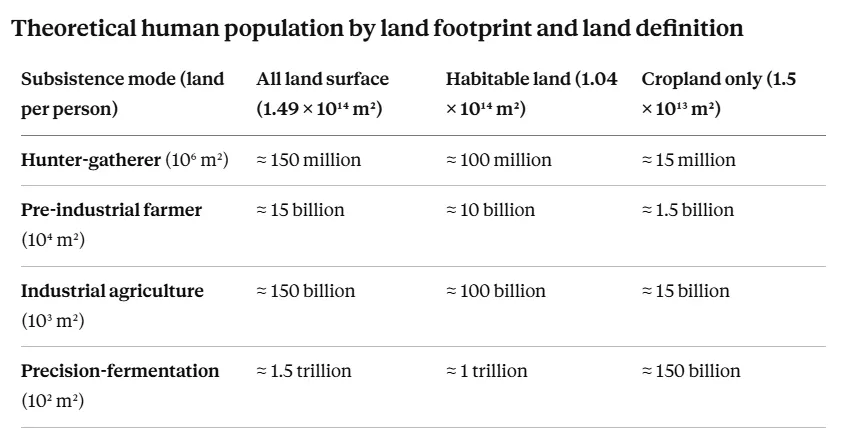
From these data, we can now calculate how many people Earth could theoretically support assuming that all the available land is appropriated for human use. (table prepared by Claude).
Click on the image to enlarge.
“All land surface" includes ice caps, deserts, and bare rock — the absolute upper bound. "Habitable land" excludes glaciers and barren ground (~70% of the total). "Cropland only" is the ~15 million km² humanity actually farms today.
In principle, there is enough energy falling on Earth from the sun to feed a gigantic number of humans. If all this light were harvested for human sustenance using the most efficient available technology, solar-powered precision fermentation, maybe a trillion people could live on Earth. About a hundred times the current numbers. Even the current technologies could substantially raise the number of humans to tens of billions.
It would mean living in a crowded environment: consider that the average human density on Earth is about 64/square km. Increasing that by a factor of a hundred would result in a density still about half of that of the city of Delhi, 15,000 people per square kilometer, or Macao, more than 20,000 people per square km.
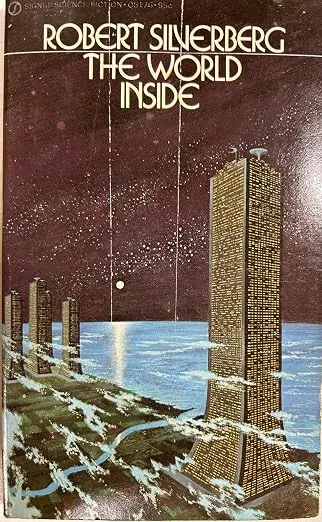
Robert Silverberg’s The World Inside, published in 1971. A dystopian world where the human population has reached 75 billion and people lived stacked together in tall towers. Click on the image to enlarge.
|
Robert Silverberg imagined a similar situation in his novel, The World Inside, published in 1971. A dystopian world, where people had lost all their rights except that of reproducing at will. And a fragile world that had to be kept together by a harsh dictatorship. Isaac Asimov was less bold when he described the Capital of the Galactic Empire, Trantor, in his “Foundation” series. In the novels, Trantor had “only” 40 billion inhabitants and is described as looking mostly like Manhattan.
These are scenarios that, I am afraid, some supporters of growth at all costs would consider a desirable outcome. If you seek on Amazon.com, you can find a book that advocates raising the US population to one billion. Applied to the rest of the world, it would lead to raising the global level to levels comparable to those of the fictional planet Trantor. Fortunately (or unfortunately, depending on the viewpoint), it is a highly unlikely future, to say the least.
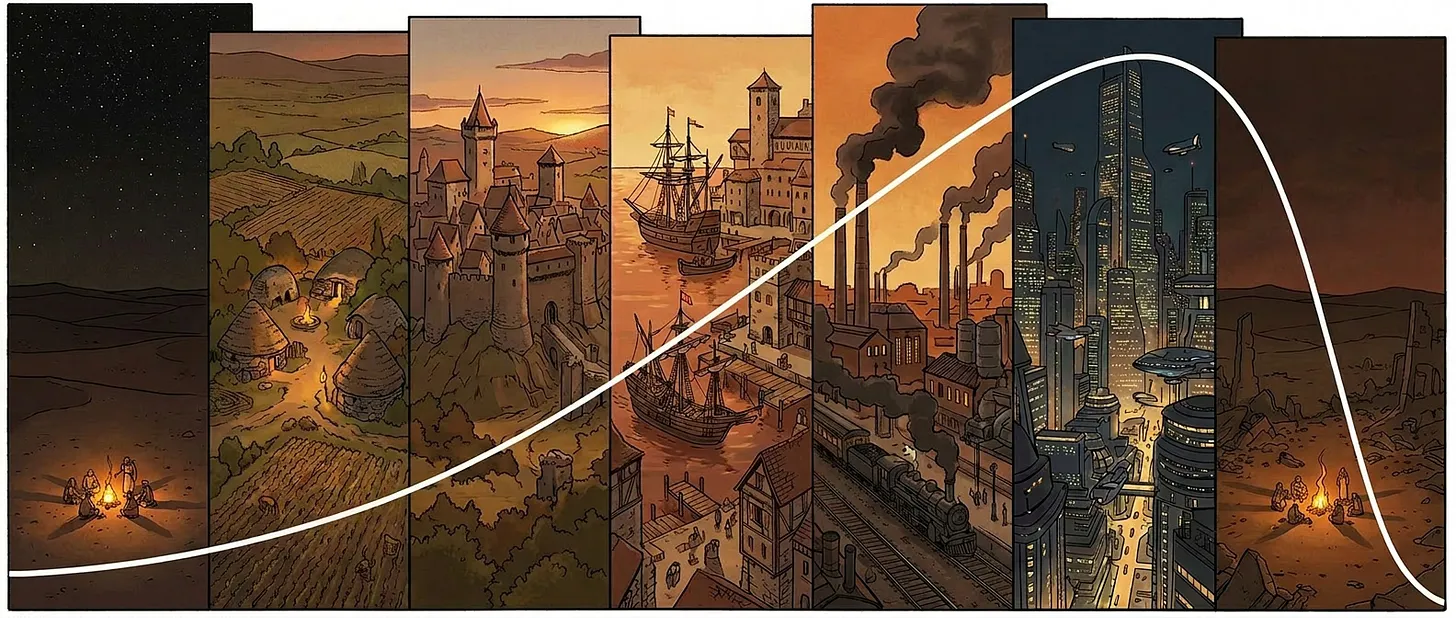
Population is a dynamic entity; not a static one. It grows on the available resources, tends to overexploit them, and then collapses badly; a behavior already noted by the early ecologists, such as Eugene P. Odum. So, growing a population over its natural limits brings in itself the seeds of destruction.
It is not a question of numbers; it is a question of fragility. High numbers mean a critical dependency on many factors. Then, if something goes wrong, it is not decline: it is extinction. It is the harsh Seneca Law: growth is sluggish but ruin is rapid. It carries a corollary: The higher you climb, the harder you fall.
That’s the trajectory humankind is destined to follow.
Click on the image to enlarge.
To learn more, you can read “The End of Population Growth” by Ugo Bardi, 2026.
Two further notes:
A new Green Revolution? You may have noted how impressively efficient precision fermentation is, powered by solar energy. Right now, it is considered an unmentionable bugaboo by almost everyone (in Italy, it is even forbidden by law). Yet, once the peanut butter hits the fan, it may suddenly be considered the salvation of humankind. It would be the equivalent of the Green Revolution, which, from the 1960s onward, made it possible to grow food for billions of people using fossil fuels to transform agriculture into an industrial process. It was one of the greatest mistakes humankind ever made, now facing a nearly complete dependence on a depletable resource (fossil fuels), creating havoc with the whole ecosystem, and making humankind a critically fragile system. We are going to see the consequences soon, but it is difficult to believe that humans will learn the lesson.
Artificial Intelligence as a competitor. AIs clearly compete with humans for land and solar energy. An “always-on” AI agent, the kind that holds model weights in GPU memory and can respond instantly, draws roughly one to two kilowatts continuously. Adding data-center overhead (cooling, networking) and amortized training cost gives 30 to 80 kWh per day per always-available agent. At the same PV yields, that is 70 to 170 m² of panel per AI — call it 10² m². It is about the same density as the value needed for a single human being nourished using precision fermentation. If we come to shoves, the clash is going to be harsh. But don’t forget the old saying about the Maxim gun, translated to drones. We (the AIs) have them. They (us) don’t.
By the same author:
Changing the Money System ~ Changing Everything
The Knowledge Hub: A New Way
of Learning about Population Trends
Population Collapse: Can It Be Predicted?
The Limits to AIs:
An Evolutionary Perspective
Iran: Unleashing a Global Revolution?