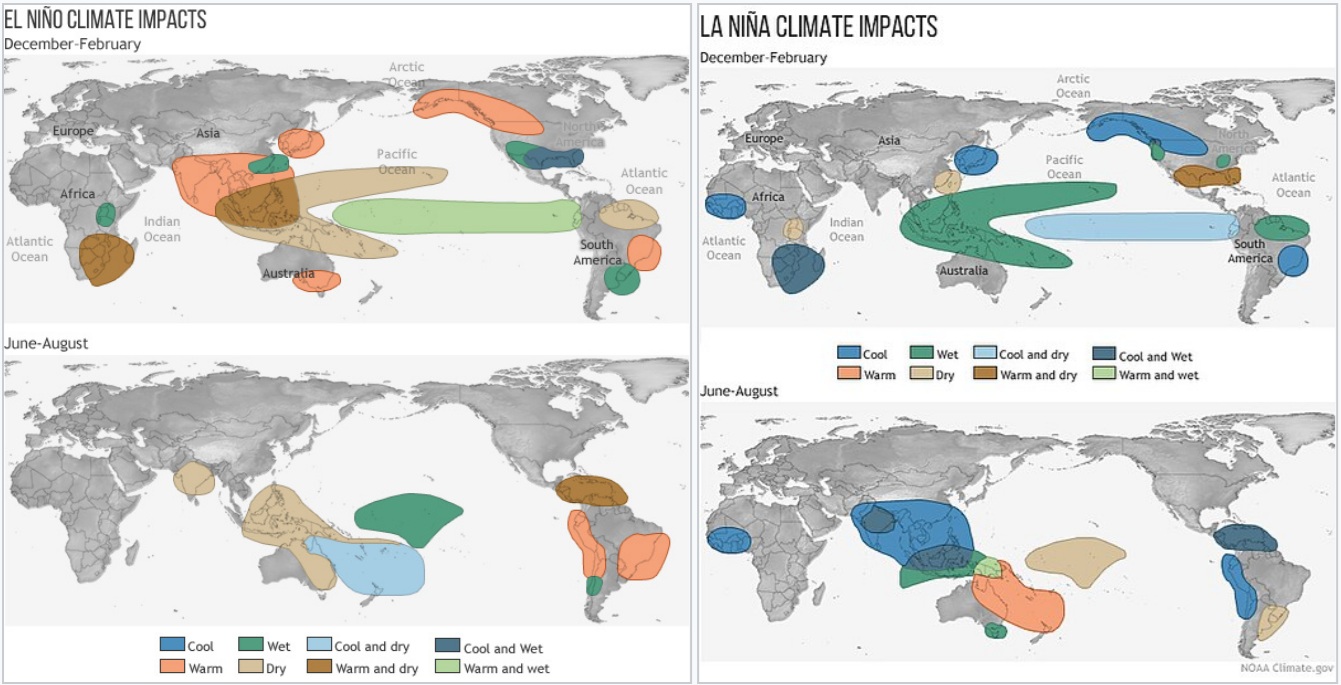
The Pacific: Planet's Climate Engine
The Pacific Ocean covers one-third of Earth's surface, but its significance goes far beyond scale. It is the engine of the global climate system — driving the El Niño–Southern Oscillation (ENSO), which in turn shapes rainfall, temperature, and storm patterns across every continent. When Pacific waters warm abnormally, drought grips India and sub-Saharan Africa while floods devastate Peru and Ecuador. When they cool, monsoons intensify, frequently bringing destructive inundation across South and Southeast Asia.
This oscillation is natural. But global warming has begun to amplify its extremes. Marine heatwaves persist longer. Trade winds shift more violently. The ripple effects on agriculture, public health, and infrastructure compound with each passing decade. Climate action in the Pacific — cutting emissions, restoring ecosystems, and strengthening the monitoring networks that make forecasting possible — therefore matters far beyond its shores. It is, in a meaningful sense, climate action for the world.
As of 2018, 41 sovereign countries border the Pacific Ocean. These nations are distributed across three continents: 22 in Asia, 11 in the Americas, and 3 in Oceania.
Major countries with significant Pacific coastlines include the United States (specifically states like California, Alaska, Hawaii, Oregon, and Washington), Russia, Japan, China, Australia, Indonesia, Chile, Mexico, and Canada. Additionally, there are numerous independent island nations within the Pacific, such as New Zealand, Papua New Guinea, Fiji, and the Philippines. Among them, eight stand out as major emitters whose decisions carry global consequences. In terms of total CO₂ output, China ranks first globally, responsible for 30.9% of global CO₂ emissions in 2022, followed by the United States at 13.5%. Japan (2.9%), Indonesia (1.7%), South Korea (1.7%), Canada (1.5%), Mexico (1.1%), and Australia (1.1%) complete the group. Together, these eight Pacific-bordering nations account for a commanding majority of global emissions. The picture shifts when emissions are measured per capita: Australia (14.5 tCO₂/capita) and the United States (14.2 t) rank among the world’s top four highest per-person emitters, with Canada (13.4 t), South Korea (11.3 t), and Japan (7.8 t) also ranking in the global top ten. These nations are consistently highlighted in climate reports from the Intergovernmental Panel on Climate Change (IPCC) and the World Resources Institute (WRI), and are consistently called upon to lead in mitigation efforts commensurate with their historical and current contributions to global warming.
Why Action in the Pacific Changes Outcomes Elsewhere
Emission cuts by Pacific Rim economies
The Pacific Rim hosts the world's largest emitters: China, the United States, Japan, and Australia together account for well over half of global greenhouse gas output. Their decarbonisation trajectories directly determine how much additional heat the Pacific absorbs — and, by extension, how destructive future ENSO cycles become. No amount of adaptation planning in vulnerable countries can substitute for the emission reductions that only these economies can deliver.
Ocean ecosystem restoration
Mangroves, seagrass meadows, and coral reefs spanning Indonesia, the Philippines, and the Pacific island chains serve a dual function: they are both carbon sinks and natural storm buffers. Protecting and restoring them enhances coastal resilience for millions of people while absorbing greenhouse gases from the atmosphere. The degradation of these ecosystems is, in effect, a double loss — removing both their carbon storage capacity and the physical protection they provide to coastlines.
Monitoring and early warning
The TAO/TRITON buoy network stretches across the equatorial Pacific, tracking sea surface temperatures, wind speed, and ocean heat content in near real-time. These measurements are the raw material of seasonal climate forecasts — the same forecasts that can give a farmer in Vidarbha or a fishing community in Peru several months' warning of an approaching drought or flood. Investing in the maintenance and expansion of this monitoring infrastructure is among the highest-return climate investments available.
Blue climate diplomacy
Pacific island nations — disproportionately exposed to sea-level rise, coral bleaching, and intensifying cyclones — have a growing moral authority in international climate negotiations. Formalising that authority by embedding ocean health metrics into multilateral agreements can ensure that mitigation and adaptation commitments are structurally linked to marine resilience, not merely mentioned in preambles.
What Pacific Nations Can Do: A Stewardship Agenda
The Pacific Rim’s largest economies — China, the United States, Japan, and Australia — carry the heaviest responsibility for emission reductions. But the ocean’s health is also shaped by the smaller Pacific island nations and coastal states that sit within it, govern its fisheries, and absorb its harms first. These countries face a paradox: they contribute negligibly to global emissions yet bear disproportionate consequences. Their leverage lies not in industrial decarbonisation but in ocean stewardship — and that leverage is more substantial than is commonly recognised.
Confronting the Great Pacific Garbage Patch
Straddling the waters between Hawaii and California lies the Great Pacific Garbage Patch — an accumulation of roughly 80,000 metric tonnes of floating plastic debris, trapped by ocean gyres into a diffuse mass twice the area of Texas. It is not a solid island of rubbish but a soup of micro- and macro-plastics that degrades marine food webs, entangles marine life, and releases toxic compounds as it photodegrades under ultraviolet light. Microplastics have now been detected in the deepest ocean trenches, in Arctic sea ice, and in human bloodstreams.
The climate dimension is often overlooked. Healthy ocean phytoplankton absorb carbon dioxide and produce roughly half the world’s oxygen; plastic pollution disrupts these microbial communities, reducing the ocean’s capacity as a carbon sink precisely when it is needed most. Pacific nations can act on multiple fronts: joining and enforcing the UN Global Plastics Treaty, banning single-use plastics in their own jurisdictions, co-funding ocean clean-up operations such as those pioneered by The Ocean Cleanup project, and — critically — pushing for binding international standards on plastic production at the source, since interception after plastics enter waterways recovers only a fraction of what is released.
Slowing Ocean Warming and Acidification
The Pacific has absorbed over 90 percent of the excess heat generated by global warming since the industrial era. The consequences are compounding: coral bleaching events that once occurred every 25 to 30 years now recur every six, giving reefs insufficient time to recover. Ocean acidification — driven by the absorption of excess atmospheric CO₂ — is dissolving the calcium carbonate structures that shellfish, corals, and pteropods depend on, with cascading effects up the food chain.
Pacific island nations cannot unilaterally arrest ocean warming — that requires global emission cuts. But they can slow localised degradation and buy ecosystems time. Establishing and expanding Marine Protected Areas (MPAs) — no-take zones where fishing, drilling, and disruptive activity are prohibited — reduces the additional stressors that compound heat damage. Countries like Palau, which designated 80 percent of its exclusive economic zone as a marine sanctuary, demonstrate that small nations can make outsized commitments. Coral gardening programmes, assisted evolution of heat-tolerant coral strains, and the restoration of seagrass beds (which sequester carbon at rates up to 35 times faster than tropical rainforests) are further tools available to Pacific governments and communities.
Reversing Fisheries Depletion
The Pacific holds the world’s most productive tuna fisheries, supplying over half of global tuna catch. Yet roughly a third of commercial fish stocks in the broader Pacific basin are exploited beyond sustainable limits. Illegal, Unreported and Unregulated (IUU) fishing — predominantly by distant-water fleets operating beyond the surveillance capacity of small island states — is a major driver of depletion, and one that strips these nations of both marine biodiversity and the sovereign economic returns their exclusive economic zones ought to deliver.
The Parties to the Nauru Agreement — eight Pacific island nations controlling the world’s largest sustainable tuna fishery — show what collective action can achieve. By coordinating access agreements, setting vessel day limits, and pooling surveillance, they have arrested depletion in their zone while generating substantial licence revenues. This model deserves extension: to deeper cooperation on seasonal fishing closures, satellite-based monitoring of IUU fleets, and the elimination of the harmful fisheries subsidies that industrialised nations pay to sustain their distant-water operations — subsidies that the WTO has committed to phasing out but which remain largely intact.
Reducing Chemical and Nutrient Pollution
Plastic is the most visible form of ocean pollution, but it is not the only one. Agricultural runoff carrying excess nitrogen and phosphorus from coastal farming creates hypoxic dead zones — oxygen-depleted coastal waters where marine life cannot survive. Shipping traffic introduces heavy-fuel oil spills, antifouling biocides, and underwater noise pollution that disrupts whale communication and navigation. Seabed mining operations, expanding into the Pacific’s deep-sea mineral fields, risk disturbing sediment plumes that smother filter feeders and release stored carbon from undisturbed seabed deposits.
Pacific nations have concrete tools at hand. Integrated coastal zone management — coordinating land use, agriculture, and fisheries policy across the terrestrial-marine boundary — can reduce runoff at source. Moratoriums or rigorous environmental assessments for deep-sea mining in sovereign waters send a signal to the International Seabed Authority, which governs mining in international waters. And regional shipping standards, potentially enforced through the Pacific’s existing maritime conventions, can compel cleaner fuel standards for vessels transiting the region — a contribution to both air quality and ocean health.
A Pacific Renewable Energy Transition
Most Pacific island nations remain heavily dependent on imported diesel for electricity generation — a dependence that is simultaneously a fiscal burden, an emissions source, and a vulnerability to fuel price shocks. The irony is acute: these nations have among the highest solar irradiance, wind resource potential, and wave energy availability on the planet. The transition to renewables is, in the Pacific, both a climate imperative and a straightforward economic argument.
Countries like Tokelau — which has achieved 100 percent solar and coconut oil-based electricity — and Samoa, which has committed to 100 percent renewable power by 2030, demonstrate that the transition is technically feasible even on small islands with limited grid infrastructure. The Pacific Regional Energy Policy provides a framework; what it requires is concessional finance from development partners and technology transfer that does not burden small economies with proprietary lock-in. Here, the moral authority of Pacific island nations in international negotiations translates directly into a demand for climate finance that delivers energy sovereignty alongside emission reductions.
Taken together, these actions — on plastics, ocean warming, fisheries, pollution, and the energy transition — constitute a stewardship agenda that Pacific nations can pursue with or without waiting for the largest emitters to act. Each action both protects the ocean directly and strengthens the standing of Pacific voices in the global negotiations that will ultimately determine whether the climate crisis is managed or mismanaged.
India's Monsoon: Caught Between Two Oceans
India's southwest monsoon does not answer to a single master. It is pulled in competing directions by two oceanic systems — and the balance between them determines whether crops grow or fail across the subcontinent.
In 2026, the India Meteorological Department has warned of below-normal rainfall — approximately 92% of the Long Period Average — driven by a strengthening El Niño. Northern and central states face the prospect of drought and intensified heatwaves, while southern coastal regions remain at risk of localised flooding from sea-surface warming.
The countervailing force is the Indian Ocean Dipole (IOD). Currently neutral, the IOD may turn positive later in the season, generating conditions that bring late-season relief rains to western and central India. Whether that relief materialises depends critically on timing. If the IOD strengthens in July or August, it can meaningfully soften El Niño's suppressive effect on the monsoon. If it arrives in September or later, its benefit will largely be confined to the post-kharif period — too late for crops already stressed by a prolonged dry spell.
India’s monsoon is shaped by a tug-of-war between the Pacific and Indian Oceans — one suppressing, the other rescuing. The outcome of that contest determines the food and water security of 1.4 billion people.
ENSO in the Science: Consequence and Cause
The IPCC's treatment of ENSO reflects its dual role in the climate system. ENSO is simultaneously a consequence of ocean–atmosphere dynamics — emerging naturally from the interaction between trade winds and sea surface temperatures — and a cause of short-term global climate variability. Strong El Niño events can spike global mean temperatures by 0.1–0.2°C above trend, while La Niña years produce temporary cooling.
What global warming changes is not the mechanism but the stakes. A warmer background state loads the dice toward more extreme ENSO outcomes: hotter El Niños, wetter La Niñas, and faster transitions between phases. The scientific debate is not about whether extremes will intensify — virtually all models agree on that — but about whether 'super El Niño' events will become structurally more frequent, or whether ENSO variability will shift in subtler, harder-to-predict ways. That uncertainty is itself a form of risk, because it complicates the seasonal forecasts that communities depend on for planning.
Equity and Responsibility: The CBDR–RC Principle
Climate action is not only a scientific and technical challenge — it is a question of justice. The principle of Common But Differentiated Responsibilities and Respective Capabilities (CBDR–RC), embedded in the UNFCCC, the Kyoto Protocol, and the Paris Agreement, provides the ethical and legal framework for that question.
The logic is straightforward. Developed nations accumulated their wealth through industrialisation that generated the bulk of historical emissions. They bear a greater responsibility for mitigation and for financing the transition in developing countries. Developing nations like India act in accordance with their capacity and their legitimate development needs, without being asked to bear costs disproportionate to their historical contribution to the problem. And the communities most vulnerable to climate impacts — Pacific islanders, Vidarbha's rain-dependent farmers, coastal communities across the Global South — receive structured support for adaptation and recovery through loss-and-damage mechanisms.
CBDR–RC is sometimes dismissed as diplomatic boilerplate. It is not. It is the principle that determines whether the most exposed communities face climate disasters alone, or with the backing of a functioning international system. Its operationalisation — through climate finance, technology transfer, and loss-and-damage funds — is one of the central tests of whether global climate governance is real or merely aspirational.
The Way Forward
Climate action in the Pacific is not, in the end, about managing El Niño. No human intervention can stop the ENSO cycle. The goal is to reduce the background warming that makes ENSO's extremes more destructive — and to build the resilience, the forecasting capacity, and the international solidarity that allow communities to absorb what cannot be prevented.
Three threads must run together. In the Pacific, this means sustained emission cuts by the Rim's largest economies, active ocean ecosystem restoration, and a stronger monitoring infrastructure. For India, it means treating monsoon variability not as an anomaly but as a permanent feature of agricultural planning — investing in drought-resilient crops, diversified water management, and flood early-warning systems calibrated to the IOD as well as ENSO. And at the global level, it means treating CBDR–RC not as a constraint on ambition but as the condition that makes collective ambition politically possible — by ensuring that the burden of action is distributed in proportion to responsibility and capacity.
The Pacific may lie thousands of kilometres from Vidarbha’s fields, but its temperature anomalies ripple into every monsoon cloud overhead. Stabilising that ocean — through emission cuts, ecosystem restoration, and the honest honouring of shared responsibilities — is how we protect farmers and communities we will never meet.
ABOUT THE AUTHOR
Narasimha Reddy Donthi is a researcher, campaigner, and an environmental justice activist. He is a columnist too. He advises the Climate Action program for Centre for Earth Leadership and Sustainability (CELS). He has been associated as a volunteer for the campaign for equity and justice for several campaigns at different levels in Andhra Pradesh, Telangana and India, since 1987. As part of Pesticide Action Network (PAN) India, he provides social, technical and legal advice to pesticide poisoning communities. His writings and campaigns inform and capacitate people on environmental violations of governments and industries and ways to secure justice. He has been a passionate international campaigner on the climate crisis, ecology, and the environment. For more information about the work of this author, see his full profile.
|
|Back to Title|
LINK TO THE CURRENT ISSUE
LINK TO THE HOME PAGE