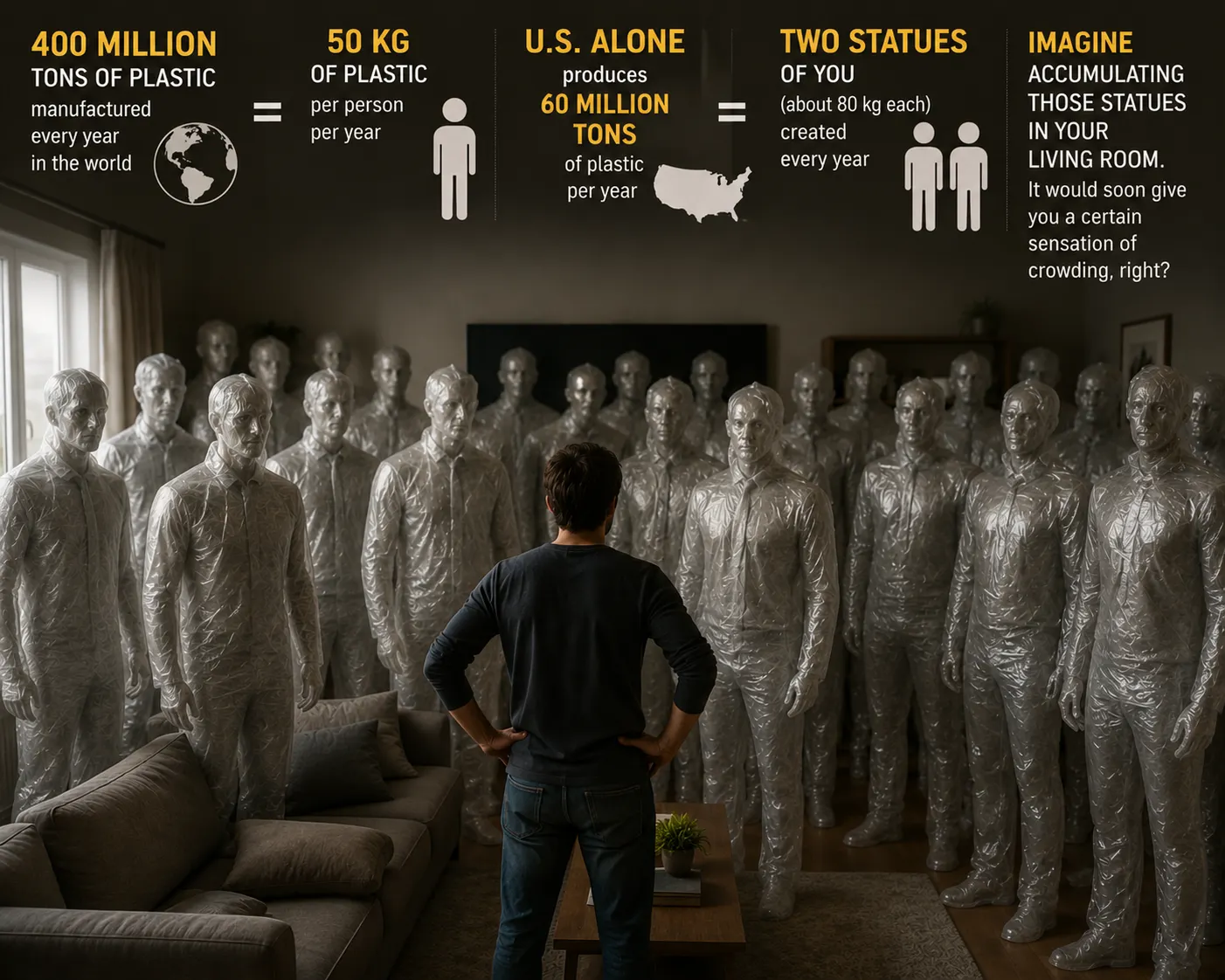
Every year, two plastic statues of you, and of the same weight (80 kg on average), are created.
In the 1970s, Coca-Cola introduced plastic bottles for the first time. At that time, I was living in the suburbs of New York City, and I remember people being perplexed enough that a reunion of the residents of the neighborhood was held in the local library. People were used to glass bottles and to recycling them. Some said they had tried Coke in the new bottles and it tasted bad. Others disliked the idea of plastic bottles as bad in itself. Only the local police officer was favorable, because sometimes glass bottles were abandoned in the streets and would damage car tires. The reunion ended with the general agreement that nobody would ever buy Coke in the new bottles.
Alas, that was long ago. Today, the story of plastic bottles tells us how easy it is to force things down people’s throats, even though they try to resist. Governments, of course, are masters at the propaganda game. Coca-Cola doesn’t have the same volume, but in terms of buying Coke in plastic bottles, yes, they could. Oh, yes, easily. They know the right PR tricks.
Why did they do that? Well, because they are interested in selling Coke, not bottles. And the cheaper the bottle they can use, the higher their profits will be. Plastic bottles are cheaper than glass ones, and the beauty of the idea was that the cost of the pollution generated by plastic bottles was passed on to the community: taxpayers had to pay the direct costs (garbage collection) and indirect costs (pollution). That didn’t affect Coca-Cola’s profits, and it was true independently of whether they drank Coke or not.
Of course, part of the propaganda operation centered on recycling, supposed to be able to eliminate all pollution problems. The beauty of the operation was that the burden of recycling was shifted in large part to consumers. You were supposed to be a good citizen by making the effort to dispose of your plastic bottle in the appropriate container, and you were told that it would be recycled. Nice and green, right?
Unfortunately, it was a scam. A huge scam, one of the many that are part of our world, and in which we all would still like to believe. But belief alone is not enough. It was Philip Dick who said that “reality is what is left when you stop believing.” And so we are discovering what huge scam the thing called “plastic recycling” is.
First, the problem: we have more than 400 million tons of plastic being manufactured every year in the world. Visualize it as about 50 kg per person per year. If you are American, think that the US alone produces some 60 million tons of the stuff per year. It means that every year, two plastic statues of you, and of the same weight (80 kg on average), are created. Imagine accumulating those statues in your living room. It would soon give you a certain sensation of crowding, right?
But the real problem is that you will keep milling those statues into fine dust, which you would then have to breathe, drink, or eat. It is what we are doing.
Now, the non-solution. Simply, plastic recycling is impossible if you understand it as “closing the cycle” of production. To close it, you would need to return plastics into the fossil fuels that were used to create it, methane or crude oil, and then the fuels would have to be pushed back into the reservoirs where they came from. Can you imagine the energy that would be needed, especially considering that the energy we use comes from fossil fuels? That’s a cycle that cannot be closed.
What we are doing, instead, is to turn plastic into more plastic and call it recycling (doesn’t it remind you of Tacitus’ “they made a desert and called it peace”?). But that cannot close the cycle. The plastics you recycle are still around; they simply continue haunting you as zombies do in movies. There is no evidence that recycling reduces the amount of plastic produced, and if there were some, you can be sure that the plastic industry would have turned recycling into anathema.
Instead, recycling is done only for a minor fraction of the plastic produced (10% if you believe the data from the industry). And recycling is never, or almost never, able to reuse discarded plastics to recreate the same initial products. Recycled plastics suffer from the typical “downcycling” problem. Since you mix different types of plastics during the recycling operation, the result is a material of lower quality than the initial product. Besides, some plastics are lost at every stage of the cycle, so you can do it once, maybe a few times if you are lucky. Then, everything is forever dispersed into the ecosystem. And you will breathe it, drink it, and eat it.
The real solution. There is no solution except zero plastic from fossil fuels. Which is, of course, heresy in the current way of thinking. Just note how the recent meeting convened by the United Nations in Busan, South Korea, on curbing plastic production ended in a failure. The lobbyists for the chemical industries succeeded in sabotaging an agreement that would only have curbed plastic production a little. Imagine agreeing on zero plastics!
And onward we go. Apparently, when having to choose between money and people’s health, our representatives made a clear decision.
Below, an excerpt from a good post by “The Slick” — the title is a little misleading. It is not that recycling in itself is a terrible idea — it can be done for many things and, after all, Earth’s biosphere has recycled everything it consumed over the past four billion years. It is plastics recycling that is a terrible idea.
From “Stay Slick”
Hear me out: recycling is a terrible idea.
In theory, it’s fantastic: trash turns into treasure, waste into a resource. Less landfill, less pollution, and a happy planet smiles approvingly upon us as we sort our garbage into color-coded bins.
Except, it doesn’t work; it just makes us feel like it does, and that we’re doing our part. So we sort, rinse, and toss (on a good day), filling our garbage bins to the brim with little to no guilt, believing it will all come back anew.
But it doesn’t. Instead, it ends up in landfills, in the ocean, and in our bloodstreams. Recycling, in practice, is more disappointing than opening a biscuit tin only to find out there is no biscuit, only sewing supplies.
Recycling isn’t inherently bad. Humans have been creatively reusing materials for millennia; Paul Revere’s horse may have worn horseshoes made of recycled scrap metal. During the Great Depression, cookie tins became lunchboxes, and flour sacks became dresses. Back then, it wasn’t called recycling, just common sense. Waste not, want not.
So why did we need a new word? The word ‘recycle’ first appeared in the 1920s to describe industrial processes that reused waste materials and by-products. It only took its modern meaning during the late 1960s, with the rise of the environmental movement, when it emerged as the solution to a problem that didn’t need to exist in the first place.
This, Slick, is the story of how we got scammed: of how containers became waste, how responsibility was externalized, and how we got told we had the power to save the world when all we got was the burden. Maybe the greatest corporate psy-op in history.
1. Life In Plastic: It’s Fantastic!
Up until the middle of the 20th century, beverage companies used glass bottles in closed-loop systems. You paid a deposit upon purchase, got it back when you returned your bottle, and the producer washed and reused the container. Losses were tracked. Efficiency mattered. Producers owned their waste.
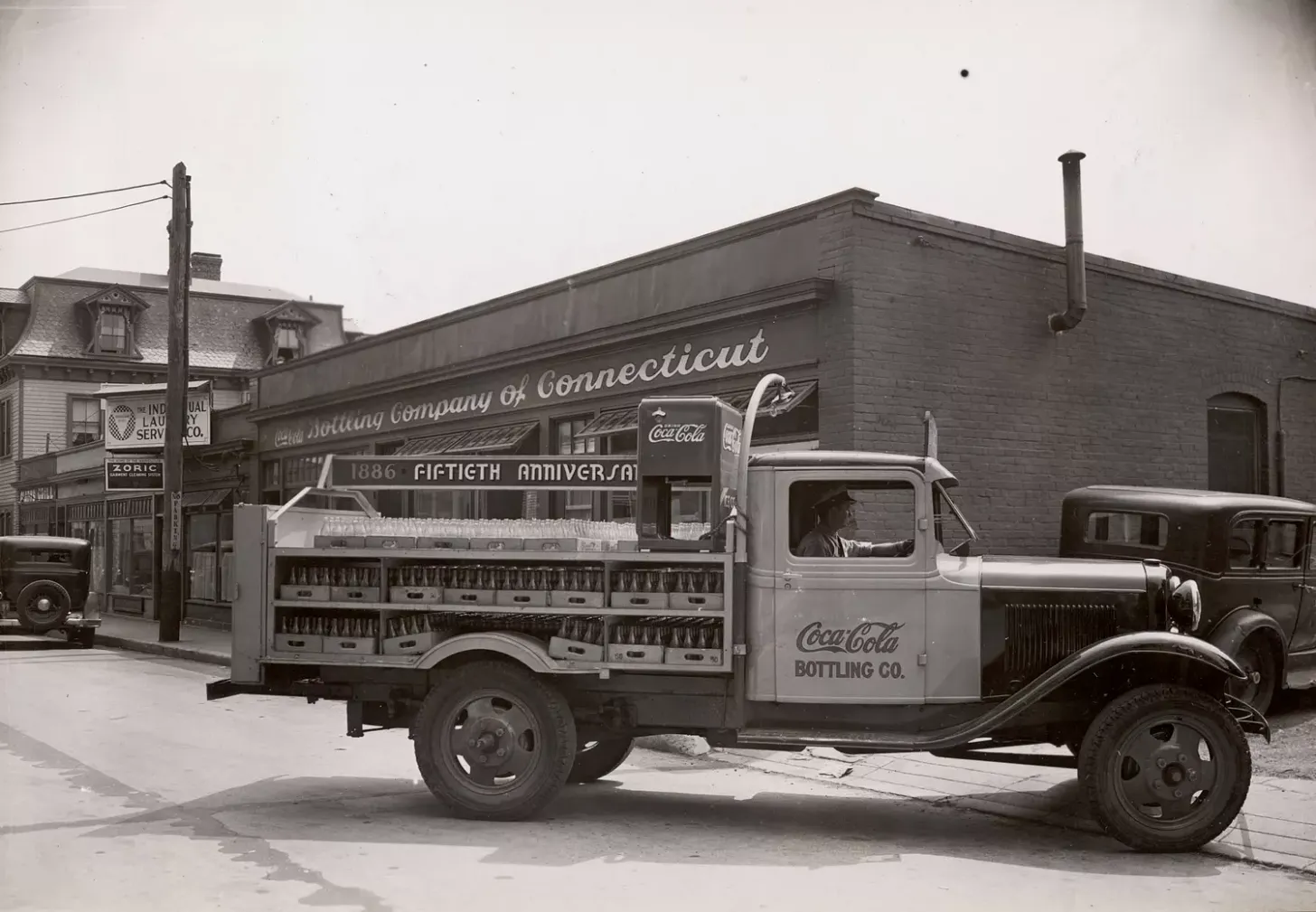
Coca-Cola truck, 1936. Photo by Frederic Lewis/Archive Photos/Getty Images
Click on the image to enlarge.
Then came the Post-War boom. Plastic became cheap and scalable. Companies ditched reuse for disposables—no need to collect, just produce more. Waste became someone else’s problem.
Plastic Planet
Fast-forward to today. Every year, we produce over 400 million tons of plastic globally—that’s about the weight of all humans on Earth or a million fully-loaded 747s. We could wrap the whole planet in cling film several times over, every year. And we kind of do.
Out of those, less than 9% gets recycled. Which means over 350 million tons don’t. So what happens to the rest?
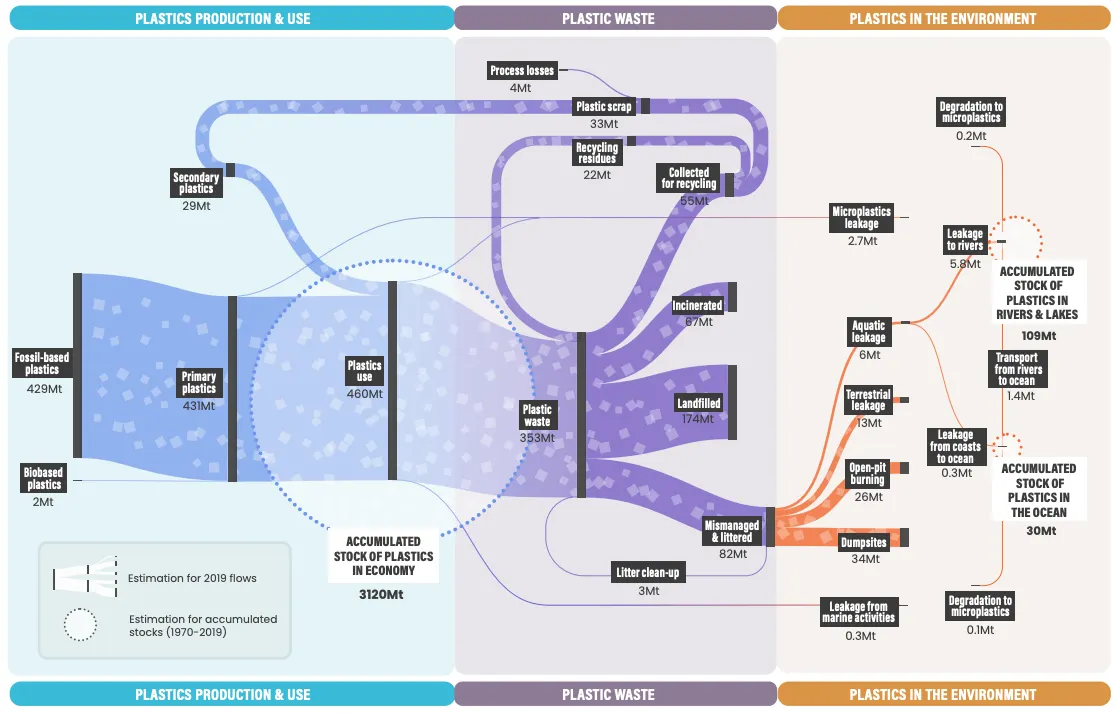
Source: OECD. Click on the image to enlarge.
Well, it gets ‘recycled’ too—into toxic chemicals.
About 20% is just littered or ‘mismanaged’, which means dumped or burnt in the open.
About half ends in landfills, where it’s mostly contained—except for the heavy pollutants that leach.
And about 20% gets incinerated, turning into a bit of energy and a lot of toxic pollutants.
I’m not talking about CO2 and methane (though maybe we should be). I’m talking about dioxins and furans, PAHs (polycyclic aromatic hydrocarbons), and heavy metals like mercury, cadmium, and lead—not to mention PCBs (polychlorinated biphenyls) in older plastics, banned in the US in 1979.
What do these do? It’s not too bad, right?
No, it’s not… If you’re not too fussed about cancer, genetic damage, neurotoxicity, and damage to the hormonal, reproductive, and immune systems.
One man’s trash is another man’s cancer…
Continue reading this post at “Hey Slick”
By the same author:
Changing the Money System ~ Changing Everything
The Knowledge Hub: A New Way
of Learning about Population Trends
Population Collapse: Can It Be Predicted?
The Limits to AIs:
An Evolutionary Perspective