Every year in my course “Feminism and the Environmental Movements,” we take a part of one class session about halfway through the semester and explore what an ecofeminist world should look like. I begin by drawing a large circle on the whiteboard, representing the world and as a class we discuss what belongs in the world. That information goes on the inside of the circle. What we don’t think belongs within an ecofeminist world, I write on the far corners of the board. Then there are those topics about which no consensus can be made. Those I write along the edge of the circle, and we spend considerable class time debating the reasons why those ideas are controversial.
Consistently, various patriarchal institutions, and indeed patriarchy itself, find themselves banished to the far reaches of the whiteboard: racism; sexism; dualistic thinking; homophobia; transphobia; classism; capitalism; (neo)colonialism; and war. Those ideas that make it within the circle often include diversity, responsibility, nature, feminism, interconnection, care, relationality, community, consensus decision-making, animals, and nature. What stays along the edge is often ideas like eating animals, whether religion is necessary or not, violence, and so on.
I often push them on the religion issue, reminding them that while it may not be important for them, some people find great sustenance in their spiritual lives. When it comes to violence, the debate often comes down to whether or not humanity can every truly rid the world of violence and whether or not human nature is somehow always minimally violent. Sometimes, the discussion around violence looks at how some animals kill other animals for sustenance and how that kind of violence is deeply connected to their needs. Other times, particularly this year, we discussed how eating animals requires violence if some of us want to continue to do so.
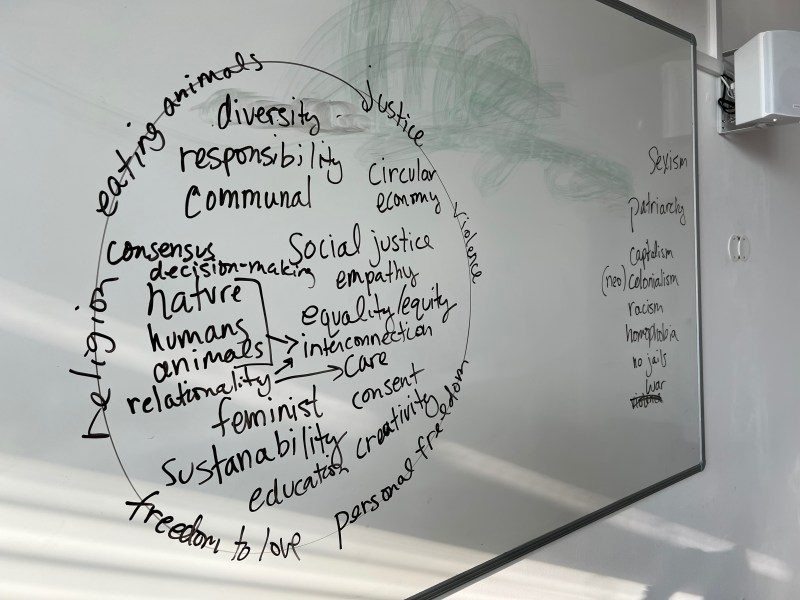
Author’s photograph of in-class project. Click on the image to enlarge.
After we have this basic idea on the board and discussion is well exhausted, I will then (time permitting) pose the question: how do we get from where we are to here? This is when the conversation often turns rather pessimistic. Students often cannot think of examples of how to uproot capitalism in any meaningful way. They do not see ways in which they can convince people to stop hating others for the color of their skin, for whom they love, for their gender identity, and so on, nor can they decide how much democracy is or is not a ecofeminist system or failing that, how to have large populations who practice consensus. So, they often say something along the lines of the following: we should recycle, buy second-hand clothing, eat less animals, eat locally, vote for individuals whose values match ecofeminist ones, and participate in activist movements for change. I find that this list often leaves me wanting as many of us do these things already and find it hard to see truly meaningful change to the system.
I thought that perhaps I need to branch out for answers and decided to come to this blog for inspiration. My question for the reader is twofold.
- What do you think needs to be included in our ecofeminist world?
- How do we work to bring about that world?
I would love to hear your suggestions. May an ecofeminist world soon become reality.
ABOUT THE AUTHOR
Ivy Helman, PhD, is a queer ecofeminist Jewish scholar, activist, and professor living in Prague, Czech Republic. She is currently teaching at Charles University in the Gender Studies Program.
|
|Back to Title|
LINK TO THE CURRENT ISSUE
LINK TO THE HOME PAGE