
|
Mother Pelican
A Journal of Solidarity and Sustainability
Vol. 22, No. 7, July 2026
Luis T. Gutiérrez, Editor
|
|
|
|

|
|
|
How to Think About the Future (Part 2):
Four Variables Shaping the Coming Decades
Nate Hagens
This article was originally published on
The Great Simplification, 9 June 2026
REPUBLISHED WITH PERMISSION

Illustration provided by the author. Click on the image to enlarge.
|
Hello. This essay is the second part of my recent series, “ How to Think About the Future,” where we’re taking a deeper dive into both scenario building, and ultimately planning and acting for our future.
In the first part I talked about why I think it’s important to hold the future as a landscape of possibilities – to not just hold the futures we’d prefer, but all those that are possible. I discussed the trap I often see people fall into: becoming settled on a particular view of the future, then framing and judging everything else against it. In contrast, I (and many other systems scientists I’ve studied) find it most helpful to have a distribution of possible futures to consider, with a midpoint.
The reality is, I don’t know which specific future is coming. None of us do. So the more honest, and ultimately helpful, move is to learn how to hold several at once. And today I want to lay out the building blocks for how to do that.
Four Economic Scenarios
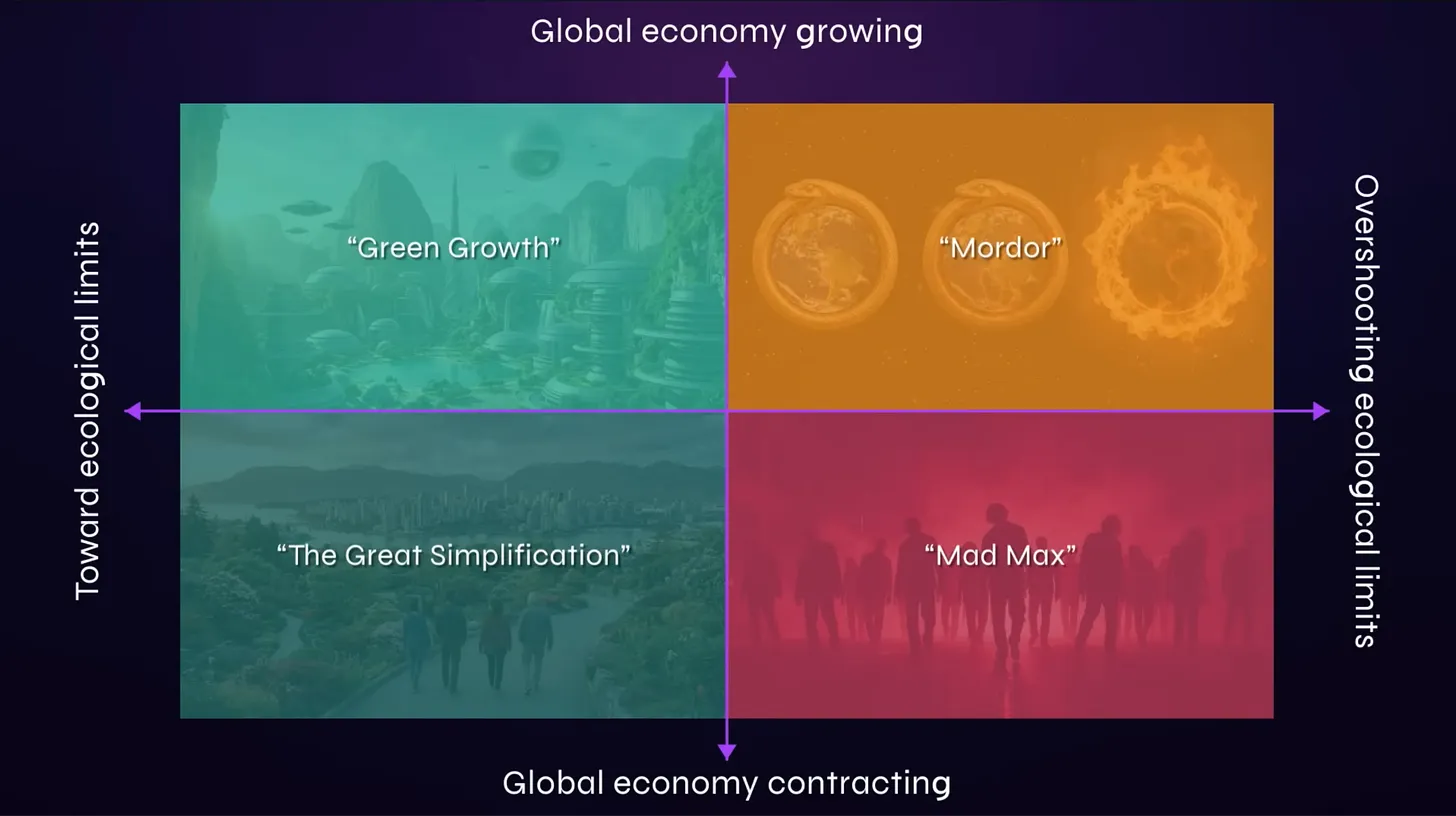
I’ll start with a framework most of you have already heard me talk about on this platform. The four scenarios I’ve used for years to describe possible futures are Green Growth, Mordor, The Great Simplification, and Mad Max. If you’re newer here and want to dig deeper into these scenarios, I encourage you to check out my 2024 Summit Presentation.
Click on the image to enlarge.
I’ll quickly refresh the logic: the first axis of this grid represents whether the global economy keeps growing in aggregate, or begins to contract from today’s level of throughput. The second axis is whether that growth or contraction happens in a way that stays closer to ecological limits, or whether it runs further into overshoot and keeps liquidating the living world.
These two axes give us four quadrants: Green Growth would give us physical expansion that bends toward ecological regeneration. The Mordor economy would bring expansion that stays extractive and further exceeds planetary boundaries. The Great Simplification would combine economic contraction with coordination and ecological stewardship. In a Mad Max world we would see economic contraction, along with ecological (and other) deterioration.
Of course the world won’t land neatly in just one of those boxes – these are directional attractors. Different regions may be in different quadrants at the same time. The quadrant you’re in might also shift, sometimes abruptly. But I think these four categories are useful. They provide an immediate handle on the directional possibilities via a simplistic two-by-two grid. However they also hide something important, because none of our futures will be only an economic story. Two people can agree we’re heading into contraction, but still disagree completely about what life will be like and feel like, because they’re imagining different power structures, geopolitical backdrops, and ecological conditions.
So today I’m going to keep these four scenarios as the foundation – I’ll treat them as the first of four grids, adding additional ones that capture some dimensions the economic grid doesn’t cover: power and distribution, geopolitics, and Earth systems. There will also be an additional section about technology, and I’ll explain why I’m treating it as a wildcard or modifier rather than another grid layer.
Each scenario will consist of a two-by-two grid with four quadrants. The spectrums in these grids give us a way to talk about direction and tendency of the future, without pretending that it has any sort of precision. Growth or post-growth is one layer, now let’s add what determines the lived experience under that headline.
Types of Power
We’ll start with power. But before I lay out the axes, I want to step back and explain what I mean by power, especially because the word gets used so widely and loosely that it can get confusing.
When I say power here, I don’t mean energetic power – the ability to do work. I mean four specific sources of power that actually shape the outcomes in any society one could study. I’m expanding here on what I learned from one of the Daniel Schmachtenberger “Bend Not Break” podcasts.
The first source of power I’m talking about is military power: who has the guns, and the capacity to use or threaten force. Military power is the oldest source of power, and the one that ultimately backstops the other three. The second is political power: who makes the laws, appoints the judges, and controls the legitimate authority of the state. Political power shapes the rules everyone has to live under. Third is monetary power: who has the capital, decides what gets funded, and controls financial flows – and therefore resource flows. In a financialized economy, this source has gotten enormously bigger over the past fifty years, to the point where in many places it now drives political power rather than the other way around. The fourth source, which is newer and growing fast, is technological power: who controls the platforms, data, algorithms, and infrastructure that the rest of life now runs on top of. Twenty years ago, this would have been a footnote inside the money category. Today it’s becoming its own source. And honestly, in some domains it’s already the dominant one.
Source. Click on the image to enlarge.
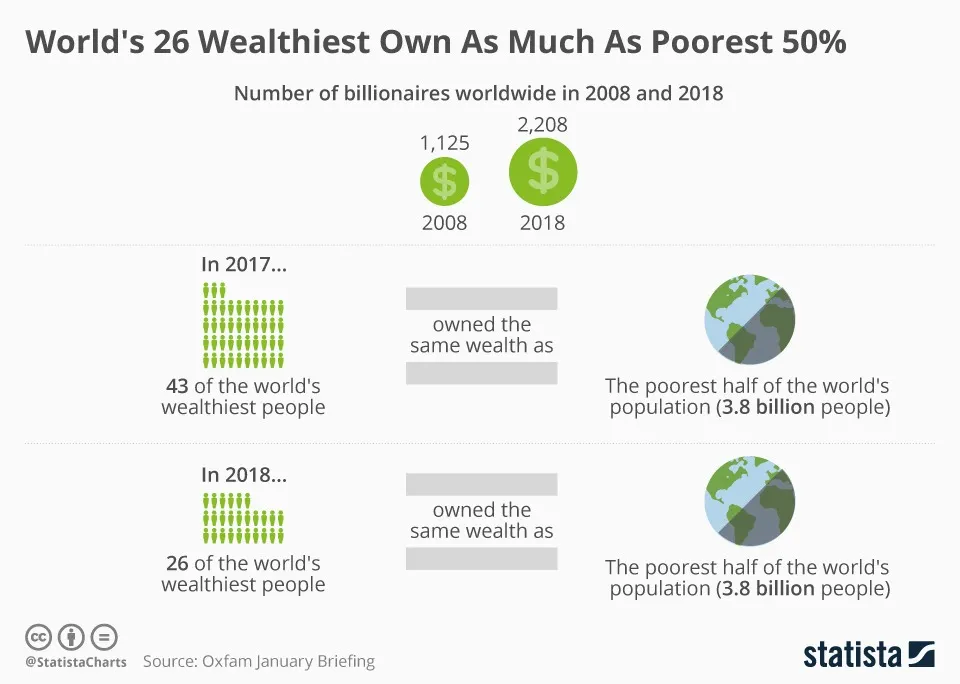
As we are seeing in real time in April of 2026, military power remains the ultimate power – at least for now. Who controls violence holds the real power, and the other categories are more about how that power gets enacted. We are still fire apes after all, and a small percentage of us have dark triad traits. This is both an important point, and a provocative one for a future scenario analysis – that the backstop power, violence, might report to the technology or wealth class. As a reminder, the world’s 12 wealthiest people hold the same financial wealth as the four billion humans at the bottom of the financial pyramid. The AI race is in the hands of a relatively small group of people and an even smaller group of companies, and the current trend in many countries’ governments is moving toward concentrating and consolidating power.
Power Distribution Scenarios
Now that we’ve defined what we’re talking about when we’re using the term “power,” we can look at any society and ask which of these four aspects of power are concentrated and which are distributed. The answer often tells us something the headline numbers don’t. A country might have broadly distributed political power – one person, one vote – and still be deeply unequal because money and information are in very few hands. The vote might be broad, but other leverage in the society is very narrow.
Click on the image to enlarge.
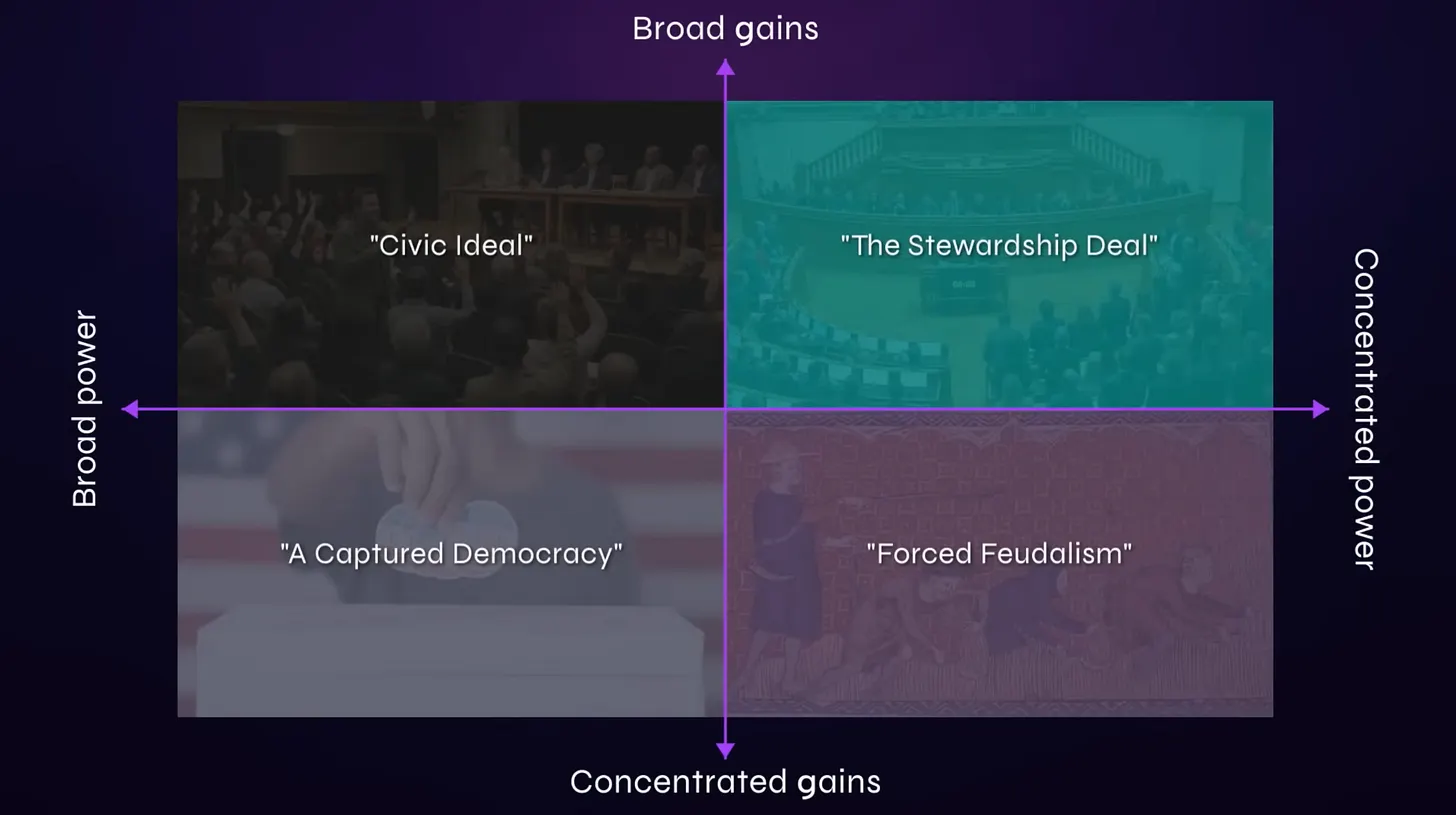
So the first axis of this grid is power: is decision-making authority in the economy broadly distributed or pretty concentrated? The second axis is gains: are the material benefits of the system broadly shared, or captured by a narrow group? Where is the ecological and energy surplus flowing?
An important aside, and something I’ve been thinking a lot about recently, is that during a period of growth, the “Who gets what“ question feels like a question about fairness: Am I getting my share? Are things more or less fair and equal? But during contraction, that question may transform into something much more basic: Is there enough? Can I feed my family? Can I heat my home?
The axes stay the same, but how it feels to live inside each quadrant changes dramatically depending on whether the economic headline is growth or contraction. It’s like a phase shift from fairness to basic needs.
These two axes – power and gains – produce four quadrants: The civic ideal has broad power and broad gains – people participate meaningfully in decisions, and the resulting outcomes reach most of the population. Think about functional democracies with strong public goods during growth, and coordinated rationing during contraction. Hard, but also dignified. The stewardship deal is in the quadrant of concentrated power and broadly shared gains – a small group holds authority, but the outcomes are broadly distributed because the rulers choose to, or need to, keep the population functioning. Singapore and East Asian post-war development states are modern examples. It can be stable, but it’s dependent on the continued competence and goodwill of whoever’s at the top – and that’s a fragile thing to depend on over time. Broad power and narrow gains might be labeled a captured democracy – everyone votes, but institutions are really only nominally democratic. The real gains flow to a small class, meaning industry leaders and lobbyists write the laws. The formal structure professes “shared power,” but the lived experience feels a lot more “rigged.” I think this is arguably where much of the West already sits today. During contraction, this becomes the most unstable quadrant because people have just enough political voice to be angry but not enough real power to change outcomes. You’d get extreme regime swings and rapidly dissipating trust in government. Lastly, concentrated power and narrow gains could be called forced feudalism. A small group both rules and takes – this might look like kleptocracy or colonial extraction. During contraction, this would be the most dangerous quadrant because the people have no voice and also no share. This is where violent resistance or total societal breakdown becomes most likely.
I’m deliberately using one grid here to cover what you might separately call “governance,” “political economy,” and “social structure.” Those three things move together more than they move apart. This is complex enough, so I think one reasonable scenario grid with caveats is more useful than three grids that seem independent, but really aren’t.
We’re two grids in – both are “domestic” in the sense that they describe what happens inside a society. The next grid zooms out to the international level, because even the best domestic arrangement can be disrupted by what’s happening between nations.
Geopolitical Scenarios
This third grid captures the international backdrop that shapes energy security, supply chain reliability, whether coordination on shared problems is even possible, and the background risk of major wars.
Click on the image to enlarge.
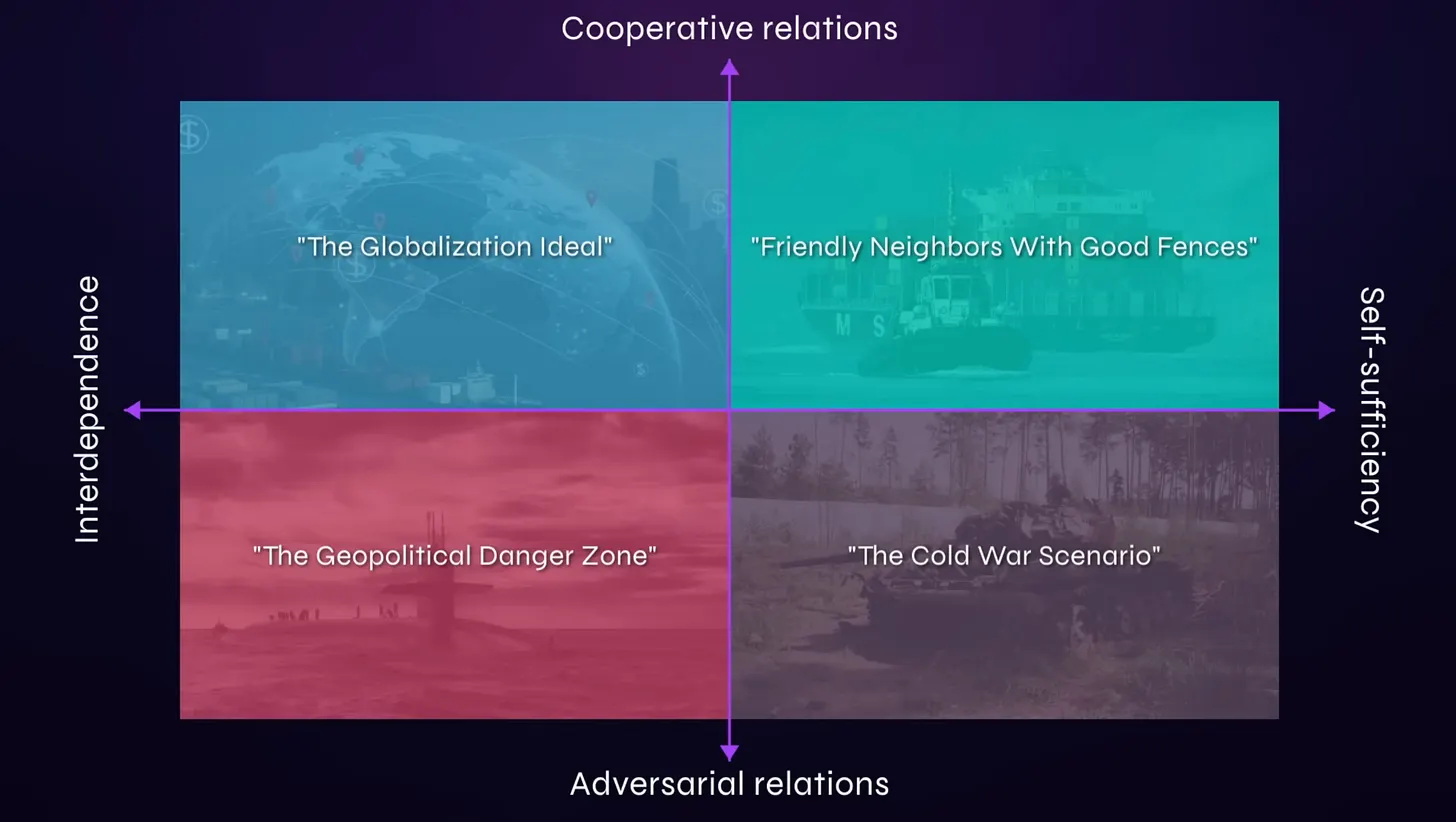
The first axis is cooperation versus adversarial relations: can major powers coordinate on shared problems, even if they don’t like each other or view each other as adversaries in other realms? The second axis is interdependence versus self-sufficiency: are nations deeply enmeshed in global supply chains for essential needs, or have they built enough regional and domestic capacity to function more independently?
I should note upfront – true self-sufficiency is nearly impossible at modern levels of complexity. Even North Korea depends on China for fuel. The U.S. is mostly energy self-sufficient, but also deeply interdependent on semiconductors and pharmaceuticals. So “self-sufficient” on this grid means relatively self-sufficient, at least enough that a major disruption doesn’t immediately threaten your ability to function. Countries sit somewhere along this spectrum, and many are actively moving along it right now.
So what would the four quadrants along these two axes of coordination and dependence be? The combination of cooperative relations and interdependence gives us the globalization ideal. Trade flows freely and shared institutions manage disputes – this is broadly what the world aimed for from about 1990 to 2015. It’s extremely efficient, but everything is wired to everything else, so a disruption anywhere eventually shows up everywhere. You can think of the second quadrant as friendly neighbors but with good fences. States are cooperative, yet self-sufficient. Regional blocs trade and maintain relations, but don’t depend on each other for survival. Things move slower and are more redundant. This might actually be the most stable long-term configuration under the energy contraction of the carbon pulse because it reduces the transmission of shocks while preserving some cooperation. What I would label the danger zone is a combination of adversarial relations and interdependence. There are hostile relations between powers that still depend on each other’s resources and chokepoints, and every economic node becomes a potential weapon. Hormuz as leverage, the Taiwan Strait as a pressure point – this is arguably where we are right now. This situation is extremely unstable because a single chokepoint failure cascades globally. The Iran war is demonstrating this in real time with sulfuric acid, helium, fertilizer, and the like. Finally, we have the Cold War scenario, which combines adversarial relations with self-sufficiency. This is the Superorganism fission I mentioned in a recent Frankly on what I label “the quadruple bifurcation.” Two or more blocs have decoupled enough to survive independently, but they are hostile to each other. There is lower risk of supply chain cascade, but paradoxically higher risk of direct military confrontation because the economic deterrent of mutual damage is now reduced. If you don’t depend on each other, the cost of fighting goes down. That’s a sobering thought.
You can see this grid playing out live right now. The closure of the Strait of Hormuz is showing every country what adversarial relations with interdependent supply chains actually feel like. The Philippines has declared an energy emergency, Bangladesh is closing universities to save electricity, and Japan is releasing its largest oil reserves. The response everywhere is movement toward greater security and self-sufficiency. The question is whether that movement happens cooperatively or adversarially – that’s the axis that determines whether we get friendly neighbors with good fences, or Cold War fragmentation.
Three grids in – economic direction, power, and geopolitics. These describe human choices. The last grid is different from the first three because it describes boundary conditions – what the planet is doing at the same time we invent, legislate, debate, and fight.
Earth Systems Scenarios
The final grid is about Earth systems. This is the grid that “bats last,” as many point out. We might be able to steer it, but it has a momentum and metabolism of its own.
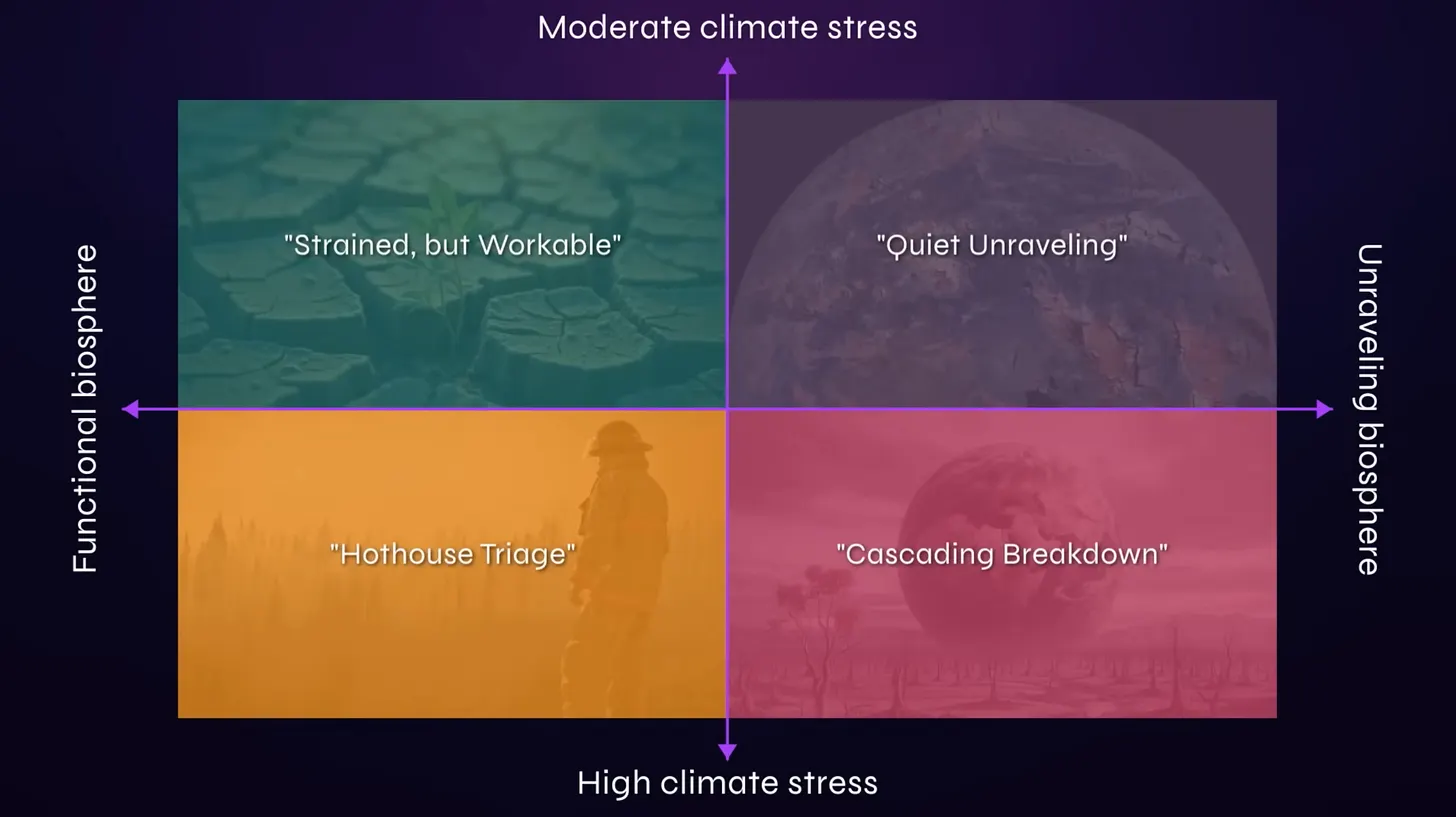
Click on the image to enlarge.
The first axis on this grid is stress from global heating. I don’t just mean average warming – I mean both the volatility and the extremes: heat waves, droughts, floods, fire seasons, and crop shocks, as well as compound events where multiple extremes hit at the same time. The second axis I’ll summarize as biosphere integrity: are the living systems we depend on still broadly functional, or are they unraveling? Soils, freshwater, forests and their functions, fisheries, pollinators, and trophic webs. This is the dimension the planetary boundaries work focuses on, and it’s the one that often gets overshadowed by the climate conversation, despite being equally critical. Maybe more critical in some ways.
Here are the four quadrants that these axes produce: The strained but workable scenario brings moderate climate stress, with the biosphere still being broadly functional. Adaptation is hard and extremes are more frequent, but systems still mostly function. There is still some slack, and mistakes are survivable. A quiet unraveling happens when there’s moderate climate stress, but the biosphere is thinning underneath. Soils degrade, pollinators decline, fisheries shrink, water tables drop, and food production gets harder even without dramatic weather. That’s because the biological foundations are weakening. This scenario is insidious because it doesn’t make headlines the way hurricanes and heatwaves do – it’s the slow erosion of Earth’s carrying capacity, and the slow shifting of baselines away from the stability of the Holocene. The Hothouse triage means severe climate stress with a partially-resilient biosphere. This is the scenario of constant emergency management. Society is always responding to some major issue, and is in a constant state of rebuilding. Important resources are perpetually diverted from development to recovery. The last scenario is the cascading breakdown, where we would simultaneously see severe climate stress and an unraveling biosphere. There would be multiple systems failing at once, and compounding failures where each shock hits before recovery from the last one is complete. In ecological terms, this is where overshoot finally stops being a fancy phrase and becomes a concept we feel every day.
An important thing to highlight here is that none of these four quadrants includes a fully healthy and stable climate or biosphere. That’s because we’re already locked in on some level of degradation in these systems. We’ve already loaded the atmosphere and oceans, significantly degraded soils across major agricultural regions, and pushed past safe thresholds on seven of the nine planetary boundaries. So this grid describes trajectories from an already-compromised starting point in 2026 – all these scenarios ask the question, “How much harder does it get?”
Let’s be clear though – choice still matters. Regenerative agriculture can rebuild soil health over decades. Ecosystem restoration can recover some biosphere function. There are many people working on global cooling initiatives and many other regenerative ideas. Yes, the overall trajectory is set, but the destination still has quite a bit of flexibility – it’s why I work so hard on these issues. Could humanity, at the eleventh hour, become more stewards than reapers?
Technology and Demographics
You might be wondering why I don’t have a separate grid for technology. AI, automation, surveillance, renewable energy, biotech – these will obviously shape the future.
Here’s my reasoning: technology’s effect depends almost entirely on the context in which it sits. The same AI is a tool for liberation in one power structure and a tool for enclosure in another. The same agricultural technology is regenerative in one economic model and extractive in another. Technology mostly amplifies whatever the surrounding system is already doing – for better in one context, for worse in another.
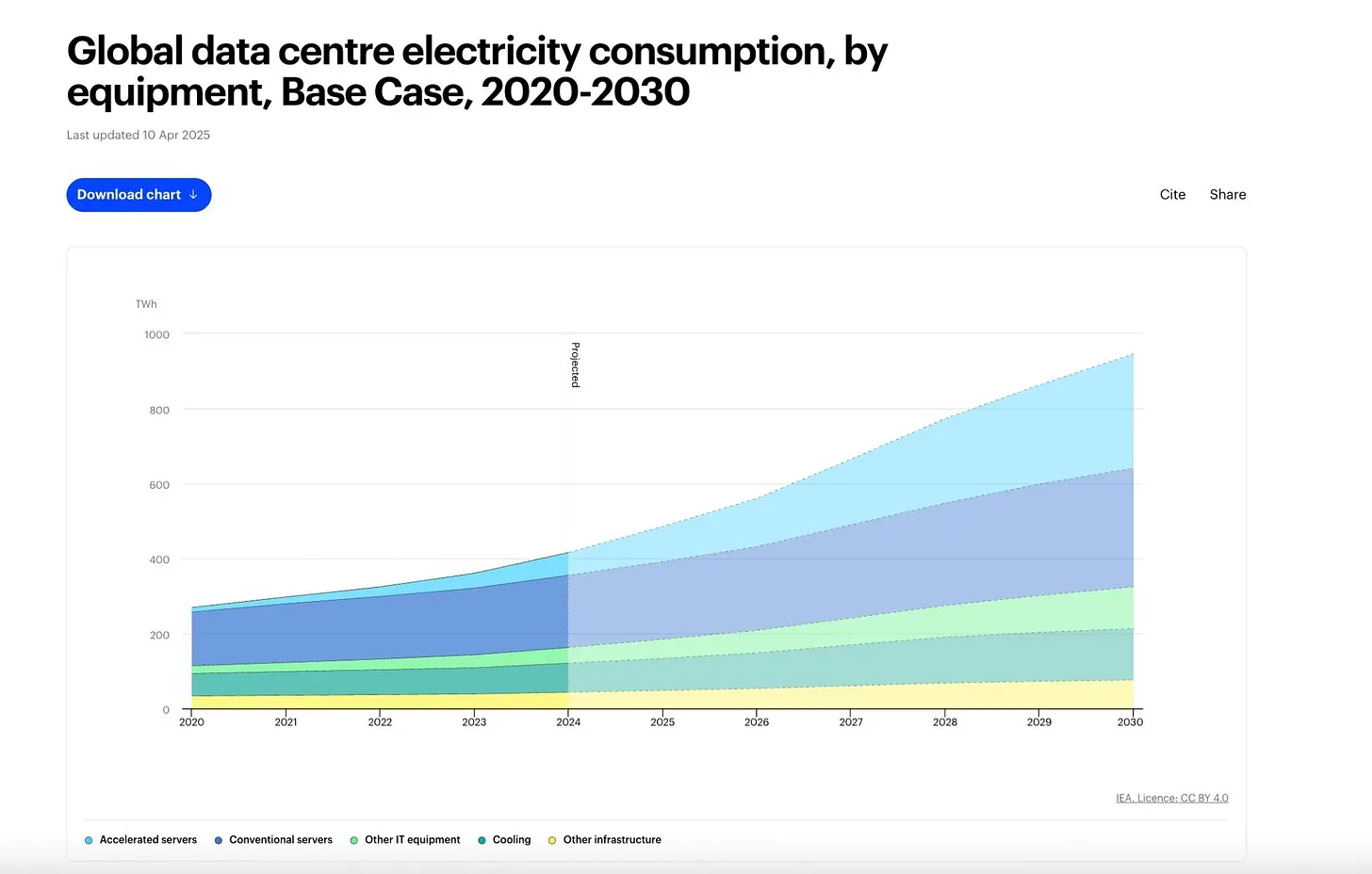
Source. Click on the image to enlarge.
Some of you are going to push back on this, and say AI in particular deserves its own grid. I have thought about it. The reason I chose otherwise is that the data centers running AI are themselves a massive new draw on the energy system, and energy is the binding constraint in this whole framework. Global data center electricity demand is on track to roughly double by 2030, with AI as the main driver.
So AI isn’t outside these four grids, it sits inside them, amplifying whatever direction the underlying system is already moving. In Mordor, it makes extraction more efficient and surveillance more ubiquitous. But in a managed simplification, it could make design and repair more accessible. Technology amplifies things, and what it amplifies depends on which system it sits inside.
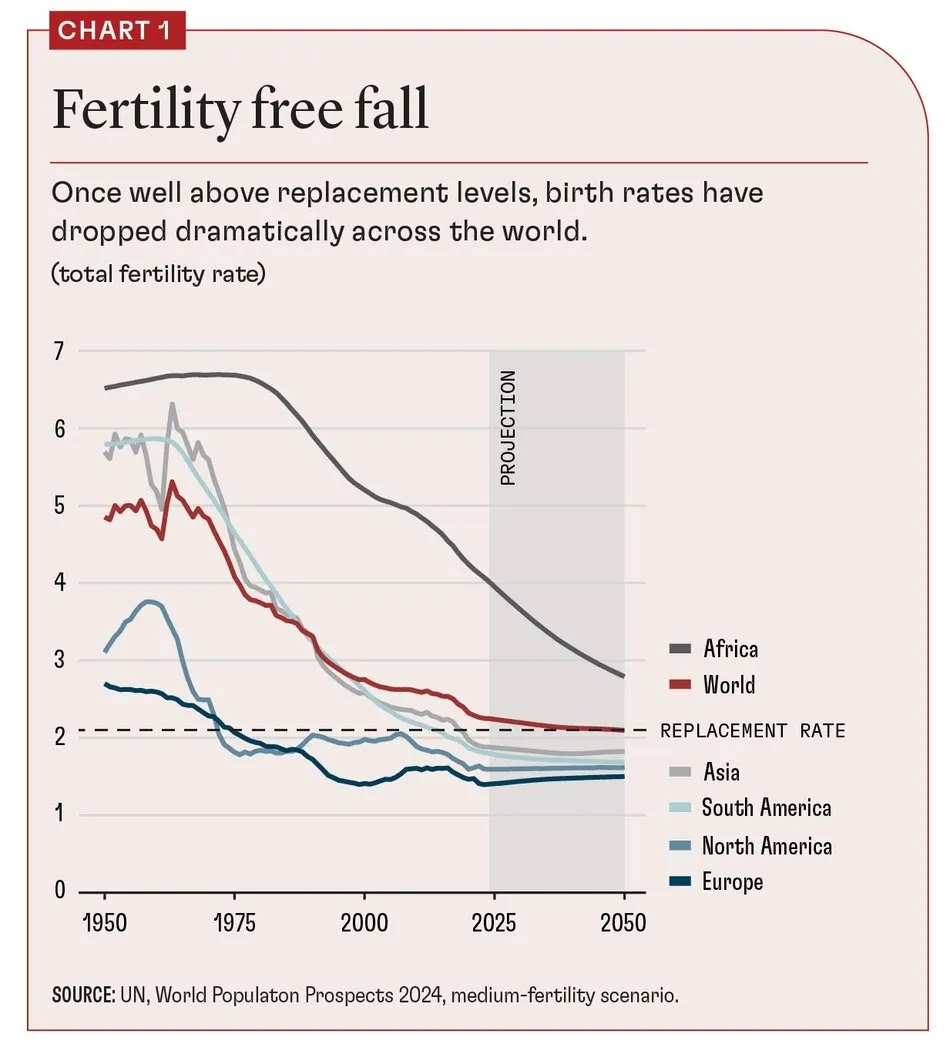
Source. Click on the image to enlarge.
One more thing I considered, and chose not to give its own grid, is demographics. Global fertility has fallen faster than any forecast predicted. South Korea hit a fertility rate of 0.72 in 2023, a third of replacement. Most of the developed world is now well below replacement. This reshapes labor, care work, political power, and migration over the same timeframe these composite worlds describe. I chose not to give it a separate grid because its effects show up inside the other four, like technology. But demographics and population are sitting underneath all of this, and in a longer version of this framework it might earn its own dimension.
There are actually probably tons of other potential grids that could be made and incorporated into future scenarios – demographic change, mental and physical health, freedom of communication and information. Maybe you all can build on this and expand this conversation: what other grids might also be important spectrums for anticipating the future? How might they interact with the ones I’ve laid out today?
Looking Ahead
There are a zillion ways to parse all this – I came up with these four grids, which I think cover the main bases: Economic direction – growth or contraction. Power and distribution – both how it’s concentrated and how it’s shared. Geopolitics – adversarial versus cooperative relations, and independent or connected. Earth systems – basically warmer climate or much warmer, and more or less biosphere integrity.
Plus technology as a modifier to it all.
None of these can be a “future scenario” by itself – these are only layers. A real scenario would be a composite of these layers. We won’t live in a general Great Simplification, we’ll live in a Great Simplification with a particular power structure, a particular geopolitical backdrop, and a particular ecological condition. The same economic headline scenario will produce radically different lived realities depending on what else is in the stack.
In the next part of this series, I’m going to build a handful of scenario composites from this foundation that will be vivid and concrete enough so we can feel the difference between living inside one world versus another. Imagining these scenarios is important because it will then inform which interventions make sense depending on which stack we’re considering, or maybe actually moving into in 2026, and which ones we’d like to steer toward.
Once we can articulate the stacks somewhat clearly, we can perhaps reduce our arguing about single-story futures and start talking more about practical robust choices and effective strategies under genuine uncertainty.
I’ll see you then, thanks for reading.
Want to Learn More?
If you would like to see a broad overview of The Great Simplification
in 30 minutes, watch our Animated Movie.
You can also find additional resources on our Website.
By the same author:
What to Do As the World Falls Apart: A Framework for Action
A Guide to Staying Human (Part 1): Desperately Seeking Agency
Why 'Community' Fails: Everyone Wants a Village,
Nobody Wants to Be a Villager
A Guide to Staying Human (Part 2):
Navigating Dread and Carrying the Weight of Tomorrow
ABOUT THE AUTHOR
Nate Hagens is the Co-founder and Director of The Institute for the Study of Energy and Our Future (ISEOF). Formerly in the finance industry at Lehman Brothers and Salomon Brothers, since 2003 Nate has shifted his focus to understanding the interrelationships between energy, environment, and finance and the implication this synthesis has for human futures. Allied with leading ecologists, energy experts, politicians, and systems thinkers, ISEOF assembles roadmaps for understanding how human societies might adapt to lower-throughput lifestyles. Nate also moderates the podcast The Great Simplification, on "illuminating the path for future generations, navigating uncertainty through understanding. and building a resilient future together."
|
|Back to Title|
LINK TO THE CURRENT ISSUE
LINK TO THE HOME PAGE
|
|
|
|
"The difference between stupidity and genius
is that genius has its limits."
— Albert Einstein (1879-1955)
|
|
Page 20
|
|
|