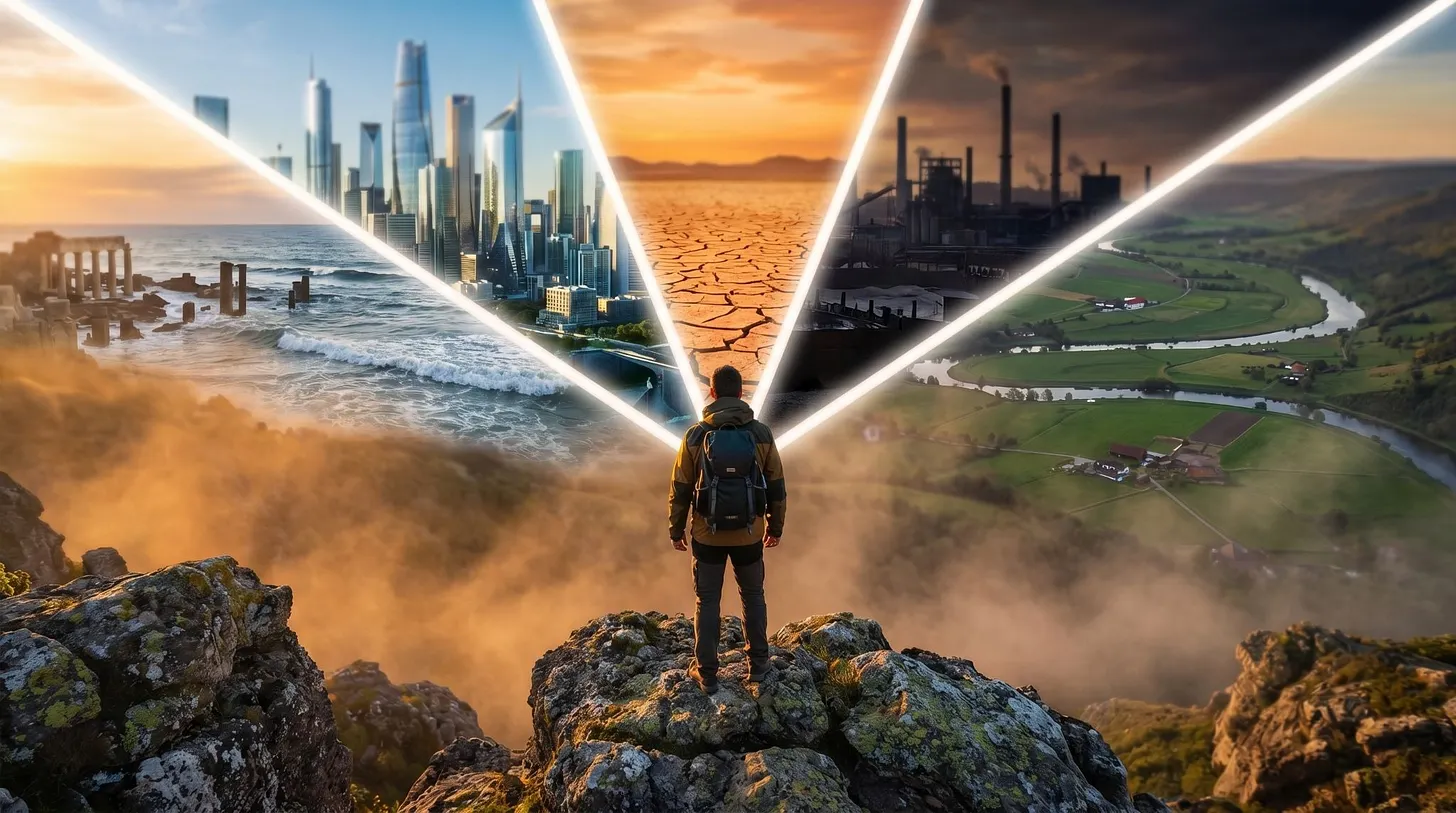
This is the first essay in a new series I’m calling “How to Think About the Future.” If you’ve followed The Great Simplification for any length of time, you’ve probably noticed we cover a lot of different topics: energy, ecology, economics, AI, geopolitics, mental health, food systems, governance, permaculture, plastics, nuclear, soil, water, meaning, and community…pretty much everything that relates to the unfolding more-than-human predicament.
Every single time we put up an episode on one of these topics, we get a predictable kind of comment. Maybe you’ve left one yourself, or maybe you’ve read one and agreed. It usually sounds something like these:
“Why are you having a nuclear expert on? Nuclear is too late and too expensive to matter.”
“Why are you talking about plastics and toxic chemicals when the global economy is going to collapse anyway?”
“Why feature renewable energy experts when we both know renewables can’t replace fossil fuels at scale?”
“Climate isn’t even in the top ten risks people are worried about, so why are you spending so much time on it?”
There are dozens of other examples along the same vein. I read these comments, though my staff tells me not to, and I take most of them seriously. That’s how I roll, for better or worse. Based on my experience, each of these assertions comes from someone who has likely settled on a particular view of the future and is framing everything else against it.
If you’ve decided that economic collapse is imminent, then conversations about long-term ecological restoration feel like a luxury. If you’ve decided that AI is going to change everything, then conversations about soil biology feel sort of quaint. If you’ve decided that global heating is a socialist hoax, then climate-focused episodes feel like a waste of your time, or worse, a hit to this platform’s credibility. I understand the impulse as I also notice this tendency in myself, though less so now. It’s human nature after all.
This type of thinking used to bother me, but now I get it. There’s an efficiency to having a single storyline in our heads. It tells us, as biological organisms with finite lifespans, what to pay attention to and what to ignore. It lets us sort the world quickly and save cognitive effort.
But after more than twenty years of observing and thinking about this behavior in myself and others, I’ve formed a different perspective, one that I want to present here. Instead of saying “This future is coming, let’s prepare for it,“ I want to take a step back and ask some different questions: How do we think about the future when many futures are still plausible? How do we plan and engage when we genuinely cannot predict?
This essay is the first of an ongoing series. Before we dig into any specific scenarios, I want to talk about how to simply hold the future in our minds when there are many plausible futures. That’s this essay.
Part two will be about specific scenarios. I’ll lay out four simple grids that capture the main dimensions of our coming lived experience: economic direction, power and distribution, geopolitics, and Earth systems. Each one will have a two-by-two grid that I previewed in ”What to Do as the World Falls Apart: A Framework for Action.”
Part three will be about how to map the terrain, the hills and valleys, which shape the probability of these futures. I’ll discuss how humans might be able to flatten or steepen those hills and shift the odds toward better futures.
Part four will be about the way that these scenario grids stack on top of one another to create a composite world, because real futures will arrive as combinations, not as single variables.
The final part will be about the concept of “shortfall risk” and robust responses, where we talk about planning when we’re unable to predict what lies ahead, and what factors remain important across multiple possible futures.
Okay, here’s Part 1 on how to think about the future.
The Only Authentic Response
I don’t know which future is coming. No one does. We all hold a base view of what we think the most likely future will be, which some hold on to more tightly than others, and a range of other possibilities beyond that based on the factors we hold to be most important.
My own base view, based on energy, debt, ecological, and geopolitical trends, is that the global economy is going to hit a wall in the relatively near future. I think there’s a meaningful probability that one of the next two recessions ends up being a depression and will involve chaos and reform in the debt and currency markets of developed nations. That’s the middle of my distribution. I’ve held that view for quite a while and data continues to reinforce it.
But I also hold this view with humility. First, I could be wrong. And second, even if I’m right about the broad direction, the way it actually unfolds involves branching possibilities that I can’t predict in advance. That same financial wall could lead to a managed simplification, authoritarian consolidation, chaotic fragmentation, or a hundred shades of reality in between. Knowing some sort of wall is coming doesn’t really tell us which side of it we end up on.
Holding all of this is hard. It’s constitutionally and emotionally expensive. The reason I do this work the way I do (reading so many papers, having guests from lots of different fields, and tracking seemingly disparate domains) is because I’ve come to think the only authentic response to our situation is to see it as clearly as possible, and then find a way to act, at least directionally. Scenario thinking has become my way of doing that. It’s how I stay functional in the face of information that could otherwise be paralyzing.
This is why I keep having all these conversations: nuclear, plastics, AI, renewables, governance, food systems, and mental health. I have them because each is relevant to some plausible future, although I don’t know which one we’re going to be living in. The viewer who tells me that nuclear power is irrelevant might be right. So might the viewer who says soil ecology and global cooling are the only things that matter, or the one who’s focused on AI. Each of them is holding part of the picture, and the picture is much bigger than any of us can see alone. I hold my own base case view with some confidence, but also with some humility, because I know that humans, including me, tend toward overconfidence.
Complexity and Current Events
I want to talk about something I’ve been watching with increasing frustration over the past several weeks, because it’s something most people in leadership and media get wrong. And the Iran situation has been intensifying the pattern.
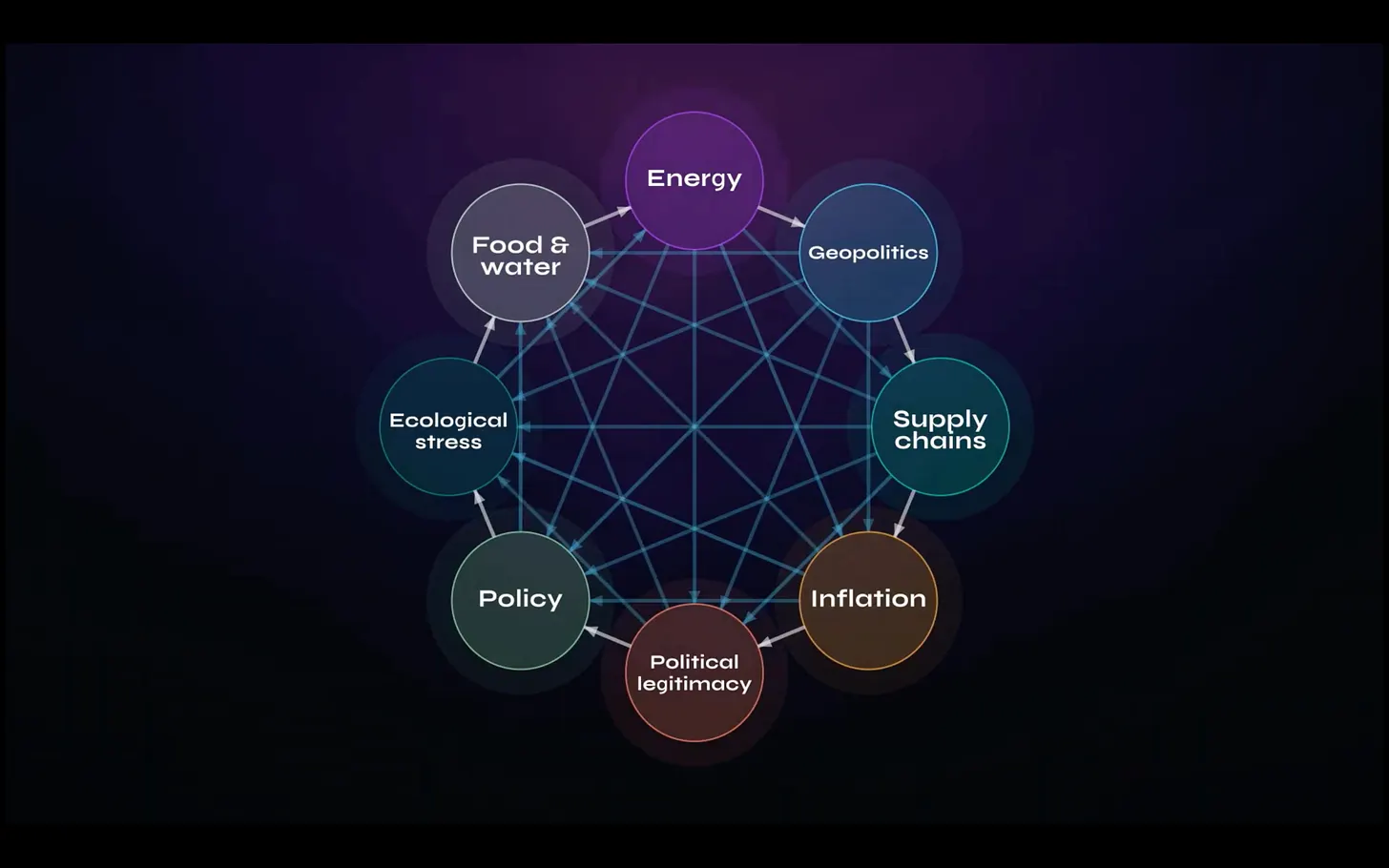
Most people think about future challenges as if they’re independent problems sitting in separate buckets. Climate problem over here, politics problem over there, technology problem somewhere else. Each one gets its own department, its own experts, and its own set of solutions. But as viewers of this channel know, these are not independent problems. They’re coupled systems that interact and amplify each other – and often manifest together.
Click on the image to enlarge.
Energy clearly affects geopolitics, then geopolitics affects supply chains. Supply chains affect inflation. Inflation affects political legitimacy. Legitimacy affects what policies are possible. Policy affects ecological stress and impact. And coming full circle, ecological stress affects energy, food, water, and everything else downstream (though most people are yet unaware of this).
We are seeing this chain of relationships unfold right now. A military decision in late February took just a few months to cascade into an energy crisis, fertilizer shortage, food and energy security threat, political legitimacy challenges in multiple governments, and (in my opinion) an increased chance of financial and currency reset. These things are connected. And if risks are correlated and systems are coupled, then we can’t plan for challenges one at a time. We’ll have to think in combinations.
This is why two people can look at the same dynamics and verifiable facts and still come away with very different pictures of the future. One person is tracking the climate, while another is tracking AI, energy, or debt. These folks are all seeing real things, they’re just holding different slices of a coupled system.
Phase Shifts and Path Dependencies
The coupling of different domains also changes how complex systems behave. They don’t move smoothly, rather in fits and starts.
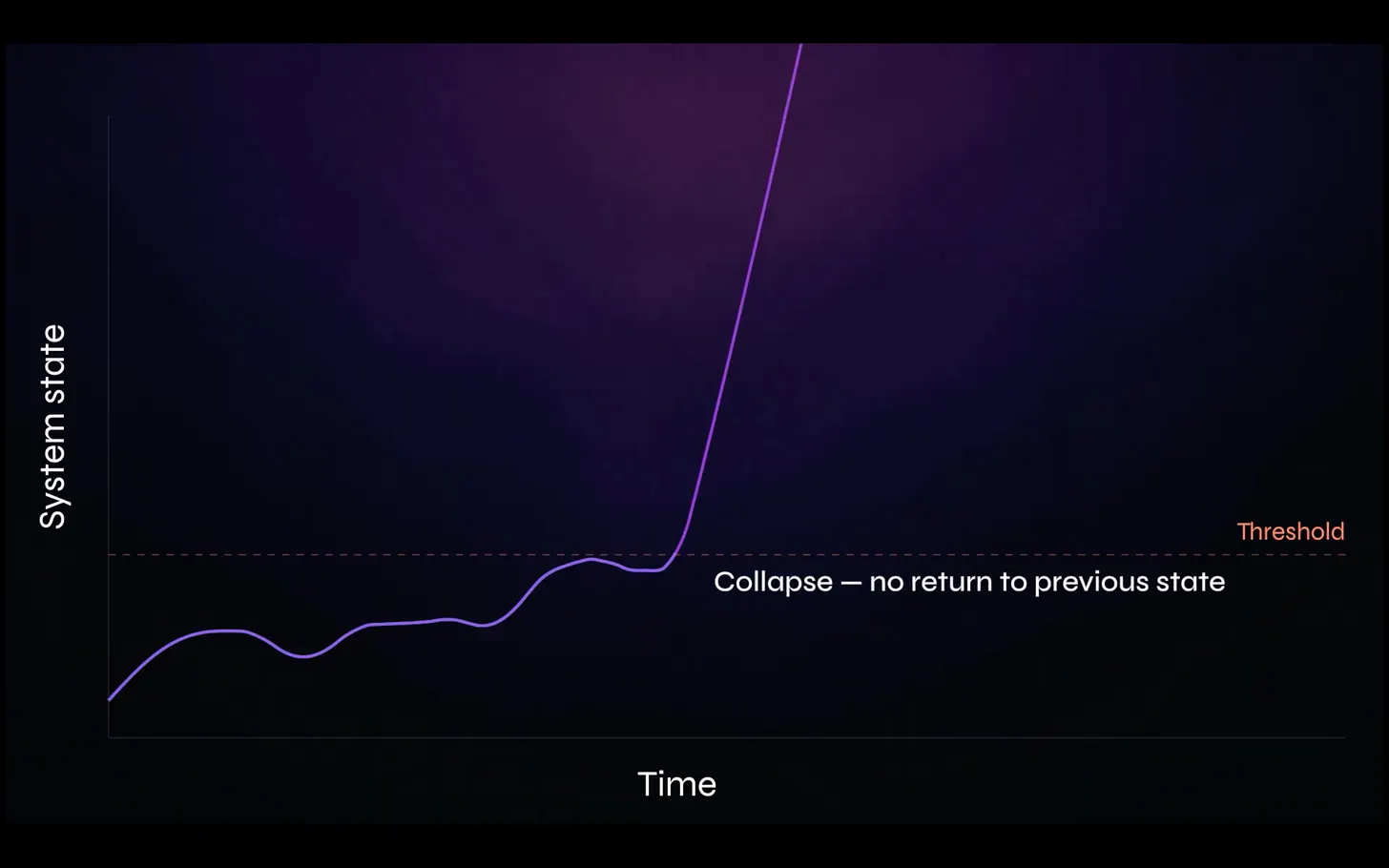
You’ve probably heard the phrase, “Sometimes decades happen within weeks.” We have periods of stability, then something breaks, locks in, or cascades. Then the range of possible next steps changes, sometimes overnight. This is definitely true of climate systems, political systems, financial systems, ecosystems, and supply chains. The pattern is stability, stability, stability…then a phase shift. That’s where the big changes come.
Part of what makes this hard to plan for is something ecologists call “path dependence.” Once you’re on a particular track, the cost of switching rises. Decisions compound. Infrastructure gets built for one energy system and it becomes expensive to rebuild for another. Political alliances solidify. Economic structures create constituencies that defend themselves. So the future is only partially shaped by what happens next. In reality, it’s largely shaped by what’s already been locked in by previous choices, even choices that didn’t feel like choices at the time.
Click on the image to enlarge.
The other thing complex systems do is cross thresholds. There’s a building of gradual pressure, then a sudden shift. Ice sheets, political legitimacy, and soil systems work this way. You push and push and nothing seems to change…and then suddenly everything changes at once. And we usually can’t see these tipping points until we’ve already crossed them.
This is why people (including high-paid analysts and consultants who extrapolate the future from recent trends) often get blindsided. They’re assuming a linear relationship between cause and effect, but the systems that matter most are the nonlinear ones. They have thresholds. They have feedback loops. And they have moments where the rules change in the blink of an eye.
Forecasting Versus Scenario Thinking
So when we think about the future, the current trend lines aren’t the most important things to understand. Rather, we should strive to understand the conditions under which systems might shift from one regime to another. Instead of asking, “What’s the most likely outcome?“ we can ask, “What are the different regimes or flavors that this system could shift into, and what would cause each shift?“ That’s what good scenario thinking tries to capture.
This is where the real problem with how most of us think about the future rears its head. Most of us are used to holding one storyline at a time, and these can look dramatically different from person to person. Then arguments ensue as if only one of them can be true. We disagree on facts, sure. But more deeply, we disagree on what kind of thing the future even is.
Most of the time, however, those storylines actually aren’t competing. They’re just incomplete on their own. People are looking at different layers of the system, or different time horizons, or different aspects of the world, and the arguments that mushroom from those differing lenses are mostly people defending their slice, rather than attempting to see the whole picture.
Click on the image to enlarge.
Many of us are trained, almost from birth, to think about the future the way we think about a trend projection. We tend to think of it as a single line on a chart or an educated guess, like next quarter’s earnings or tomorrow’s commute time to work.
This is called forecasting. Forecasting does work for narrow, short-term, well-understood systems, like predicting the weather for tomorrow versus a month or year from now. But it does not work for complex, long-term, coupled systems where surprises dominate. From the vantage of 2026, the future of human civilization on Earth seems to be the most complex, most coupled, and most surprise-prone system we have ever tried to think about.
Scenario thinking is a different kind of tool altogether. A scenario is basically a coherent mini-world. It’s a set of conditions that hang together well enough for us to ask practical questions inside it: What would be scarce? What would be abundant? What would be rewarded? What would be punished? What kinds of institutions would survive or thrive? What kinds of failures would be hard to recover from? What would daily life feel like for the people living there?
The shift I’m asking you to make in this series is to move from forecasting to scenario thinking. To move from trying to be right about the future to trying to be prepared for several versions of it, and contributing to the better ones. Yes, this shift is probably harder than it sounds. It’s taken me over a decade to think this way and I still struggle at times. There are fundamentally human reasons leading people to default into single-story thinking. As I’ve said before, our nervous systems want certainty. Holding multiple possibilities open at the same time is metabolically expensive and cognitively hard. It physically and emotionally feels worse. The mind reaches for resolution because resolution allows the mind to stop working so hard.
Furthermore, our careers and identities attach to narratives. If you’ve built your professional life around green growth, techno-optimism, peak oil, collapse awareness, or colonizing Mars, then admitting other futures are plausible can feel like a threat to your identity. I’ve learned, both from reading the comments on this platform and in real life, that people defend their “futures” the way they defend their families.
Institutions also reward confident stories. Nobody gets funding for, “I’m not sure which of these six futures we’re heading into, and here’s how we should plan for all of them.” You get funding for, “Here’s what’s coming and here’s the solution I’m selling.” The incentive structures embedded in our culture push toward certainty – usually false certainty.
Scenario thinking has to be a deliberate practice. It runs against the grain of how we’re wired, how we’re rewarded, and how our current culture operates. But it produces better thinking, and in this moment it produces thinking relevant to our survival, thriving, and finding of better pathways than the default. Interestingly, a branch of mathematics formalizes this scenario thinking in differential equations and dynamical systems, made more expansive recently with machine learning.
There is an older version of this in the form of religion. For most of human history, almost every person on Earth was raised inside a single story about where the world came from, where it was going, and how they fit in. Because it was held by everyone around you, it felt less like a story and more like reality. I’m not saying this to put religion down. Some of the people I most respect are religious, like recent guest Iain McGilchrist. I highly recommend watching our most recent episode together, “Wisdom in a World in Crisis: The Counterintuitive Need to Slow Down and Find Spaciousness.” Some of the most grounded responses to what is coming are happening inside religious communities.
Single-story thinking was the water we swam in for most of human history. It is the default setting of the human animal, so holding several plausible futures at once is something we haven’t really ever asked the human nervous system to do. Underneath today’s trends and data, there are stories: that progress is the natural shape of history, that humans are separate from nature, that more is always better. These stories shape what people think is possible more than any of the data we present.
I will come back to this in the “Guide to Staying Human” series that I started with “A Guide to Staying Human (Part 1): Desperately Seeking Agency.” But for now I invite you to notice that the future you think is plausible depends, at least partially, on which deeper stories you are already holding. This is the moment when we might have to hold multiple plausible futures in this liminal space in order to change the initial conditions of the future.
Shortfall Risk
If the future is a space rather than a point, systems stagger rather than move smoothly, and risks are correlated rather than independent, then what are we actually trying to accomplish when we think about the future?
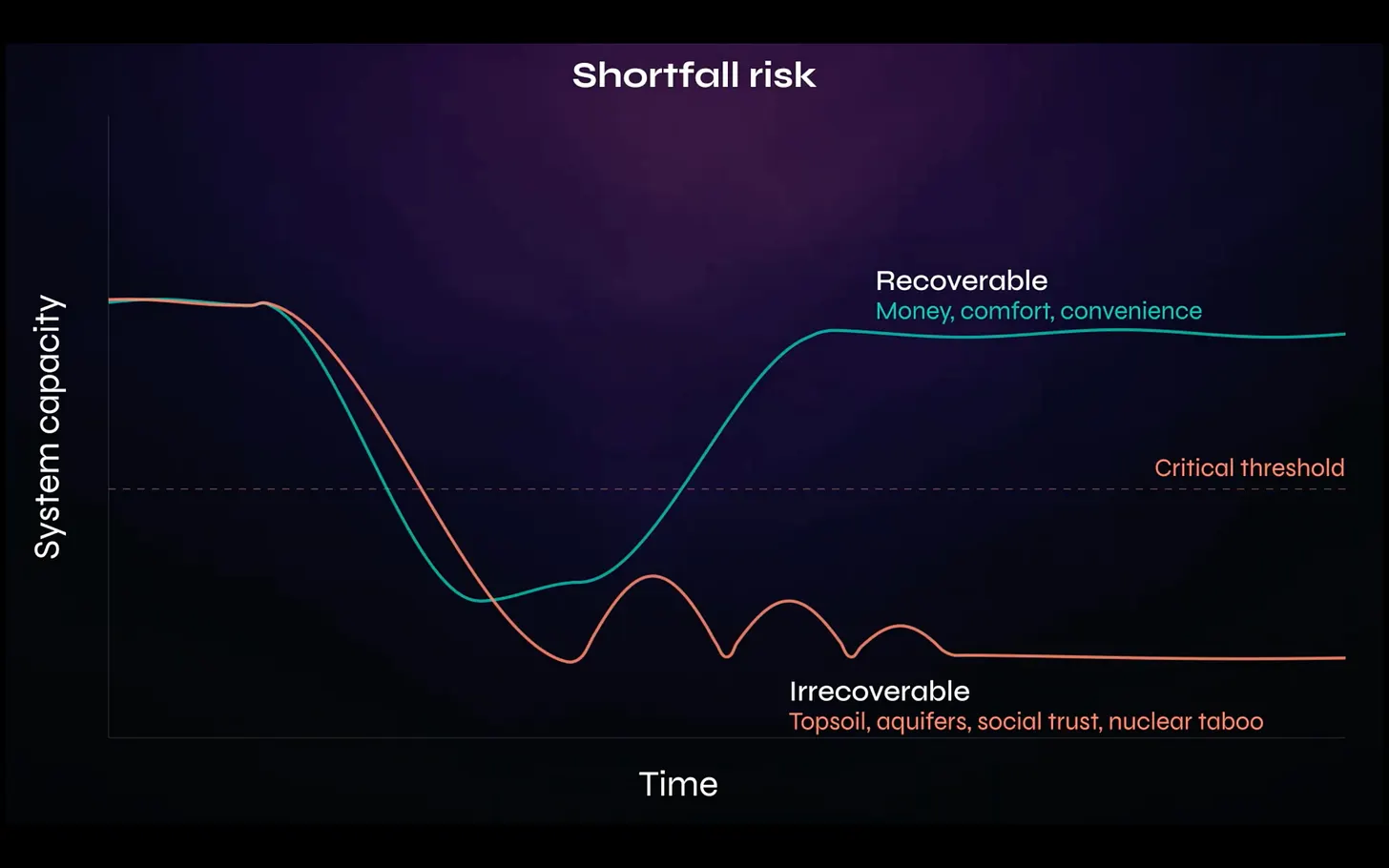
This is where I’ll introduce the concept that I first learned when managing client portfolios on Wall Street: shortfall risk. In complex systems, the average outcome is rarely the biggest danger. The shortfall risk is. A shortfall is when something essential drops below a certain threshold and doesn’t come back, at least not easily. On Wall Street, it was the minimum return needed to cover expenses, but the same logic runs well beyond finance: food systems, grid stability, clean water access, social trust, governance capacity, topsoil, pollinator populations, the nuclear taboo, and democratic institutions. Lots of essentials we’ve come to take for granted are now facing the risk of shortfall.
Click on the image to enlarge.
These things share common features: they’re hard to build, slow to accumulate, and once they fall below a certain level, they don’t bounce back within the lifespans of the people who lost them. Lost topsoil takes centuries to rebuild. If you deplete an aquifer, it may never refill on human timescales. Critically breaking social trust might make coordination nearly impossible for a generation. If we cross the nuclear use taboo, proliferation incentives would mushroom overnight…pun intended.
This all creates a fundamental asymmetry in planning. Some losses are recoverable. You can lose money and (usually) make it back. You can lose convenience or comfort and then adapt. But other losses would be effectively permanent. Good scenario thinking (and the resulting planning) is about protecting the things that cannot easily be rebuilt across the range of plausible futures.
Looking Forward
Overall, this series does not attempt to pick the one correct future. We’re trying to do something more useful here, and perhaps more difficult: expanding our perception so that we see more than one plausible world at the same time. We’re trying to identify what things are coupled, so we can see how dynamics in one domain will amplify dynamics in another. We’re trying to find the shortfalls, irreversible losses, and thresholds that we cannot afford to cross. We’re trying to build a robustness that transfers across multiple futures, instead of betting everything on one outcome. And we’re trying to distinguish between losses we can recover from and losses we cannot.
One of the reasons I’m doing this series is that I talk to a lot of people, whether it’s on the podcast, in emails, or at events. There are many people I’ve never met before, but who I immediately feel a kinship with because they’ve been with this work for years. What I hear, over and over, is that people feel overwhelmed. They have a feeling that the future is going to be different from the past, but they can’t get their head around it. The prominent cultural narratives are either, “Everything will be fine because of technology,“ or, “Everything is going to collapse.“ I’ve come to accept that neither of those narratives is useful, and probably inaccurate, and both of them lead people to check out. Some people check out because they think it’ll all work out, while others check out because they think nothing can be done. Either way, nothing happens.
I believe that scenario thinking is a potential antidote to both of these narratives. It says, “I don’t know which future is coming, but I can prepare for a range of them. I can protect what matters most. I can build capabilities that transfer across worlds. And I can do that starting today, with the people around me, the things I can see and touch, and what matters most to me.”
This was the aerial view: how to hold the future as a range of interacting conditions as opposed to a single story. This is also a navigation challenge for me, for all of us, and ultimately for our culture. In part two of this series, we’ll make this a bit more concrete by doing some of the scenario thinking I introduced here.
Thank you for reading. More to come soon.
Want to Learn More?
If you would like to see a broad overview of The Great Simplification
in 30 minutes, watch our Animated Movie.
You can also find additional resources on our Website.
By the same author:
What to Do As the World Falls Apart: A Framework for Action
A Guide to Staying Human (Part 1): Desperately Seeking Agency
Why 'Community' Fails: Everyone Wants a Village,
Nobody Wants to Be a Villager
A Guide to Staying Human (Part 2):
Navigating Dread and Carrying the Weight of Tomorrow
ABOUT THE AUTHOR
Nate Hagens is the Co-founder and Director of The Institute for the Study of Energy and Our Future (ISEOF). Formerly in the finance industry at Lehman Brothers and Salomon Brothers, since 2003 Nate has shifted his focus to understanding the interrelationships between energy, environment, and finance and the implication this synthesis has for human futures. Allied with leading ecologists, energy experts, politicians, and systems thinkers, ISEOF assembles roadmaps for understanding how human societies might adapt to lower-throughput lifestyles. Nate also moderates the podcast The Great Simplification, on "illuminating the path for future generations, navigating uncertainty through understanding. and building a resilient future together."
|
|Back to Title|
LINK TO THE CURRENT ISSUE
LINK TO THE HOME PAGE