Homo sapiens faces an evolutionary reckoning. Our global social/political economy --- the corposystem (Lamoreux & Bennett, 2024) --- increasingly violates the fundamental operating principles of Earth's biosphere, or "biosystem," of which humanity is an intrinsic part. The biosystem, the system of life on Earth, is an extraordinarily complex, integrated system of systems Capra & Luisi (2014) that has evolved over 3.8 billion years to capture energy, process information, and cycle materials in autopoietic ways. Living systems sustain themselves by recycling their components (Varela, Maturana & Uribe, 1974). This essay examines the hierarchical relationships among Earth's systems, the fundamental requirements for life's persistence, and the evolutionary mismatch between the corposystem and the biosystem that contains it.
The Hierarchical Organization of Living Systems
All life exists within nested hierarchical systems (ecosystems made of organisms made of cells, etc.), each emerging from and dependent upon the systems that preceded it. In general, each system is composed of interacting subsystems that function together to generate properties, that is, functions or structures, that are retained because they are uniquely useful within their various environments. As a result, every system is composed of other systems in ways that are unique but logically consistent. For example, the biosystem tends to select configurations that are useful for saving life. The corposystem logic, driven by its imperative of continual growth, is fundamentally different from that of the system of life in several ways.
The universe itself constitutes the most encompassing system, characterized by continuous change driven by shifting energy relationships among its components. Within this context, the Earth biosystem represents the totality of living processes: the integrated network of all organisms, their genetic information, material cycles, and energy transformations.
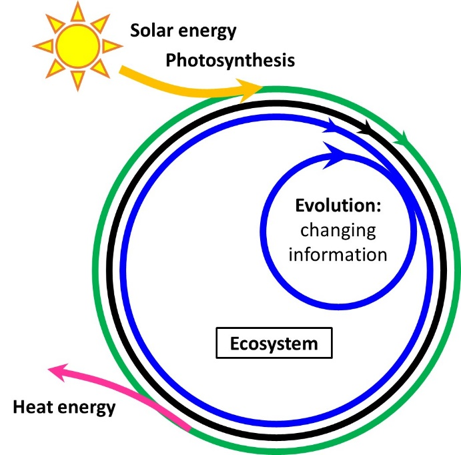
Figure 1. Requirements of a sustainable living system. Yellow/incoming arrow: Energy from the sun is captured, through photosynthesis. Green/outermost cycle: Organic chemical energy cycles through life (food chains). Black/next cycle in: Organic matter recycles, carrying biological information and energy within biological structures. Blue/two innermost cycles: Genetic (and other biological) information, determining the processes fueled by the energy, recycles over long timescales, modulated by evolution. Pink/arrow leaving: Energy released as heat, after doing work maintaining life. (Taken from Lamoreux and Bennett, 2024.) Click on the image to enlarge.
The biosystem performs three essential functions that define life itself: capturing solar energy and converting it to chemical energy suitable for powering living processes; propagating genetic information that directs life processes, with modifications over time in response to environmental conditions; and recycling the materials of which all living organisms are composed, thereby very rarely producing permanent waste.
The Fundamental Requirements for Life's Persistence
The system of life maintains itself within the non-negotiable requirements of evolution that apply globally across all living systems. First, continuous capture and flow of energy. For the biosystem, this energy originates in solar radiation which photosynthetic organisms convert to chemical energy that then flows through food webs, from plants to herbivores to carnivores and parasites to decomposers and back for recycling.
Figure 2. Aquatic food web. Illustration by Kestin Schulz et al via Wikimedia Commons. Click on the image to enlarge.
Second, material cycling occurs at the same time. Living systems are materially closed but energetically open; the energy that drives material processes is derived mostly from photosynthesis. A very few micro-organisms can make use of other energy sources to sustain cellular life, but the vast majority, and the system of life itself, cannot make use of oil, gas, coal, or other non-photosynthetic energy to provide the energy that the biochemical processes require for staying alive. The third requirement is the accurate and variable transmission of information that enables reproduction and evolutionary adaptation in response to environmental shifts.
Evolution is the ever-present force that maintains balance among living systems, continuously adjusting the composition and relationships of all systems to changing environmental conditions. Humans cannot alter how evolution functions. It is there, as a feature of life. Humans have no control over it, nor can we escape it. We can only choose whether to align with its operations or suffer the consequences of misalignment. For example, we cannot change the fact that death and extinction are essential to maintain the balance of every living thing in relation to all the other evolving systems. We can change the balance, and we have changed it, but we cannot change the fact that balanced interactions are necessary to maintain life itself.
The Corposystem: Global Political Economy as an Emergent Phenomenon
The corposystem emerged as H. sapiens developed agriculture, cities, writing, technology, and industrialization. The system encompasses food production, education, medicine, markets, and governance. It is defined ideologically by its ability to generate profits through growth of the corposystem.
The corposystem's growth imperative drives it to treat the biosystem as an endless source of raw materials and an infinite sink for waste. This system's functional imperative differs fundamentally from the biosystem, of which the corposystem is a part. The biosystem requires a modest and flexible balance among its parts --- material cycling and balanced energy flow. Where the biosystem recycles everything and produces no pollution, the corposystem generates artificial waste streams that accumulate in air, water, and soil. Where the corposystem promotes the accumulation of complexity (i.e., 'complexification,' as in systems theory), the biosystem maintains diversity. Where the biosystem optimizes for balance among the systems and the processes necessary for life as well as operates on evolutionary timescales, the corposystem grows profits and operates in response to quarterly returns and electoral cycles.
To sustain balanced interaction among the systems, each within their environment, living systems must produce more offspring than can survive. This excess serves two purposes: it provides energy flow as one system eats another, and (together with genetic variation) it enables natural selection of those best adapted both to the external environment of the moment and to the balance of the cycle of life. Yet our modern corposystem has overwhelmed this balance through medical technologies that prevent human death and industrial agriculture that increases population numbers maximally while stalling natural death processes required to sustain the balance of life. The result, so far, is climate change and the metacrisis. A metacrisis is a cluster of problems that all relate to a common cause. In this case the common cause is an imbalance among the systems that make up the biosystem, as a result of human overgrowth.
The Inverted Logic of Food Production
A prime example of the conflict between the growth imperative of the corposystem and biosystem balance is evident in human food production. For two centuries, industrial agriculture has operated under a seemingly self-evident directive: to feed a growing population, we must produce more food. This foundational rule of civilization appears intellectually and morally unassailable, yet it is a tragically flawed misunderstanding of population biology.
According to Hopfenberg and Pimentel (2001), population dynamics research shows that, in humans who have eliminated most predation and disease, population size is a function of food supply. Food availability is a primary determinant of human carrying capacity, as is the case for other species (Hopfenberg, 2003, 2025; Zulkarnaen and Rodrigo, 2021). More food enables more people to survive, and more people are then cited as justification for still more food production. This logic inverts cause and effect. In fact, food availability operates as the independent variable, the driver of population size; while population size functions as the dependent variable, the consequence of increasing food supply.
The consequences of this inverted logic that manifest across Earth's systems are catastrophic. Human population numbers have exploded from one billion in 1800 to more than eight billion today, an increase unprecedented in human history. Supporting this population requires converting wild landscapes to corporate monocultures, mining ancient aquifers, saturating soils with fertilizers, and releasing carbon dioxide and methane at rates that destabilize the global climate. Each impact represents a drawdown of natural capital, the biosystem's accumulated resources, in the service of short-term economic surplus. This can be thought of as a resource debt to the biosystem, which can never be repaid in the face of an ever-increasing human population (Rees, 2023, 2025).
Evolution as a Balancing Mechanism
Evolution functions continuously as a balancing mechanism to maintain the most efficient equilibrium among all the available systems within their environments. Diversity, reproduction, death, and changing relationships constitute how the biosystem maintains itself. When any subsystem, like the corposystem, grows beyond sustainable limits, evolution acts as a negative feedback loop to restore balance, routinely through reduction or extinction of the offending system. In our case, the extent to which the colossal size of the corposystem continues to decrease efficient human interactions with the environment, to that extent humans will be "selected against" by evolution. Selection may take the form of starvation, war, plague, poverty, climate change or all of these --- the metacrisis.
Systems tend to become more effective at their specialized functions over time, but this can harm other systems. As harm accumulates, the offending system may face extinction. For example, systems that pollute themselves or destroy their own source of food are not likely to survive. In this case the offending system is H. sapiens and its corposystem. The relentless increase in the size of the human population and the corposystem now endangers the biosystem's capacity to sustain life, placing both humankind and corposystem growth in direct conflict with thermodynamic, ecological and evolutionary forces that operate independently of human desires, economic calculations and corporate activities.
Humanity's unique capability dwells in an adequate understanding of these dynamics and the willingness to act accordingly. We know that evolution requires death to balance living systems. We know that by reducing mortality through medicine and food production without correspondingly reducing fertility, we have unbalanced the biosystem. We possess birth control technologies to address this imbalance, yet we do not deploy them sufficiently for aligning our population with Earth's carrying capacity.
The Impossibility of Separation
Living systems require continuous flows of energy and information. Humans cannot survive without the biosystem; we cannot build a replacement, and no such system exists elsewhere in the accessible universe. The biosystem required more than 14 billion years of cosmic evolution to assemble. Destroying it through short-term economic optimization represents the ultimate failure of inter-generational responsibility and stewardship.
Biological systems mature according to thermodynamic, environmental and evolutionary constraints. They may grow rapidly and die, sustain themselves in a balanced relationship, or follow intermediate trajectories. Humanity retains the option of conscious choice, but exercising this option requires understanding the relationship between the corposystem and the biosystem. Even if we understood how, no technological fix, no geoengineering scheme, no space colonization can substitute for alignment with the principles that have sustained life on Earth for billions of years.
Metacrisis as Evolutionary Mismatch
The multiple crises facing civilization --- climate change, biodiversity loss, resource depletion as well as social inequality and political instability --- are not separate problems. They are interconnected manifestations of a single underlying condition: the mismatch between the corposystem's growth and the biosystem's functioning. Climate change is occurring currently because burning fossil fuels releases carbon sequestered over geological time. Long-term resilience is lost when diverse ecosystems are converted to agricultural monocultures. Resource depletion occurs because treating finite resources as infinite commodities leads inevitably to their exhaustion. Social inequality and political instability are consequences at all organizational levels within the corposystem.
The global political economy's primary metric, the gross domestic product of nations, compounds these problems by failing to distinguish between activities that enhance well-being and those that diminish it. Debt-based money compounds the problem further, as interest requires future growth for repayment, locking the economy into expansion trajectories even when expansion leads toward collapse. The financial system thus operates as an amplifier of the underlying mismatch, converting the finite stocks of the biosystem into economic flows that are erroneously believed to increase perpetually. Nothing can grow forever within a finite planet.
Toward Biosystem Alignment
Achieving alignment requires fundamental transformation. First, we must reduce the human population load or "ecological footprint" (Rees, 2021, 2023) on biosystem resources via birth control, while addressing corposystem overshoot by integrating environmental and evolutionary education at all levels. Second, accounting systems must internalize environmental impacts so that prices reflect ecological reality. We should tax pollution, resource depletion, and carbon emissions to redirect economic activity toward regeneration rather than extraction and liquidation, making visible the costs that currently remain external to market transactions. Third, financial systems should be reformed to support sustainable activities: central banks should possess tools like green quantitative easing to redirect capital toward renewable energy, ecological restoration, and distributed economic activity. Fourth, governance systems must incorporate long-term ecological constraints into decision-making, which currently optimizes short-term economic outcomes.
Fifth and most fundamental: a cultural shift must manifest. We need cultural systems that replace human exceptionalism with biosystem literacy and sustainability, not growth, as the ideal. This requires confronting vested interests --- billionaires, interlocking directorates of multinational corporations and political elites --- whose power depends on perpetuating the delusion of endless growth. Education must include thermodynamic, ecological, and evolutionary principles that constrain all living systems. We must reframe "feeding the world" not as a problem of agricultural production, but as a complex challenge involving population dynamics, equitable distribution, and ecological limits. Every public policy must be evaluated against its long-term impact on planetary habitability, not short-term economic progress. The transition from a corposystem organized around growth to one organized around stewardship and sustainability requires a fundamental reorientation of perceptions, values, and collective purpose. Perhaps new objective(s) for human existence will replace the corposystem aim of wealth accumulation.
Conclusion
Humankind emerged within the biosystem and remains embedded within it, despite the apparent independence of our technological civilization. The corposystem has developed according to principles --- continuous growth, maximal material throughput, short-term profit optimization --- that directly conflict with the biosystem's requirements for balance, material cycling, and zero pollution. Evolution functions continuously to restore balance, often through extinction of the offending system.
Two futures remain open. One: we cling to the collective delusion that the corposystem can transcend thermodynamic, environmental, and evolutionary constraints. Another: we summon the clarity of vision, coherence of mind, and political will to manage a transition toward biosystem-aligned reorganization. The biosystem will continue with or without us. The question is whether or not we will choose adherence to the "rules of the house" of our planetary home, adapting our capabilities to the principles that have sustained life on Earth for billions of years.
We thank Prof. Dot Bennett for her helpful review and comments, and Edie Richards Salmony, J.D., for her suggestions and backup.
References
Capra, F. and Luisi, P.L. (2014). The Systems View of Life: A Unifying Vision. Cambridge: Cambridge University Press.
Hopfenberg, R. and Pimentel, D. (2001). Human population numbers as a function of food supply. Environment, Development and Sustainability, 3(1): 1-15.
Hopfenberg, R. (2003). Human carrying capacity is determined by food availability. Population and Environment, 25(2), 109-117.
Hopfenberg, R. (2025). In Pursuit of Sustainability: The Root Cause of Human Population Growth. The Journal of Population and Sustainability, 9 (1):19-25.
Lamoreux, M. L. and D. C. Bennett. (2024). Scientists’ Warning on the Problem with Overpopulation and Living Systems. The Journal of Population and Sustainability, 8 (1):95-111.
Rees, W. E. (2023). The human eco-predicament: Overshoot and the population conundrum. Mother Pelican: A Journal of Solidarity and Sustainability, Vol. 19, No. 1.
Varela, F. G., H. R. Maturana and R. Uribe. (1974). Autopoiesis: The organization of living systems, Its Characterization and a Model. Biosystems, 5:187-196.
Zulkarnaen and Rodrigo (2021). Modelling human carrying capacity as a function of food availability. The Proceedings of Anziam, 62(2020): 318-333.
ABOUT THE AUTHORS
Steven Earl Salmony, Ph.D., M.P.A. is a retired practicing psychologist. In 2001 Steve founded the AWAREness Campaign on the Human Population to raise consciousness of the colossal threat that the unbridled, near exponential growth of absolute global human population numbers poses for life as it is known to us. His campaign has focused upon the best available science of human population dynamics and the topic of human overpopulation of earth in our time. He can be reached at sesalmony@aol.com.
M. Lynn Lamoreux, Ph.D., was an early woman in biological science, retiring in the year 2000. She predicted the metacrisis based on flaws in our understanding of Darwin’s theory of evolution and then watched many of those predictions unfortunately come true. She believes that a successful recovery will require that we address the root biological causes of the metacrisis, as well as its human symptoms.