People everywhere are currently experiencing the socio-economic, political, and ecological repercussions of rising oil prices. Most assuredly, the abundance of relatively cheap energy that civilization has enjoyed over the past 150 years or so, particularly oil, is very much in the news.
He reminds us that everything and system formed by humans is essentially a physical process for transforming energy and materials into things humans value, from food and shelter to status and experiences. Although measured in dollars, every transaction is an energy transformation, from extraction to processing and distributing any needed or desired product. Energy makes everything possible. For Hagens, this realization reveals our culture’s depth of energy blindness: to wit “Every dollar of GDP represents a physical transformation powered by energy somewhere. Once you see this, you can’t unsee it.”
Hagens’ Trio of Videos – Oil 101, 201, and 301
The above introduction should suffice in encouraging you to view Hagens’ trio of videos, altogether featuring key aspects of humanity’s dependence on oil to continue expanding and sustaining the goals of our human superorganism. From this point forward, it will be each reader’s responsibility to make the time and requisite effort to view, study, and ponder the compactly well-organized and presented contents.
Viewing all three videos requires only 41 minutes of total viewing time, but if time constraints arise, using the 1.25-speed setting might help. Some readers may find the information repetitive, yet still worthwhile to review, if only to recommend the trio to others, especially anyone who appears energy blind. I’ve also included descriptions of each video, which will save you some time. The questions raised at the end of each video are worth reading and pondering.
After reading each brief description, just click on the links to view each video. So, here we go . . .
Oil 101: What You Actually Need to Know About Oil
This opening piece introduces oil as far more than a fuel, which is stored ancient sunlight, created over millions of years from microscopic marine life, and consumed by humankind in a few centuries. In that sense, oil functions like a vast natural battery that we are rapidly discharging.
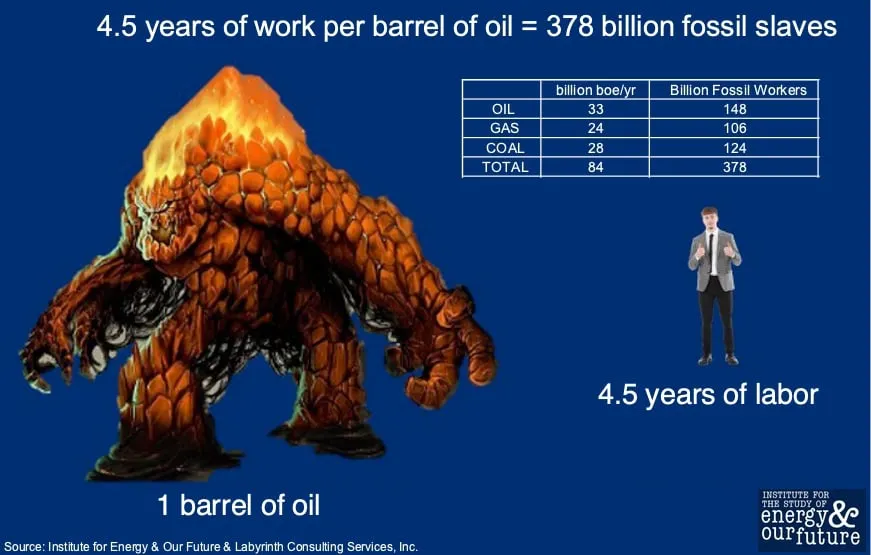
A single barrel of oil represents an enormous amount of work, the equivalent to five years of human labor. Scaled globally, since the industrial era this “invisible workforce” has powered the dramatic rise in population, economic output, and consumption.
Yet, most people rarely notice this dependence. When all systems are accounted for – transport, heating, food production, and supply chains – the average American effectively uses energy at a rate far beyond biological needs, a disconnect that helps explain our “energy blindness”. We benefit from massive energy flows, but fail to recognize their presence or value.
This video segment invites reflection on how differently we might view the economy if we begin viewing energy as the true foundation of all goods and services – and what it would mean to live within more human-scale energy limits.
Oil 201: What Happens When the Oil Stops Flowing
This installment examines how deeply modern society depends on cheap, abundant energy, and how vulnerable it becomes when that assumption falters.
Key systems – such as industrial agriculture, manufacturing, water treatment, and global trade – are all optimized for low-cost energy inputs. What appears efficient in economic terms is often highly wasteful in terms of physical reality. Nowhere is this clearer than in food production, where fossil fuels are heavily embedded – from fertilizers to transport – resulting in far more energy invested than is ultimately consumed.
At the same time, conventional oil resources are declining, with newer sources like shale behaving differently, i.e., less stable, more costly, and more dependent on continuous investment. Proposed alternatives like solar and wind offer important benefits, but differ in quality and function. So-called “renewable energies” are better understood as rebuildable infrastructures rather than simple replacements for fossil fuels.
The broader pattern is sobering. Societies tend not to replace energy sources, but to layer new ones on top of old. This raises difficult questions about whether an actual transition is possible, and how disruptions in oil supply could ripple through everyday life.
Oil 301: The World After Cheap Energy
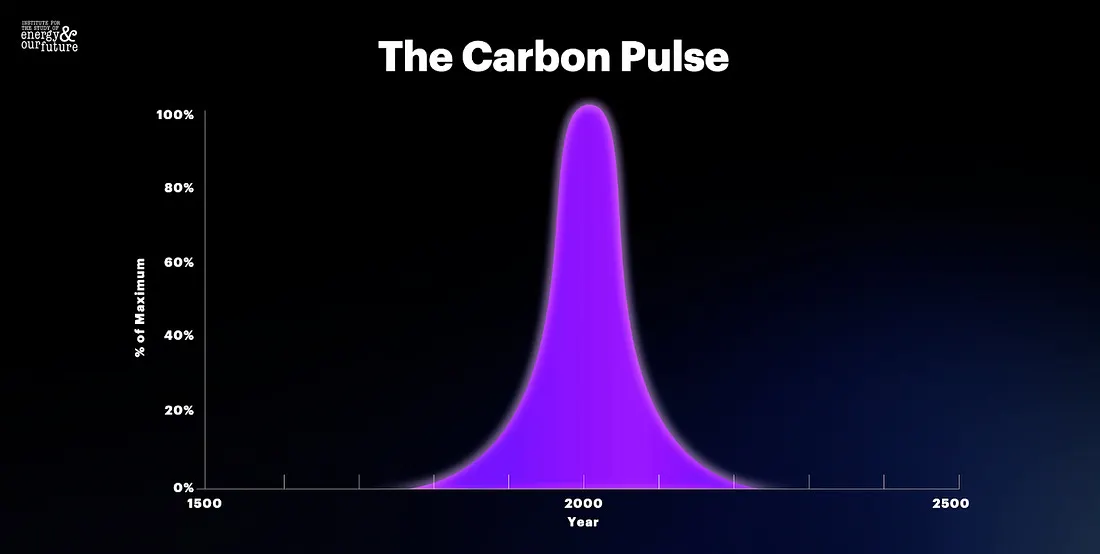
This final segment places our current moment within a larger arc: the rapid drawdown of a one-time inheritance of fossil energy, referred to as the carbon pulse. Modern civilization, vastly larger than in pre-industrial times, has been built on the assumption that this energy surplus would continue indefinitely.
But energy, not money, ultimately determines what work can be done. Financial systems may temporarily mask physical limits, yet they cannot override them. The expansion of unconventional oil, for example, has relied on favorable financial conditions that may not persist.
This leads to a broader insight: the energy crisis and ecological crisis are inseparable. The same processes that have powered economic growth have also driven environmental degradation and resource depletion. As pressures mount – from climate impacts to resource scarcity – natural systems and human institutions alike face increasing strain, while geopolitical tensions shift toward control of energy resources.
Rather than framing this trajectory purely as collapse, the piece suggests the possibility of a “great simplification”, a transition toward ways of living that emphasize well-being over throughput. When grounded in relationships, purpose, and community, human fulfillment does not ultimately depend on high-energy consumption.
The closing reflection asks what it means to recognize the temporary nature of our energy inheritance – and how we might choose to live as that era begins to wane.
Wrap Up
If you’ve read this far, perhaps you’ve viewed the videos – or will do so asap. The information provided is extremely valuable in conveying a fundamental understanding and appreciation for oil’s key role in powering our entire homocentric world. For additional information, consult the episodes’ notes and links to learn more. Notes are located at the bottom of the page for each episode.
As for what to expect regarding future posts, I hope to undertake a series devoted to the Transcendental Triad of Truth, Goodness, and Beauty. Another interesting topic might focus on tracing human development, from a time when humans were mostly absent from existing land spaces to the present time, providing evidence of our human-built landscapes. For example, amazing AI technologies are making it possible to create time-lapse videos showing the growth in large U.S. cities, including New York City, Chicago, and Denver.
Whatever I feature may not be on a weekly basis, but whenever I get around to it. We’re downsizing our possessions again, and more time is needed to rearrange life suitable to old-age living needs. So, we might as well do it while we’re still able to function physically and mentally.
Finally, here’s a homework assignment for you. After viewing the three videos, be more attentive to energy use – yours, as well as society’s. Ask yourself: What would we do without carbon-based energy to power our needs and wants? Power down – or continue as usual?
Think on these things . . .
Clif (with Bettye Ware, reader/editor)
By the same author:
Natural Landscapes to Cityscapes ~
400 Years of Transforming America's Natural Systems
Downsizing for Life's Final Stage, Part 1
Downsizing to Simplify and Enhance Life, Part 2
ABOUT THE AUTHOR
Clifton Ware, D.M., emeritus professor (voice), professional singer and author of four published books and two unpublished works, retired in 2007 from the University of Minnesota-Twin Cities School of Music, where he taught for 37 years. In retirement – as a self-described socio-ecological philosopher focused on sustainability issues – he continues seeking an evidence-based, big-picture understanding of socio-ecological systems, including the symbiotic interconnections and role of humans as an integral part of Nature. In 2013 he founded Citizens for Sustainability in St. Anthony Village, MN, produced Sustainability News + Views (2014-2019), a weekly newsletter featuring a variety of articles and a commentary, co-composed 13 Eco Songs with his wife, Bettye, organized Sustainability Forums, and performed eco-oriented programs and presentations for several organizations.
|