
|
Mother Pelican
A Journal of Solidarity and Sustainability
Vol. 22, No. 5, May 2026
Luis T. Gutiérrez, Editor
|
|
|
|

|
|
|
Oil 201:
What Happens When the Oil
Stops Flowing
Nate Hagens
This article was originally published on
The Great Simplification, 23 April 2026
REPUBLISHED WITH PERMISSION
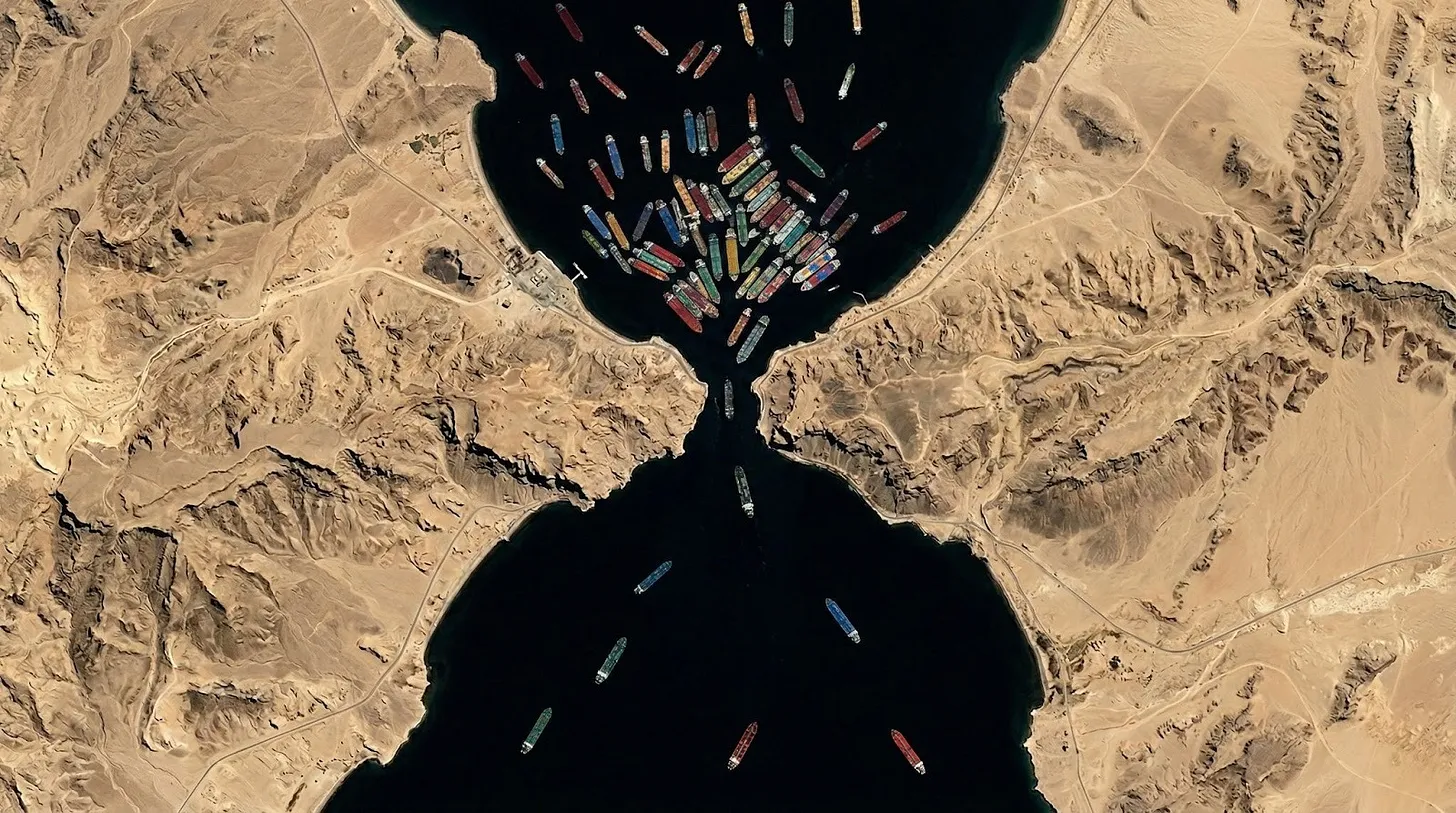
Illustration provided by the author. Click on the image to enlarge.
|
In the last essay, we explored what oil is, and how it’s effectively acting as an invisible fossil pixie dust throughout many of our lives. But there’s a parallel associated risk: we’ve built everything – our institutions, our governments, our stories, our expectations about the future – on this cheap energy input. Now, its scale and affordability are no longer guaranteed.
The Price Trap When energy prices spike, entire systems can become fragile and often break. Because oil has been so consistently cheap, the economic logic has been to imagine and engineer thousands of mechanical processes around that cheapness.
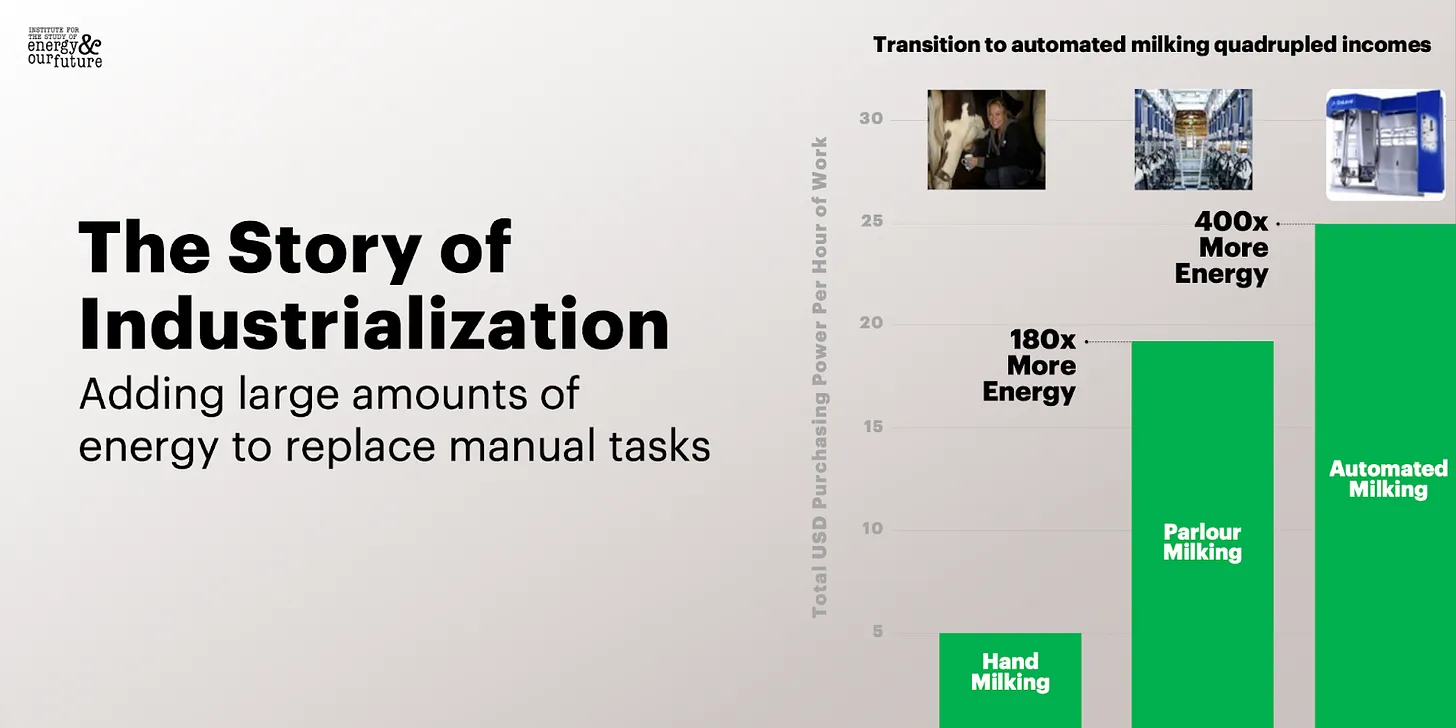
Illustration provided by the author. Click on the image to enlarge.
The Industrial Revolution is really the story of adding hundreds or thousands of units of fossil energy to tasks that humans used to do by hand. A dairy farmer manually milking cows was limited to a few dozen animals. Modern industrial dairy applies enormous quantities of diesel, electricity, refrigeration, and transport to the same basic task, producing orders of magnitude more milk at a much lower price and higher profits – but importantly at a very different cost sensitivity.
The energy payoff of processes like this is terrible in pure physics and efficiency terms because lots of energy is wasted. However, the financial payoff has been enormous because the primary input to the process is energy that effectively costs almost nothing. This is why energy price spikes hit so hard in the global economy: our processes around the world were designed within the context of cheap energy, especially oil.
Even at $500 a barrel, oil would still be a remarkable gift for the work it performs for us. But our current industrial system could not function at anything close to those prices because every margin, business model, and supply chain was calibrated to cheap and stable energy inputs.
The per-unit margins were always thin, so when cheap energy turns expensive, the margin disappears and often turns negative.
We Eat Oil
Nowhere is this pattern more consequential than in the thing we all do three times per day: eat. To some people this might sound like an exaggeration, but when we sit down for a meal, what most of us are really eating is processed fossil fuels.
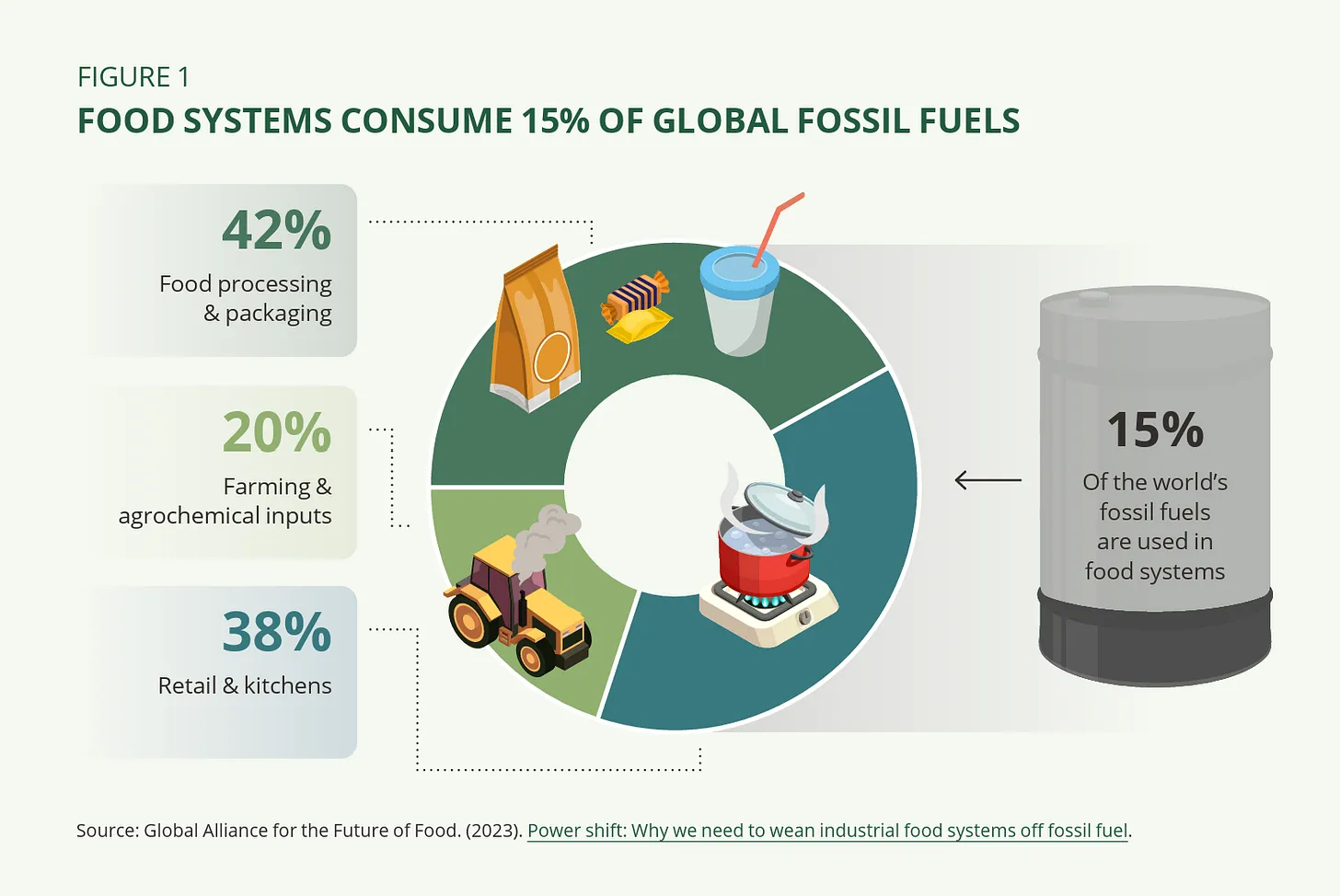
Illustration provided by the author. Click on the image to enlarge.
What’s truly staggering is that roughly half the nitrogen in your body today carries a chemical signature from the Haber-Bosch industrial process, which makes synthetic fertilizer from natural gas. That single industrial process is what allows Earth to feed roughly four of our eight billion humans. Beyond food, our clean water, pumping, treating, desalinating and distributing it, also requires fossil fuel inputs.
When people talk about oil and gas, they’re mostly thinking of our cars, but we should also be thinking of groceries and dinner. With that said, even food is only one part of the story.
Supply Chains
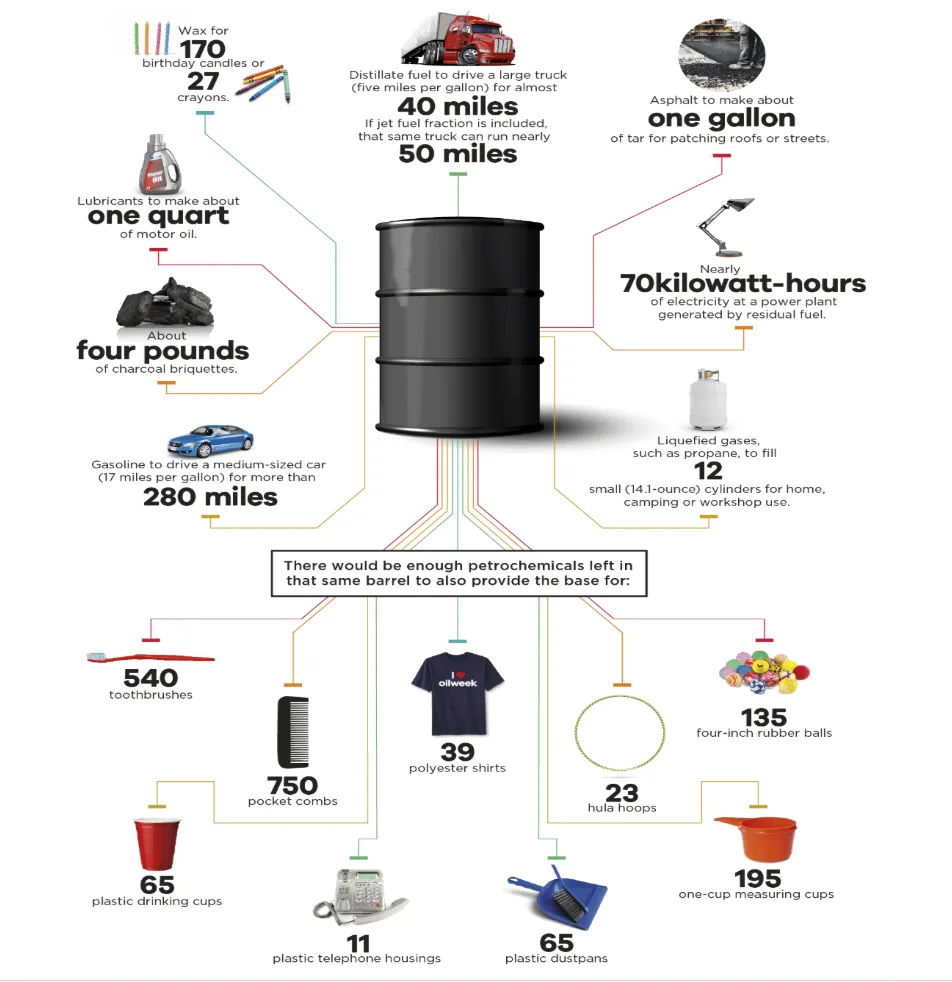
Illustration provided by the author. Click on the image to enlarge.
Oil is woven into virtually everything we touch. Only about 40% of a barrel of oil becomes gasoline. The rest is diesel, jet fuel, heating oil, bunker fuel, asphalt, and feedstock for roughly 6,000 other products like medicines, plastics, surgical devices, synthetic clothing, electronics, contact lenses, tents, kayaks, the interior of our cars, and the list goes on.
Assumptions that electric cars or other substitutions would eliminate our need for oil misses the overwhelming majority of what non-gasoline oil actually does. All of these products are woven into global supply chains, which are now of extraordinary complexity. There are uncountable tiny, invisible components, each with their own petrochemical ancestry, each manufactured somewhere, shipped somewhere else, and assembled somewhere else. Only then are they shipped to stores and to us.
When people talk about supply chain disruptions, what they usually mean is energy and material disruptions.
ABOUT THE AUTHOR
Nate Hagens is the Co-founder and Director of The Institute for the Study of Energy and Our Future (ISEOF). Formerly in the finance industry at Lehman Brothers and Salomon Brothers, since 2003 Nate has shifted his focus to understanding the interrelationships between energy, environment, and finance and the implication this synthesis has for human futures. Allied with leading ecologists, energy experts, politicians, and systems thinkers, ISEOF assembles roadmaps for understanding how human societies might adapt to lower-throughput lifestyles. Nate also moderates the podcast The Great Simplification, on "illuminating the path for future generations, navigating uncertainty through understanding. and building a resilient future together."
|
|Back to Title|
LINK TO THE CURRENT ISSUE
LINK TO THE HOME PAGE
|
|
|
|
"Religion is a culture of faith;
science is a culture of doubt."
Richard Feynman (1918-1988)
|
|
Page 9
|
|
|