As a result of the Strait of Hormuz closure, you’ve probably heard a lot about oil in the news lately, but you might not be sure why the situation is such a big deal. The answer lies in the fact that our entire modern civilization is only possible because of oil. The following series outlines a way of seeing oil from a systems perspective, and my hope is that it might help contextualize the massive historical moment we are witnessing unfold today.
This will be the first of three essays on the subject. In this one, we’ll cover the basics of oil – what it is and how it benefits society. These are things we should have been taught in school, but weren’t. The second essay will expand to look at how our systems and institutions depend on oil, and how this knowledge can help us understand our present moment. The last essay will widen the lens of the first two and help us explore what all of this means for the future of humanity and the Earth.
How Oil Was Formed
Let’s first start with the basics: what is oil, really?

Illustration provided by the author. Click on the image to enlarge.
Most people’s mental image of oil comes from a cartoon of dead dinosaurs turning into goo. In reality, oil formed from dead marine phytoplankton and algae that captured solar energy tens of millions of years ago. They were compressed by heat and pressure over geological time, creating a super energy-dense liquid substance. It’s a solar battery that took millions of years to charge, and we are draining it in centuries. Coal and natural gas are a similar story.
The Power in a Barrel of Oil
So how much work does this ancient sunlight actually do for us?
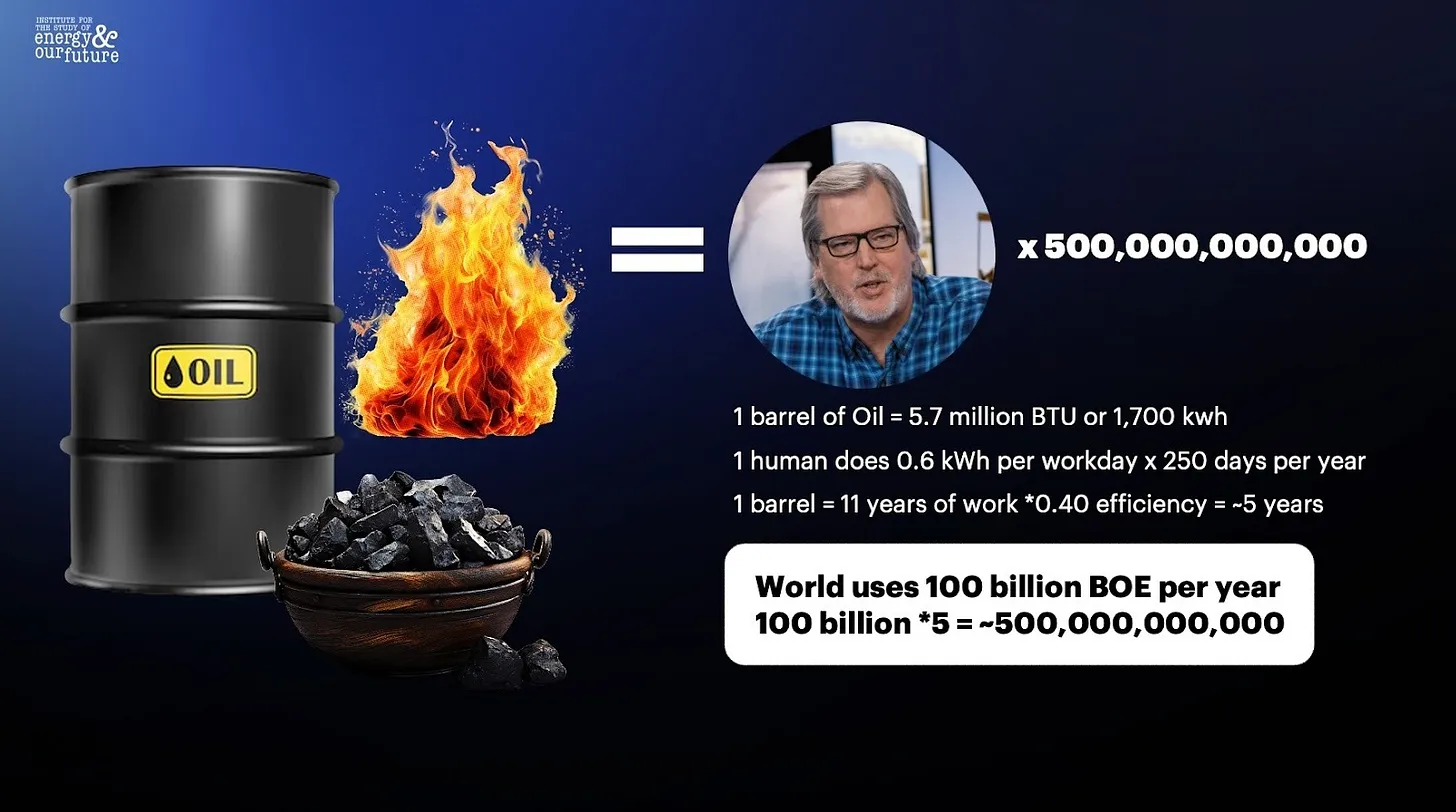
Illustration provided by the author. Click on the image to enlarge.
A barrel of oil replaces around five years of human labor for about $100 (as of writing this at least). A single barrel contains roughly 1,700 kilowatt hours of work potential, while a healthy human doing physical work generates about 0.6 kilowatt hours per day. Depending on how strong a person is, what the task is, how many hours a day they work, and how efficient they are, anywhere from 1 to 20 years of human labor is replaced when a barrel of oil is combined with machines. So for the average human, five years is a solid approximation. This powerful economic subsidy is indistinguishable from magic on human time scales.
Here’s a way to feel this: the next time you drive your car somewhere, imagine running out of gas and pushing it home, even with three or four friends. A gallon of gasoline that costs you $4 would take you and your buddies weeks to replace with human muscle – and would be pretty unpleasant in the process. We never think about this. We just swipe the credit card and go places, and all we pay for is the cost of pulling the oil out of the ground – not the millions of years it took to create it or the environmental cost of burning it. This makes oil absurdly cheap relative to the work it performs.
Economic textbooks and business classes teach that energy’s contribution is its dollar price tag – in effect saying that oil’s cost share is equal to the value it provides. In reality, the cost we pay is orders of magnitude smaller than the value that oil provides for us. Oil is the deepest subsidy in the history of civilization, and it’s mostly invisible…except in energy crises like we are experiencing now.
This is all based on a single 42-gallon barrel of oil. Now multiply it by the total amount we burn every year, and we’ll see what this looks like at scale.
ABOUT THE AUTHOR
Nate Hagens is the Co-founder and Director of The Institute for the Study of Energy and Our Future (ISEOF). Formerly in the finance industry at Lehman Brothers and Salomon Brothers, since 2003 Nate has shifted his focus to understanding the interrelationships between energy, environment, and finance and the implication this synthesis has for human futures. Allied with leading ecologists, energy experts, politicians, and systems thinkers, ISEOF assembles roadmaps for understanding how human societies might adapt to lower-throughput lifestyles. Nate also moderates the podcast The Great Simplification, on "illuminating the path for future generations, navigating uncertainty through understanding. and building a resilient future together."
|
|Back to Title|
LINK TO THE CURRENT ISSUE
LINK TO THE HOME PAGE