While most people spend the majority of their time at home or work, third places provide an alternative and informal space for people to gather. They are
“neutral grounds where individuals are free to come and go as they please with little obligation or entanglements with other participants”. Typically, third places require patrons to spend little to no money and minimal time there, and can therefore act as social levelers and mitigation to social isolation. These sites are important for building community, political cohesion, and social ties generally.
Some examples of third places include libraries, parks, churches, community centers, coffee shops, schools, and universities. Third places are open to people of diverse backgrounds, age, culture, and gender and further allow for the everyday interactions needed to build community. However, despite their importance to societal and community function, third places are disappearing. We argue that their disappearance will reduce the ability of communities to create social cohesion and fight climate change, and that climate change and increased temperatures will reduce access to already dwindling third places.
Part of the reason third places are disappearing is because of the demands of the political economy, which sees no economic value in free third places and instead incentivizes places outside of work that require money to be spent to spend time there. In other cases, third places that were generally open to a broad community in the past are changing to require patrons to spend money. In one survey on third places, the most common response when people were asked “what are the opportunities for communication in public places in your neighborhood?” was “none”. Twenty-nine percent of people had no third place that they could think of where they lived. For those that did have third places, some of the most commonly cited places in this study included: outdoor parks, the street, neighbors’ yards, block parties and cookouts. Here, a new problem with the decline of third places comes into focus - climate change.
Climate change threatens to increase the number of uncomfortably hot days in areas around the world. In the United States, a report from the U.S. Census Bureau shows a quarter of the population currently lives in areas vulnerable to extreme heat. Given current trends, this number will rise. The University of Chicago’s Climate Impact Lab also shows the number of days above 95F/35C a location is likely to experience given different emissions scenarios. These data show that given the moderate emissions scenario (SSP2-4.5), the United States will have an average increase of 14 days above 95F by the end of the century compared to the historical 1986-2005 average. These estimates vary state to state, with Texas, for example, projected to have an increase of 46 days above 95F by 2080-2099. In the high emissions scenario (SSP5-8.5), this estimate rises to 89 more days with temperatures above 95F - an absolute total of 125 days. Heat at these levels becomes much less tolerable, and people are therefore less likely to use these third places.
Many of the states with the highest projected increases in high temperature days are in humid areas (e.g. the Southern United States), where the combination of humidity and heat can be more uncomfortable and can have severe health impacts. The figure from the National Oceanic and Atmospheric Administration shown below shows the heat index of the interaction of temperature and humidity, and the danger to human health associated with each.
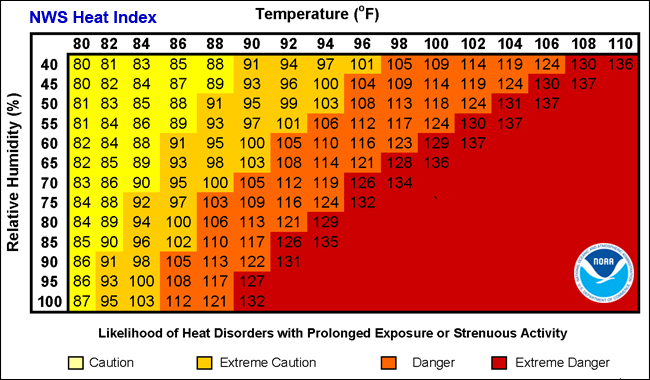
Figure 1: NWS Heat Index. Source: US National Weather Service.
Click on the image to enlarge.
If greenhouse gas emissions are not curbed and these temperature predictions are accurate, millions of people will lose access to third places, accelerating the decline already underway. The loss of third places will affect more than community resilience; the availability of third places is associated with higher quality of life, sense of community, and even better public health. These connections highlight the relevance of frameworks like One Health, showing another example of how neglecting the health of the environment will contribute to a decline in human health and well-being and vice versa.
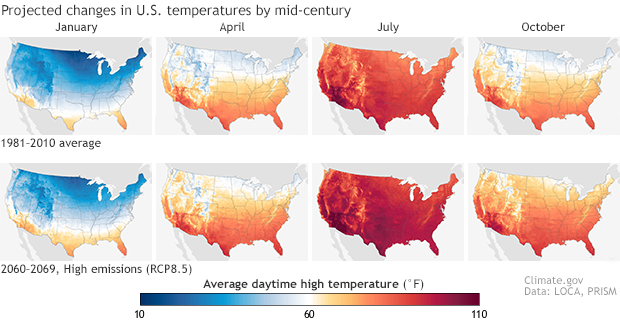
Figure 2: Projected Changes in U.S. Temperatures by Mid-Century.
Source: National Oceanic and Atmospheric Administration.
Click on the image to enlarge.
While climate change threatens to limit access to third places, this relationship is bidirectional. Social cohesion, particularly at the community level, contributes to climate resilience and action. Thus, there is the potential that as climate change reduces the viability of former third places, community cohesion declines and climate action declines in a cycle.
The world is facing an unprecedented ecological crisis, while simultaneously dealing with the erosion of democracy and social upheaval. Given this, recent articles in Mother Pelican and elsewhere have called for increased attention and effort to build community resilience. Heinberg writes, “Collapse is accelerating. So must our efforts to build personal and community resilience. . . Get out and join with others in projects to make your town stronger and more socially and environmentally stable.” We agree. Unfortunately, we suggest that climate change may create a feedback loop, whereby communities are weakened as third places become less accessible due to heat and cannot organize to fight climate change.
This is not a foregone conclusion. Parks and outdoor areas may be important third places, but others exist and can be created. Libraries, recreation centers, hobby shops, and even religious buildings can provide free places where community can be built. Even if we fail to mitigate the heating effects of climate change, these indoor places will be essential for community to continue to exist and thrive in a warmer world. The utilization of these indoor spaces can promote stronger social cohesion to encourage more solutions to the dwindling outdoor space of third places due to climate change. But for this to happen, there will need to be action. It’s not too late if we advocate for the creation and expansion of these third places today.
ABOUT THE AUTHORS
Michael D. Briscoe is an Assistant Professor of Sociology at Colorado State University Pueblo. His research and teaching focus on the intersection of human, animal, and environmental well-being. He is the author of the book Stocks or Stakeholders: The Benefits of Considering Animal Interests.
Mary C. Sanchez is a Psychology and Sociology Student at CSU-Pueblo. Her research interests consist of community-based interventions for mental health crises, socially and culturally informed therapeutic interventions, mental health issues, and broader social implications.
|