Trump's feud with Pope Leo echo past Vatican-state conflicts, highlighting Catholicism’s complex role in American politics.
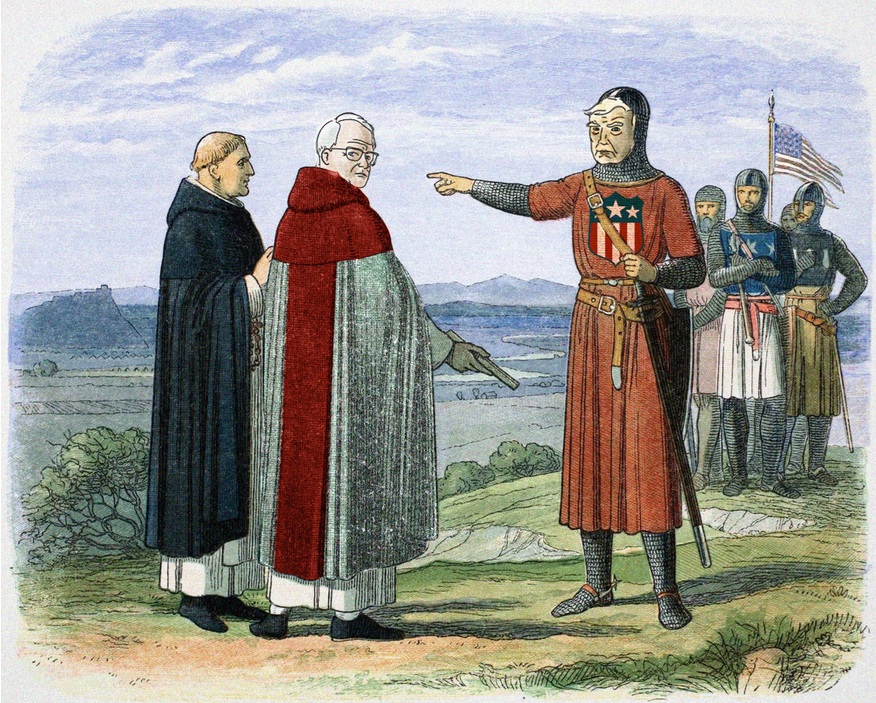
Imagine the scene: a soft-spoken Bishop of Rome, calmly refusing to budge from Catholic principles, assailed with the puerile rhetoric of an enraged head of state who surrounds himself with sycophantic clergy. Two weeks ago, I would have assumed such a tableau described
Pope Pius VII’s stand against Napoleon in the early 1800s. Since then, however, we’ve seen a real-life soap opera play out between Donald Trump’s administration and the Vatican. This extraordinary conflict marks a stark departure from the status quo, but also has the hint of some intriguing historical “rhyming.” After all, it is only the latest in a long line of feuds between popes and politicians.
This conflict (which Wikipedia editors have rushed to dub the “2026 United States – Holy See rift”) is enrapturing because it features everything from the boilerplate (pope decries war) to the macabre (Pete Hegseth’s imprecatory prayers), from the too-good-to-be-true (Avignon captivity threats at the Pentagon) to the bizarre (the AI Jesus image). As with most phenomena involving a two-thousand-year-old church, this kind of rift has many precedents. We could turn to fourteenth-century France, when King Philip IV threatened fellow megalomaniac Boniface VIII with accusations that make Trump’s social media posts look polite (Philip charged that pope with sorcery, sodomy, and literally cavorting with demons. None of these accusations were proven in the court of law). We could even turn to the eleventh century and examine the dueling hierocratic claims of Gregory VII and the Holy Roman Emperor Henry IV, who was famously released from papal excommunication only after kneeling barefoot in the snowy Apennines.
While this deep history of church-state conflict is fascinating, I think it is safe to assume that Donald Trump is not interested in it (though JD Vance certainly is). Trump and his advisors, however, are surely aware of two more recent phenomena. The first is the history of the ambivalent place of global Catholicism in US public life, and the second is the Trump administration’s fraught and transactional relationship with the Catholic Church. Both are equally important, but for the moment I’ll focus on the former.
That US presidents would have some friction with the leader of the world’s 1.4 billion Catholics is not really notable. The official teaching of the Catholic Church, from the viewpoint of either the Republican or Democratic pole of American public life, is an almost unthinkable admixture of “conservative” and “liberal” values and tenets, all held with a decidedly impractical degree of inflexibility. On the one hand, an ancient hierarchical church ruled by a prince-like patriarchy rails against abortion and “gender ideology” and challenges IVF and contraception (although the latter are accepted by most Catholics and by most Republicans). On the other hand, these same bishops critique environmental destruction, work to alleviate poverty, and direct vast human and economic resources to ease the plight of migrants with no interest in whether they are “legal.” They decry the manifest social injustices in US society, from insufficient healthcare access to the ravages of ICE and the persistence of racism.
This dissonance goes back to the colonial and largely Protestant origins of the American republic. George Washington (a Freemason) and Benjamin Franklin (a deist) carved out an initial opening for Catholics during the fight for independence—Washington by welcoming “papists” into the military and government and by banning bigoted displays such as Guy Fawkes Day, Franklin by working to ensure that an “enlightened” priest (John Carroll) who affirmed religious liberty and separation of church and state became the new republic’s first Catholic bishop.
While latent anti-Catholicism was widespread in nineteenth-century America and occasionally saw violent spikes, by the twentieth century Catholics had a strong claim to being sufficiently Americanized. Sometimes, in traditional Roman eyes, this Americanization had gone too far. When Catholic Al Smith received the Democratic nomination in 1928, he was challenged by Protestants familiar with recent papal diatribes against modern sins such as religious liberty (“indifferentism”) and church-state separation. Smith was pressed: if elected president, would he attempt to implement the reactionary vision sketched out in papal “encyclicals” (official teaching letters)? The New York Democrat was genuinely confused. “What the hell is an encyclical?” he replied to one challenger.
The election of John F. Kennedy in 1960 was a crowning moment for American Catholics. They had arrived. This political apotheosis coincided with release from a purported intellectual and cultural “ghetto” via the reforms of the Second Vatican Council (1962–1965). Vatican II formally endorsed religious liberty, and it also helped consolidate the papacy’s enthusiasm for a post-WWII multilateralism that repudiated communism and fascism, embraced decolonization and racial civil rights, and envisioned a democratic, humanitarian future.
It was not until 1984, under Ronald Reagan, that the US normalized diplomatic relations with the Vatican. Tension between the White House and the Holy See cropped up periodically, following predictable lines: over abortion with Clinton and Obama, hawkishness with Reagan and Bush. But in all of these episodes, cordiality mostly prevailed (at least publicly) and popes and presidents treated one another with mutual respect. John Paul II and Cardinal Joseph Ratzinger protested George W. Bush’s preemptive invasion of Iraq in 2003 as a textbook violation of the Just War tradition. But Bush was always deferential, even fawning. After Ratzinger became pope, Bush stated when he looked into his eyes he saw “God.”
By the time Trump became president in 2016, three generations of Catholics had reached the highest levels of the US government, staffed the CIA, flooded into the universities, and celebrated Notre Dame wins on the football field. Reliably anti-Communist, comfortably “Judeo-Christian,” and extra eager to show off their patriotism, Catholics had become as American as baseball.
Almost. Elements of Catholicism that had always clashed with the American project have turned out to be features, not bugs. Catholicism remains an uncomfortable fellow traveler with contemporary American society because it is paradoxically both pre-modern and hyper-modern. Catholicism is pre-modern insofar as church leadership structures and teaching organs predate the nation state. But the church is also hyper-modern insofar as it is a global, multi-racial society that instinctively seeks to relativize the hegemonic grasping of any particular nation.
While rejecting key elements of the sexual revolution, recent popes have also confidently asserted a vision for a globalized human family. This worldview is predicated on generous humanitarian migration and a new “integral ecology” that takes climate change seriously. It challenges capitalism and consumerism, and views modern warfare with a suspicion that at times seems to border on pacifism. Such a vision simply doesn’t fit within the two-party American system. It is also, in almost every respect, antithetical to the “America first” worldview of Trump’s MAGA movement.
The specific contours of the recent US-Vatican clash are marked by three enormously important contingencies: (1) Trump’s psychology; (2) his partly successful but incomplete transactional plan for winning US Catholics over to MAGA; and (3) the astounding and unforeseeable wrinkle: Trump’s overlap with the first American pope, a man formed by Latin American theology and praxis and a Roman global vision for the church. While Trump’s recent actions are reckless and unnecessary, it is probably more remarkable that it has taken so long for a modern US President to identify the leader of this global society, to which one in five US citizens nominally belong, as a political problem that must be directly confronted.
|Back to Title|
LINK TO THE CURRENT ISSUE
LINK TO THE HOME PAGE