When I was invited to write a chapter on men in feminism for a scholarly book, I told the editors that I would have to include discussion of my writing on the radical feminist critiques of pornography and transgender ideology, which are controversial subjects in academic feminism. They assured me that wouldn’t be a problem, but I submitted a draft early because I’ve had editors reject such writing at the last minute. Their response did not surprise me: “The editorial team has met and decided the article does not fit with our mission for the book.”I’m grateful to Julie Bindel for offering to run the essay on her Substack in installments, starting with today’s introduction to the challenges for men in feminism. The second part makes a case for radical feminism and analyzes masculinity-in-patriarchy. Part 3 deals with pornography, and Part 4 analyzes transgender Ideology. The final installment argues for feminism from men’s self-interest and reflects on dilemmas for men in feminist projects.
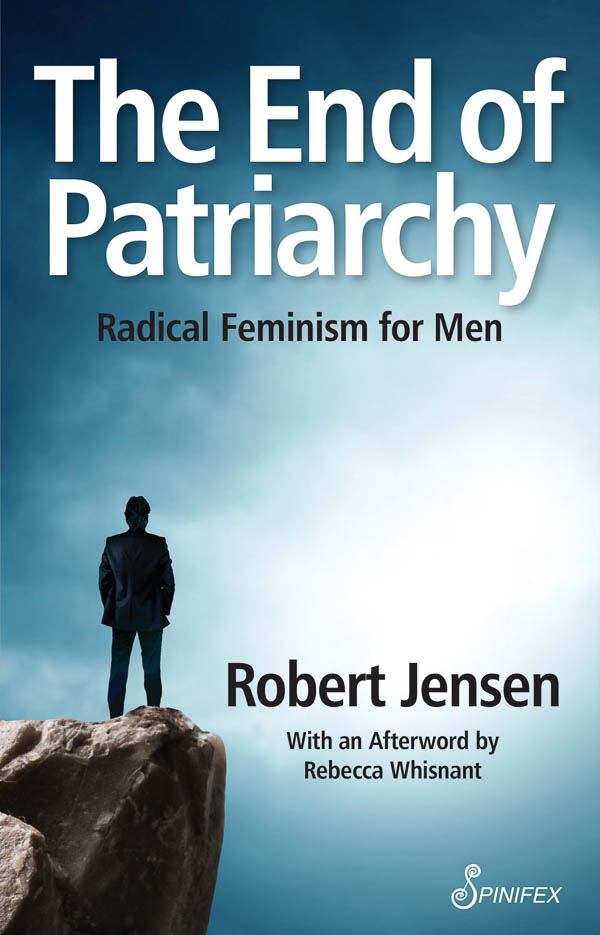
Readers of this Substack will recognize some of these ideas from articles of mine that Julie has published over the past few years or from my books Getting Off: Pornography and the End of Masculinity (2007) and The End of Patriarchy: Radical Feminism for Men (2017)
Members of dominant classes have uneasy standing in movements that challenge their class power and privilege. Can we contribute to intellectual debates and political change without replicating a dominance dynamic? Why should anyone trust us? Should we trust ourselves?
As a white man born in the United States who has worked in professional jobs during a period of economic expansion, I have considerable first-hand experience with this quandary. As a friend once told me, “Jensen, if you had been born good looking, you would have had it all.” What guidelines should someone with my advantages follow?
During my time in feminist scholarship and activism, one of the commandments for men has been “accept the leadership of women,” reminding us that we have no claim to authority and don’t automatically know best. Like most platitudes, however, it’s sketchy.
The obvious question: Which women? Working in scholarly or political arenas as a pro-feminist man means working with feminists and rejecting or ignoring most of the claims of anti-feminist and non-feminist women. But another equally obvious question: Which feminists? There has never been a single, unified approach to any intellectual/political movement, including feminism. Liberal, radical, socialist, Marxist, cultural, psychoanalytic—the list of feminist theories goes on and on. I can’t accept the leadership of all feminist women when they disagree among themselves. Making choices is inevitable, as others have pointed out.
Many men avoid those conflicts by describing themselves as “male allies” engaged in “allyship” on “male allyship journeys,” terms that not only don’t help navigate conflicting feminisms but sideline men’s self-interest in embracing feminist principles as active participants with a stake in the struggle. Pro-feminist men, like all people, have mixed motives. (One of my favorite aphorisms is “I’ve never met a motive that wasn’t mixed,” though I haven’t been able to track down its origins.) I have yet to meet a saint in academia or political organizing who acts with no concern for self-interest. We do things for complex reasons involving not only our sense of justice and also our psychological and social needs.
In this essay, I confront these tensions, rejecting the duck-and-cover strategy some men use. Men must balance the need for humility with the inevitability of making intellectual and political judgments, taking responsibility for how we analyze the sex/gender system and challenge patriarchy. We should explain why we follow the leadership of particular women, endorse particular analyses, and support particular policies to challenge institutionalized male dominance. If we avoid those decisions, we almost always by default “choose” the conventional wisdom in our social circles. I offer as examples the radical feminist critiques of pornography and transgender ideology, cases in which men too often step back to avoid conflict and end up endorsing (explicitly or implicitly by their silence) the dominant liberal/postmodern position. What should guide pro-feminist men in our intellectual and political decisions? To quote a friend, we must not only pursue justice but be in this struggle “to save our own lives.”
I will begin with a summary of my career, explaining why I embrace radical feminist analyses and critique not just “toxic masculinity” but the culture’s obsession with masculinity/femininity. I will apply those analyses to pornography and transgender ideology, concluding with an account of how arguments from justice and self-interest don’t conflict.
Who am I?
I retired in 2018 as a full professor in the School of Journalism after 26 years at the University of Texas at Austin. I have written a dozen books (a few more if one defines “book” broadly) and lectured on every continent (except Antarctica), while getting paid to do something I loved (teaching). What are the secrets to my success? Mediocrity and dumb luck.
Dumb luck came in many ways, beyond white, male, and U.S. citizen. I was born in 1958, which meant my post-secondary education came when state universities were affordable and graduate assistantships were generous. When I finished my Ph.D., job openings were relatively plentiful. But one bit of dumb luck was distinctive: In the first month of my doctoral program, I met Jim Koplin, a retired psychology professor who was the volunteer office manager for Organizing Against Pornography in Minneapolis. He quickly became my closest friend, gave me insightful advice on navigating academic life until his death in 2012, and was my model for how men could work in feminist organizations with integrity. (Jim will pop up now and then in this chapter, but for anyone interested in more detail, see Plain Radical: Living, Loving, and Learning to Leave the Planet Gracefully.)
My mediocrity takes more explanation. When graduate students asked me for career advice, I said, “The secret to my success is that I’m mediocre, and I know it.” I don’t lack self-confidence but rather was validating students’ experience with inflated faculty egos and reminding myself of my limits. The coin of the realm in universities is being a big thinker with original ideas. But most of us aren’t big thinkers, and original ideas are rare. Rather than being satisfied with striving for competence, professors too often puff themselves up. Jim helped me resist this temptation. He saw that my intellectual background was inadequate, especially in math and science, and that I was unlikely to catch up on all fronts. Compassionately, as a friend, he helped me understand that while I didn’t have the makings of an intellectual star, I wrote clearly and could contribute to intellectual life as an interpreter of other people’s work. I think I got pretty good at identifying smart people who had innovative ideas and summarizing (and, in some cases, expanding on) those ideas for regular folks, whether undergraduates in my classes or the public.
I did enough scholarly publishing to get tenure in 1998 but after that wrote almost exclusively for general audiences. I never saw my fate as being tied to media/communication studies or its professional associations, or any academic discipline. Once tenured, I wasn’t dependent on scholarly arbiters of what was fashionable theory and research.
That’s the easy part. More difficult is explaining why radical feminism struck a chord in me. What made me so open to an argument that so many men rejected? I struggle with how to write about this, in part because I struggle to understand it and in part because it is emotionally intense. My forthcoming book, This I Don’t Believe: A Fulfilling Life without Meaning, gives the best account I have come up with so far, and I’ll condense that story here: As a boy, I was used in ways that so many girls and women get used. It takes a lot out of me to write that sentence but to avoid it would be dishonest. Not all boys have that experience, of course, and I am not suggesting that radical feminism is relevant only to those who have experienced abuse and violation. But I can’t pretend it isn’t part of my story.
A note about terminology. There’s a longstanding debate about whether men should call themselves feminist or pro-feminist. If feminism is the project of women’s liberation, can men be feminists? I once gave this a lot of thought, deciding to describe myself as a man who worked in feminism and avoid labeling myself a feminist. These days, I am comfortable with either label but believe that because feminism is essential to men’s well-being, we need to be feminists.
Next in Part 2: The case for radical feminism and against masculinity-in-patriarchy.
Links to Parts 2 to 5:
Not Just an Ally: Radical Feminism for Men ~ Part 2 of 5
Not Just an Ally: Radical Feminism for Men ~ Part 3 of 5
Not Just an Ally: Radical Feminism for Men ~ Part 4 of 5
Not Just an Ally: Radical Feminism for Men ~ Part 5 of 5
|Back to Title|
LINK TO THE CURRENT ISSUE
LINK TO THE HOME PAGE