The Pro-and-Con Objectives of Techno Optimism and Green Growth
Backstory
Welcome to this updated exploration of sustainability, what it is, and what it means for the future. For the past 20 years I’ve explored all relevant socioeconomic issues that help explain our human story, from a deep-time perspective to the present, particularly in relation to the causes for our developing human predicament (metacrisis), and our prospects for creating a sustainable future.
Previous posts featuring various aspects of sustainability include: How We Got This Way—An Unsustainable Existence; What Does Sustainability Mean?; and Two Contrasting Paradigms: Pro-Growth vs. Post-Growth. This post and the next will combine information from previous posts, plus fresh information pertaining to six paradigms based on achieving long-term sustainability goals.
What prompted me to undertake an updated consideration of sustainability was hearing a podcast’s guest expert criticize the term “sustainability”. Apparently, he assumed the term referred to sustaining the prevailing socio-economic, pro-growth paradigm, which is a misunderstanding. This two-part series should help explain sustainability according to two pro-growth and four de-growth / post-growth paradigms.
Any realistic concept of sustainability must acknowledge the three main characteristics of humanity’s existing civilizational worldview: 1) reductionism, 2) individualism, and 3) an anthropocentric perception of human supremacy. The overall unfortunate outcome is our growing separation from the rest of the natural world. In short, we are estranged from our original evolutionary context.
It needs pointing out that the systemic socio-economic mechanism perpetuating this worldview – a capitalistic, profit-oriented, socio-economic global paradigm – is not sustainable. So much harm has already been done to the ecosphere (the source of our true wealth) that a realistic expectation for attaining a potentially desirable sustainable level is rapidly waning. It seems obvious that continuing this outmoded paradigm promises ultimate disaster for all earthly life.
If, as climate scientist James Hansen predicts, the global average temperature rises 2C (3.6F) degrees within the next decade or so, the capability of maintaining life as we have known it will be practically impossible, at least in some regions of the globe. Mitigation and adaptation measures will be far more difficult to manage if we don’t take strategic downsizing steps very soon.
As regular readers are aware, continuing material growth on our finite planet is an irrational strategy in a world of declining natural resources and socio-ecological challenges. Obviously, this includes human population growth, the principal driver of ongoing material overconsumption – and the overproduction of toxic wastes that pollute our air, water, soil, and all lifeforms.
So, in this post we’ll consider the two sustainability paradigms that remain committed to a “sustainable growth” narrative. I think you’ll be surprised not only by the variety of positions held and promoted, but also how the general public fails to appreciate and support the most sensible perspectives.
Sustainability – A Basic Definition
The most widely cited definition of sustainability was formed in 1987, when the United Nations (UN) sponsored the Brundtland Report – Our Common Future – which was produced by the World Commission on Environment and Development. Sustainability is defined as:
“Development that meets the needs of the present without compromising the ability of future generations to meet their own needs.”
In this definition are embedded three key concepts: 1) intergenerational responsibility; 2) integration of economy, society, and environment; and 3) the assumption that, while development can continue, it must be reformed. The report’s emerging model is often described as the “three pillars” of sustainability: 1) environmental protection; 2) economic development; and 3) social equity.
The only questionable pillar for de-growth proponents (including me) relates to “economic development”, a topic deserving cautious evaluation. Prioritizing economic growth typically ignores ecological limits. Any sensible “development” must give attention to ecological limits. A more appropriate term might be “economic transformation”.
Holding this general definition in mind, it’s important to also remain aware that sustainability cannot be considered a single theory but rather a spectrum of competing paradigms. That is, there is no mutually unified belief regarding what needs to be sustained.
I think readers will agree that a top priority should be focused on sustaining existing lifeforms, which includes having access to essential life-sustaining resources – clean air, water, and soil; food, shelter, and clothing; energy, tools, and arts, etc. Of course, we want to sustain life-affirming positive values and qualities, including love, compassion, cooperation, empathy, curiosity, learning, health and wellness. I’m sure you can think of other “needs”, perhaps even some “wants”, as long as they remain sustainable.
Each of the six paradigms presents unique perspectives and interpretations of what sustainability means and ways to achieve it. There may be others, but these are the ones drawing the most attention currently. Here we address only the sustainability paradigms clinging to outmoded “economic growth” paradigms, the most radical being the growing influence of techno-optimism.
Pro-Growth Paradigms: Techno Optimism and Green Growth
Techno Optimism claims to focus on maintaining economic growth while also reducing ecological harms, a position I find confusing. Just consider the enormous requirement of natural resources needed in creating and maintaining technologically complex equipment and systems. AI data centers alone promise to drain social and ecological systems of electrical energy and precious water sources. And what about the enormous investments in space stations, rockets, robots, and the like? One example is the extra equipment needed for self-driving vehicles, which require rare-earth materials.
Techno-optimism’s core belief is the power of technological innovation, economic growth, and markets to solve all environmental problems. This cornucopian belief is based on three key assumptions: 1) technological innovation decouples growth from environmental damages; 2) efficiency improvements reduce resource use; and 3) renewable energy and circular economies will maintain prosperity. Typical policies support the development and use of green technology, carbon markets, renewable energy expansion, and circular economy strategies.
Influential techno-optimist representatives Marc Andreessen and Ben Horowitz are well known for their publication –The Techno-Optimist Manifesto. Andreessen’s statement, “there is no material problem – whether created by nature or by technology – that cannot be solved with more technology” succinctly explains the techno-optimistic paradigm.
Other prominent representatives include: Garry Tan, CEO of Y Combinator and advocate for effective accelerationism; Guillaume Verdon (”Beff Zezos”, pseudonym), founder of accelerationist movement; Ray Kurzweil, futurist and author known for his “Law of Accelerating Returns”; Patrick Collison, CEO of Stripe and proponent of “Progress Studies”; Peter Thiel, venture capitalist and co-founder of PayPal and Palantir, and promoter of radical innovation; and Balaji Srinivasan, investor and author of “The Network State”, advocating for decentralized technology. Of course, there’s also Elon Musk, the world’s richest human and enthusiastic dreamer of creating a “Star Trek”-like future of great abundance.
Key techno-optimistic intellectuals include: Friedrich Hayek and Ludwig von Mises, free-market economists of the Austrian School; Milton Friedman, an economist who emphasized the role of free markets in human progress; Nick Land, a philosopher known for acceleration theories; Julian Simon, an economist who argued that human beings are the “ultimate resource” and that technology can overcome resource limitations; and Stewart Brand, author and founder of the Whole Earth Catalog, and proponent of ecological and technological optimism.
The four core beliefs of techno-optimists are based on: 1) accelerating technological development and capital accumulation to maximize human potential; 2) combining free markets and technological innovations, a self-sustaining, positive force for progress; 3) eliminating regulations for innovative technologies, including AI, to avoid stifling progress and harm to humanity; and 4) enabling the power of technology to overcome energy and resource limitations.
Green Growth (Mainstream Sustainability and Sustainable Development)
This mainstream paradigm is the dominant international policy framework for sustainable development, organized in many cases according to the Sustainable Development Goals produced by the United Nations Environment Program (UNEP). A diverse coalition of global institutions include the World Bank, International Monetary Fund, International Energy Agency, and the UN Educational, Scientific, and Cultural Organization (UNESCO), which leads the International Decade of Sciences for Sustainable Development (2024–2033), with a focus on science-driven solutions.
Many Fortune 500 companies have integrated sustainability into their core strategies to ensure long-term competitiveness. There are four notable categories:
• In technology and data, Google is focused on using 24/7 carbon-free energy, Microsoft is set on becoming carbon negative by 2030, and Apple on becoming carbon neutral across the supply chain by 2030.
• In consumer goods and retail, Unilever is set to become net-zero by 2039, IKEA is aiming for climate-positive by 2030), and Walmart is focused on Project Gigaton.
• In apparel and manufacturing, Patagonia is a leader in circularity and corporate activism, LEGO is using sustainable materials.
• In industry and energy, Schneider Electric is ranked top for sustainability, and Ørsted has transitioned from fossil fuels to renewables. And there are many more positive examples.
Key Non-Governmental Organizations (NGOs) are committed to green initiatives. The World-Wide Fund for Nature (WWF) works with businesses and governments to transform markets toward sustainability, the Nature Conservancy (TNC) focuses on land/water conservation and science-backed solutions, and Ceres mobilizes investor and company leadership to drive sustainability across capital markets. The World Resources Institute (WRI) conducts research to bridge environmental needs with economic development, and the Rainforest Alliance promotes responsible business practices in agriculture and forestry. Most environmentally-oriented organizations appear to be working along similar lines as the organizations mentioned here.
Financial and regulatory bodies are also involved in this category. The International Sustainability Standards Board (ISSB) sets global baselines for sustainability disclosures; Principles for Responsible Investment (PRI) promotes ESG (Environmental, Social, and Governance) integration in investments; and the European Union (EU) drives stringent legislative frameworks for sustainable finance and operations.
Key individual influencers also play significant roles. Corporate CSOs, like Kate Brandt (Google), Lisa Jackson (Apple), and Kara Hurst (Amazon), are influential in driving internal corporate change. Sustainability advocates are well represented by Paul Polman (former Unilever CEO), various sustainability influencers, including Leah Thomas (Intersectional Environmentalist, and Leonardo DiCaprio (UN climate representative).
As a key-influencer global organization, the UN General Assembly has proclaimed 2026 as the International Year of Volunteers for Sustainable Development (IVY 2026). The purpose aims to accelerate progress toward the goals established in the 2030 Agenda, consisting of four pillars: 1) emphasizing volunteer power; 2) fostering inclusive policies; 3) measuring contributions; and 4) securing commitments.
In sum, the mainstream organizations covered above state that economic growth is acceptable but it must be “green”, with an emphasis on balancing economic, environmental, and social goals. With these three emphases, sustainability is framed in terms of better management rather than systemic transformation. It’s unfortunate that this powerful view stops short of facing the need for a radical transformation – away from the current socio-economic paradigm of growth, growth, growth.
Wrap Up
What opinions do you have regarding these two pro-growth sustainability paradigms? If you’ve been committed to one or both of these approaches, what assumptions have led you to believe their capability in effectively addressing a future of depleting natural resources, accelerating extreme climate conditions, uninhabitable regions, declining food sources, and extinction of vital life-supporting species?
I prefer accepting that which appears evidentially true (real), and responding honestly using practical, long-term strategies. Although these two pro-growth paradigms may be well intentioned, I’m convinced that neither will save humanity and the planet. While the techno-optimistic worldview appears somewhat delusional, the mainstream focus on tweaking all aspects of an outmoded pro-growth paradigmatic worldview is an insufficient strategy.
In sum, I heartily agree with socioecologists who concur that both pro-growth paradigms present challenges so comprehensive in size, scope, scale, and speed (due to technological innovation, notably AI) that continuing to stress growth is a dysfunctional aspiration for creating a sustainable future. I don’t expect all readers will agree with me, but I hope this post – and the next one featuring four potentially sustainable paradigms – will present some intellectual food for thought in challenging preconceived beliefs and opinions.
Thanks for staying with me on this journey through a complex morass of interrelated issues, beliefs, perceptions, opinions, biases, and worldviews. Living with meaning requires a deep devotion to seeking what I term the Transcendental Triad: Truth, Goodness, and Beauty, a likely series of upcoming topics to be explored.
Please think on these things . . .
Clif (with Bettye Ware, reader/editor)
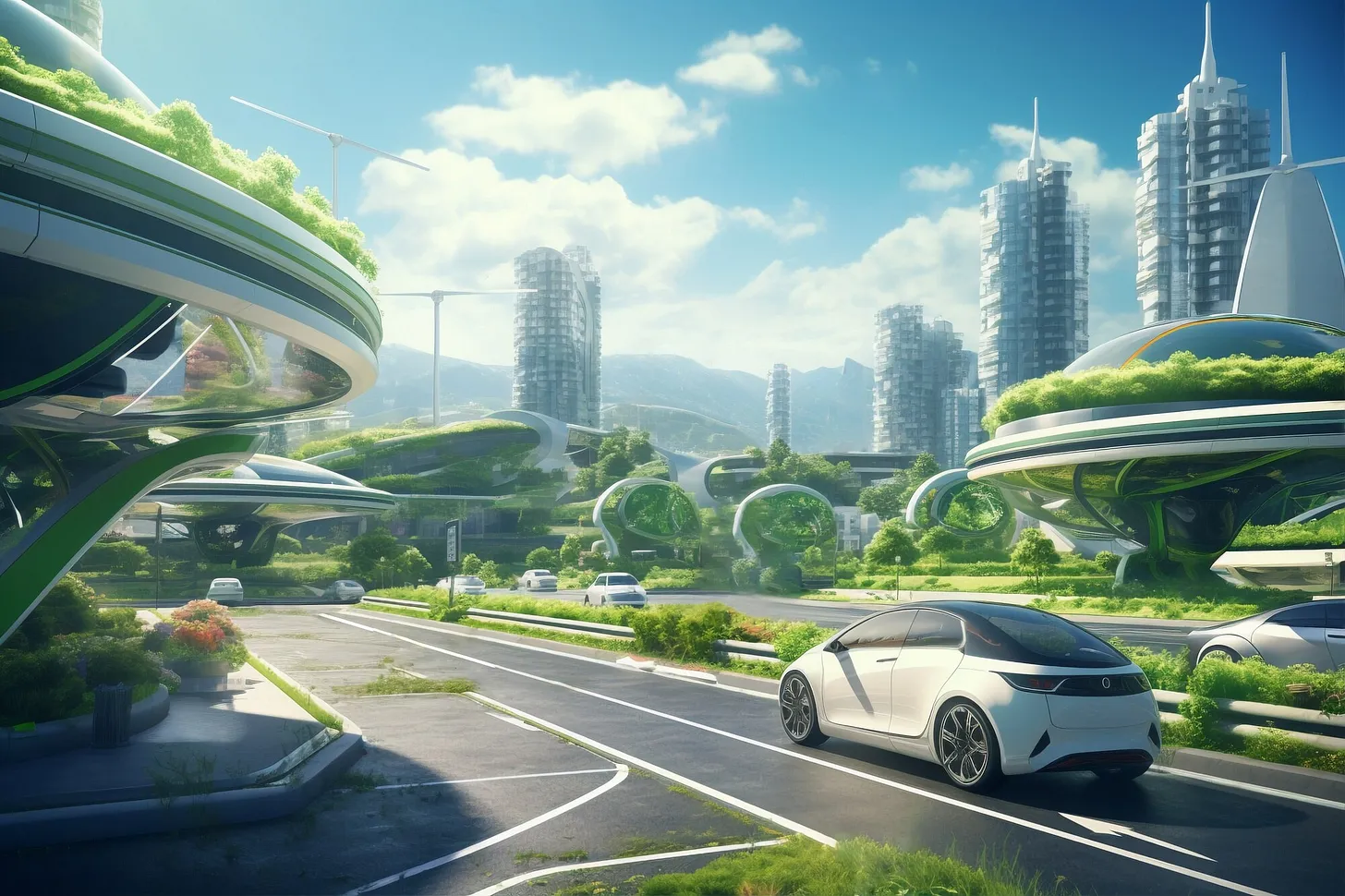
A 'green-growth' urban scene (with no signs of animal life).
Click on the image to enlarge.
By the same author:
Sustainability According to De-Growth
and Post-Growth Paradigms
OIL—What You Need to Know and Understand
Natural Landscapes to Cityscapes
ABOUT THE AUTHOR
Clifton Ware, D.M., emeritus professor (voice), professional singer and author of four published books and two unpublished works, retired in 2007 from the University of Minnesota-Twin Cities School of Music, where he taught for 37 years. In retirement – as a self-described socio-ecological philosopher focused on sustainability issues – he continues seeking an evidence-based, big-picture understanding of socio-ecological systems, including the symbiotic interconnections and role of humans as an integral part of Nature. In 2013 he founded Citizens for Sustainability in St. Anthony Village, MN, produced Sustainability News + Views (2014-2019), a weekly newsletter featuring a variety of articles and a commentary, co-composed 13 Eco Songs with his wife, Bettye, organized Sustainability Forums, and performed eco-oriented programs and presentations for several organizations.
|
|Back to Title|
LINK TO THE CURRENT ISSUE
LINK TO THE HOME PAGE