The attack on Iran made visible our critical dependency on the supply chain for many commodities we can hardly live without. It is not just a question of fossil fuels for transportation. It is the whole social and industrial system that depends on a reliable supply of energy and feedstock for the industry and agriculture.
Right now, the Web is seeing a spike in posts and papers about the effects of the closure of the Strait of Hormuz. People are noting that a considerable fraction of the world’s fertilizer production moves through the strait and, if things don’t change, we risk a serious crisis in terms of food production. The disaster might become long-term, or even permanent, if governments were to start playing the tit-for-tat game: “You destroyed my refinery? And I will destroy yours!” They could do even worse things.
So, what’s going to happen? You know that when discussing these matters there is always the risk of crying wolf too early. Paul Ehrlich made this mistake in 1968 when he predicted widespread famines in the near future with his book The Population Bomb. (**) Yet, it is also true that the wolf of the story eventually came. So, it is a good idea to always consider the worst-case hypothesis. You wouldn’t want to fly a plane that was designed by people who didn’t take into account that it could crash.
Stephen Newbury did exactly that with a post in his blog, “The Ultimate Avatar of Balance, titled “The Catabolic Correction.” You can find a more formal academic version at this link. Newbury starts with considering what would happen if we had to keep agriculture running without diesel fuel (that doesn’t mean running out of oil; the supply is sensitive to political events, as we are seeing nowadays). So, suppose we want to replace diesel tractors with draft animals. The numbers are the following, citing from Newbury’s post.
Currently, humanity cultivates approximately 1.5 billion hectares of arable land.
Historically, it required one draft horse (delivering 750 Watts of mechanical power) to plough and maintain 2.5 hectares of land effectively over a season.
From this, he estimates that some 450 GW of animal power would be needed to keep ploughing at today’s rate using horses. That translates to some 600 million horses or other draft animals. So many horses simply do not exist in the world — maybe one tenth of that number gallops around today. Even in terms of other draft animals, the total number falls badly short of the needs. But the real problem is that draft animals need to be fed with agricultural products, which become unavailable for human consumption. It is a question of EROI (energy return on investment). Tractors don’t have this problem: they are “fed” with diesel fuel generated by fossil fuels.
Then, Newbury concludes that if we don’t have diesel fuel:
This mathematical reality dictates a brutal paradigm shift: broadacre agriculture must be entirely abandoned. You cannot plough the Russian Steppe or the American Midwest by hand.
It means that,
6.6 billion people are entirely supported by the continuous application of fossil fuels. Over 80% of the human biomass currently on Earth exists strictly because of the Haber-Bosch process and diesel mechanisation.
Newbury also mentions the Seneca Collapse, the rapid autocatalytic fall of complex systems. Then, there is the “climate attractor” — that is, how pollution in the form of increasing CO2 concentrations in the atmosphere is going to hit back at agriculture and make things collapse even faster.
Newbury’s numbers are basically right; they are confirmed by multiple previous estimates. Some time ago, Vaclav Smil estimated that no more than 3.5–4 billion people could be fed sustainably without fossil fuels. Hannah Ricthie published a similar estimate in 2017.
Could you call this a “stark reality”? Yes, but always remember that making predictions is tricky — especially when they deal with the future, as they say. These calculations are not predictions: they are necessary consequences of the assumptions that created them. And the assumptions can be questioned.
First, there is a question about timing. It is true that a Seneca Collapse of the world’s commercial and political system would lead to the collapse of the supply of food and fertilizers. But the system has a certain resilience. Collapses do occur, but not always, and not always so sharply as they could.
I discuss in my book, The End of Population Growth, how the world’s population is likely to start declining in the near future as a result of natural factors. As a result, agricultural production could decline without causing anyone to die of starvation. Admittedly, the models don’t generate the disappearance of billions of people in a few years, but the trend would surely make things less dramatic.
Then, there is technology. Do we really need Broadacre Agriculture to feed the world’s population? Do we really need synthetic fertilizers? How about diesel tractors? The answer is, “yes, now we do, but not necessarily in the future.”
There are many kinds of agricultural processes that don’t really need the brutal system of ploughing and overfertilizing the land used nowadays. Some are hi-tech processes, such as precision agriculture and, in the future, synthetic food production. Others are low-tech methods and imply local cultivation and care of the land.
It is true that agriculture needs energy, but the idea that we cannot do anything without diesel fuel is typical of a current of thought that assumes that photovoltaic and wind energy cannot exist without fossil fuels. They miss the high EROI of PV and other renewable sources. Today, renewables can produce sufficient energy to replace the current plants as they degrade, recycling the minerals used to construct them. Modern renewables are exactly what the name says: renewable.
My coworkers and I were already working on that idea in the early 2000s: how to electrify agriculture and make it truly renewable by getting rid of the fossil fuel dependence. You can read some of our results in a paper that we published in 2013. (*) My friend and colleague, Toufic El Asmar, was an expert on how to adapt the agricultural practices of poor countries to environmental and technological changes. Unfortunately, he left us a few years ago, but his legacy remains in the work he performed. Our conclusion was that, yes, there exist technologies that can support agriculture without the need for liquid fuels. That includes the production of synthetic nitrates that can be done using electricity.
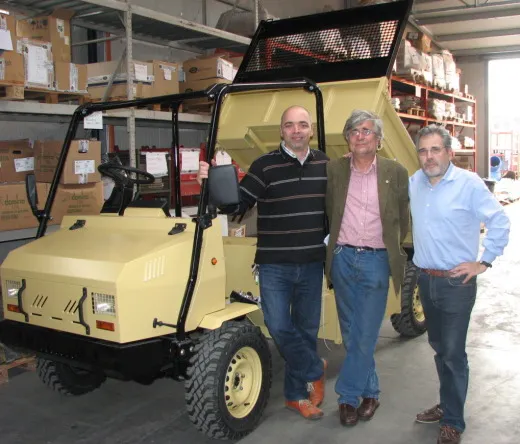
We also built a prototype of a solar electric tractor that we called the “RAMSES” vehicle (you see it at the beginning of this post). It is described on the “Cassandra’s Legacy” blog. The RAMSES was a multi-purpose machine designed to provide the power necessary for a multitude of agricultural practices: fertilizing, seeding, collecting, transporting, and more. It still used lead batteries, and it was not supposed to compete with the brute force of diesel tractors. But today, with a new generation of batteries, we could do much more in terms of range and power.
Unfortunately, humans are not as smart as they think they are. My research group was not the only one working on electrifying agriculture (and by the way, a tractor similar to the RAMSES was built at the University of Tehran by a colleague of mine). But, on the whole, the world’s agriculture has remained tightly bound to fossil fuels. In our world, innovation is not only difficult, but it is also actively opposed as long as someone makes money with the old ways.
Does this mean that a gigantic world famine is unavoidable? As things stand, I am afraid that there is a serious risk of seeing exactly that. Right now, Western Governments appear to be actively working at sabotaging renewable energy, evidently seen as a threat to their fossil-based dominance. If they keep doing that, then we are going to see a serious food production collapse. And don’t forget that starving one's enemy has always been one of the most effective weapons in war — it wouldn’t be surprising if it were to be used extensively nowadays.
But let me repeat: physics is unavoidable, human choices are not.
|Back to Title|
LINK TO THE CURRENT ISSUE
LINK TO THE HOME PAGE