I live in the U.S.A. and am a citizen thereof, but from an economic perspective, and according to what I hear in the news, I’m also considered a “consumer.”
We have been referring to ourselves as consumers for so long that this label now sounds normal. It has become a neutral descriptor – almost scientific – like we’re describing a person’s role in an economy the way you might describe how the top hat or the little dog pieces move in a Monopoly game. But if you reflect on this word it’s not only kind of weird, but also quite a narrow way to label a person.
A consumer is also an ecological term: autotrophs, heterotrophs, producers, consumers, and the like. But economically, a consumer is explicitly a mouth, an appetite, and something to feed – it’s a word that describes a human being primarily as an appetite with a wallet.
I believe this framing has quietly shaped the last several decades of Western culture. It has turned our lives into a shopping buffet and then – indirectly – our vibrant blue-green planet into a warehouse.
In this essay, I want to take the word “consumption” and unpack it into something more precise and perhaps useful ahead of The Great Simplification.
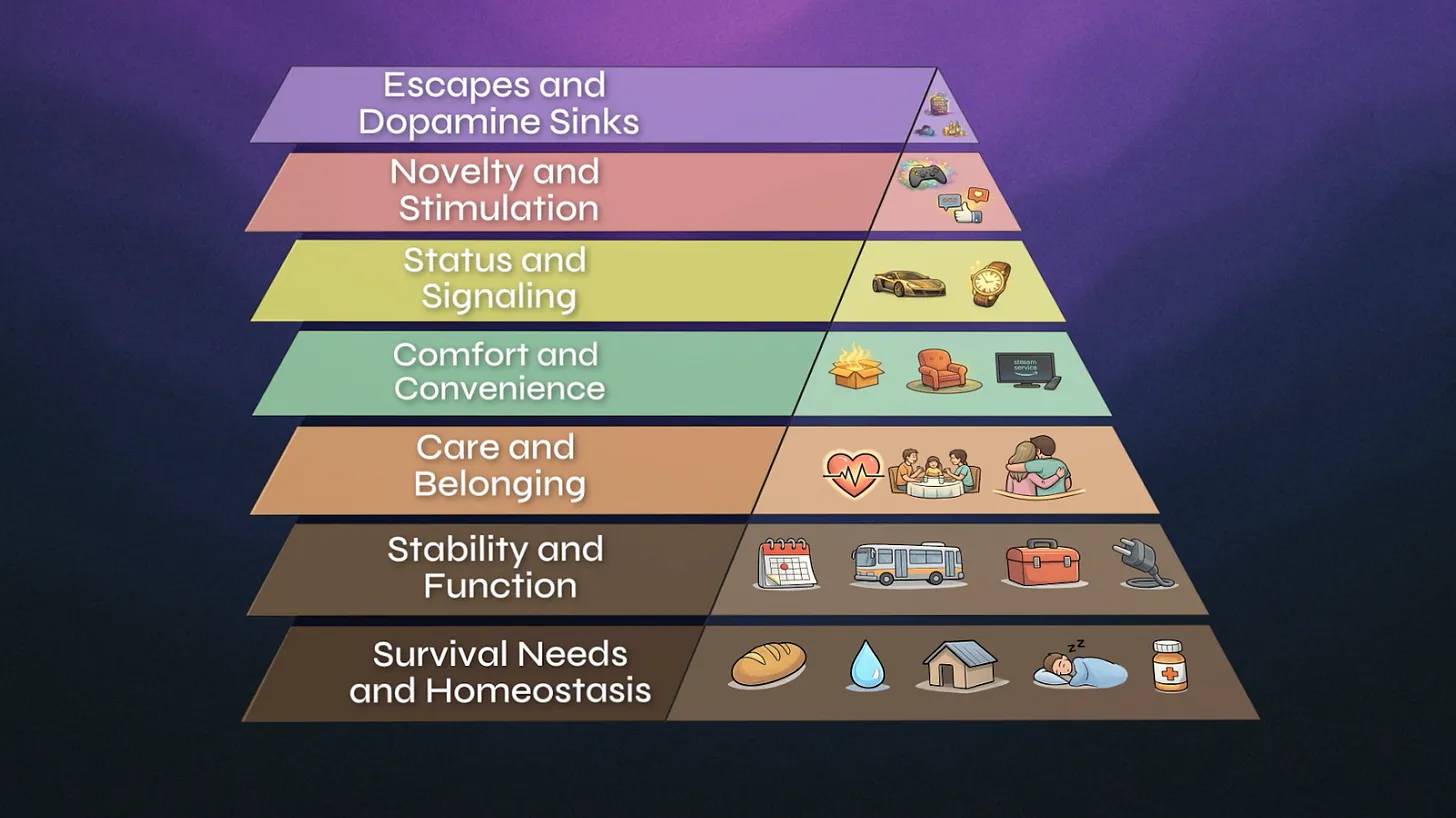
I plan to explain a simple diagram, which I’ll label the “Consumption Pyramid.” It maps out the many different connotations consumption has in our lives: keeping bodies alive, life running, relationships intact, and sometimes, honestly, just numbing our stresses in this pell-mell crazy world.
The reason I think this matters is both from an ecological perspective as well as a personal and practical one. I think we’re entering a period where the world is going to feel less stable, more volatile, and more expensive in ways that are hard to predict – other than maybe directionally. If you buy this premise, or even the possibility of this premise, then being able to move lower down this pyramid by choice becomes a form of sovereignty or resilience.
Layers of the Consumption Pyramid
There’s seven layers to the Consumption Pyramid. As we move from the foundation upwards, we’ll find things that are less about survival and more about mood, identity, and escape.
Most of us don’t live on one rung of this pyramid, we move around. I can be grounded in one part of my life and compulsive in another (and I often am). One can be minimalist about status and still stuck in a stimulation loop when they become tired or stressed. You can have incredible discipline for three months straight and then slide upward in this pyramid during a stressful week (that’s me too).
So, this framework isn’t meant to be any sort of moral purity ranking but maybe more like a weather map – a way to notice where you are in our consumption reality, and why you’re at that level.
Layer one is survival needs
It’s the most obvious one: calories from food, water, basic shelter, sleep, medicines. In some climates, heating or cooling – not as comfort, but as a survival necessity.
This tier is made up of the physical things your body requires for immediate safety and homeostasis. If a human life is really on the borderline at this layer, then everything else is downstream of that crisis – it’s hard to talk about self-actualization when you’re worried about being evicted.
So this layer is completely physical.
Layer two is stability and function
This is the layer that keeps a human life bending and not breaking. Think of reliable utilities, basic transportation, the tools used for work, childcare basics, and repairs – basically the boring infrastructure supporting a functional life that most of us in the West take for granted.
The repayment of debt also falls in this layer for a lot of people, even if it shouldn’t. If your monthly obligations are high enough, this layer’s “stability” becomes something you’re actually renting from the future.
The contents in this layer probably differ widely based on where you are in the world. In modern western economies, the drivers may be more psychological than physical. Specifically, the stress of a life embedded in a system that creates too many points of failure with too few buffers.
Layer three is care and belonging
This is where “consumption” gets more interesting, because it stops being about objects we require and starts being about what defines us as human – and what keeps us being human.
It includes shared meals, community obligations, therapy, exercise, travel to see your family, perhaps a modest (or extravagant) hobby that fulfills you, the time and financial spending that maintains relationships and health.
This layer is often missed in conversations about consumerism because on the surface it doesn’t look much like shopping. But it is real – at least in many parts of the world. Humans require social glue and the feeling of being held inside a web of human and non-human relationships. We can have the heat on and the bills paid but still be metaphorically starving if we lack things in this layer.
Layer four is comfort and convenience
The specifics here vary, but they might be along the lines of deliveries of coconut water and garbage bags, upgrades for our devices, nicer versions of basic services, a bigger living space, a subscription to Netflix (or BritBox, in my case).
I want to emphasize that this layer, just like all the others, is not inherently evil. A lot of the choices in this category are completely sane and can provide much needed relief. They’re often a way for us to buy back time in a high pressure life within a society that is, to use this quote two Franklys in a row, “slowly slouching towards Bethlehem.”
But there’s a catch: convenience often quietly creates dependency and can atrophy away the skills you used to have. It can make you less tolerant of friction or intermittent access to dopamine and oxytocin. It can convert small hardships into real emergencies, because your life no longer has any experience of being even slightly inconvenienced. It can also be expensive in a way that’s not obvious at first, because the cost is measured in fragility and a lack of buffer as opposed to dollars or euros.
Layer five is status and signaling
This category is consumption as social language: brands, aesthetics, flexing, and the purchase that says, “I’m the kind of person who has taste, success, fitness, intelligence, ideological purity, or belonging.” I think some portion of this consumption is harmless self-expression – humans have always adorned themselves in some way or another, from hairshirts to tattoos. We’ve always used objects as symbols. This is very human, playful, and benign. But some of it is also defensive or offensive social armor with an objective to secure one’s position in a tribe – consciously or unconsciously.
The key point is that consumption in this layer is not really about the object that’s purchased – it’s about the message from the object.
A side note: the status layer is usually expensive because it only works if other people can see it and if the signal is somewhat scarce in our society.
Layer six is novelty and stimulation
Rooted in restless discomfort, this layer helps temporarily distract us, usually through technology, impulse purchases, or endless content. It might appear in your life as an uneasy sense that there might be something better just one click away.
This layer is less about identity and more about feeling: you’re not trying to become someone else, you’re just trying to directionally shift your internal state away from where it’s at in the moment.
I believe this is where a lot of modern life, at least Western modern life on the upslope of the Carbon Pulse, sits by default because boredom has become intolerable in our society. And as we’ve discussed on this channel with many guests and in many Franklys, when novelty is always available, the ordinary feels dull…even if our “ordinary” would appear extraordinary for most of our ancestors. We now require more and more input to feel the same amount of aliveness. The wanting shouts louder than the having.
Layer seven is escape and dopamine sinks
This is where consumption becomes a form of anesthesia, compulsion, and dissociation. It’s where the ghost of dopamine past starts fully calling the shots and pushing us into patterns that don’t restore us – rather they just remove our authentic selves for a while.
This might be through gambling, doom scrolling, binge shopping, drugs, alcohol, or porn, all at a time when our algorithmic feeds have been engineered to keep us just slightly unsatisfied and still clicking.
I want to be careful here, because it’s easy to talk about this as some sort of a moral failure. I don’t think it is, at least most of the time. As Anna Lembke said earlier this month on this podcast (How We’ve ‘Drugified’ Our Entire Existence: Dopamine & Addiction In the Digital Age), which I highly recommend you watch, if a prehistoric man were dropped into Times Square today, he would’ve quickly become addicted to the smörgåsbord of stimulation available to us.
Ecologically, this consumption is essentially turning billions of barrels of ancient sunlight into microliters of dopamine. I think this level is what we get in a culture where chronic stress meets engineered technological temptation.
It would be one thing if consumption of all these things actually made us happier and healthier, but I increasingly think a large percentage of what society labels “pleasure” is actually more like relief from pain. If we pull on that thread a little further it’s also a relief from, in my experienced opinion, the knowledge of what we’re missing in our lives and what we are losing in the natural world.
Consumption at this level gives us the choice to feel like we can escape our own mind for a few hours or days or weeks.
The Pyramid as a Map
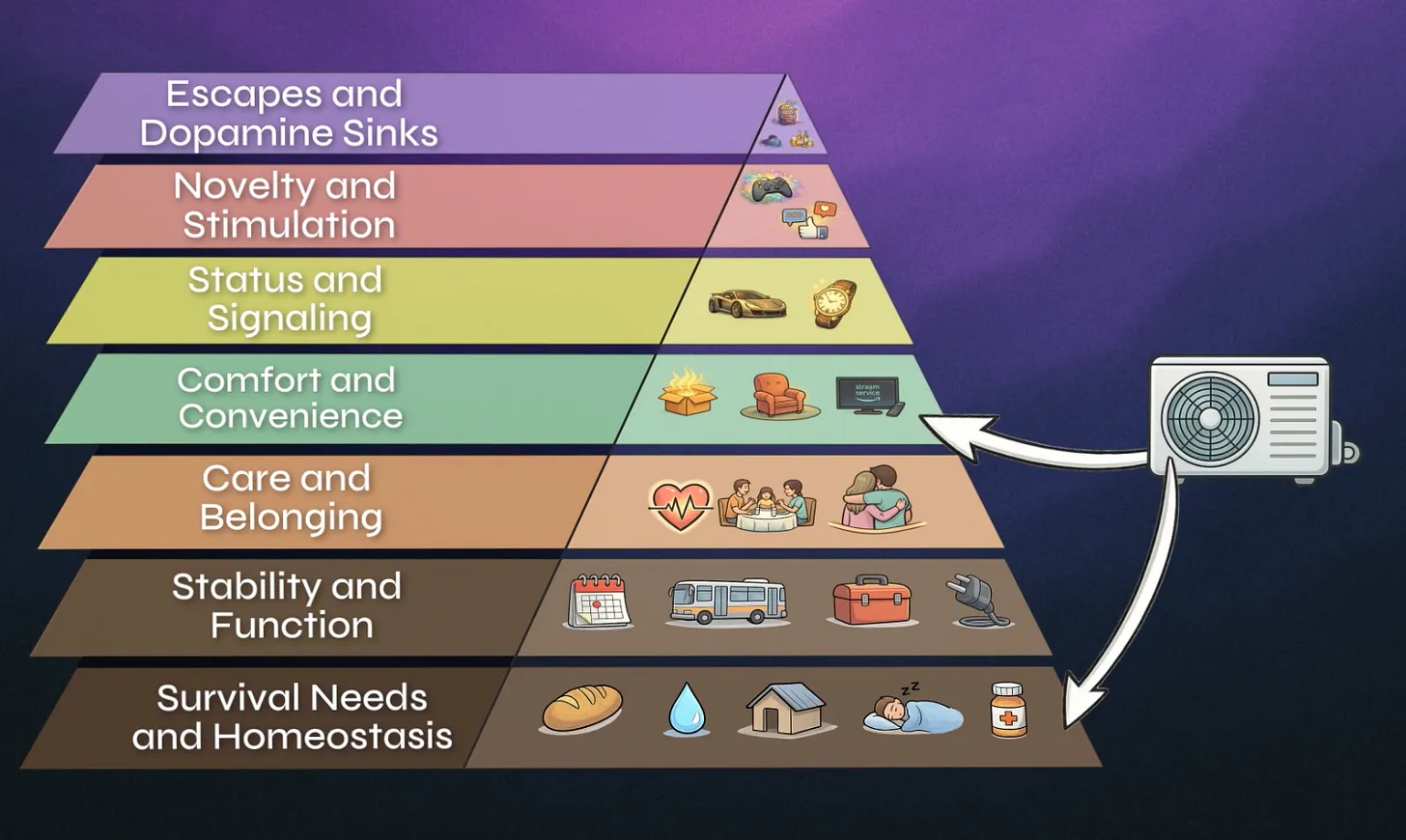
Click on the image to enlarge.
This is what the pyramid looks like in my mind. But this is not a linear story – the pyramid is not fixed and the boundaries aren’t rigid, especially in the middle. That’s because consumption is often doing more than one job at once – the same physical thing can reside on different layers of the pyramid for different people.
A smartphone might be a status object for one person but a functional necessity for another, because it’s how they work, access their bank, and use public services. Another, increasingly relevant, example is air conditioning, which could mean comfort in one climate and survival in another.
Even the concept of convenience is relative. A meal delivery service can be frivolous in one context but a lifeline in another, especially with someone dealing with a disability or caregiving. I’m a bit embarrassed to share where I got the idea for this Frankly: a few weeks ago, during the overnight hospital stay for my knee surgery, I was daydreaming about an Indian restaurant on the way home. I always stop there when I’m passing through, and I called ahead to order but there was no answer. I got there, and the entire plaza was locked and gated. It dawned on me that this was around the time of the I.C.E. activity in Minneapolis.
I don’t actually know what happened at the plaza, but I do know that I.C.E. was staging in the hotel next door. A realization hit me hard: I was worried about garlic naan, while the people who might have cooked it for me could’ve been worried about deportation. Maybe that’s not what the actual situation was, but the broader point still holds. How many of these simultaneous ‘mutual inconveniences’ with massively different stakes are happening in our world all the time?
My intent is not for this framework to become a way to judge other people who are consuming higher up the pyramid. The same category label means different things depending on baseline and context.
On a global level this becomes even more obvious. In some countries – increasingly many of them – what we would call stability and function is no longer guaranteed (or maybe never was). In others, comfort and convenience has become so normal that it feels like a right – such as the country I live in.
Which brings me to the point of this essay.
We’re starting to realize the last few generations have lived through, to put it mildly, an extremely unusual period. We’ve had cheap energy, expanding global supply chains, an economy built around abundance and speed, and relatively secure institutions in many places. We’ve had, for the most part, a stable ecological backdrop underpinning it all.
It was easy to drift upward in this pyramid and for conveniences to become defaults – a true hedonic ratchet (where each new comfort becomes the new normal). Cheap and abundant energy plus available credit gave us, to use a golf metaphor, unlimited mulligans for society.
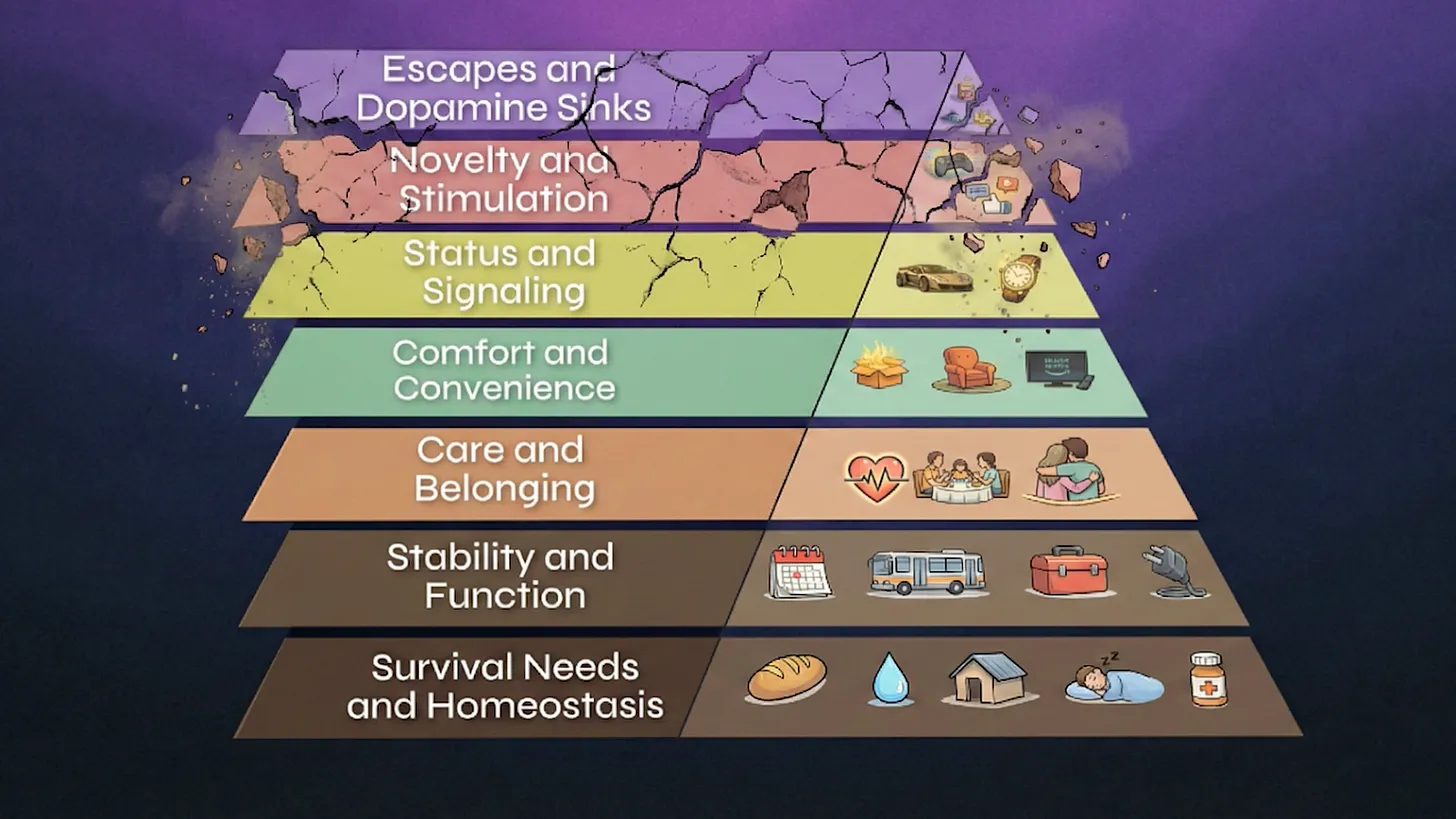
But if we’re moving into a period of simplification – whether that comes from energy constraints, geopolitical instability, inflation, climate impacts, or probably some combination – then these baselines are going to change.
Click on the image to enlarge.
In a less stable world, the top of the Consumption Pyramid does not shrink gracefully. It likely even snaps at some point, because the higher layers tend to be supplied to us via more global, more brittle, more interdependent, and more complex systems that need to run smoothly in order to be cheap and affordable. But the lower layers, while not always easy, tend to be more substitutable, more repairable, more local, and more adaptable.
That’s the heart of what I want to say here. For people who are aware that the world may soon become more intermittent, it can make sense to move down the Consumption Pyramid intentionally. Not out of morality (although that might be helpful to our larger predicament as well) but out of practicality.
Context and Related Questions
With that framework in mind, I’d like to offer some questions that I’ve been grappling with in my own life.
The first has to do with comfort – which has this weird property that once you get used to it, it stops feeling like comfort and starts to feel normal. Subtly it can become a requirement in your life – and likely has for many of us in the West. The risk of this is that you end up living at a throughput level that feels like “ordinary” life, even though it’s quite an anomaly in the historical sense. From a material throughput standpoint, this is sometimes referred to as the “hedonic treadmill.”
So the related question is: Where in your life has comfort quietly become a requirement? And what would it feel like to practice being okay without it before you have to?
The second point is about relief substitution. If we really think about it, a lot of consumption is not really about wanting or consuming something. Usually, it’s more about not wanting to feel something. We reach for this type of consumption – a purchase, newsfeed, snack, or Netflix show – not because it nourishes us, but because it quiets something down within us. We don’t want to feel something uncomfortable, even just for a moment or a couple hours, so we numb it.
I’ve been noticing this and reflecting on it in my own life. Relief can be appropriate at times, but when relief becomes our default strategy, it ends up keeping that deeper hunger intact. You end up being still tired, still lonely, or still overwhelmed – you just took the edge off for a bit. I expect many followers of this platform will resonate with this.
The related questions are: What do you reach for when you’re stressed or lonely? Can you guess what might be the underlying need that you’re trying to meet?
As an aside, I want you to know that when making these questions, they are often originally intended for myself. Many of them come from my little Frankly diary, which is why they may sound a bit personalized. Said differently, I’m sharing with you what I’m exploring and wondering about myself in my own life.
My next point centers on dependency versus flexibility. One way to think about the Consumption Pyramid is that the higher layers often require the world to remain stable and smooth for you to feel okay. They depend on systems running on time, prices staying affordable, supply chains remaining intact, and your attention being constantly fed. When those conditions hold, it feels like freedom. But if that world were to get more intermittent, those same patterns might become traps.
My question is: Which parts of your lifestyle do you think are genuinely giving you freedom, and which parts are making you dependent on the Global Superorganism growing and remaining frictionless?
Lastly, this whole pyramid sits inside a larger question about our identity as humans. “Consumer” is a role, but it’s not the only role we have. Modern life tends to minimize the importance of our other roles: maker, neighbor, caretaker, collaborator, citizen, friend, or dog owner, to name just a few.
I think that shift matters because perceived roles change one’s behavior – they change what feels rewarding and what one notices. Perhaps if we untether ourselves from our inherited roles as Homo sapiens within the Superorganism, it might not be a credit card or a phone that we reach for.
So my question is: If you stop thinking of yourself as a consumer, even just for a moment, what other roles come back to your mind? What would you do differently this week if you lived primarily from one of those roles?
“The Elephant Man,” Joseph Merrick, famously said, “I am not an animal. I am a human being.”
I will close with a rhyming appeal of my own: I am not a consumer. I am a human being.
If this framework I just laid out is useful, don’t just sit with it alone. Share it with two or three friends, and make a Saturday coffee or tea out of the questions. Perhaps this will land as a deeper part of the conversation.
I’ll talk to you soon. Thank you for reading.
ABOUT THE AUTHOR
Nate Hagens is the Co-founder and Director of The Institute for the Study of Energy and Our Future (ISEOF). Formerly in the finance industry at Lehman Brothers and Salomon Brothers, since 2003 Nate has shifted his focus to understanding the interrelationships between energy, environment, and finance and the implication this synthesis has for human futures. Allied with leading ecologists, energy experts, politicians, and systems thinkers, ISEOF assembles roadmaps for understanding how human societies might adapt to lower-throughput lifestyles. Nate also moderates the podcast The Great Simplification, on "illuminating the path for future generations, navigating uncertainty through understanding. and building a resilient future together."
|