The Biophysical Phase Shift
The things I’ve been articulating about the global biophysical and social situation for the past decade or so are no longer “in the future,” but are coalescing all around us in the immediate present. As such, I think we are approaching what I would call a biophysical phase shift in our culture and the global economic system.
When I say biophysical phase shift, I don’t mean one dramatic event that happens on a single date. I mean a gradual transition where our old assumptions stop reliably working and the world becomes more materially and ecologically aware again. A time when the map our culture has used in recent decades starts to deform because the terrain is changing underneath it.
This hasn’t fully happened yet, but it’s starting. The biophysical blinders are coming off the global human economy, not because people suddenly became wiser but because constraints are pushing upward through the layers. Finance can – and did – stretch reality for a while, and in turn politics can delay recognition, but neither can repeal energy costs, material limits, or ecological feedbacks.
That is what I mean by a biophysical phase shift. More stories in the news will look like one-offs. More weeks will feel chaotic – like the past few have felt for many of us. But the developing patterns underneath will be consistent. Real resources, supply chains, and stable ecosystems will matter more, while institutions – which are indicative of the capacity to coordinate at scale without tearing ourselves apart – will matter most of all.
The Biophysical Pyramid
Click on the image to enlarge.
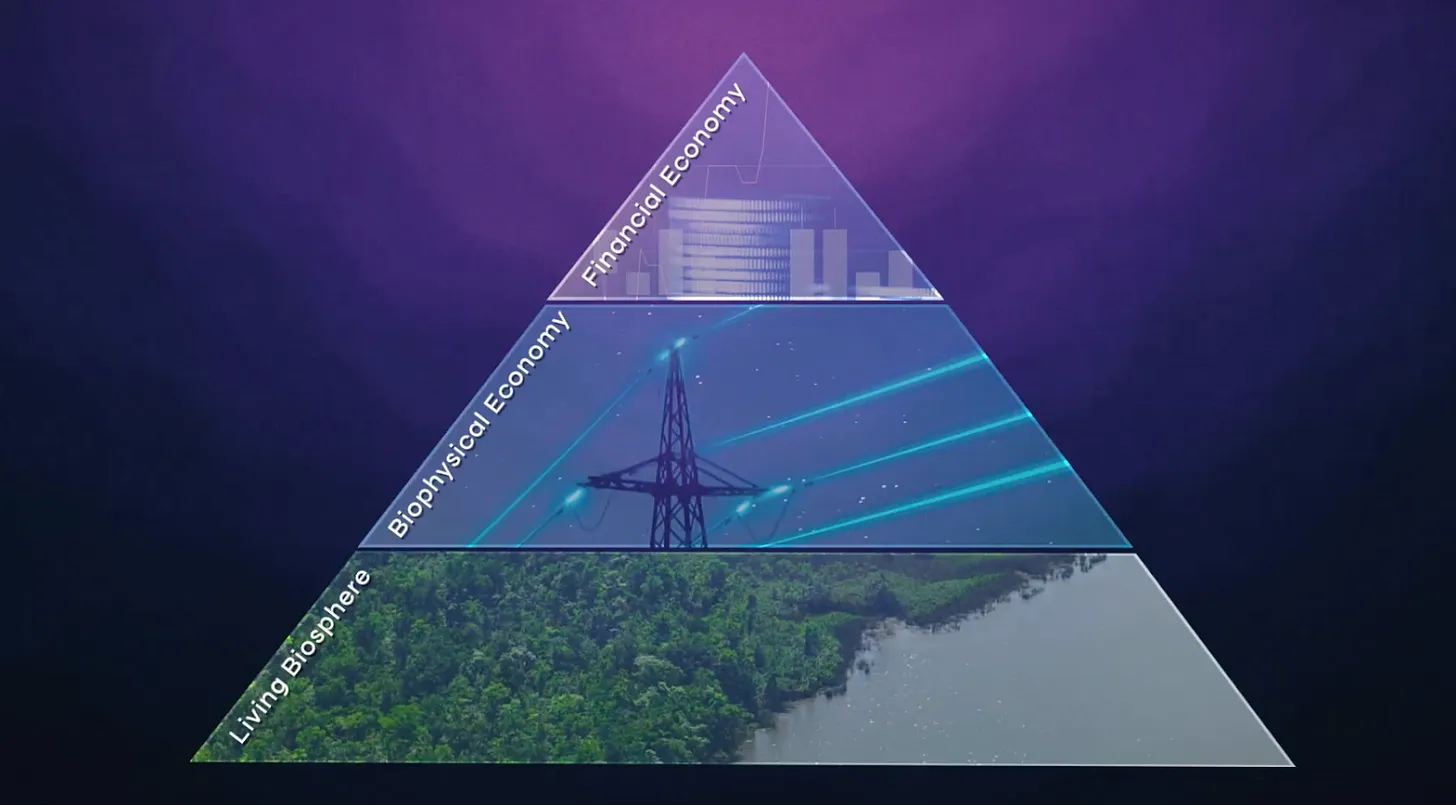
Most of us unknowingly experience our lives and expectations as sitting inside a kind of pyramid. At the top is the financial economy: prices, incentives, wages, debt, markets, and the stories we tell ourselves about growth and opportunity. That layer is what most of us interact with every day – it’s become the map we’ve confused for the terrain.
Underneath that top layer is the biophysical layer: energy, materials, minerals, supply chains, machines, and the human behavior that makes all of it cohere. This is the biology and physics that serve as the connective tissue of the financial economy – the part that turns abstract prices into real goods and services.
Below that is an even deeper and more invisible layer: the living biosphere. This layer is all of Earth’s life support systems – the soil, water cycle, forests, oceans, and stable climate backdrop for all of it. The biosphere provides quiet services that make the other layers possible, and for the most part, they’re delivered without invoices and assumed to remain free – forever.
Click on the image to enlarge.
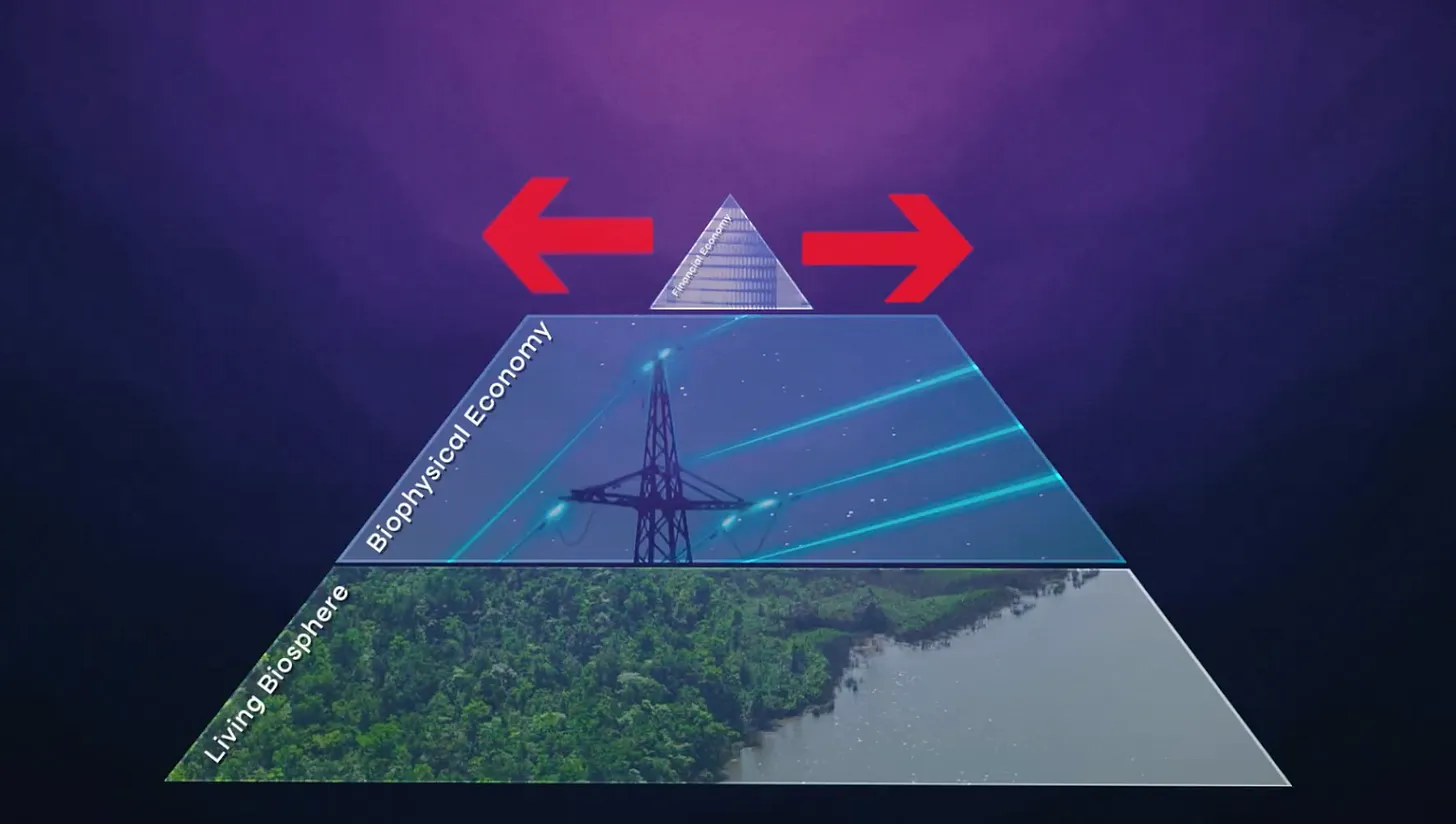
For a long time, that top financial layer of the pyramid was relatively small compared to the layers beneath it. This was a moment when there was room to expand and the underlying energy base was able to grow quickly. The biosphere still looked inexhaustible to industrial civilization, at least in the way we accounted for it. In that world, it was easy to believe the financial layer could keep getting bigger without running into hard limits – and it was easy to build societies around that assumption.
Click on the image to enlarge.
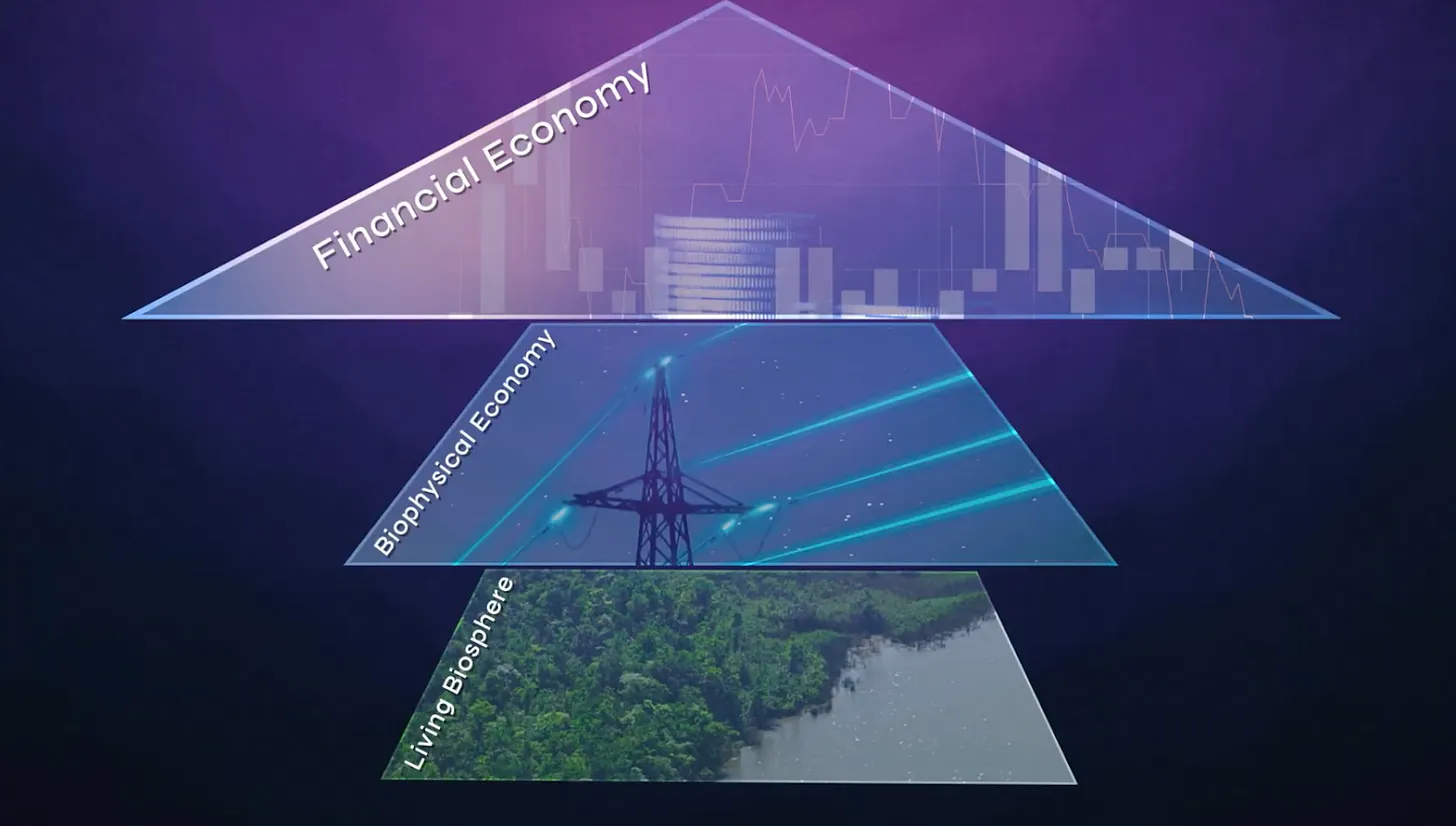
What’s changed in recent history is the relationship between claims and capacity, or perhaps more accurately, that a larger quantity of people now recognize this relationship.
Over time, the financial claims on reality have grown to match reality more closely. In the last couple decades – especially as the global Superorganism hit the turbocharge button – those claims have begun to outpace what the biophysical layer of energy, materials, and minerals can actually support. We now have a misshapen pyramid where the top has swollen faster than the middle can carry. At the same time, the waste and externalities produced from fueling the whole system are eroding the ecological substrate underneath it.
Implications
When our pyramid becomes top-heavy – or rather when it becomes more widely recognized that this is what’s happening – the system starts to behave differently. We get more volatility and friction, more conflict over inputs that used to feel stable and abundant, and more attempts to convert physical resources into political leverage.
There’s also an increase in public awareness that something about the financial system is distorted, even if that awareness doesn’t fully recognize our monetary system’s connection to the biophysical layer and living natural systems that are the foundation of the pyramid.
We will continue to see more and more news stories and information signalling what is “bending,” what is “breaking,” and where the leverage points remain in our society. These things do not represent the whole story, rather they act as indications that the underlying constraint layer is pushing up into the headline layer.
In (unfortunately) much smaller circles, we’re seeing sobering documents like the U.K. government’s national security framing of biodiversity loss and ecosystem instability. These are signals that institutions – at least some of them – are beginning to treat biosphere risk as a first order variable and no longer a side issue.
This platform – The Great Simplification – has always been, and will always be, about what pathways and interventions might be able to steer humanity and the biosphere away from the default path we are currently on. The future is not something we’ve already finished building. But in order for better futures to emerge, we have to keep learning, changing, and contributing to the conversation.
I will have much more to say about this in the future – perhaps almost too much to say.
Thank you for reading.
ABOUT THE AUTHOR
Nate Hagens is the Co-founder and Director of The Institute for the Study of Energy and Our Future (ISEOF). Formerly in the finance industry at Lehman Brothers and Salomon Brothers, since 2003 Nate has shifted his focus to understanding the interrelationships between energy, environment, and finance and the implication this synthesis has for human futures. Allied with leading ecologists, energy experts, politicians, and systems thinkers, ISEOF assembles roadmaps for understanding how human societies might adapt to lower-throughput lifestyles. Nate also moderates the podcast The Great Simplification, on "illuminating the path for future generations, navigating uncertainty through understanding. and building a resilient future together."
|