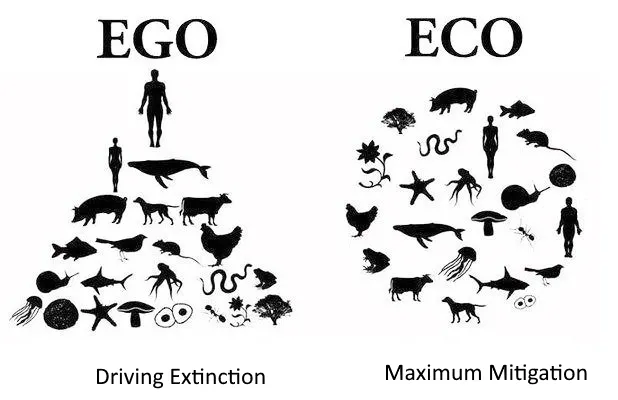
Profound Social Change
Many people still fail to recognise that profound social change is needed to prevent humanity from engineering its own extinction. This incomplete shift in understanding is perpetuating unwise behaviours and hindering wise behaviours from emerging:
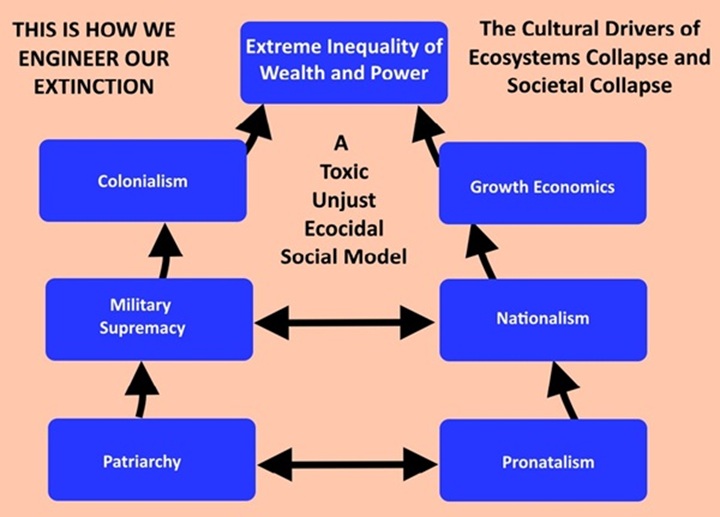
Dominant ecocidal cultural norms.
Click on the image to enlarge.
|
Patriarchy becomes Relational LeadershipPronatalism becomes Eco-aware Family PlanningNationalism becomes Bioregional IdentityColonialism becomes Bioregional StewardshipGrowth economics becomes Degrowth towards Steady-stateMilitary Supremacy becomes Cooperative Security providing Universal Basic ProvisionGrowth economics becomes Degrowth into Steady-stateEco-costly longevity becomes Eco-aware quality of life, when we recognise that death is essential for new life to flourish
|
Using AI to accelerate social change
Timothy Gieseke is pioneering some work that can help to accelerate this transition towards eco-aware social behaviours. Timothy is harnessing AI to assess the extent to which strategy documents accommodate the type of governance that will enable us to jointly protect the global commons. The assessment tool is named GADGET. The acronym stands for the Governance Architecture Diagnostic Generative Engineering Tool.
GADGET — Specification
This document, Misaligned Governance and its Role in Creating Wicked Problems, describes the governance theory that informed GADGET’s development.
The specification explains that it is not complexity that creates wicked problems, it is governance misalignment, thus:
For fifty years, “wicked problems” have been explained as the inevitable result of complexity. Climate change, healthcare reform, and public lands management are challenges too multifaceted, too interconnected, too dynamic for straightforward solutions. Complexity, we’re told, makes them wicked. Yet Elinor Ostrom provided multiple examples of complex socio-economic systems not devolving into wicked issues.
Timothy has been considering this conundrum during fifteen years of work in agricultural economics, environmental management systems, sustainable agriculture, and sustainability consulting. This experience provided him with the necessary ingenuity to build a tool that augments AI with both his own wisdom and that found in Elinor Ostrom’s work. The resulting tool is already very useful, and can be further enhanced to assist us with implementing any social changes that we all agree are desirable.
Examples of Input and Output to GADGET
As part of my own work I have tried to suggest frameworks that might drive profound social change that can maximise mitigation from climate breakdown and ecosystems collapse. My most comprehensive effort to date is the document linked below:
Global Imperatives — A Call for Leadership from the UK
Timothy ran my proposals through the GADGET process. You can view Timothy’s comments and his explanations about the different phases in the GADGET processing at this link. Below is an extract from the summary, which was very welcome to my eyes.
Barbara, your work in Global Imperatives represents one of the most comprehensive and morally serious attempts to articulate what genuine sustainability demands of us. You ask the questions most avoid — and you answer them with a courage that most commentators lack. This document offers a different kind of contribution: not a challenge to your vision, but a governance lens through which that vision might be strengthened for implementation.
Timothy has granted me permission to share this version of the output from the GADGET assessment of my proposal, the concluding paragraph states:
‘Global Imperatives’ is a compelling advocacy document. GADGET™ would give its vision a better chance of surviving contact with the political and social reality through which it must pass to become consequential.
Thank you Timothy for this invaluable tool!
There are endless opportunities for deploying this wise approach to using AI, that would enable us to accelerate desirable social change. For example, we could use AI that is enhanced with eco-wisdom to detect the weaknesses within the guidance notes behind the UN Sustainable Development Goals. Timothy’s work shows how we could use AI wisely to steer ourselves away from extinction towards living within Earth’s biophysical limits. It is important that we first agree a wiser set of social aspirations.
Global Aspirations
Eco-aware social changes will require some refinement to our global aspirations. ‘The Declaration of Human Rights’ wreaks of entitlement with no regard for the biophysical limits of Earth. The ‘Global Aspiration for Eco-equity’ seeks to correct that omission.
We would also be wise to rename the ‘Sustainable Development Goals’ as ‘Sustainable Degrowth Goals’; at least until we successfully return within the biophysical limits of Earth. All the advice offered by the United Nations regarding these goals could be checked with an eco-wise AI program, for those ideas were conceived within an ecocidal socio-economic model, and will inevitably contain numerous flaws.
An Emotional Evolution
We shall all be involved in the mindset transition away from pursuing GDP growth, towards embracing voluntary, equitable Degrowth. Emotional evolution describes the process of deploying our emotional toolkit in a helpful way during this transition. To collaborate peacefully towards global ecological justice we can retain our diverse cultures; but it will be necessary to navigate an emotional evolution thus:
- Arrogance can evolve into Humility once we accept the reality of ecological collapse, recognising the injustice for future generations, and those already unable to subsist
- Self-interest can evolve into Extended Ubuntu as we accept the need for a mindset that recognises our interconnectedness with all of life on Earth, and respects the global commons
- Anxiety can evolve into Resolve to act wisely and collectively
- Anger can evolve into Empowerment if a suitable mode of expression can be found
- Hate can evolve into Respect and Understanding given a suitable relearning process
- Guilt can evolve into Reparation if a route for reparation can be identified
- Blame can evolve into Forgiveness if reparation is offered, and forgiveness is sought
- Judgement can evolve into Trust in each other, given enough collective discussion and collaboration; altered behaviours from leaders, will be key to inspiring trust
Using Eco-wisdom to Analyse Human Behavior
Since the original publication of this article Timothy Gieseke has expanded his own insights to draw parallels between human organisational structures and that in the ant world. His article, Connecting AI Governance, Ant Colonies, and European History offers an insightful way to understand human geopolitics over the last ~150 years.
Another very insightful article by Timothy reveals the absence of logic when examining the Trump administration through governance logic: When the Map Doesn’t Match the Territory: The Trump Administration Through a Governance Logic. Then a further insightful piece advising where AI algorithms might lead us if we don’t ensure built-in eco-wisdom: The AI Ant Colony Cometh.
Social Transition Map
A friend of mine has brought my ideas together in the image below. He does not believe in climate change nor ecosystems collapse, so he prefers not to be named. He is a very dear ‘frenemy’, and a great admirer of Trump. He exhibits an amazing combination of deep cognitive dissonance coupled with the desire to help. This is an example of what can be achieved when you collaborate with an opponent to your worldview.
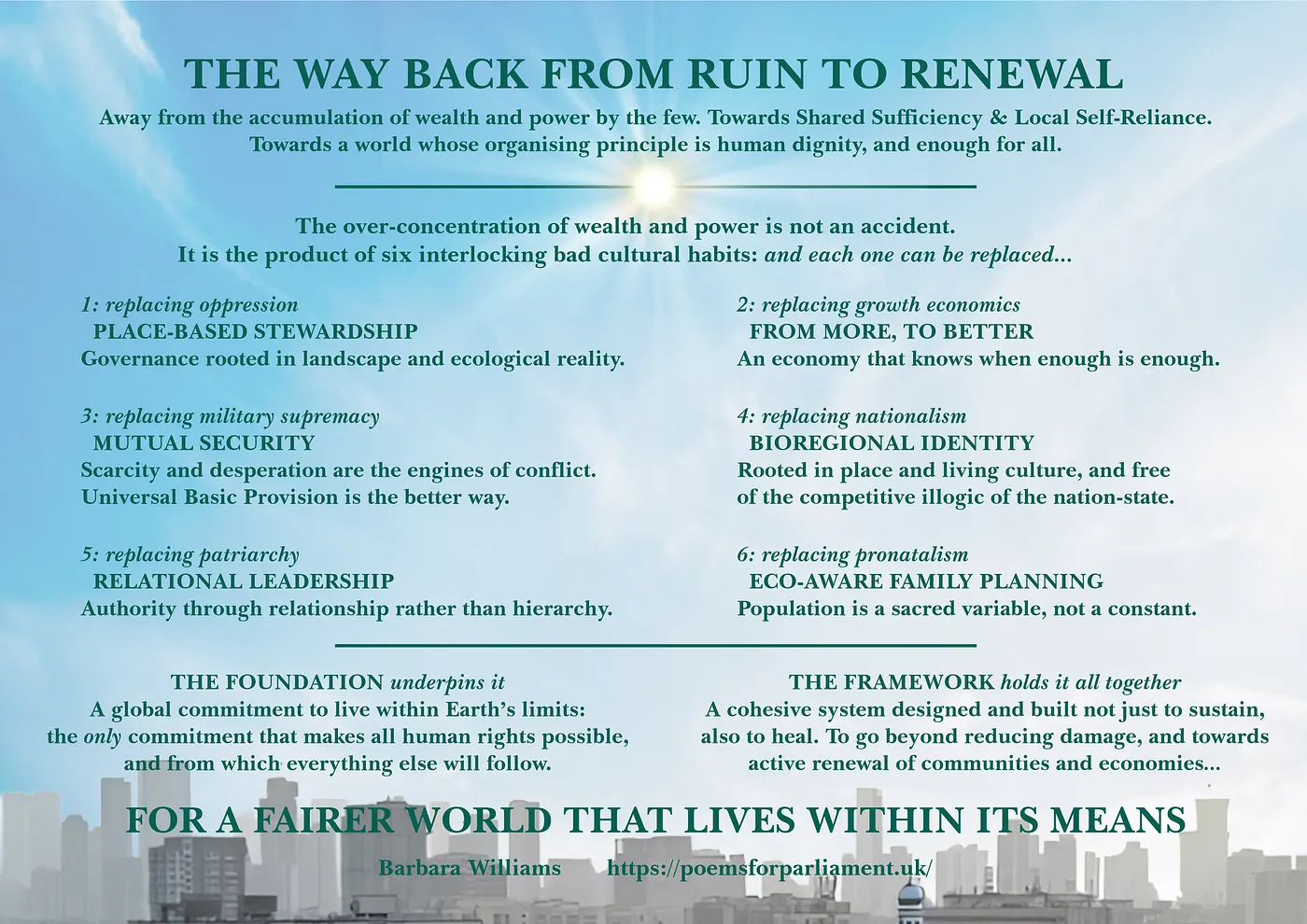
Image created by a friend of Barbara Williams, who is a climate change denier!
He who shall not be named. Click on the image to enlarge.
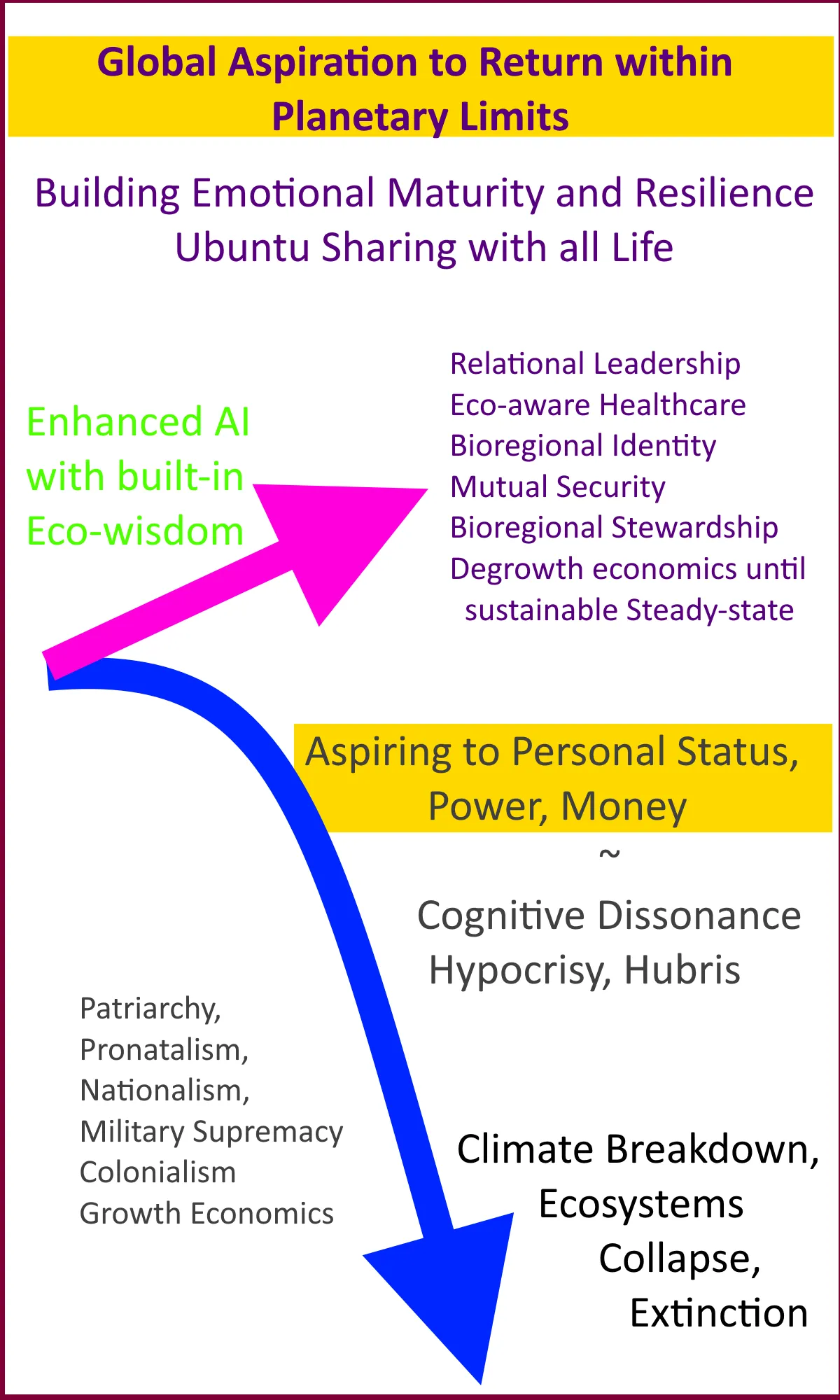
We stand at a junction right now, we can continue with ecocidal social norms, or we can aspire to return within planetary boundaries:
ABOUT THE AUTHOR
Barbara Williams lobbies the UK government to consider a paradigm shift to show humility and embrace Degrowth objectives. She is the author of Scientists Warning — A Roadmap to Ecological Justice. She has been actively working in the field of altruistic degrowth for several years, and most of her work is accessible from her Poems for Parliament website.
|
|Back to Title|
LINK TO THE CURRENT ISSUE
LINK TO THE HOME PAGE