From ancient Dacia to modern Iran, empires behave in the same way before they collapse.
This is a revised version of a post published on Cassandra’s Legacy in 2014. It highlights the similarities between the last times of the Roman Empire and those of the current Global Empire. In both cases, a dying empire became even more cruel and brutal than usual, trying to solve its problems by military expansion. For the Romans, it led to a faster collapse. For the current global empire, it will probably lead to the same result. See also Nafeez Ahmed for similar considerations.
Gold and the beast: a brief history the Roman conquest of Dacia
The Roman Empire was a beast of prey. It grew on conquest, by gobbling its neighbors, one by one. By the first century AD, the Roman Empire had conquered everything that could be conquered around the Mediterranean Sea. But the beast was still hungry for prey.
And what a beast that was! Never before had the world seen such a force as the Roman legions. Well organized, trained, disciplined, and equipped, they were the wonder weapon of their times. What made the legions so powerful was not special weaponry or a strategy. It was precious metals: gold and silver. The Romans had not invented coinage, but they systematically used gold and silver coins to pay their soldiers. Roman citizens were paid to fight in the legions, but non-citizens could also be paid to form the auxilia, troops that supported the main body of the army. It meant the Roman army could be swelled to as many fighters as the state could pay. Gold was the blood, the lymph, and the nerves of the beast of prey.
More gold meant larger armies, and larger armies meant that the Romans could loot more gold from the conquered population, and more slaves to be used to extract gold and silver from the Roman Mines in Spain. Once culturally absorbed, the conquered regions could also provide auxiliary troops. The beast kept growing bigger, and the more it grew, the more food it needed.
But even the mighty Roman legions had their limits. Eventually, the Empire had run out of neighbors rich enough to be worth invading or weak enough to be easily defeated. In 53 BC, the Roman legions were cut to pieces by the Parthian cavalry at Carrhae while trying to expand into the rich East. A few decades later, in 9 AD, a coalition of German tribes inflicted another crushing defeat on the legions in the dark forest of Teutoburg. Not even Varus, their commander, came back alive.
The Empire was constrained in the East by the Parthians, by the Germans in the North, by the Atlantic Ocean in the West, and by the Sahara Desert in the South. It had no more space to expand. Confined in a closed space, the beast needed food, but where to find it?
At the same time, in the 1st century AD, the Spanish gold mines started showing signs of depletion. Production stalled, and the Roman Empire couldn’t even keep the gold it had. The Romans had developed a taste for expensive goods that they could not produce: silk from China, pearls from the Persian Gulf, perfumes from India, ivory from Africa, and much more, and those fancy things had to be paid in gold and silver. Slowly, the Roman stock of precious metals disappeared to the East through the winding Silk Road in central Asia and from Africa to India by sea. It was a wound that was slowly bleeding the beast to death.
With less and less gold available, the legions’ power could only decline. That the Empire was in deep trouble could be seen when, in 66 AD, the Jews of Judaea - then a Roman province - took arms against their masters. Rome reacted and crushed the rebellion in a campaign that ended in 70 AD with the conquest of Jerusalem and the burning of the Jewish Temple. It was a victory, but the campaign had been exceptionally harsh, and the Empire had nearly gone to pieces in the effort. Nevertheless, by sacking Judaea, the empire managed to bring home a considerable amount of gold and silver it desperately needed. The beast was eating itself, but, for a while, it was satiated.
But the problem remained: the beast needed food. The Empire needed gold to pay for its huge military apparatus. But where to find it? It was at this point that the Romans turned their sight to a region just outside their borders: Dacia, an area in the North-East of the Empire that included Transylvania and the Carpathian mountains. The Dacians had gold mines, and they had been quietly exploiting them to create their own coins and to build up their military power. The beast was smelling food.
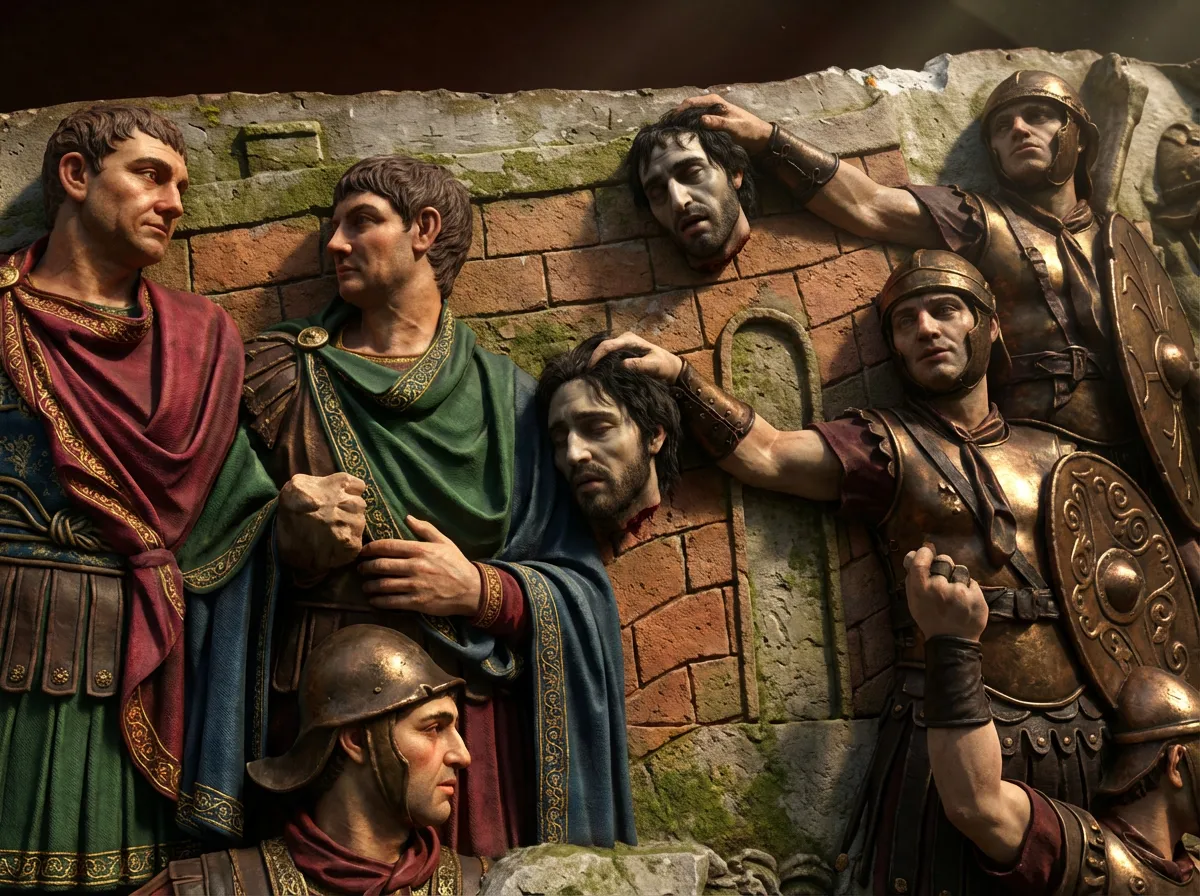
The beast had sighted its prey. In the year 101 AD, an aggressive Roman Emperor, Trajan, invaded Dacia. The campaign was harsh and difficult, and the Dacians put up a spirited resistance. Surely, the nightmare of the Teutoburg disaster of nearly a century before must have haunted the Romans, but this time, after two campaigns and five years of war, the gamble paid off. The Dacians were defeated, their leaders were killed or committed suicide and Dacia was transformed into a Roman province. The beast had made another kill.
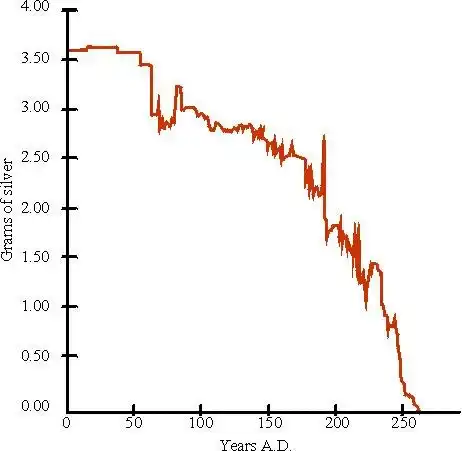
But the prey turned out not as fat as expected. We don’t have data on the booty that the victorious legions brought back from Dacia, but we know that the silver content of the Roman denarius coins just continued its decline, which would eventually lead it to become pure copper. The Dacian mines, apparently, couldn’t match the wealth that the Spanish mines produced in their heydays. The Romans spent more money to conquer Dacia than they could gain by looting it. The beast had become too huge to be fed just with crumbles.
The beast was still starving, still restless, still desperately trying to find an exit. After the conquest of Dacia, in 113 AD, Trajan attempted another bold project: that of expanding into the East. After a huge military buildup, the legions marched again against the Parthian Empire. It might have been a revenge for the disaster of Carrhae in 44 BC. But the effort was too great, even for the mighty Roman Empire. After some initial successes, the Romans simply had to stop. The beast had found a prey too big and too strong to be taken down.
The death of Trajan, 117 AD, was probably a stroke of luck for the Romans. We don’t know if he understood that he had embarked on an impossible task, but when he was gone, the point was clear to Hadrian, his successor. Hadrian stopped all attempts to conquer new territories, reduced the military budget, and concentrated on building defensive walls, a policy that was basically kept by all his successors. The beast had retreated to its den to recover from its wounds.
Hadrian's policies slowed down the decline of the Empire, but couldn’t avoid its final destiny. Gold and silver continued to bleed away from the Roman territory and could not be replaced. The Western Roman Empire started to contract and disappeared forever after a few centuries as an impoverished shade of its former self. The beast died of starvation.
Now, replace “gold” with “crude oil,” “denarius” with “dollar,” “Roman Empire” with “Global Empire,” “Dacia” with “Iran (and also Greenland, Venezuela, and others)” and note the similarities. The globalized beast will die of starvation.
Ugo Bardi’s latest book: The End of Population Growth.

|Back to Title|
LINK TO THE CURRENT ISSUE
LINK TO THE HOME PAGE