A Primer for Paradigm Shift is a book disguised as a website. The Primer is an optimistic “how to” for creating a sustainable and uplifted society and advocates consumers becoming citizens. It is not about trying to make the American Consumer Culture “green,” rather it calls for leaving the American Consumer Culture behind.
Paradigm shift is not a future utopia. It is part of every day life for a growing number of people. The more the better.
The Primer’s scope is split between care for the natural world and the social uplift of society.
Its focus is personal, home, neighborhood and nearby. The ideal is for modest projects to connect, build on each other and increase the scale of economic, social and political transformation. The Primer explains why we have an enormous horizontal Movement For Transformation ready to discover itself.
We have many allies, assets and tools to work with plus a wide range of real life examples of paradigm shift to help point the way. Paradigm shift is not a future utopia, it’s here and now. No need for a tech breakthrough, rather the break through is our own consciousness – how we prioritize our time and money as individuals and society.
The Primer is free. The website is “living.” There will be new content added continuously. The Primer invites input from readers, especially information about groups and individuals who are engaged in projects and initiatives that fit within the realm of paradigm shift.
Who will be interested in the Primer? Anyone with a care for the well being of people and planet.
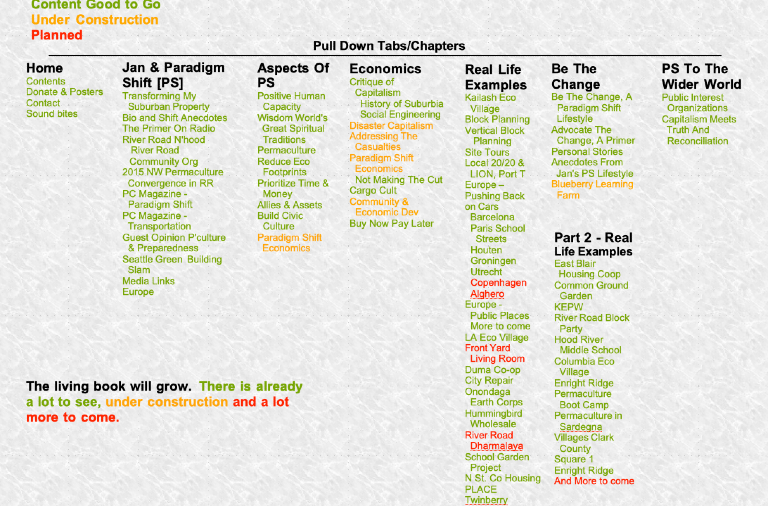
The graphic shows all the writings in the Primer. Some are under construction.
More content to be added over time.
Click the image to enlarge.
|
Paradigm Shift
As used by the Primer, paradigm shift means the purposeful movement of individuals and society towards a condition where our needs fit within the boundaries of the natural world, a society that brings out the best in positive human capacity and a society that is served by an honest and responsible economic system. Core to sustainability and uplift is to downsize our material lifestyles as gracefully as possible – food choices, housing, transportation, recreation and more. At the same time, to upsize our personal and social lifestyle.
The Primer explains that virtually every progressive public interest organization, large and small, local or national, exists to repair some kind of damage caused by capitalism and its consumer culture. That means they are all on the same “Team.” The League of Women Voters has much in common with the Occupy Movement and The School Garden Project. This Team has enormous reason and capacity to make common cause.
The Primer’s tabs across the top of the page serve as chapters with the drop down menu showing content of those chapters. The tabs are Home, Jan, Aspects, Economics, Real Life Examples, Be The Change, To The Wider World.
The Primer is loaded with graphics and photos. One graphic shows the “Wisdom Of The World’s Great Spiritual Traditions.” The Primer explains how this Wisdom can guide a lifestyle, a Movement and an economic system. There are galleries that show eco villages, pushing back on cars, suburban permaculture, public places in Europe, front yard gardens and more. Another photo shopped image illustrates the American Cargo Cult.
Chapters
Home includes a static table of contents that shows every topic at a glance of writing in the Primer. Home also includes over 50 soundbites, the Primer concentrated to its most basic.
First, a bit of biography. The content for the Primer has been adding up for decades.
I am a baby boomer, my resume totally middle class – a good student, Scout, church going, well behaved, degree in Geography. No police record during those years. I always seemed to fall in with the right kind of people.
Over the years, I have protested nuclear power, advocated for veggie and vegan food choices, helped protect a national forest area burned by arson from salvage logging, helped oppose construction of a large computer chip factory in Eugene, helped stop a major highway project in Eugene and have low budget travelled out of the country for over 6 years to nearly 40 countries.
I have always been keen to follow current events and have gained an appreciation for the writings of Naomi Klein, Ralph Nader, Noam Chomsky and others. The product of my activism, travel, reading, the news, experience is that capitalism is not broken. Rather, mayhem and damage to people and planet is just what it does. Paradigm shift is a completely sensible response to an economic system hard wired to mal-practice. Humans are capable and deserve better. The Primer goes into more detail.
Permaculture
Another formative life experience has been making acquaintance with permaculture. I heard the term, “suburban permaculture” for the first time when living in Houston. I took a PDC in Austin. Thanks Jacque, Bob and Patricia! Permaculture plays a very important role in the Primer.
Years later after moving to Eugene, I bought a modest two bedroom home on a quarter acre suburban property. The intention from the start was a permaculture transformation, to reduce my own eco-footprint and to produce a useful amount of food, energy, water, aesthetics and preparedness on site. The place has been perfect for what I wanted to do – property and house orientation, solar access, neighborhood and relatively hands off city regulations.
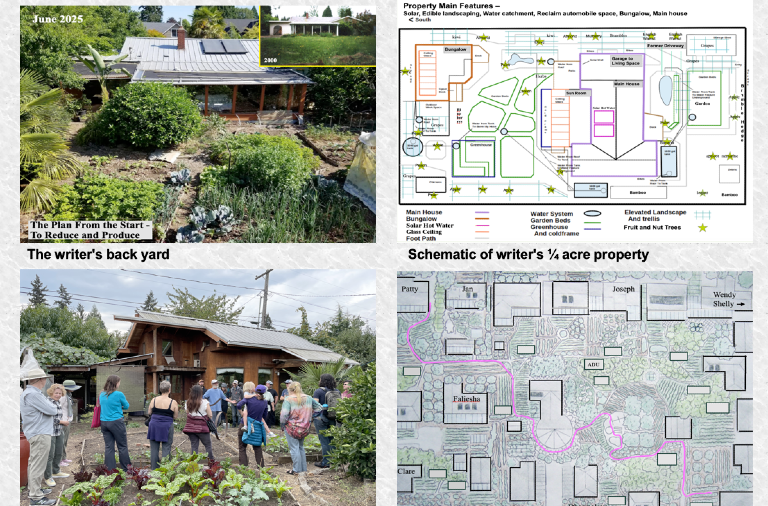
These are images that show the writer’s 1/4 acre suburban property in Eugene plus a paradigm shift vision for the surrounding neighborhood. Click the image to enlarge.
|
After 25 years, there is edible landscaping all over and veggie garden front and back. I took out the driveway early on. I do not have a car. The south side patio is now enclosed passive solar. I built a 400 sq ft passive solar Accessory Dwelling Unit (ADU) which is my space. There is a 6500 gal rain water system. I have housemates for company, income and to reduce everyone’s eco footprints. I give a break on rent for car free housemates. My place is an educational resource to the community, literally, thousands of people have visited over the years to see what permaculture and priorities of time and money can do for a suburban property.
Twenty five years later, transforming this property has been one of the very best experiences of my life. The place is a great example of the concept – prioritize one’s time and money. What I spent on all the improvements is about the same as a mid sized new car. I am far more aware of what it takes to satisfy some basic needs.
There are 50 million suburban homes in the US and that is an enormous potential for creating jobs, reducing eco- footprints and advancing the cause of paradigm shift.
Aspects
A Movement needs principles, ideals, values and vision – common denominators – to bring people together. One chapter of the Primer is Aspects which are principles, ideals and actions for paradigm shift.
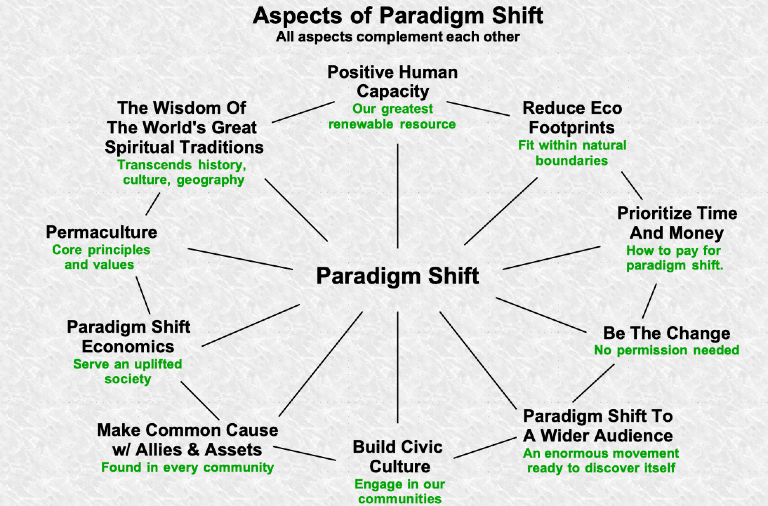
The home page of the Primer shows a graphic [see above] of the primary aspects of paradigm shift – Positive Human Potential is our greatest renewable resource. Reducing Our Eco-Footprints is a core part of paradigm shift. How we Define Our Own Time And Money is how we pay for and create paradigm shift. Be The Change encourages the reader to shift their own lifestyle and then become an advocate based on their own experience. Another aspect is Taking Paradigm Shift To A Wider Audience.
More aspects. Every city and town has surprising Allies And Assets to work with for building civic culture. When we move away from the consumer culture, we can move towards an economic system that is honest and serves an uplifted society. Transformation and uplift starts at home. Permaculture is a powerful set of ideals and principles for paradigm shift along with The Wisdom Of the Word’s Great Spiritual Traditions – care for the natural world, service to the community, uplift of the spirit, modesty of lifestyle and personal accountability.
All these aspects support each other.
Economics
Economics is a critical part of modern life and paradigm shift. Capitalism and the consumer culture are not companions for sustainability and uplift.
A short but potent critique of capitalism deconstructs its mythologies such as the magic hand, efficiency, informed choice, the metric GNP and the idea of American Exceptionalism. The Primer explains the rise of the Consumer Culture, a social engineering scheme intended to create a society of consumers instead of citizens.
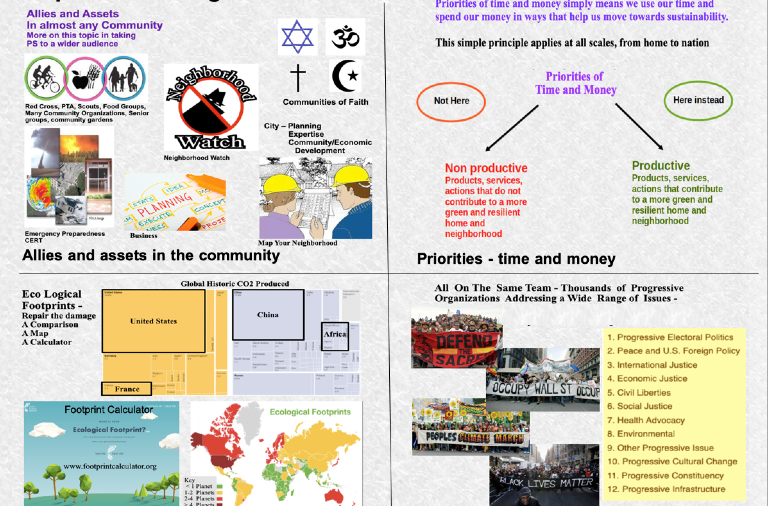
These graphics show different allies, assets and actions for paradigm shift. Allies in the community, prioritize time and money, an enormous existing Movement ready to be discovered, why and how to reduce eco-footprints.
Click the image to enlarge.
|
An important term in economics is “External Cost.” That means, the price of products and services does not tell an honest story about the production, use and disposal of that product – social and environmental well being pay that external cost. On Dec. 2, the New York Times reports San Francisco will sue a dozen makers of junk food because of external costs. Our affluence is totally dependent on a dishonest economic system. It’s subsidized by damage to people and planet.
A core task of paradigm shift is reducing eco-footprints. The Primer calls for de-growth in a graceful way. There is a full explanation of the use and value of the “footprint calculator.” An extended writing is a fiction story extrapolating from real life what we could have done here in Eugene, on behalf of paradigm instead of cars and self interest. Many of our society’s biggest problems are largely avoidable.
Another fascinating question, what products and services we are familiar with now that don’t make the cut in paradigm shift? An honest economic system would sell its products and services at an honest price to account for external costs. That means we would pay a lot more for everything. The Primer identifies a wide range of familiar products that would miss the cut.
The Primer is oriented towards the middle class, people who can “afford to downsize”, but what about people already struggling to make ends meet, millions who are very likely a preview for millions of others on the historical downslope. The Primer suggests to those on the downslope – don’t aspire to a middle class lifestyle. Choose paradigm shift instead, you already have a head start.
The Primer asserts, as long as capitalism as we know it defines the economy and the political system, there is no way society at large will reach a healthy relationship with the natural world and social/spiritual uplift. Still, every effort to advance paradigm shift is important.
People can make many changes to their own personal economic condition with no permission needed. Even better when people can make common cause with others. Economics is about taking care of the needs of life. Many needs can be taken care with barter, trade and social cohesion instead of cash while some “needs” can simply be eliminated. We have many tools, assets and allies to work with.
Real Life Examples
Many great stories in the Primer describe examples of paradigm shift in real life. Untold pioneers of paradigm shift point the way, including many individuals and groups that may not even identify with paradigm shift, yet they are still on the team. These examples are the building blocks of paradigm shift that already exist. The Primer calls for these building blocks to make common cause. We are not starting from scratch.
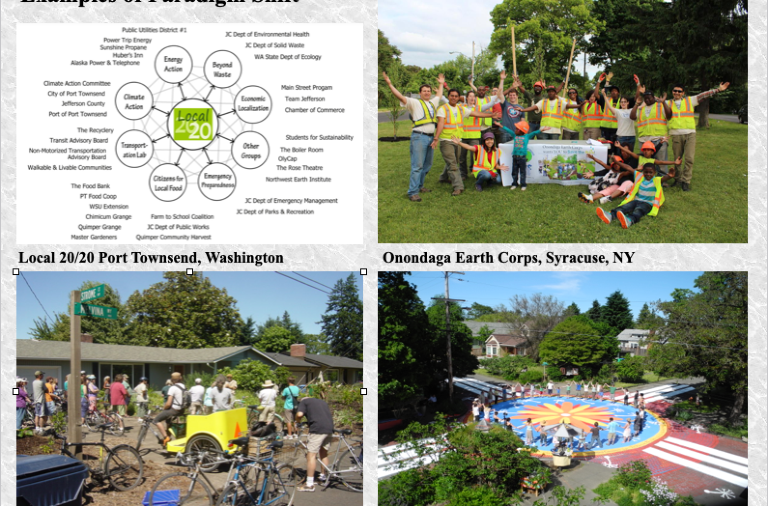
Real live examples of paradigm shift. Local 20/20 in Port Townsend, Washington; Onondaga Earth Corps in Syracuse, New York; City Repair in Portland, Oregon; a suburban permaculture site tour in Eugene, Oregon. Click the image to enlarge.
|
Besides my own property, I describe the Onondaga Earth Corps in Syracuse, New York – empowering young people to be the change. They are learning skills for life and greening their community. The School Garden Project in Eugene teaches kids about soil science in gardens and also growing, preparing and enjoying fruit and veggies. Our neighborhood hosted the 2015 Northwest Permaculture Convergence that attracted 700 participants.
Here in Eugene, we have been enjoying permaculture site tours for nearly 25 years to visit properties and places that fit movement towards sustainability such as Hummingbird Wholesale which is a cooperative trust business model that partners with local farmers to transition to food crops and to go organic. That’s only fraction of the Hummingbird story. The Primer also takes a look at Duma Community and Maitreya Eco Village.
Kailash Eco Village in Portland is another remarkable story. Twenty years ago, a 35 unit apartment complex was broken down and lawless. Now it’s a thriving eco-minded urban community with 50 renting members and a waiting list to join.
At Kailash, gardens and greenery have replaced pavement. There are car shares, co-op bikes and trailers, garden areas, composting, humanure, shared spaces like the tree house and community room. There is a lot of positive interaction with the surrounding neighborhood, particularly emergency preparedness. Everyone is a member to at least one committee for taking care of the needs of the eco-village. These committees are places to learn social, group process and management skills important for paradigm shift.
And now, the larger apartment complex next door is in its fourth year of becoming another eco-village. The two share a common boundary. Imagine, there are tens of thousands of apartment complexes all over the country that have eco-village potential.
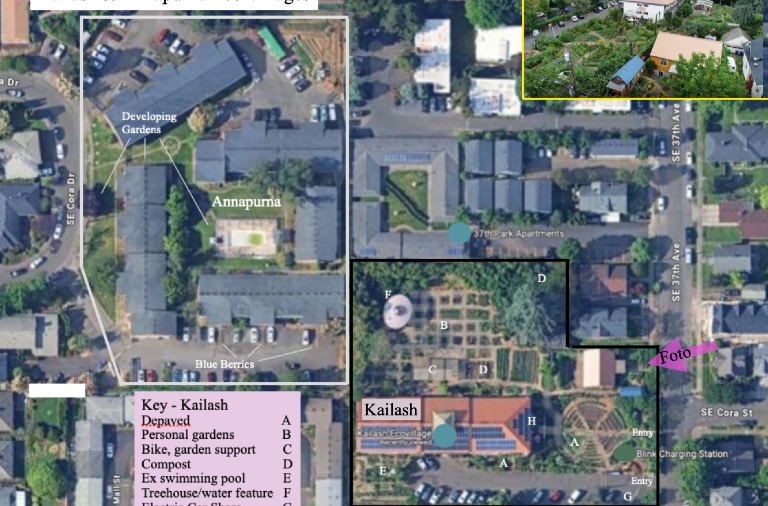
This aerial view of Kailash and Annapurna Eco Villages in Portland, Oregon.
Trashed out apartment complexes reborn as affordable thriving eco villages.
Click the image to enlarge.
|
There are other examples of paradigm shift. A friend a few blocks away has turned her suburban front yard into an edible outdoor living room. In the summer there are comfortable chairs, a fire pit, trellised fruit and veggies, garden beds and potted plants and all close enough to the mellow suburban street to greet passersby who often stop and chat. Her street also has great block parties.
Local 20/20 in Port Townsend, Washington is based on action groups for creating a more green and prepared community. One spin off project is LION – Local Investment Opportunity Network. LION connects local investors with local entrepreneurs. Those involved work out their own investment plans. The Primer also takes a look at local economic and community development. Paradigm shift calls for ways people can invest in local sustainability projects.
I have made several visits to Europe with a big interest in public spaces and pushing back on cars. The Primer describes explorations of Groningen, Utrecht and Houten, Holland, all known for being bike and pedestrian friendly. Freiberg’s Vauban Neighborhood occupies the site of a former cold war military base and was designed purposefully to discourage cars. Paris is well known for heroic efforts turning car space into people space.
Barcelona is famous for its “super blocks” and “green axis” where cars are restricted and car space has been traded for play grounds, bike and pedestrian amenities. The Primer has a lengthy photo gallery with captions to describe dozens of places in Europe that are friendly to bikes, pedestrians and transit including Warsaw, Alghero, Strasbourg, Trento, Milano, Nice, Ventspiel, Ljubljana and more.
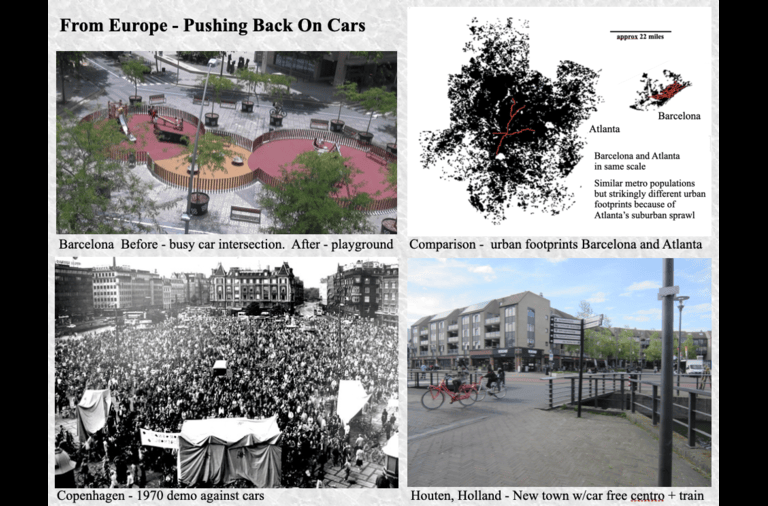
Pushing back on cars in Europe. Car intersection to playground in Barcelona. Scale comparison Barcelona and Atlanta, Georgia. Car free centro in new town Houten, Holland. Public demo in Copenhaben 1970 to protest plans to expand car intrastucture.
The plans were cancelled. Click the image to enlarge.
|
The Primer will add more real life paradigm shift projects such as Twinberry Co-op in Cottage Grove, Oregon, the Permaculture Boot Camp near Missoula, Montana; LA Eco Village; “vertical block planning” in Seattle. The Primer invites readers to send info about sustainability and uplift projects they know of.
Be The Change
Paradigm shift will take a lot of participation. Consumers becoming citizens is the invite and entry to participation. The entire Primer is a DIY source for applied paradigm shift in one’s own life. And check the Soundbites. Going further, Be The Change suggests finding one’s own niche, a sort of “specialty.” The Primer asks what assets and opportunities does the reader have to help share paradigm shift with the wider world and then suggests the reader become an advocate of paradigm shift based on one’s own niche, assets and experience. The Primer is loaded with powerful action based content new advocates can use to motivate others to Be The Change.
Taking Paradigm Shift To The Wider World
Advocating paradigm shift starts at the personal level but can upsize by considering what allies and assets does one have to work with in the community? Allies and assets can be many community organizations: faith groups, schools, neighborhood associations, even city programs. Virtually every progressive public interest organization exists to address some kind of social or ecological damage caused by capitalism and the consumer culture. That means they are all on the same team. That’s a big team! That means we have an enormous Movement ready to discover itself.
A huge leap forward for paradigm shift can take place when thousands of organizations share a coordinated message to their members that 1] these groups exist to address the damage caused by over-consumption of resources and energy, 2] there are thousands of other like-minded organizations and 3] their members can all help mitigate many kinds of social and environmental problems when they quit buying the products and services that cause the damage and members can help build civic culture.
The time and money saved can be freed up to invest in sustainability and uplift instead such as transforming suburban strip mall parking lots into mixed use micro downtowns to reduce use of cars, build affordable housing, create civic culture and transform suburbia.
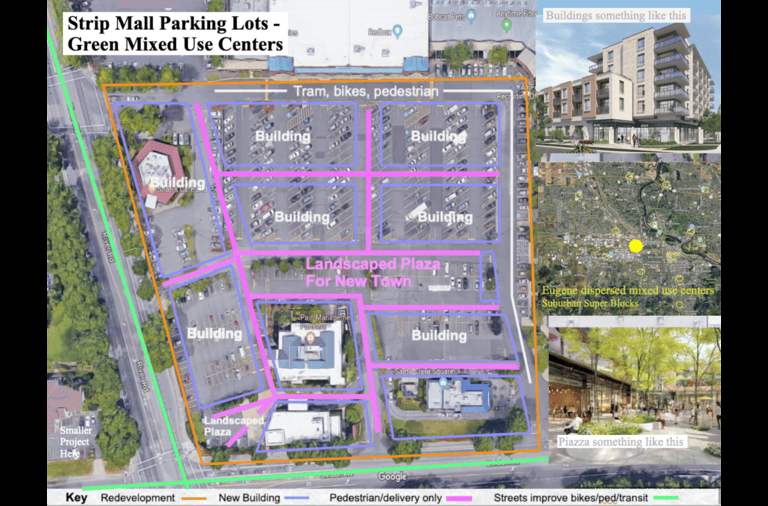
Idealized, hoped for turning a strip mall parking lot into a mixed use suburban micro downtown. There are thousands of similar parking lots all over the country that could be reborn as mixed use to reduce eco-footprints and build civic culture.
Click the image to enlarge.
|
This is not a time for organizations or individuals to be shy about moving past the consumer culture. There is an enormous Movement for transformation waiting and ready. The Primer is free to access. It is open source. The “how to” content is timely and empowering.
Final Thoughts
The world counts 8+ billion people, the US pushing 350 million. The annual global economy is about 115 trillion dollars and the US about 30 trillion. One could ask, given those numbers, what is the significance of small scale paradigm shift? One could reply, consider downward trends and consider the social, spiritual and environmental ideals described in the Primer and many other kindred sources. There are near endless reasons to downsize to elevate our own value for what it means to be human. There are untold benefits to be gained when consumers become citizens. Paradigm shift starts at home and so do the benefits.
ABOUT THE AUTHOR
Jan Spencer lives in Eugene, Oregon. His interests are a convergence of care for the natural world, permaculture, urban land use, social uplift, economics and paradigm shift. Jan invites comments to the article and welcomes invitations to speak with classes, events, symposia relating to permaculture, social uplift, economics, paradigm shift and any topics found in the Primer. Jan is into human powered bikes, frisbee. and looking after his place. His websites are
A Primer for Paradigm Shift and
Suburban Permaculture .
|
|Back to Title|
LINK TO THE CURRENT ISSUE
LINK TO THE HOME PAGE