Our latest work,
What Happens to the Savings?, focuses on the dangerous assumption that “savings” earned through conventional sustainability actions represent actual and lasting reductions in ecological impact. This is exemplified by the logic that filling a stainless-steel water bottle results in one less plastic bottle being produced—a reasoning that forms the official logic of the sustainability sector, from corporate ESG messaging to national climate commitments.
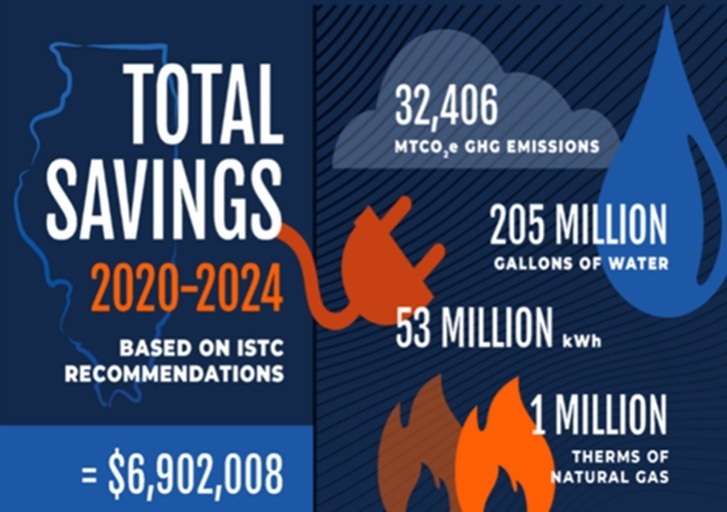
Even in scientific and technical settings, it is generally accepted that practices designed to reduce resource requirements—such as fuel per mile or paper per package—will result in lower overall demand and subsequent environmental benefits. Back when I worked as a technical assistant for the Illinois Sustainable Technology Center (ISTC), I observed a different reality. While we pushed the "win-win" message that saving resources helps both the economy and the environment, I noticed that companies saving money via efficiency naturally reinvested those savings into growth: more production, new hires, and bigger bonuses. The savings were not held from use or put toward lasting environmental protection.
It is actually double-counting to claim both financial and resource savings simultaneously. If $7 million is saved by reducing demand for water and energy, the consequences of re-spending those funds must be subtracted from the impact-reduction claim. In an economic system where growth is the ultimate goal, these funds are required to be re-spent in greater volumes, perpetuating the fraudulent idea that economic growth can be decoupled from environmental impact.
The Savings, Redeployed
Even when "saving" is successful in one respect, the resources are often redeployed to serve other growth opportunities. In What Happens to the Savings? we detail three distinct examples drawn from the past decade of sustainability messaging:
- Electronic Communication vs. Print: The campaign to save trees by using email and the internet led to real reductions in global printer paper consumption. However, the paper industry did not stop pulping trees; instead, output shifted toward packaging for e-commerce, which was also supported by the rise of the internet.
- Residential Energy Efficiency: Sustainability policymakers have successfully kept U.S. residential electricity demand level over the past two decades, largely by encouraging more efficient lighting, cooking, heating, and cooling technologies. Yet, the electricity industry simply found new customers in the commercial sector, primarily powering data centers for AI and the "internet of things", including – ironically – your smart thermostat.
- Transportation and EVs: The deployment of electric vehicles (EVs) and improved fuel efficiency has significantly slowed the growth of global gasoline sales. Nevertheless, growth in the petroleum industry has not slowed because other products, such as diesel, jet fuel, and marine engine fuel, have taken up the slack.
These promises were made by prominent sources, including climate scientists and leading environmental organizations. While campaigns like "Think Before You Print" successfully prompted behavioral change, they failed because they left out the
economic growth imperative; the structural or cultural need to foster continual economic growth (measured by GDP) to ensure social stability. This phenomenon operates above the individual scale; a kind of emergent phenomenon with various causes ranging from human nature to profit motives. But no matter the cause, the pursuit of endless growth deserved to be named for its ability to vanquish well-meaning sustainability efforts. The failure to factor endless growth into the calculations of planetary sustainability is why our movement has not delivered results at the planetary scale.
Sustainability’s Next Evolution
With green leaf logos and eco-reminders popping up all over the place, it can seem that there is momentum building. Perhaps such efforts could come together to create comprehensive change, boosted by an international climate agreement or a green new deal. However, the lessons of What Happens to the Savings emphasize that without a limit on economic growth, no such positive shift is coming. An ever-growing and globally-connected economy always finds a way to shift demand elsewhere. That means the next era of sustainability initiatives will need to be focused on right-sizing and re-aligning the economy to provide equitable wellbeing for all.
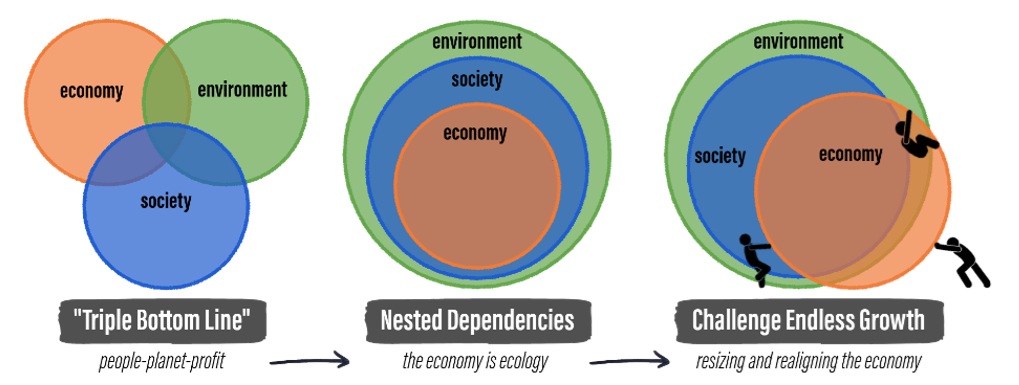
Adding macroeconomic context and degrowth to sustainability efforts.
Illustration provided by the author. Click on the image to enlarge.
|
Globally, and cooperatively, we’ll need to face the reality of economic limits. We’ll especially need the folks who are already working hard on sustainability solutions to adopt a macroeconomic context for their work. At Degrowth Institute, we are taking the findings from our Challenge to Growth series and bringing them to audiences already engaged in climate action, sustainability advocacy, and environmental research. We present this definition of degrowth:
Degrowth is intentional downscaling of the global economy for the
purpose of achieving ecological sustainability and social justice.
Sometimes this message flat. Really, you’re talking about limiting the size of the economy? That’s crazy. But more often than not, the reaction is positive. So many tireless advocates have seen their hard-won savings lost to an onslaught of new products and corporate profits, accumulating in the hands of a few. Often carried out with a green tinge – just look at Elon Musk’s early marketing of electric vehicle, rooftop solar, and hyperloop technologies, off of which he’s become the world’s wealthiest person.
Degrowth is a breath of fresh air for so many because it presents a backstop to unjust and ecologically dangerous redeployment of the savings. In the past year we have helped environmental groups across the US add degrowth to their discussion groups, meeting agendas, and even official reports. We have struck up political dialogue with environmental justice groups who are already well-versed in resisting unequal economic expansion at a local scale. And we have helped add a dissenting voice to calls for abundance and green growth, which ignore economic upper limits.
In response to, “you’re talking about restricting economic growth?” we are training people to confidently say, “Yes” with our Challenge to Growth series series providing the backup. We center economic size because it is the key factor that cannot be ignored for the sake of true sustainability.
ABOUT THE AUTHOR
John Mulrow is the executive director of Degrowth Institute, co-founder of DegrowUS, and adjunct professor of Environmental and Ecological Engineering at Purdue University. He holds a BS in Environmental Science and Policy from Stanford University and completed his Masters and PhD in Civil Engineering at University of Illinois Chicago. He was a Postdoctoral Fellow in Civil and Environmental Engineering at Georgia Tech from 2020-2022. His research aims to improve environmental assessment by accounting for social outcomes and biophysical limits to economic growth. John is based in Chicago, where he’s worked on urban farming, composting, and climate action for many years.
|
|Back to Title|
LINK TO THE CURRENT ISSUE
LINK TO THE HOME PAGE