What do you do when you are in a car crash?
Do you put on your seatbelt?
No. No time for that. You could have buckled your seatbelt when you left home. Too late for that now. If you could go back in time, there are a number of things you could have done. You could have decided not to leave home, based perhaps on the reports of ice on the roads, or reports of heavy traffic on the road where your accident is currently in progress. But in that brief moment, as your life flashes before your eyes, you have no time to solve the problem of time travel. No way to go back to the time when you had agency.
The answer to the question what do you do when you are in a car crash is simple. One word.
Physics.
Momentum carries you through the windshield. Forces of collision apply vectors of change to the velocity to your car and to the other car. Gravity kicks in as your body is flying through the air, thrown from the wreckage that was until very recently two functioning cars. Physics acts without thinking. Physics is what happens when you are past the point of control, when things are changing on a timescale that is too short for the reactions and remedies provided by the human brain.
A few years ago I published a paper on the global human population, I had followed up on work published in 1972 and again in 2004 about the determinants of global population as encoded in a systems dynamics model. A “systems dynamics model” is a plan, a collection of cause and effect relationships, each with numbers attached. When you run the model using standard systems dynamics methods, you get predictions. You get predicted population, pollution, economic stability, birth rate, death rate and a slew of other parameters. Then, if you wait thirty years you can compare your predictions to what really happened. In effect that’s what they did in their 2004 book. It turns out that the model (called the World model in 1972, and World3 by the same authors in 2004. A different author had published World2, also back in the 70’s.) predicted that population would peak mid-21st century. Then it would go down, of course. Where else could it go?
The World model’s prediction was a wake-up call, or scientific quackery, depending on which side you were on. The authors were part of the Club of Rome, a think tank of sorts that dealt with global social and environmental issues. They were the first to think outside the box of neo-classical economics -- the first to see economics as subservient to the environment. This was long before climate change was a thing, but they saw it coming. They saw something coming, at least.
I teach a population course in which I have the students read the book “Limits to Growth, The Thirty-year Update”, the story of World3 [1]. The students study the various scenarios in which humanity might have reacted to the coming collapse by making changes that could increase the food supply or mitigate the other factors that were seen to be leading to the coming collapse. Students learned that humans could save themselves from collapse if they take collective, corrective actions. They could buckle their global seatbelts, decrease their speed, or steer away from danger. But the corrections would have to be applied well before the crash was underway.
Have you ever been to a meeting and wanted to ask the speaker a question but were unable to get to a microphone? That was me.
You can’t write to the authors of a scientific work to point out flaws. It doesn’t work like that. There is no such microphone for that. The only way to respond to the work of science is to publish science. It took awhile, but I did that [2]. In my article I responded that World3 was too complicated. There were to many knobs to turn and levers to pull. If the model’s impact on the world’s leaders was mindless rejection, it was perhaps because the work was inaccessible. Politicians and economists, untrained in art of systems dynamics, must have stared at the spiderweb of interconnected causal relationships that is World3 and thrown up their hands. They must have rejected the conclusions of the model, not the model itself. They couldn’t have rejected the model, because they didn’t understand it. The method was a black box to them.
So I made a new model, World4. (When I asked World1/World3 author Dennis Meadows if I could call it World4, he said “Go ahead, I can’t stop you.” And he pointed me to the work of Rees and Wackernagel [3], their “ecological footprint” literature, advice I took. ) In World4 there are very few knobs and levers. I was hoping that in its simplicity it would be more accessible to students, to economists, and maybe to policy makers.
It was never my intention to promote hopelessness. But that’s what World4’s numbers were spelling out for me. I went for simplicity, and in doing so I found despair. Within the space of available actions, there is no way to avoid collapse, says the model. I felt compelled to publish an escape route which involved traveling back in time to the 1970’s and making policy changes (The new policy would set aside half of the Earth’s wild lands and not touch them. Then, climate would stabilize and we would avoid collapse, said the model.), but this “solution” felt foolish to me. It was buckling your seatbelt after the crash has begun. Worse, it was like pretending we had already buckled our seatbelt.
Because the model is simple, I can explain it to you here in a few words. World4 is a system composed of two quantities, (1) ecological footprint, and (2) technology. They interact to produce a quantity I call “carrying capacity” which in turn determines population.
Carrying capacity is not an additional knob or lever, it is entirely determined by ecological footprint and technology. As the footprint goes up, carrying capacity goes down, because we need Nature’s services to survive. As technology goes up, the footprint goes up, and as long as the footprint is not too high the carrying capacity also goes up, because technology makes us more efficient. And technology grows intrinsically, like a living thing itself. (There are pop-science articles about the phenomenon of technology growing like a living thing [4].) It’s just two interacting quantities. The rest is emergence.
Population emerges from carrying capacity. Like all K-selected species, we grow to the limit, or we shrink back to the limit. The limit, the carrying capacity, determines the population. It happens in subtle ways. More to go around means more people can exist. You or I may restrain ourselves and not have kids even though times are good, but we can’t stop others from taking advantage of good times. As a population, we behave in predictable ways. In chemistry these are called “bulk properties”, as opposed to atomistic properties. Population is an emergent property of carrying capacity because it is a bulk property, not subject to the decisions of individuals. And carrying capacity is, in turn, an emergent property of the health of the ecosphere, multiplied by a technology factor. Our future on Earth emerges from our actions in the past. We have destroyed the ecosystem, and we depend on it for survival, therefore we are destined to collapse. Collapse is not something we can decide to do or not. It is not something we can stop once it starts. But it is something we can study and understand.
Knowledge is power. Although we can’t stop collapse, we do have agency as individuals. The more we, as individuals, know about how the future is going to play out, the better prepared we, as individuals, will be to survive the collapse, perhaps even to do well during collapse.
The key understanding that comes from studying the emergent properties of the World4 model and from reading the history of human civilization [5], is that collapse is fungible. If it doesn’t happen one way it happens another way. If it’s not war, then it’s famine. If it’s not famine, it’s disease. But there are many many more modes of collapse than there are Horsemen of the Apocalypse. In fact, an apocalyptic collapse is the least likely. Thomas Malthus said as much in his 1790 treatise on population [6]. A society reacts constantly and organically to the food supply. If there is not enough, then a society makes laws, or greed and corruption take hold, or religious mores restrain the masses, or wars of conquest find new supplies at someone else’s expense, or a technological breakthrough staves off all of these other solutions. Famine is not the rule but the exception. We can look forward to a fungible and complicated collapse.
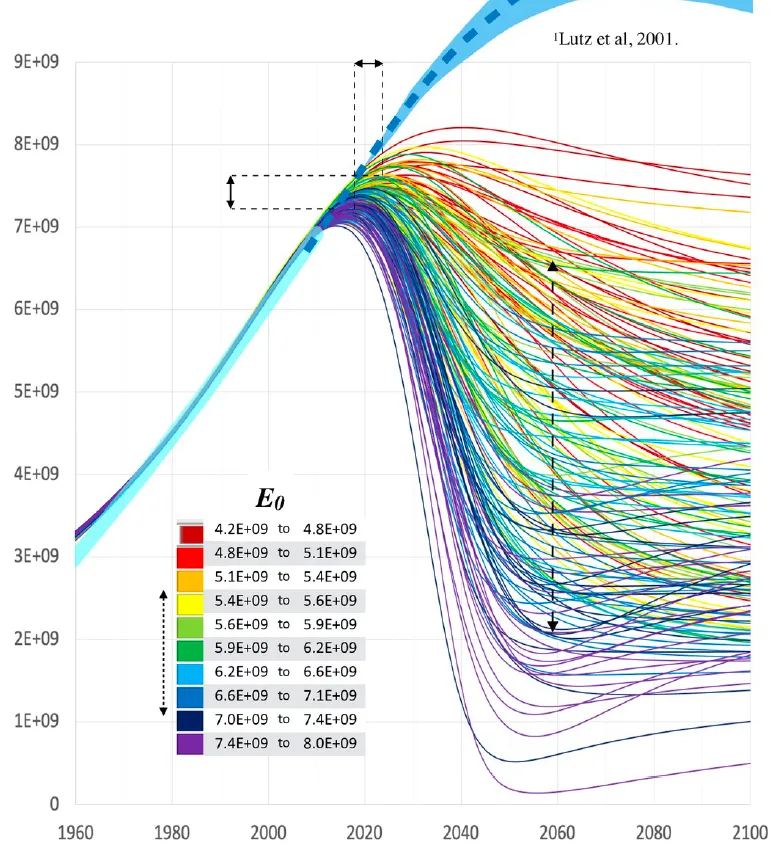
One could argue that we are in it right now. World4 predicts a population peak right about now. Having accepted that it is too late to buckle the seatbelts, we accept the business-as-usual model. Rational people must throw irrational hope out the window. Only then can we make real predictions.
The position of the peak in the present or in the immediate future is guaranteed by the hyper-exponential speed of population growth. We have not grown exponentially. Because of the exponential growth of technology, and because technology is a multiplier of the growth rate, the rate of population growth has been growing exponentially for a thousand years. This becomes clear when we compare the doubling time -- a constant when growth is exponential -- of the year 1500 (doubling time was 700 years) and the year 1963 (doubling time was 37 years!). If we extrapolate the declining doubling time forward from 1963 we find that it reaches 0 in the year 2026. This year. This calculation was published by the polymath Heinz von Foerster in 1960 in the prestigious journal Science, entitled provocatively “The Doomsday Equation” [7]. A zero doubling time, implying an infinite growth rate, is impossible of course. But up to the 1960 date of publication, global population fit the Doomsday Equation very well. And it continued to track that crazy hyperbolic curve for another 20 years before showing signs of slowing.
Hyper-exponential growth, the growth equation of World4, fits the data just as nicely as the Doomsday Equation, but it does not imply impossible, infinite growth. It implies steady technological growth instead, which is easy to swallow and matches our intuitive view of technology.
But regardless of which growth equation you choose, it is the anti-growth equation that matters. Von Foerster did not provide one, except to make a tongue-in-cheek statement about being “squeezed to death”. In World4, the reverse growth equation is the retraction of life-sustaining ecological services due to the destruction of the environment. And we would reach impossible, infinite anti-growth if we destroyed all of it. But we will never get there. We will stop growing when the degree of destruction counterbalances the growth of technology.
Population growth due to technology is hyper-exponential. Very steep. Collapse due to environmental destruction is even steeper, assuming business-as-usual, with no miracles allowed. In fact, it is infinitely steep in the limit of total environmental destruction.
At some point -- let’s call it the “singularity”-- the anti-growth forces of disintegrating Nature, increasing more steeply than the hyper-exponential growth born of technology, will surpass the latter and population will spiral in the negative direction. The Seneca Effect [8] argues that the collapse will be faster than the growth which brought us to where we are, but really we don’t know. It could be fast or it could be slow. But once a downward trajectory begins, it will be a long time before we will again have positive population growth. Singularity is the term that fits, since this will happen exactly once in human history.
Welcome to peak population! It is just a prediction, made by an inanimate computational model designed to fit the data and beholden to a strict set of encoded assumptions. Some of those assumptions could be wrong. Then the prediction would be wrong, too. Even so, perhaps we might have another ten years, twenty years of growth.
But look around you. Does this look like growth? Or does this look like the singularity?
If the singularity is now, then we should be seeing unprecedented levels of breakdown of society, of trust. We should be seeing war, famine, corruption [9], the rise of religious extremism [10], the subversion of long-standing international treaties [11], and greed beyond all reason [12]. Are we seeing that? Check out the references. Its anecdotal but I believe we are.
At the peak, things start going backward, not all of the sudden but as a natural consequence of years of curving in that direction. Are things curving in the downward direction? Have they been doing that curving for a good many years? Does it look like it will not soon stop?
If we are saying yes to these questions, then we are at the peak, or near to it.
References
[1] Meadows D, Randers J, Meadows D. “Limits to Growth. The 30-year update.” Chelsea: Chelsea Green Publishing Company (2004).
[2] Bystroff, C. (2021). Footprints to singularity: A global population model explains late 20th century slow-down and predicts peak within ten years. PLoS One, 16(5), e0247214.
[3] Wackernagel, M., & Rees, W. (2004). What is an ecological footprint. The sustainable urban development reader, 211, 219.
[4] Kurzweil, R. (2005). The singularity is near. In Ethics and emerging technologies (pp. 393-406). London: Palgrave Macmillan UK.
[5] Diamond, J. (2011). Collapse: how societies choose to fail or succeed: revised edition. Penguin.
[6] Malthus, T. R. (2024). An essay on the principle of population. In Evolution in Victorian Britain (pp. 25-40). Routledge.
[7] Von Foerster, H., Mora, P. M., & Amiot, L. W. (1960). Doomsday: Friday, 13 November, AD 2026: At this date human population will approach infinity if it grows as it has grown in the last two millenia. Science, 132(3436), 1291-1295.
[8] Bardi, U. (2017). The seneca effect. New York, États-Unis: Springer Publishing.
[9] Whoriskey, P. (2025). Disbanded anti-kleptocracy unit had entangled Trump allies. The Washington Post. Mar. 27, 2025.
[10] Jasko, K., LaFree, G., Piazza, J., & Becker, M. H. (2022). A comparison of political violence by left-wing, right-wing, and Islamist extremists in the United States and the world. Proceedings of the National Academy of Sciences, 119(30), e2122593119.
[11] Mazzetti, M. (2025). Trump’s Affinity for Putin Grows More Consequential Than Ever. International New York Times, Mar. 11, 2025.
[12] Rau, E. G., & Stokes, S. (2025). Income inequality and the erosion of democracy in the twenty-first century. Proceedings of the National Academy of Sciences, 122(1), e2422543121.
ABOUT THE AUTHOR
Christopher Bystroff is Professor of Biological Sciences and Computer Science at Rensselaer Polytechnic Institute, Troy, New York, USA.
|