A reflection introducing Degrowth Institute’s brief “Has the Economy Outgrown the Planet?”
Imagine you are driving on the highway, rushing to your next destination – a presentation you cannot be late for. A straight road with gently rolling hills stretches ahead of you and there are no other cars in sight. You’ve got to go fast, but you also cannot afford to be pulled over for speeding, so you’re keeping the speed limit, 70 mph. You are maxing out your mental capacity as you simultaneously review the pending presentation in your mind and concentrate on maintaining your speed.
Suddenly, your speedometer – a digital display on the dashboard – goes out. Everything else about the car is working, but you have no direct indicator of speed. Alright, don’t panic. You don’t have time to pull over and figure this out, but there’s plenty of other ways to manage your speed. First of all, you’ve got a sense of how much your foot presses on the gas pedal to maintain 70 mph. That’s not perfect, since you’ve got to press down on the uphills and let off on the downhills. Same thing with your RPM gauge – keeping RPMs constant on a hilly road will cause your speed to fluctuate. You start glancing left and right out the window to try and get a sense of how fast the roadside landscape is moving past; can you somehow keep that as a constant? Oh, what if you hold a handkerchief out the window as you drive, using it like a windsock to gauge speed!
Just as you’re thinking the hanky idea might work, the speedometer display flickers back on. Apparently in your panic you had sped up to 90 mph! You ease off the gas and get the car back under control. As you roll your window back up, you’re still pondering alternative indicators of speed. Okay, you tell yourself, time to switch the brain back to presentation mode – that’s the reason you’re on the road in the first place.
This thought experiment is not a commentary on transportation, digitalization, or today’s technology-enabled pressure to multi-task at all times and places. It is a commentary on indicators of progress toward sustainability. There is an overwhelming number of such indicators. There are sustainable development goals for nations, doughnut economics categories for municipalities, sustainability accounting standards for corporations, and life cycle assessment standards for products. There are thousands of product responsibility labeling schemes, not to mention a constant churn of new research being reported in publications like Ecological Economics and the Journal of Industrial Ecology. Finally, sustainability advocates have some common causes that stir up activism; issues like population and animal welfare. These issues are tied to data just as well as our heartstrings, sparking arguments over reproductive rights and meat consumption.
Spaceship Earth is not a simple vehicle. It’s a living being that moves and evolves on a cosmic scale, so a comprehensive dashboard of sustainability indicators with agreed-upon safety thresholds is practically impossible. But what if maintaining planetary health in the near-term is like maintaining speed in our thought experiment?
We humans are on the road, traveling through space, for a purpose: to live and thrive together. We sense there is some limit to the rate at which we can use the Earth – it’s biology and materials – and we’re busy devising indicators of that rate. Is it the total number of humans? That number can be closely estimated, but its relation to impact is subject to consumption levels. Is it carbon emissions? That’s a pressing issue of atmospheric health but ignores the rest of Earth’s life support systems. How about ecological footprint, a metric that integrates several ecological impact categories into one? That’s more comprehensive but requires a unit of normalization that translates to political action.
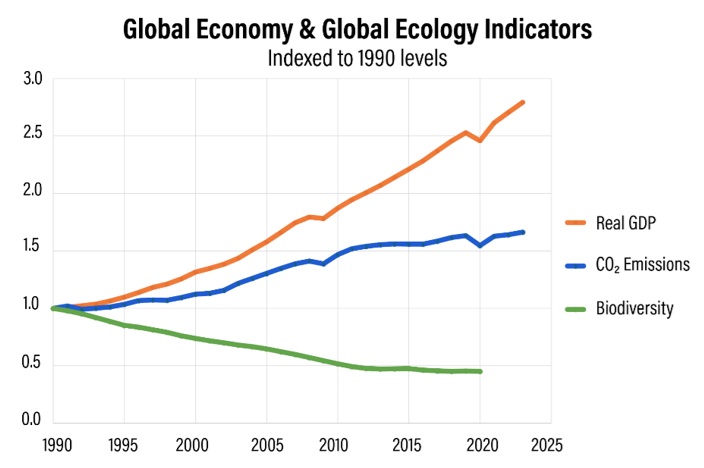
It turns out there is a single indicator that correlates well with all of the above and which requires far less translation for most of humanity. That indicator is economic size: the total value of goods and services produced by and for humans, i.e., global GDP. Like a car’s speedometer, this indicator already holds a central place on humanity’s dashboard. We’re all used to looking at it in news headlines and geopolitical comparisons; we use it in political dialogue and even casual conversation; and we’re intimately familiar with its units – dollars.
Without GDP at the center of our sustainability dashboard we are constantly grasping for alternative indicators of ecological responsibility, all of which - like the foot-pedal or handkerchief methods from the thought experiment on speed - are highly subject to external conditions. If population declines, we could be on a path to sustainability, but if everyone is living at the production/consumption level of today’s upper-middle class, then we’ll be closer to disaster.
If anthropogenic carbon emissions decline, but in the process we’ve decimated living landscapes through clean-tech resource extraction, then we'll still face global warming. Economic size, however, is inherently tied to every type of ecological effect, due to the fact that “you can’t get something from nothing.” Sustainability can be attained with an international commitment to a smaller global economy. The same simple statement cannot be said for any of the myriad other sustainability indicators.
That is the message of Degrowth Institute’s first Challenge to Growth brief, titled “Has the Economy Outgrown the Planet?”
Economic size is the most comprehensive
and useful indicator of ecological impact.
Our goal is to bring that indicator back into view, to light it up at the center of the dashboard. By doing so, we enable sustainability advocates to focus their energies on a collaborative question: how? How global economic downscaling can be done safely and fairly, and to what point, is the question deserving of our mental concentration.
As we conclude in this brief: “The next great challenge for environmental advocates is to recognize that a limit on ecological degradation means a limit on economic size.”
Our purpose is to keep traveling safely down the road, with a diversity of folks on board. Join us, at Degrowth Institute.
ABOUT THE AUTHOR
John Mulrow is the executive director of Degrowth Institute, co-founder of DegrowUS, and adjunct professor of Environmental and Ecological Engineering at Purdue University. He holds a BS in Environmental Science and Policy from Stanford University and completed his Masters and PhD in Civil Engineering at University of Illinois Chicago. He was a Postdoctoral Fellow in Civil and Environmental Engineering at Georgia Tech from 2020-2022. His research aims to improve environmental assessment by accounting for social outcomes and biophysical limits to economic growth. John is based in Chicago, where he’s worked on urban farming, composting, and climate action for many years.
|
|Back to Title|
LINK TO THE CURRENT ISSUE
LINK TO THE HOME PAGE