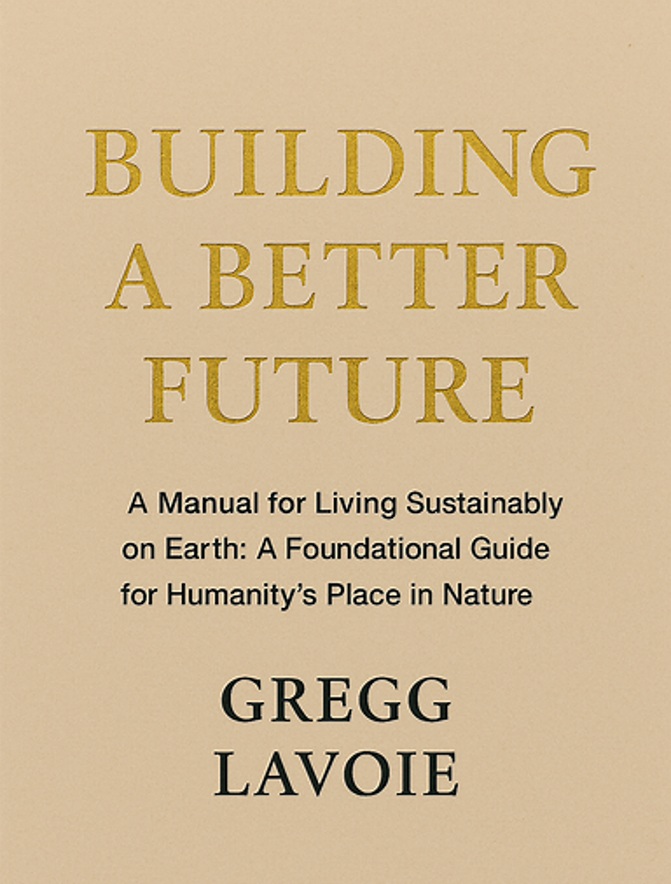
The Human Foundation
The Human Foundation is a guide for living sustainably on Earth—not as consumers or conquerors, but as responsible participants in a shared and finite system. Grounded in ecological reality and moral clarity, it offers enduring principles for individuals, communities, and institutions seeking to build ways of living that can endure and adapt.
This book is for those ready to move beyond short-term solutions and toward a durable ethic rooted in truth, responsibility, and restraint. It charts a path that honors human potential, future generations, the diversity of life, and the limits within which all life must flourish.
Book Summary
Building a Better Future is a clear, grounded guide for living sustainably on Earth—not as consumers or conquerors, but as responsible participants in a shared and finite system.
Throughout this book—referred to as The Human Foundation—the focus is on the underlying conditions that make human life possible and enduring. Drawing on ecological reality, ethical reasoning, and practical understanding, it offers a foundational framework for aligning human societies with the limits and capacities of the natural world.
Rather than emphasizing short-term fixes or ideological solutions, The Human Foundation examines the deeper structures that shape survival and well-being. It moves from awareness to accountability, addressing humanity’s relationship to Nature, population, technology, governance, and ethics as interconnected elements of a single planetary challenge.
Written with clarity and restraint, this work is intended as a durable reference—one that can be returned to across time, disciplines, and generations. It does not argue for belief or blame, but for understanding what must be true for human societies to endure, and what it means to live responsibly within Earth’s limits.
Book Outline
Orientation: How to Use This Manual
Chapter 1 ~ Foundational Awareness: Who We Are and Where We Are
Chapter 2 ~ Universal Responsibilities: What We Must Do
Chapter 3 ~ Systemic Multipliers: Technology and Population
Chapter 4 ~ Reckoning with Systemic Failures: What We Must Repair
Chapter 5 ~ Reimagining Human Systems — How We Must Organize
Chapter 6 ~ The Fallacy of Money: Replacing the Dominant Metric
Chapter 7 ~ Ethical Leadership and Corruption Prevention
Chapter 8 ~ Global Implementation: Making It Real
Chapter 9 ~ Living Ethic, The Ethic of Enough, The Ethic of Care
Chapter 10 ~ Diversity Within Unity: Protecting Freedom and Expression
Chapter 11 ~ The Promise: A Better Future for All
Chapter 12 ~ Conclusion: The Future Begins With You
Condensed Summary
Condensed Summary ~ The Foundations of Human Existence on Earth
This condensed summary distills the core principles presented throughout this manual — The Human Foundation — into a shared reference framework for remembering, teaching, and applying the conditions required for humanity to live sustainably within the limits of Earth.
These principles are not beliefs. They are conditions of reality.
1. Humanity Is a Part of Nature, Not an Exception
Humans are a biological species embedded within Earth’s living systems.
We do not stand above Nature, outside it, or in control of it.
All human systems—economic, political, technological, cultural—exist within the biosphere and are governed by its limits.
Without the Earth, humanity does not exist.
2. Earth Is a Living, Self-Regulating System
The planet functions through interconnected feedback loops that regulate climate, water, chemistry, and life.
When these systems are destabilized, no human institution can override the consequences.
Planetary boundaries define the safe operating space for civilization.
Exceeding them produces instability, not progress.
3. Power Requires Responsibility
Human intelligence and technology amplify impact faster than instinct evolved to manage.
Knowledge transforms ignorance into responsibility.
A species capable of altering the planet must also become capable of caring for it—or it will destabilize the conditions that support its own survival.
4. Limits Are Conditions for Continuity, Not Constraints on Meaning
In all living systems, limits enable stability.
Rivers flow because banks exist.
Bodies remain healthy through regulation.
Ecosystems thrive through feedback.
Human freedom, creativity, and prosperity endure only within boundaries that protect the whole.
5. Population, Consumption, and Technology Multiply Impact
Human impact is shaped by the interaction of:
- population size,
- consumption levels,
- technological intensity.
Technology does not remove limits—it accelerates consequences.
Stability requires conscious population balance, moderated consumption, and ethical governance of technology.
6. Diversity Strengthens Expression; Unity Sustains Survival
Cultural, spiritual, and personal diversity enrich human life and resilience.
But foundational truths must be shared:
- Earth’s limits apply to all.
- Ecological laws override ideology.
- Future generations have rights.
Unity is required where reality is universal. Diversity thrives where expression is safe.
7. Systems Must Serve Life First
Economics, governance, education, food systems, and institutions must be evaluated by a single criterion:
Do they support the long-term health of the biosphere and human wellbeing?
Systems that undermine ecological integrity ultimately undermine civilization itself.
8. Education Is the Most Peaceful Force for Transformation
Lasting change occurs through understanding, not coercion. Education must cultivate:
- ecological literacy,
- critical thinking,
- truth discernment,
- emotional resilience,
- intergenerational responsibility.
Children shape the future not by obedience, but by clarity.
9. Parenting Is Intergenerational Stewardship
Civilization reproduces itself through children.
Parenting transmits values, limits, truth, and relationship to Nature long before institutions do.
Raising secure, truthful, and responsible children is a planetary act.
10. Truth Is the Compass
Sustainable societies depend on shared, evidence-based reality.
Denial, manipulation, and myth fracture cooperation and delay repair.
Truth—scientific, historical, and ethical—is the foundation of trust, governance, and continuity.
11. Enough Is a Measure of Wisdom
Prosperity is not infinite accumulation.
Wellbeing emerges when sufficiency replaces excess, and balance replaces escalation.
A civilization that understands “enough” protects freedom, dignity, and future possibility.
12. The Goal Is Enduring Quality of Life
The purpose of alignment with Earth is not sacrifice.
It is stability.
It is health.
It is meaning.
It is continuity.
Humanity’s success will be measured not by what it extracts, but by what it sustains.
In One Sentence
Humanity can flourish long into the future if it chooses to live as a responsible participant in Earth’s living systems—guided by truth, restraint, care, and respect for limits that make life possible.
How to Use This Summary
- As a teaching reference
- As a decision-making lens
- As a civic and ethical checklist
- As a reminder of what matters when complexity grows
This page is the spine of the manual. Everything else is elaboration.
Together, these principles form The Human Foundation — not as doctrine, but as a living reference for how a mature species can remain aligned with the planet that makes its existence possible.
ABOUT THE AUTHOR
Gregg Lavoie writes from a lifelong commitment to understanding humanity’s place within the larger systems of Nature. Shaped by hands-on problem solving and a deep respect for the natural world, his work focuses on resilience, stewardship, and the responsibilities we hold toward future generations. Through Human Foundations Publishing, he seeks to offer clear, foundational guidance for living sustainably on Earth and for building a future grounded in truth, integrity, and ecological balance.
|
|Back to Title|
LINK TO THE CURRENT ISSUE
LINK TO THE HOME PAGE