Kleptocracy, crony capitalism, imperialism, colonialism, carbon politics or Kissinger-style politics. Call it what you wish. But the Trump semi coup in Venezuela is another example of the retro politics of the Trump administration, and it is destined to pull the US into yet another quagmire, reminiscent of Iraq, Afghanistan and perhaps even Vietnam.
There is an adage that states always prepared to fight the last war. Trump’s incoherent views of the US were always backward looking, thus to make America great again has always been retro, looking at the US through Halcyon, rose colored glasses, seeing a time when the US dominated the world.
Yet as Karl Marx once observed in The Eighteenth Brumaire, the first time history repeats itself it is a tragedy, the second time it is a farce. What is unfolding in Venezuela fits neatly into that second category. It is not merely repetition, but repetition stripped of strategic seriousness. What remains is spectacle masquerading as statecraft.
From the beginning, it has been obvious that Venezuela was never about drugs. The Trump administration’s 2025 National Security Strategy made that clear. Rather than focusing on narcotics, governance, or humanitarian concerns, it resurrected an explicitly imperial vision of hemispheric dominance. Venezuela was framed as a problem of control, not law enforcement.
That document called for an update to the Monroe Doctrine, which some critics quickly dubbed the “Donroe Doctrine.” The premise was blunt: the United States should dominate the Western Hemisphere. Europe would be left to Europe, Asia to Asia, and Africa barely merited mention. This was not realism so much as nostalgia dressed up as strategy.
Yet the 2025 National Security Strategy was hardly a strategy at all. It read like a campaign speech extended into foreign policy form. It offered slogans, not plans, and branding rather than analysis. Venezuela appeared less as a case study than as a marketing opportunity.
The document foreshadowed what soon became clear: Venezuela was never about drugs, but about domination. That domination draws on an older historical memory, one rooted in the early twentieth century. During that period, the United States treated much of South America as an economic extension of its own industrial needs. Venezuela’s oil was extracted, exported, and monetized with little regard for Venezuelan sovereignty.
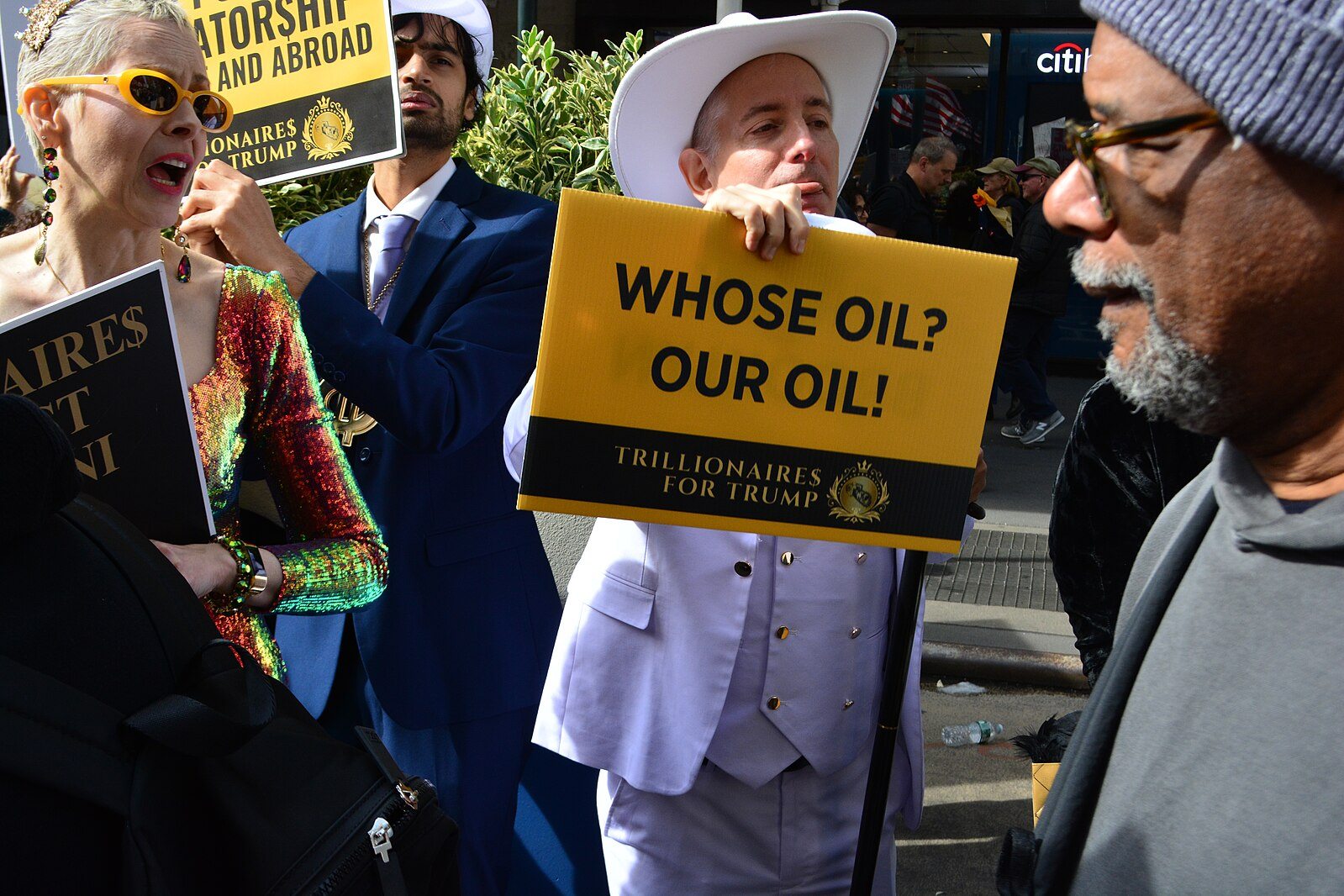
The semi-coup Trump orchestrated is an attempt to recapture that lost era. It is a bid to reclaim oil that the United States once took openly and unapologetically. The logic is strikingly familiar. As was once said during debates over the Panama Canal, what was stolen “fair and square” should be kept. That same logic now underwrites U.S. policy toward Venezuela.
Trump’s decision to charge Nicolás Maduro with drug crimes is similarly retro. It echoes the Bush administration’s justification for arresting Manuel Noriega decades earlier. In both cases, criminal charges substituted for political legitimacy. Law enforcement became a fig leaf for regime change.
This backward-looking politics is also about reviving carbon politics at a time when it is rapidly losing relevance. Daniel Yergin’s trilogy—The Prize, The Quest, and The New Map—documents how the twentieth century revolved around oil and energy dominance. But the economic logic that once favored fossil fuels is eroding. Renewable energy is no longer speculative; it is increasingly cheaper, faster, and more scalable.
China understands this shift and is acting accordingly. It is investing heavily in solar, wind, batteries, and electric infrastructure. The United States, by contrast, under Trump sought to double down on oil and gas. Venezuela thus becomes a symbolic battleground between past and future energy regimes.
Even by the standards of regime change, this effort is oddly incomplete. Henry Kissinger, for all his moral failures, at least understood how to execute a coup decisively. Chile under Allende stands as grim evidence of that competence. What Trump has engineered instead is a semi-coup, lacking both legitimacy and control.
Trump has declared that the United States will run Venezuela, but not necessarily directly. Instead, it will rely on sanctions, embargoes, financial pressure, and the seizure of oil revenues. The opposition has not been empowered but marginalized. Maduro’s vice president remains in charge, and there is little evidence that the military has defected.
The result is a dangerous stalemate. It creates the conditions for civil conflict rather than political transition. As instability grows, U.S. involvement will deepen by necessity rather than design. Oil infrastructure will need protection, and protection will require troops.
When that moment comes, the justification will change. It will be framed as security, stability, or humanitarian necessity. But the underlying motive will remain the same. Control of resources will once again be dressed up as national interest.
The final stage of this episode will likely involve personal enrichment. Trump has consistently blurred the line between public power and private gain. Venezuela offers another opportunity for branding and profit. This would mirror how earlier American elites, including the Rockefellers, benefited from Venezuelan oil a century ago.
Welcome to Trump-and-Pump America. The more we pump, the more we are told we grow. It is an old story with a new logo. And like so many times before, it is likely to end badly.
|Back to Title|
LINK TO THE CURRENT ISSUE
LINK TO THE HOME PAGE