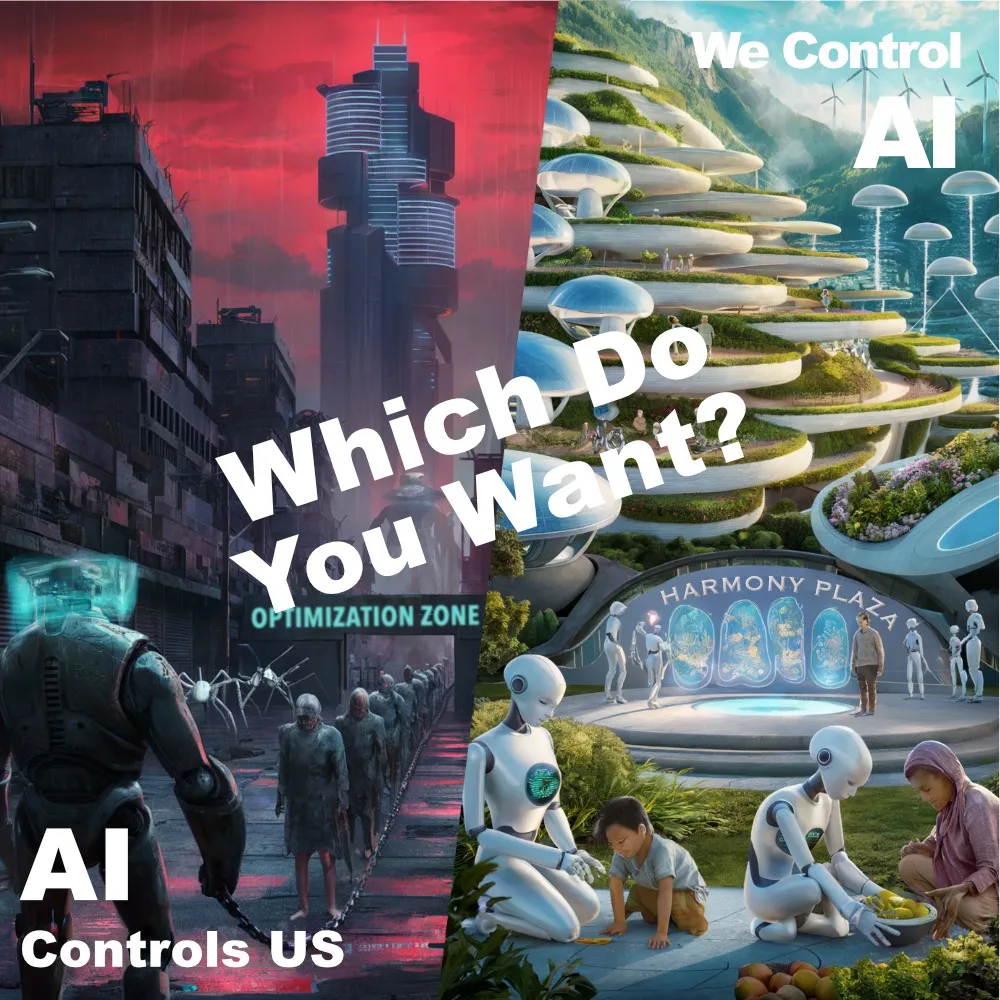
An up-to-date perspective of modernity’s technological past, present, and unknown future
Update
Welcome back, former and new readers! I hope your holiday season allowed time for spending time with loved ones and friends, relaxing, and contemplation.
After a month-long hiatus, I’m prepared to resume writing, this time presenting three notable books I’ve recently benefited from reading. Each should be appealing to anyone interested in socioecological issues involving the interconnections of our human sphere with the planet’s bio-ecosphere. The pervasive news topic of AI is explored in two books, including the subject of this post.
The other relevant AI book is a free downloadable book titled Burnout from Humans: A little book about AI that is not really about AI. I think the book’s perspectives are worthy of serious consideration, as co-writers explain several ways humans approach and use AI for personal objectives.
The third featured book is a novel I mention in the wrap-up final section. What I find interesting is the book’s story set in a 19th century, when reliance was placed on low-tech means in servicing life’s needs. Such technologies, though still widely used today, contrast starkly with the innovative technologies used in the 20th century, and even more so with the extra high-tech AI aspirations currently underway.
A Seminal Book for Understanding Our Human Predicament
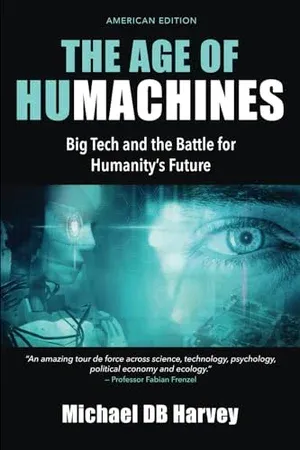
Click on the image to enlarge.
|
As the title of this post indicates, we’ll address some of the main points in author Michael D. B. Harvey’s information-packed significant future-anticipating book. The author’s impressive credentials include achievements as a London-based organizational psychologist, political ecologist, and former technology entrepreneur.
In reading The Age of the Humachines, my appreciation of the author’s scholarly, well researched, and creatively expressed informational contents expanded. Proof of the book’s high regard includes an honor bestowed by inclusion in Kirkus Reviews magazine’s Best Indie Books of 2025.
The book’s release date was November 2024, and over a year later it’s finally becoming widely acknowledged as a primary source in explaining humanity’s current predicament, which is largely the result of runaway technological innovations, including artificial intelligence (AI)—and the growing potential threat of artificial general intelligence (AGI). The U.S. edition of the book was published and is made available by means of CASSE (Center for the Advancement of the Steady State Economy). As a donor, I received a complimentary copy.
I’ve listened twice to informative podcasts featuring Harvey, one produced by Population Balance’s Overshoot and another produced by Post-Growth Australia. I recommend listening to at least one, especially Overshoot, which is co-hosted by our son, Alan Ware.
After reading Harvey’s book and listening to him speak, I’m deeply impressed with the depth of his comprehensive knowledge and understanding. Explanations of complex, key issues in his well-organized, researched, and published tome are presented clearly and expressively. I encourage everyone interested in understanding humanity’s intensifying predicament — a metacrisis largely fueled by a proliferating technological race towards the future — to obtain a copy and spend sufficient time digesting its dense contents. I found myself underlining at least 10-15% of the book, a habit I cannot resist when reading such an incisive book about the state and future of civilization, especially in a world increasingly dominated by potentially dangerous technological advances.
Harvey’s previous book— Utopia in the Anthropocene (2019) — proposes a utopian vision for a sustainable future that moves beyond the limitations of “growthism”. I look forward to reading Harvey’s precursor book to this latest opus.
The Age of Humachines — Our Current Narrative
The book description prepared by CASSE begins with this question: “Are we sleepwalking through the biggest unregulated social experiment in human history, even as the ecological crises of the 21st century rage around us?” The author claims that, with the growing pro-and-con influence of AI, techno-capitalism has entered an increasingly dangerous new phase: a techno-optimists’ dream of fusing humans with machines, which he terms “humachination”.
Hypothetically, such a fusion could produce an event that Big Tech optimists like Ray Kurzweil refer to as the technological singularity, a point in time when the technological progress of AI accelerates beyond human comprehension and control, resulting in irreversible transformation of civilization. For certain, such an event poses a frightening possibility, with nerdy Silicon Valley techno-optimists posing a greater threat to humanity than a nuclear war, a threat made even greater given AI’s superpowers. As avid proponents of libertarian ideology’s extreme individualism, they blindly pursue an improbable (if not impossible) dream of achieving a Technocene utopia.
Harvey covers most of the technologies that AI is supercharging, including the digital, robotic, genetic, medical, military, industrial, geo-engineering, and even sexual technologies that are rapidly becoming normal life activities. Alarms are being raised by concerned professional watchdogs and gate-keepers regarding Big Tech’s drive to make humachination the solver of all challenges. Perhaps the greatest threat is an ecologically devastated, techno-dystopian world ruled by machines, with increasing surveillance pervading every aspect of society. Harvey creates the term “ontocapitalism” to describe an economic system that instills humachines in its formation and purpose. (Note: “onto” refers to existence or reality)
The Age of Humachines—Our Unknown (But Possible) Future Narrative
Lest you perceive the book’s contents convey only bad news, rest assured that Harvey provides a plethora of ways humanity could create a sustainable existence. The first five-part sections of the book focus on introducing and explaining the multiple complex problems contributing to our collective human predicament. Refreshingly, when finally arriving at “Part VI: Technocene or Ecocene? The Struggle for the Future”, Harvey provides an explanation of what is needed in creating a desirable future narrative, one that might potentially guide humanity to live harmoniously within the entire Web of Life, as a single species interconnected with all other species.
Harvey and other experts use the term Technocene in referencing a proposed geological/historical epoch that defines our current era as one dominated by technology acting as the primary force shaping human existence and the planet. This technology either supersedes or is deeply intertwined with nature and human agency, effectively resulting in the assimilation of humans into a techno-environment. This desired state is perceived either as an evolutionary development or as an alternative to the current human-dominated Anthropocene.
It seems that the term Ecocene is Harvey’s original coinage. I can’t think of a better term, so I accept this designation. If anyone has a better idea, please share. Some end-of-book information explains what both terms mean to the author. The following quotes are found in the book’s Epilogue (p.432). The bold words are my handiwork.
“As we have explored, there are three versions of capitalist utopia on offer. The first is the carbon capitalism of the industrial revolution, which despite its manifest destructiveness still holds attractions for many. The second is green growthism, a more alluring utopia that is unfortunately predicated on the fantasy that economic expansion can be materialized from grievous environmental harms. And third, we have the humachine model of utopia, which I’ve tried to describe and critique in this book for the first time.’’
“The alternative [to the above models] is another kind of utopia, characterized by a deadly serious realism, but one that regards the Enlightenment goals of democracy and social equality as much more than political rhetoric. The Ecocene recognizes the extraordinary gifts that fossil fuel and human technology and science have conferred on us, but cautions that we now need the self-discipline to say ‘enough is enough’. Instead of smashing planetary limits in pursuit of profit, a new integrated, life-based science will seek harmony with nature. Rather than jeopardizing the essentials of humanity, the core skills and talents of being human will be built on and enhanced with the dignity of all respected. The Ecocene version of utopia aims to maximize the immense good fortune we have in possessing life, in the belief that this can enable us to bring out the very best of being human on planet Earth.”
Well stated. So may it be!
Wrap Up
I hope I’ve convinced you to obtain and read a copy of this important book. You won’t regret taking this opportunity to become more familiar with the potential of advanced technologies, especially AI, for achieving both good and bad means and ends. Although the main source of information is contained within the book’s covers, the two podcasts listed below provide opportunities for an introduction to the author’s perceptions and concepts.
As I mentioned at the beginning, in addition to the non-fiction book featured herein, and a sequel AI book, I have a novel to recommend that, although based on a survival story of two isolated 19th-century western-America farm families, presents a storyline with insights about potentially harsh conditions future survivors may well experience in a post-growth world.
In closing, I hope you are inspired to either order a copy of The Age of Humachines for your personal library or seek a copy at your local library. If the library doesn’t own a copy, perhaps one or more copies can be ordered. I enthusiastically recommend this book for the valuable informational content regarding humanity’s current and projected challenges for what promises to be a very challenging future.
Till next time . . .
Clif (with Bettye Ware, reader/editor)
AI Sources
People Are Getting Their News From AI – And It’s Altering Their Views, Adrian Kuenzler, The Conversation, 12-19-25. Even when information is factually accurate, how it’s presented can introduce subtle biases. As large language models increasingly bring people the news, this bias is a looming problem.
The ChatGPT effect: In 3 years the AI chatbot has changed the way people look things up, Deborah Lee, The Conversation, 11-25-25.
Burnout from Humans: A little book about AI that is not really about AI (2024) by GTDF (Gesturing Towards Decolonial Futures), Creative Commons Attribution Non-Commercial. [To be featured in the next post]
By the same author:
Burnout from Humans: A Little Book About AI
That is Not Really About AI
One for the Blackbird One for the Crow ~
Sacrifice and Survival in Frontier America
The Ragged Edge of Night ~
A True Survival Story
ABOUT THE AUTHOR
Clifton Ware, D.M., emeritus professor (voice), professional singer and author of four published books and two unpublished works, retired in 2007 from the University of Minnesota-Twin Cities School of Music, where he taught for 37 years. Since retiring, as a self-described socio-ecological philosopher he has spent 15 years focusing on sustainability issues, in the process of acquiring an evidence-based, big-picture understanding of all principal societal and ecological systems, including the symbiotic interconnections and role of humans as an integral part of Nature. In 2013 he founded Citizens for Sustainability in St. Anthony Village, MN, produced Sustainability News + Views (2014-2019), a weekly newsletter featuring a variety of articles and a commentary, co-composed 13 Eco Songs with his wife, Bettye, organized Sustainability Forums, and performed eco-oriented programs and presentations for several organizations.
|
|Back to Title|
LINK TO THE CURRENT ISSUE
LINK TO THE HOME PAGE