Once you learn about the Seneca Effect, your eyes start wandering: patterns emerge, data points align, and connections that once seemed improbable now ring with a certain inevitability. As a student of complex systems, that feeling is hard to escape when staring at the trends for global democracy.
Economic Growth: Democracy as Cause or Passenger?
We are taught that democracy is the engine of prosperity. Indeed, economic growth took off in the wake of modern democracies, as visible in Fig. 1:
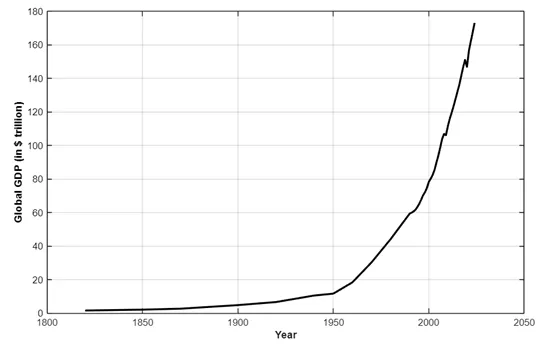
Fig. 1: Global GDP since 1820. Click on the image to enlarge.
Many agree with Acemoglu et al. that “Democracy Does Cause Growth.” But step back a moment. Is the relationship so simple? When complexity reigns, beware linear explanations.
The Patterns of Democracy: Onward, Upward, … Downward?
What do the numbers say? Fig. 2 tells the story:
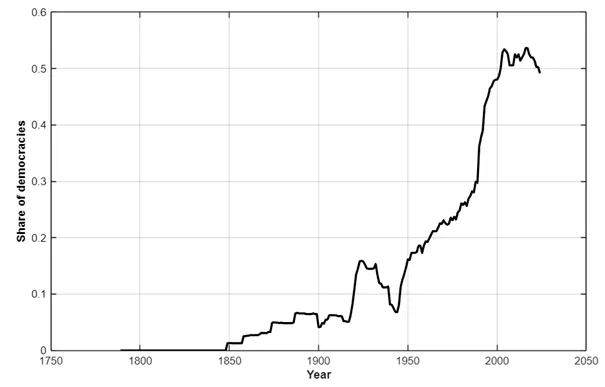
Fig. 2: Share of countries that are electoral or liberal democracies.
Click on the image to enlarge.
From 1800 until recently, democracy’s march seemed unstoppable. But, since the turn of the millennium, a stall. And now, a dip. Not yet a collapse, but enough of a bend to evoke a Seneca Curve, the kind where descent outpaces ascent.
Will democracies go the way of other overextended systems? As ever, prediction is perilous; history is a trickster.
One important caveat: the share of countries is only a rough proxy. Imagine weighting the curve by population: would the cliff steepen or flatten? Work in progress.
Biophysical Realities: Democracy’s Diet
Let’s add another ingredient: energy. No system grows without “food.” Fossil energy consumption surged alongside democracy and GDP (Fig. 3):
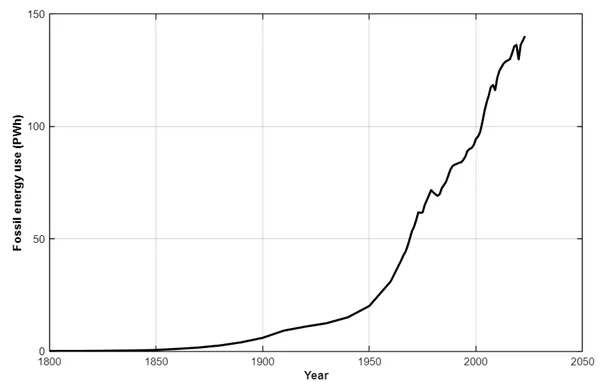
Fig. 3: Global energy use from fossil sources. Click on the image to enlarge.
As so many have underlined (Ugo Bardi, Charles Hall, Jean-Marc Jancovici, Donella Meadows et al., Herman Daly, Nate Hagens. …), energy is growth’s silent partner. Is democracy tied to energy bonanza? Or just along for the ride?
System Dynamics: Virtuous Circles, Vicious Turns
Imagine this feedback loop (Fig. 4):
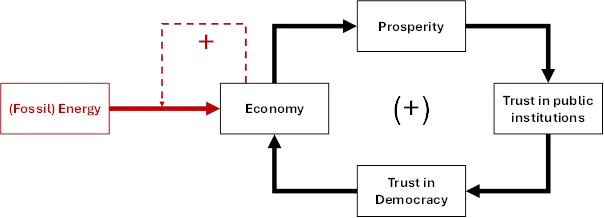
Fig. 4: Simple system dynamics model showing the connection between democracy,
economic growth and (fossil) energy. Click on the image to enlarge.
Trust in democracy fosters a larger economy à rising prosperity à greater trust in democratic institutions à … and repeat. But every virtuous circle is a potential vicious one: break the chain, and decline feeds on itself. At the heart: energy, especially the easy energy of fossil fuels.
But here’s the twist: available energy isn’t just about quantity, it’s about quality, i.e. the net energy we get after extracting, processing, and delivering it. Enter EROEI (Energy Returned on Energy Invested). For the world’s major fuel sources, EROEI has been declining.
Debt: A Proxy for Energy Strain?
As net energy shrinks, squeezing growth gets harder. Cue government debts, a way to keep the system running even as it sputters (Fig. 5):
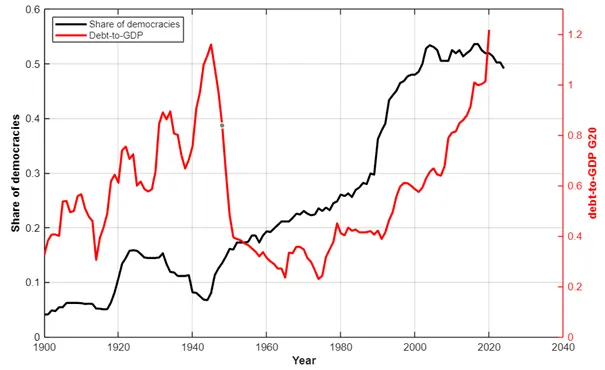
Fig. 5: Global democracies and debt-to-GDP (IMF).
Click on the image to enlarge.
Note: during the interwar years (1920–50), debt rose sharply and democracy faltered. Echoes of today? Since 2000, debt-to-GDP climbs, but democracy stagnates and (perhaps) slides.
Are We Staring at the Cliff?
So, are we living through a Seneca Cliff? The abrupt downslope of democracy? Maybe. Maybe not. The data hints at fragility, but causality in complex systems is elusive. Perhaps declining EROEI is tightening democratic institutions’ leash. Perhaps not.
Churchill reminded us: “Democracy is the worst form of government except all those other forms that have been tried.” As much as I hope we’re not nearing the precipice, I believe in warning when the wind shifts.
The lesson? Resist simple explanations. Examine feedbacks. Correlate biophysical reality with societal outcomes. Watch the cliff. And above all: discuss. As the world’s complexity tightens, our collective survival may depend on seeing, and steering away from, the abyss. Before the Seneca effect catches up with us.
Notes
Data sources:
GDP: Our World in Data, https://ourworldindata.org/grapher/global-gdp-over-the-long-run?time=1820..2024
Democracies: Our World in Data, https://ourworldindata.org/democracy
Energy: Our World in Data, https://ourworldindata.org/grapher/energy-consumption-by-source-and-country?stackMode=absolute
Debt-to-GDP: [International Monetary Fund, G20 statistics]
Further reading:
Acemoglu, D. et al. (2019). “Democracy Does Cause Growth.” Journal of Political Economy, 127(1), 47-100.
ABOUT THE AUTHOR
Thorsten Daubenfeld is a chemist and Dean of Students, Hochschule Fresenius University of Applied Sciences, Germany.
|