Staring at the Cliff right in front of us.
I always say that models are not predictions; they are qualitative illustrations of what the future could be. But as the future gets closer to the present, models can start being seen as predictive tools. It is the weather/climate dichotomy, so aptly exploited to confuse matters by politically minded people in the discussion about climate. Right now, we are getting close to the point that we could forecast a collapse in the same way as we can forecast the trajectory of a tropical storm.
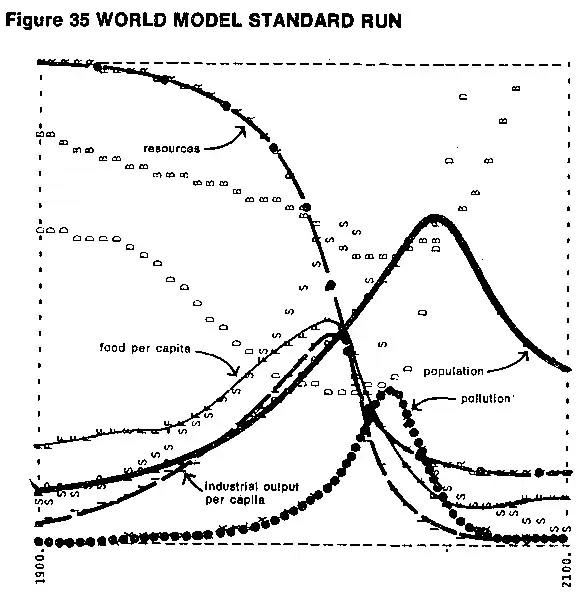
So, you remember how “The Limits to Growth” generated a long term forecast in 1972. Here it is:
Click on the image to enlarge.
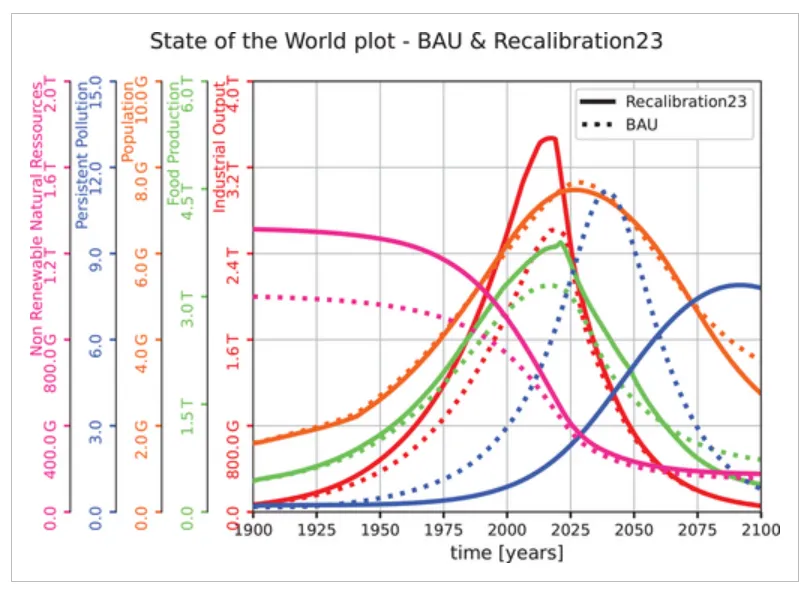
The start of the collapse of the industrial production (here calculated in per capita terms) was supposed to be at some moment between 2010 and 2020. A little too early, because we passed that moment. But that calculation was made more than 50 years ago, and it is legitimate to think that it needs some readjustments. That was what Nebel et al did in a recent paper; they recalibrated the same model (World3) on the basis of the available real-world data. And here is their result.
Click on the image to enlarge.
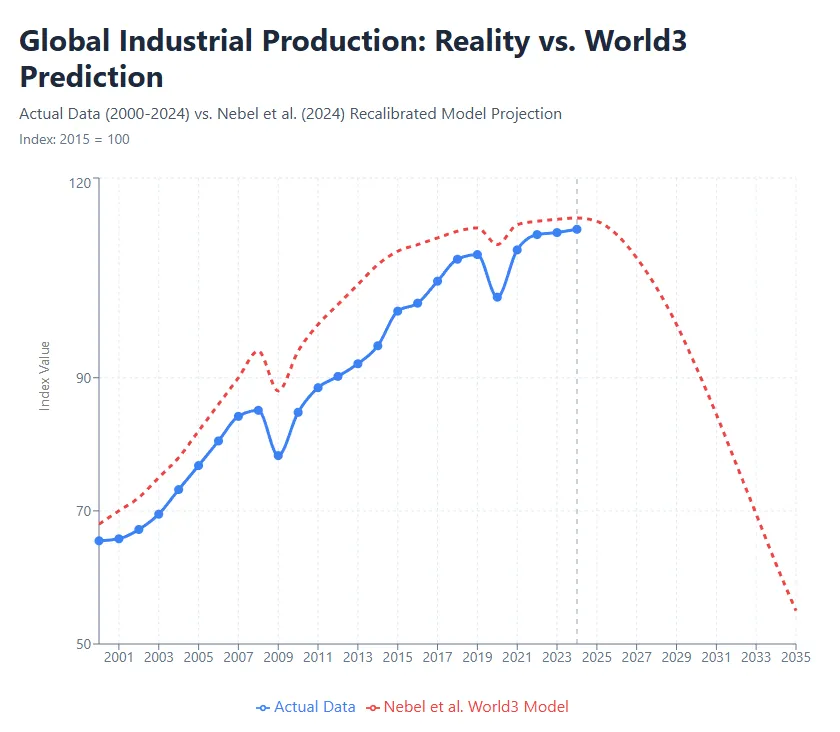
Note the red curve, industrial production. Are we facing the abyss? At first, it looks unlikely, but I compared Nebel’s data with the real-world ones for industrial production, and I had Claude plot them together. The result is shown at the beginning of this post; let me reproduce it here again:
Click on the image to enlarge.
Do pay attention to the other curves of Nebel et al.’s paper. Agricultural collapse will be at about the same time as the industrial one. Population should start collapsing a few years later. Pollution will reach a peak around 2080 at levels some three times higher than the current ones. If this is a good prediction, we are in for a rough ride, a VERY rough ride.
But never forget: even hurricanes may change their trajectory at the last moment, and there are reasons for optimism. Listen to Sabine Hossenfelder, for instance. I think that before making this clip, she smoked something really strong. But who knows? She might be right.
By the same author:
Aurelio Peccei's Last Words ~ A Message of Hope from
the Founder of the Club of Rome