In his message to the young people of Economy of Francesco, Pope Leo XIV reminded them that “the economy is not a machine that produces, but an activity that restores life to persons, communities, and our common home”. He invited participants to look at the “new things” from the peripheries, because “real change happens through the action of what is small and fragile”, and an economy truly “of Francis” is one that “strips itself of privilege and embraces reality, beginning with the leper”. The Pope urged young people to creatively carry forward the legacy of Pope Francis, recalling that “you can inspire many other young people to leave indifference behind”, and encouraging them with simple, direct words: “Take heart, dear friends! […] Let us go forward together”.
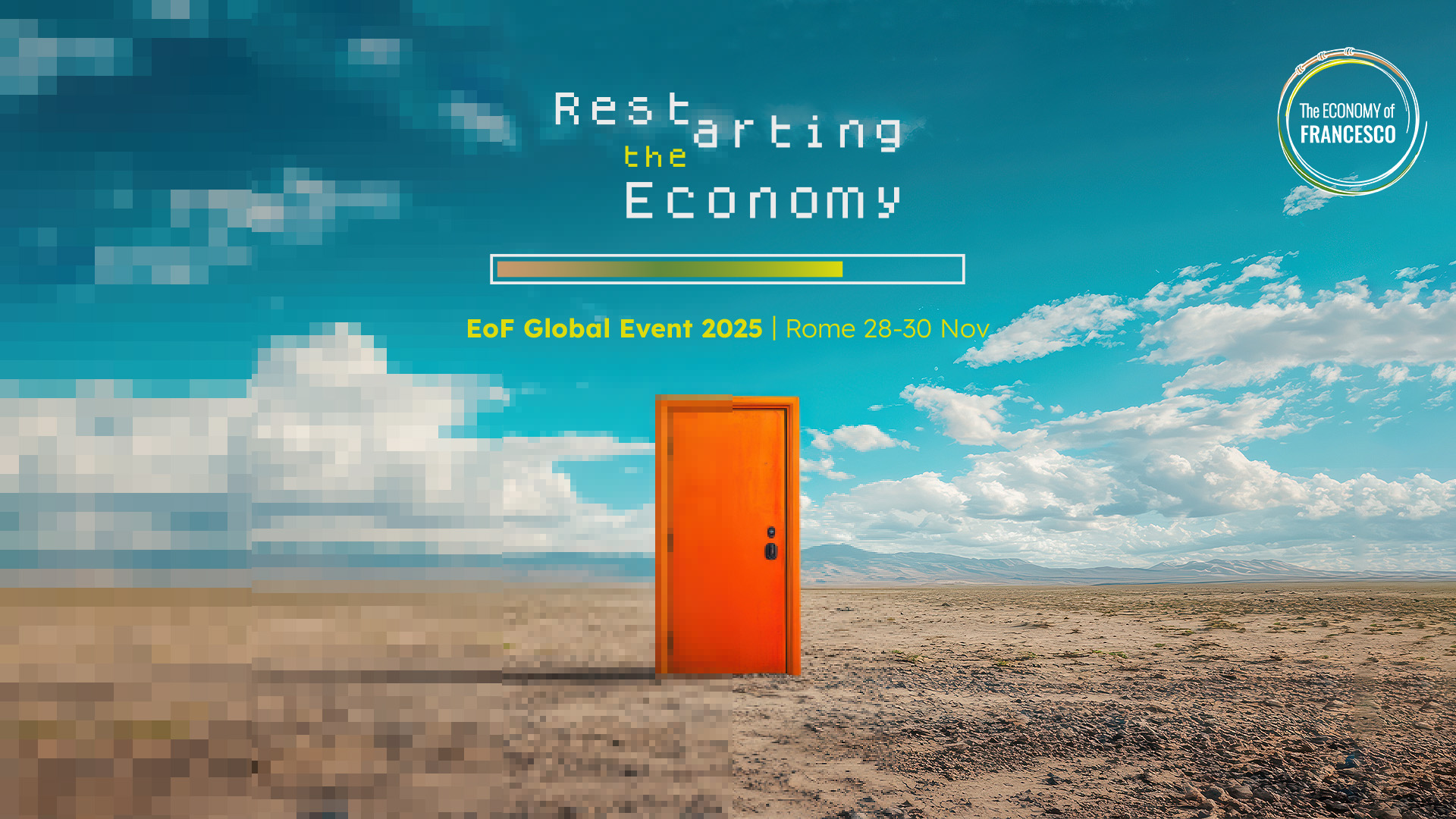
It is within this horizon that the proposals presented at the conclusion of Restarting the Economy take shape. The global gathering, held in Castel Gandolfo from 28 to 30 November, brought together economists, entrepreneurs, researchers and activists from more than sixty countries.
Throughout these days, hundreds of young participants worked to rethink the foundations of the economy, placing people, relationships, territories and the deeper forces that drive change at the center. Two proposals—developed over recent years within Economy of Francesco—emerged as particularly significant: Goal 0 – Spiritual Capital and the World Fraternity Report.
Goal 0 – Spiritual Capital originates from a clear critique: the current Sustainable Development Goals do not consider spiritual capital, the set of deep motivations that orient human action—meaning, responsibility, care, and the ability to imagine alternatives. For the young people of EoF, ignoring this dimension weakens any attempt at transformation. Goal 0 does not propose adding a new goal to the 2030 Agenda; instead, it calls for a cross-cutting principle that should inform all existing goals. The proposal calls for integrating spiritual capital into public policy design, recognizing and supporting the places where it is cultivated (schools, communities, organizations), developing shared tools to assess it, and considering it part of the civic competencies needed to address global challenges. In this vision, Economy of Francesco positions itself as a living laboratory where this capital is already nurtured and shared.
Alongside this proposal, the World Fraternity Report was presented—the first step in a broader research pathway launched within The Economy of Francesco. It begins with a simple but decisive question: can fraternity be understood not as an abstract sentiment but as a reality that generates economic and social value? The analyses conducted, the case studies examined, and the collection of quantitative data have shaped the initial results of an inquiry that conceives fraternity as a form of relational capital: a fabric of ties between individuals,
groups, and institutions capable of influencing economic life as much as more traditional indicators. The work will continue in the coming months, with the same research group committed to developing further tools and metrics.
The Report articulates this perspective across three levels: interpersonal relationships, rooted in trust, recognition and mutual care; community relationships, grounded in participation, cooperation and civic engagement; and institutional relationships, linked to transparency, equity and inclusive decision-making. On this basis, it offers an initial evaluative framework, with preliminary qualitative indicators and suggestions for application in schools, enterprises and local institutions.
Beyond analyses and proposals, the gathering also opened space for stories. The Prophetic Voices highlighted experiences of neighborhoods regenerated by youth leadership, educational pathways for adolescents, community-driven reforestation initiatives and peacebuilding projects in conflict-affected regions. The Extraordinary Ideas showcased innovative solutions—from recyclable modular housing to open-source medical devices, from transparent financial tools for small farmers to ethical AI platforms—demonstrating that an
economy grounded in innovation, justice and care is not only imaginable but already emerging.
Alongside plenary sessions, participants joined thematic workshops, took part in activities at the Borgo Laudato Si’—including work on the farm—and explored the EoF Fair, which gathered projects and research developed across Economy of Francesco’s hubs and villages. The Gratitude Wall and Garden of Hope collected messages, thanks and commitments, reflecting the climate of trust and shared purpose that marked the three days.
As the gathering comes to an end, the journey continues. The proposals presented—beginning with Goal 0 and the World Fraternity Report—will move forward through ongoing research, local projects and international collaborations within the global network of Economy of Francesco. It is a path that takes up and carries forward the Pope’s invitation: to walk on together, with our gaze fixed on what can bring life.
References
World Fraternity Report
Il messaggio di Papa Leone XIV a Economy of Francesco