
|
Mother Pelican
A Journal of Solidarity and Sustainability
Vol. 22, No. 1, January 2026
Luis T. Gutiérrez, Editor
|
|
|
|

|
|
|
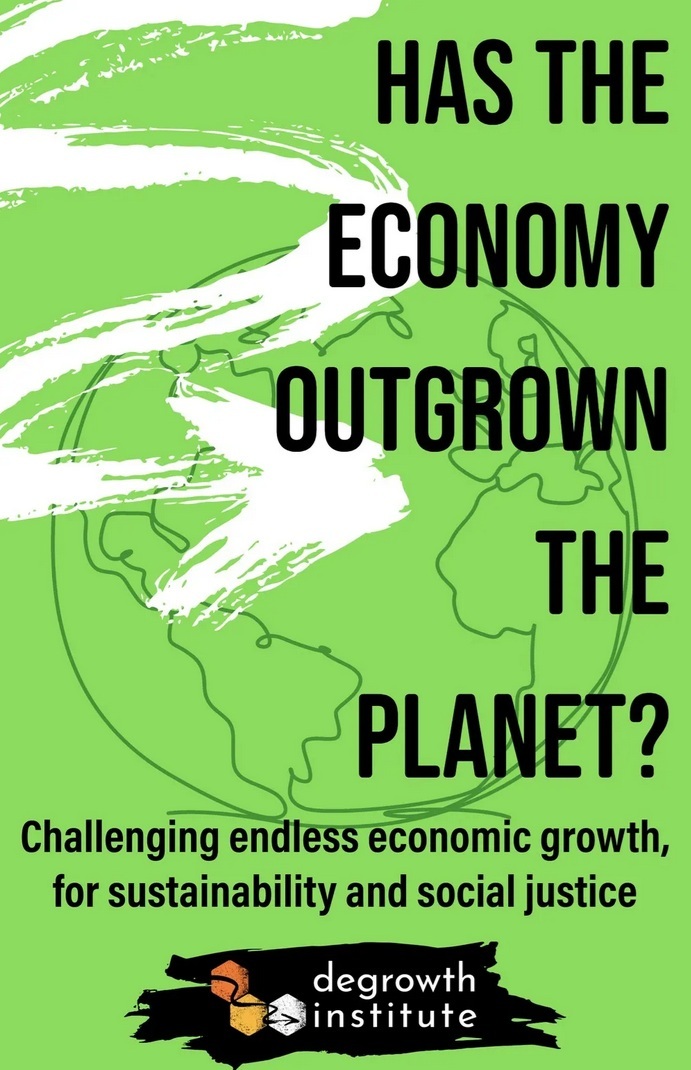
Has the Economy Outgrown the Planet?
An Introduction to Degrowth
John Mulrow
This article was originally published by
Degrowth Institute, June 2025
under a Creative Commoms License
|
Note: This is an excellent article. Degrowth is inevitable. Excerpts are provided here. A link to the full article is inserted at the end.
This brief introduces degrowth – intentional downscaling of the global economy to achieve ecological sustainability and social justice – for people working in environmental and social advocacy. It centers the question: “Has the economy outgrown the planet?” because global ecological limits have reshaped the conditions under which we pursue climate action, environmental justice, and many other pressing aims.
Efforts to reduce environmental harm and improve wellbeing are worthwhile on their own, even without thinking about the broader economy. At the same time, any effort to extend localized progress to planetary scale must account for ecological limits to economic growth.
This juncture calls for a diversity of already-motivated communities to challenge endless economic growth as an extension of their existing work, which begins with understanding that the economy has outgrown the planet. That awareness will help reshape our movements, our strategies, and our relationships with each other and the Earth, for the better.
SOME KEY POINTS
|
"The global economy is pushing past the ecological limits of Planet Earth, and climate change is not the only symptom."
"The economy is ecology... The next great challenge for environmental advocates is to recognize that a limit on ecological degradation means a limit on economic size"
"The economy is getting more efficient, but the savings are fueling further growth and extraction, not resource conservation, environmental protection, or ecological health."
"This understanding of sustainability within limits will lead us to call for an end to endless growth, and a realignment of social and ecological goals."
"Degrowth is an intentional downscaling of the global economy for the purpose of achieving ecological sustainability and social justice."
"While many societies have achieved this locally, economic downscaling has never been tackled on a global scale."
|
DEGROWTH MOVEMENT
|
"Where do we go from here?"
"Recognizing that the economy has outgrown the planet elicits a conflict. The assurance that biophysical limits to growth can be articulated and addressed is countered by an overwhelming sense that the path to economic downscaling will be impossible to navigate. How do we start building a just and ecological future when the cultural values and political practices required seem so distant from the current norm?"
"Facing such formidable questions is the work of social movements. From this point of inflection, we will need to work together, not simply on the action of economic downscaling, but on creating a shared understanding of what it means to live life well, together, and within planetary limits. As we build the degrowth movement in the United States, there is a wealth of wisdom and ongoing action to be drawn upon."
|
READ THE BRIEF
By the same author:
What Happens to the Savings?
Delivering on the Promise of Sustainability
by Challenging Endless Economic Growth
ABOUT THE AUTHOR
John Mulrow is the executive director of Degrowth Institute, co-founder of DegrowUS, and adjunct professor of Environmental and Ecological Engineering at Purdue University. He holds a BS in Environmental Science and Policy from Stanford University and completed his Masters and PhD in Civil Engineering at University of Illinois Chicago. He was a Postdoctoral Fellow in Civil and Environmental Engineering at Georgia Tech from 2020-2022. His research aims to improve environmental assessment by accounting for social outcomes and biophysical limits to economic growth. John is based in Chicago, where he’s worked on urban farming, composting, and climate action for many years.
|
|
|
|
|
"Nature abhors a vacuum."
— Aristotle (384-322 BCE)
— Spinoza (1632-1677 CE)
|
|
Page 2
|
|
|