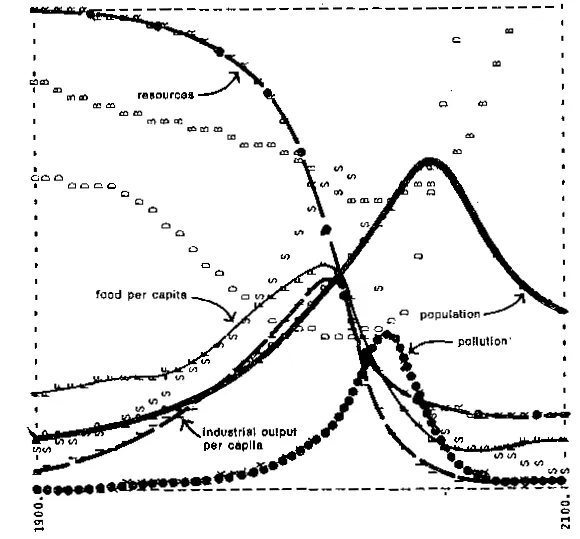
I might as well come right out and say it: Humans are wrecking their home planet, geo-politics is boiling over, civil unrest is palpable and human nature is at the heart of it all. Modern techno-industrial (MTI) society has self-organized for ignominious collapse in this century and there is nothing much we can do about it.
It’s complicated, but the ‘human nature’ part is not all that hard to comprehend (unless you are a creationist).
Let’s start with some basics:
Nothing in biology makes sense except in the light of evolution (Theodosius Dobzhansky, The American Biology Teacher, March 1973).
Fact: H. sapiens, like millions of other species, has evolved by Darwinian natural selection. It follows that nothing in human affairs makes (complete) sense except in light of evolution. Nudged by competition for the material necessities of life,[1] natural selection endowed us with at least three characteristics relevant to our present socio-ecological predicament: 1) humans invade and populate all accessible favorable habitats; 2) human populations use up all available resources; 3) under favorable conditions, human populations are capable of exponential growth. It’s worth noting in passing that those millions of other species—including competing species with ecologically similar requirements—share these same qualities. It just so happens that, by playing on manipulative intelligence, natural selection has made us orders of magnitude better at expressing them than are more ecologically ‘normal’ species.
The proof is irrefutable: humans have colonized every continent and sizable island on the planet—no other vertebrate species’ natural geographic range comes close to that of H. sapiens; humans have an embarrassing record of over-exploiting—often to the point of extinction—other species that we consider edible or that we can ‘harvest’ for economically valuable body parts from soft warm fur to hard cold ivory; industrial humans have burned through prodigious quantities of fossil fuels (we are close to peak petroleum production with no signs of backing off as the green new deal is implodes) and the world is running up against supply bottlenecks of crucial metals/minerals such as copper and rare earths. In short, humans are scraping the sides and bottom of our earthly barrel. In the process we have become the dominant geological force, changing the face of the planet and are extinguishing much non-human life.
We also win a special prize on the sheer numbers front. Normally, if a population a of K-strategic (or ‘slow life-history’) species like humans becomes excessive, its exponential growth imperative (positive feedback) is held in check by increasing disease, food and resource shortages, competition for space, higher predation rates, etc. (negative feedback). Thus, suspended between fluctuating push and pull, K-populations tend to hover in dynamic equilibrium near the average carrying capacities of their habitats. This was Malthus’ crucial insight.
It is also how local human populations behaved for most of anatomically modern H. sapiens’ 300,000-year evolutionary history. Things changed dramatically with the adoption of agriculture ten millennia ago; food surpluses enabled large permanent settlements and the emergence of ‘civilization’, but it is really post-enlightenment MTI peoples who have (if only temporarily) broken the rules that maintained equilibrium.
The industrial/scientific revolution spawned technologies, particularly improvements in public sanitation and disease control, that greatly reduced death rates while fossil fuels alleviated food and resource shortages. With the suppression of negative factors, positive feedback prevailed; between the early 1800s and 2023, the human population exploded from one to eight billion. Meanwhile, what we now call ‘neoliberal economics’ began taking form in the late 1800s. In just two centuries, the human population grew eight times larger than the maximum attained over the previous 3000 centuries
[2] and the world economy grew 100-fold in real terms! Within a few decades, small villages became towns and well-placed towns morphed into major industrial cities. By 2025, 80% of humanity was effectively urbanized, a transformation catalyzed not only by population growth, but also the migration of millions from rural to urban areas.[3] There are now about 80 cities in the world with populations in excess of five million—each has more people than existed on the entire planet at the dawn of agriculture 10,000 years ago.[4]
The momentum seemed unstoppable. And who would want to stop it? Life in higher income countries just seemed to be getting better and better, at least in material terms. Little wonder that by the 1950s, MTI governments and international institutions everywhere were adopting the neoliberal vision of perpetual economic and population growth via continuous technological advance, as the dominant development narrative of global culture.
There are, of course, significant problems—all this occurred on a finite non-growing planet with serious history. With nurture-reinforcing-nature in propelling the expansionist juggernaut, the human enterprise surged into ecological overshoot; resource consumption and waste production are overwhelming the bio-productive and waste assimilation capacities of the ecosphere. This is not merely an aesthetic concern: the functional integrity of the ecosphere is essential for human existence. Overshoot may be a quasi-natural phenomenon, but it is also a potentially terminal condition.
To make matters worse, H. sapiens’ evolutionary history has not prepared humans for life in cities of millions. Urban environments are totally unnatural. Natural selection sometimes throws a curve-ball—what was clearly adaptive under ancient conditions can be just as obviously maladaptive in modern times. As the proverbial sage would say, “That was then, this is now.”
Modern maladaptation
In hindsight—we’ve had ample scientific warning—the modern human eco-predicament seems like the product of sheer stupidity. More generously, the unprecedented and still-accelerating rate of technological change has so vastly outpaced bio-evolution that people either didn’t notice, haven’t fully grasped what’s happening or are simply too busy celebrating to care.
Belatedly, the rising cost of global heating is indirectly attracting attention to the fact of overshoot, but other major implications of the techno-industrial revolution remain mostly unnoticed. And I am not talking about other ‘environmental’ impacts—we should be as concerned about the psycho-cognitive dimensions. In particular: 1) human beings are psychologically ill-suited to hyper-populated, chemically and often socially toxic urban environments, and 2) fully comprehending the eco-social-meta-crisis is way beyond our cognitive depth; self-deluded MTI societies are floundering in the sea of reality as they struggle to say afloat.
In brief:
Modern techno-industrial peoples are no longer adapted to either the biophysical or social environments they themselves have created. MTI culture is therefore in Darwinian danger of being ‘selected out’.
This situation has been both a long and a short time coming and has yet to permeate general consciousness. The fact that MTI peoples are hardened ‘exceptionalists’,[5] unreceptive to the facts of evolutionary ecology, stands as a significant conceptual barrier. Consider it a failure of cultural narrative (and education at all levels).
Here’s what I think you ought to know:
Missing links
Anatomically modern H. sapiens evolved during the late Paleolithic, a period that lasted from three million to 10,000 years ago. Early hominids and more recent pre-agricultural human hunter-gatherers lived in tribal groups of perhaps a few tens of individuals in spatially limited, relatively knowable, predictably cyclical ecosystems; they would probably die within a few kilometers of place of birth. Typically, an individual would encounter only a few hundred other people in his/her lifetime; over thousands of generations, natural selection would fine-tune our capacity for social relationships to this reality. Eco-anthropologist Robin Dunbar suggested that this is why the maximum number of people with whom even we moderns can typically maintain stable social relationships is about 150. (What’s the population of your city?)
No doubt their spatially limited, slowly changing biophysical ‘environments’ were mysterious and fearsome and enough to early hominids. However, H. sapiens’ relatively static original habitats posed only limited challenges to the evolving brain and central nervous system. As a result, humans evolved to think simplistically, mechanically, in terms of simple cause-effect relationships, with attention focused on one thing at a time in the immediate here and now. Even this last bit makes perfect sense: individuals who survived the hazards of the next ten minutes or even ten seconds (Watch out for that leopard!) had a chance to pass their genes on to the next generation.
Most importantly, over the millennia, natural selection produced a neuro-cognitive adaptation to relatively stable environments that expresses itself even today. People subconsciously encode repeated environmental stimuli from their rearing environments, including socially constructed patterns of habitual group-think, into the synaptic circuitry of their brains.
This can be a source of both tribal cohesion and cultural evolution but has a downside. People live ‘out of’ their constructed fantasies as if they were real and true. Deeply-held religious beliefs, tribal myths, political ideologies, and even academic paradigms may contain ideas that are totally bonkers, yet such shared delusions can stubbornly persist among true believers even in the face of irrefutable contrary evidence. In adulthood, people may actually try to force the environment to conform to their preset neural structures.[6]
Such primitive cognitive modes were obviously adaptive for 97% of H. sapiens’ evolutionary history but put us in danger today. Paleolithic brains and associated cognitive processes are arguably functionally obsolete to cope with humanity’s contemporary, rapidly changing, mostly manufactured and unnaturally complex social and physical environments. Driven by the ‘growth-will-solve-everything’ imperative, eco-overshoot is dismantling and polluting the ecosphere, destroying essential life-support functions. Meanwhile, even after nearly a half-millennium of ‘enlightenment’, including two centuries of unprecedented growth and wealth accumulation, MTI societies remain unable to resolve the grotesque inequalities that accompany socio-economic and political hierarchy and are still plagued by acute and chronic urban pathologies: widespread addiction including the contemporary toxic drug crisis; grinding poverty and homelessness; overcrowding; unemployment and the mental health trauma and family violence that accompanies it; inter-racial tension and other sources of social alienation; rampant criminality from youth gangs to international racketeers, etc., etc., all of which can only become more intense as resource supplies tighten and economies crumble.
Significantly, coping with such contemporary problems demands an understanding of root causes, complex systems behavior, long-term planning and hyper-flexible institutions. Yet contemporary humans still tend to think in simplistic, reductionist, mechanical terms and are blind to past and future. Hardly anyone looks to innate human qualities; politicians and decision-makers generally don’t ‘get’ the danger of the discontinuous change—the unexpected lags, thresholds (tipping points), and other non-linearities that are characteristic of complex systems under mounting stress; market economics eschew planning; and even scientists’ understanding of familiar trends such as global heating, biodiversity loss, and the impacts of toxic pollution is confounded by unpredictable chaotic and potentially catastrophic systems behaviors. Meanwhile, government agencies seem paralyzed by regulatory capture (which is why, in the US, “permission to poison” can be called “default public policy”) and the scientific findings of seemingly front-line international organizations (e.g., the United Nations’ COP climate deliberations and its Intergovernmental Panel on Climate Change [IPCC]) are blunted by political interference and bureaucratic calcification. More generally, while it should be increasingly obvious that erroneous beliefs and irrational habits (infinite growth on a finite planet, anyone?) can be fatal both to their possessors and all those under their thrall, many folks remain captive to socially-constructed, yet neuro-habitual delusions about the nature of reality.
All of which argues that once-adaptive, conservative, cognitive mechanisms are exposing people today to unprecedented risks and hazards whose potentially disastrous outcomes become more ominous by the day. The upside is that knowing and experiencing this should give people—including policy makers and politicians—full license to rethink their prejudices, to break neurotic habits, to abandon wonky ideas and embrace unfolding reality.
But they don’t—the MTI world is mostly retrenching in defense of the indefensible. The Mergers and Acquisitions division of the Human Enterprise has acquired the ecosphere, billionaire oligarchs own much of the political class, politicians commit to the status quo, major governments hijack crucial reports on the state of the ecosphere and corporate values rule the world. (MAGA movement, anyone?)
As for most ordinary citizens, they may be confused and there are pockets of resistance but, on the whole, people seem content to go along for the ride. Gustave Le Bon described this situation well way back 1895: The masses have never thirsted after truth. They turn aside from evidence that is not to their taste, preferring to deify error, if error seduce[s] them. Whoever can supply them with illusions is easily their master; whoever attempts to destroy their illusions is always their victim.
Bottom line? MTI culture is going down, knowingly.
Notes
[1] It is impolite to say so, but competition is the major evolutionary driver. This is not to diminish the role of cooperation but cooperation among individuals of the same group is nature’s way of increasing their competitive edge against individuals of other, less cooperative groups (or species).
[2] And what about the competition? The current human population is 14,000-fold larger than the average populations of other mammal species of similar body size! Many of these non-human species’ populations have crashed as humans competitively displaced them from their food sources and habitats.
[3] They are not always attracted by the bright lights and economic opportunities offered by cities. Migrants are often forced to move by land ‘reform’ and diminishing rural prospects.
[4] This is not ‘normal’. If humans were a typical mammal whose global population corresponded to the arithmetic mean (average) of populations of mammals of similar body size, there would be only 500,000 people on Earth!
[5] Exceptionalism is the quasi-religious belief that humans are not part of nature and are exempt from natural law. From this perspective, individual behavior and social norms owe nothing to evolution (nature); we are entirely the product of learning and culture (nurture).
[6] It is sometimes said that economics is unlike a real science because economists try to force the environment to conform to their theories. By contrast, real scientists try to develop theories that conform the environment.
ABOUT THE AUTHOR
William E. Rees is a population ecologist and ecological economist. He is Professor Emeritus and former Director of the University of British Columbia's School of Community and Regional Planning; a founding member and former President of the Canadian Society for Ecological Economics; a founding Director of the One Earth Initiative; and a Fellow of the Post-Carbon Institute. Professor Rees' research focuses on the biophysical requirements for sustainability and the policy implications of global ecological trends. He is perhaps best known as the originator, and co-developer with his graduate students, of Ecological Footprint Analysis (EFA). EFA shows that the human enterprise is already in ecological 'overshoot' and that we would need 4.4 Earth-like planets to support just the present world population at Canadian material standards. Such findings led to a special focus on cities as particularly vulnerable components of the human ecosystem and on psycho-cognitive barriers to ecologically rational behavior and policy. Professor Rees has authored hundreds of peer-reviewed and popular articles on these and related topics.
|
|Back to Title|
LINK TO THE CURRENT ISSUE
LINK TO THE HOME PAGE