Socio-ecological cultivation of well-balanced human beings
This polarization series began with intentions to write at least two posts addressing relevant topics. Instead, it has expanded to seven posts. For readers who missed the first six posts, they are listed below. Taken altogether, there’s plenty of reading involved, but a quick scanning of them should help clarify all issues covered. Otherwise, perhaps the following very brief overview will suffice in describing the topics covered in all seven Socio-Ecological Polarization posts.
The first post (Our Two-Part Brain) focused on understanding how our brains determine conservative and progressive traits. The second post (Our Inherited and Acquired Personality Traits) considered ways of identifying and understanding complementary ways of thinking and acting according to influences of Nature and Nurture. The third post (Prominent Personality Types) centered on describing, identifying, and understanding the three principal personality types – extroverts, introverts, and ambiverts.
While the fourth post (Dark Triad Personalities) dealt with understanding the thinking and behavior of negative personality types – narcissism, Machiavellianism, and psychopathy, the fifth post (Light Triad Personalities) dealt with understanding the thinking and behavior of positive personality types – Kantianism, Humanism, and Faith in Humans.
The sixth post (Integration of Opposites) sought to identify a middle-ground status of balanced opposites. And now we arrive at post seven, the conclusion of this socio-ecological polarization series. Here we consider a developmental concept that, in order to create a sustainable future, humankind must transition from an egocentric stage level focused self-gratification to an ecocentric stage focused on serving the common good. Ideally, this will require a common-good wisdom founded on acknowledging and promoting the natural rights of all beings to continue existing and flourishing, and life-sustaining resources to be used wisely.
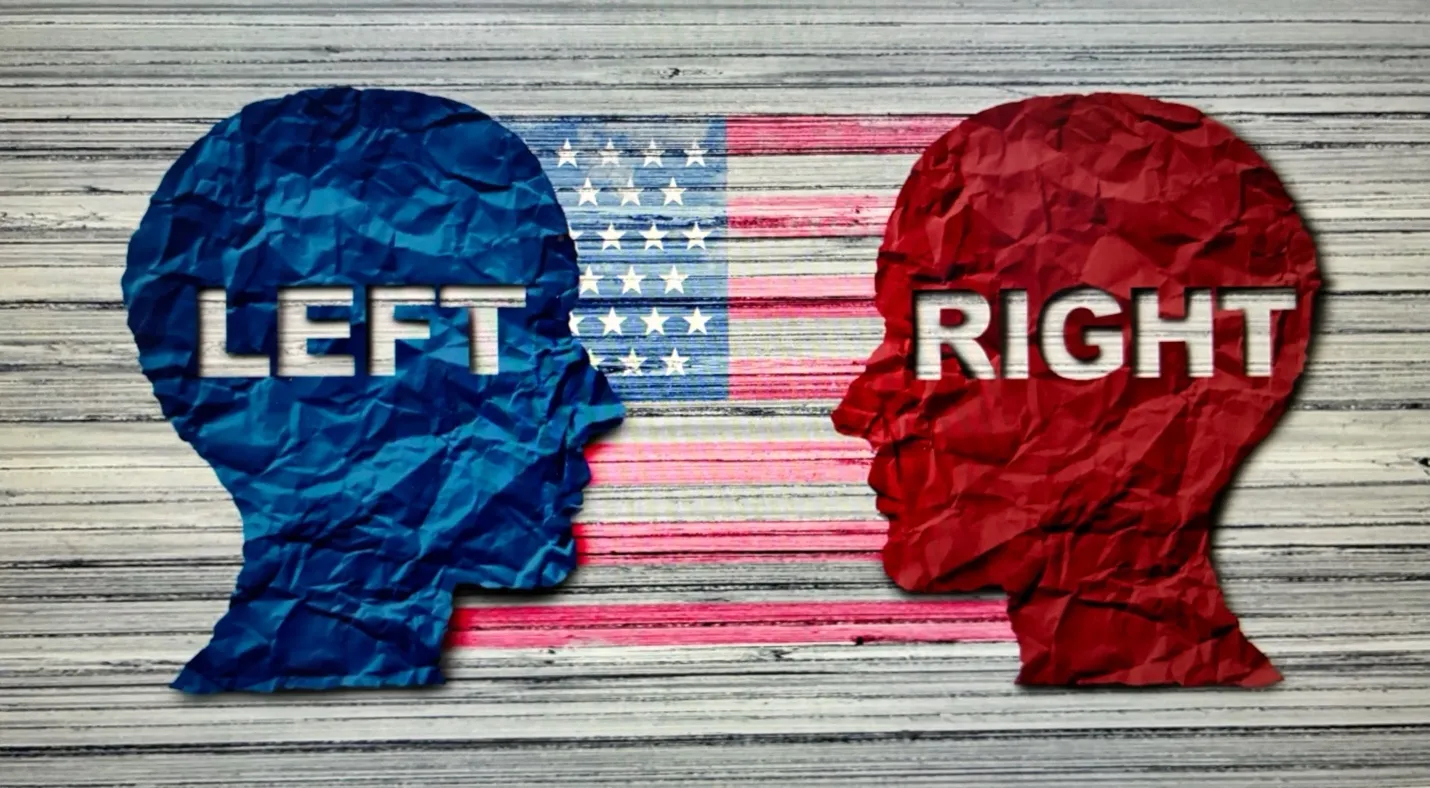
Cultivating Awareness of Forces Driving PolarizationThe general motivation for presenting this series has been to learn more about the underlying forces responsible for increasing societal polarization. The ever-widening division between conservatives (traditionalists) and progressives (liberals) is proving an extremely difficult challenge to comprehend – and, more importantly, to resolve.
A major driver of the growing confusion, anger, and fear on both polarized sides has been widely identified. In addition to a long history of civilization’s anthropocentrism, as illustrated by humankind’s expanding separation from the rest of Nature, a major modern technological marvel can be named. Yes, it’s the news media, especially social media, which no longer abstains from using AI-generated algorithms designed to promote financial incentives and influence people’s cognitive biases.
The World Economic Forum has identified the spreading of misinformation and disinformation as a major and urgent global concern, claiming that falsehoods are spreading “farther, faster, deeper, and more broadly than the truth”. The three negative terms associated with untruthful speech are: 1) misinformation, that which is intentionally falsified; 2) disinformation, that which is thought to be true but isn’t; and 3) mal-information, that which is based on reality but intended to cause harm to a person, organization, or other entities.
As we are learning, advances in AI and automated accounts (bots) are being used to rapidly and widely disseminate fake news, including convincingly “deepfake“ manipulated content. At this time, there’s no way of knowing what will happen with this technology going forward, but concerns are increasingly expressed, especially among persons associated with major societal institutions, organizations, corporations, and governments.
Stages of Human Development, from Egocentrism to Ecocentrism
I’ve previously written about the stages of lifespan development, as presented in Integral Theory, a philosophical system developed by American philosopher Ken Wilber. Since the concept provides a relevant framework for considering the development of personality traits (both negative and positive), it seems appropriate to revisit this topic.
At the outset it’s relevant for readers to understand that I take personal liberties in modifying this theory according to my understanding and preferences. It’s also important to acknowledge that concepts and behaviors observed with conservatives and progressives are the products of Nature (genetic characteristics) and Nurture (acquired traits). As we increasingly are experiencing, all personality traits are accentuated when people cope with stressful economic, socio-cultural, political, and ecological conditions. Understanding the stages of human development – from egocentrism to ecocentrism – should help in discerning the positive personality traits needed in creating a sustainable future.
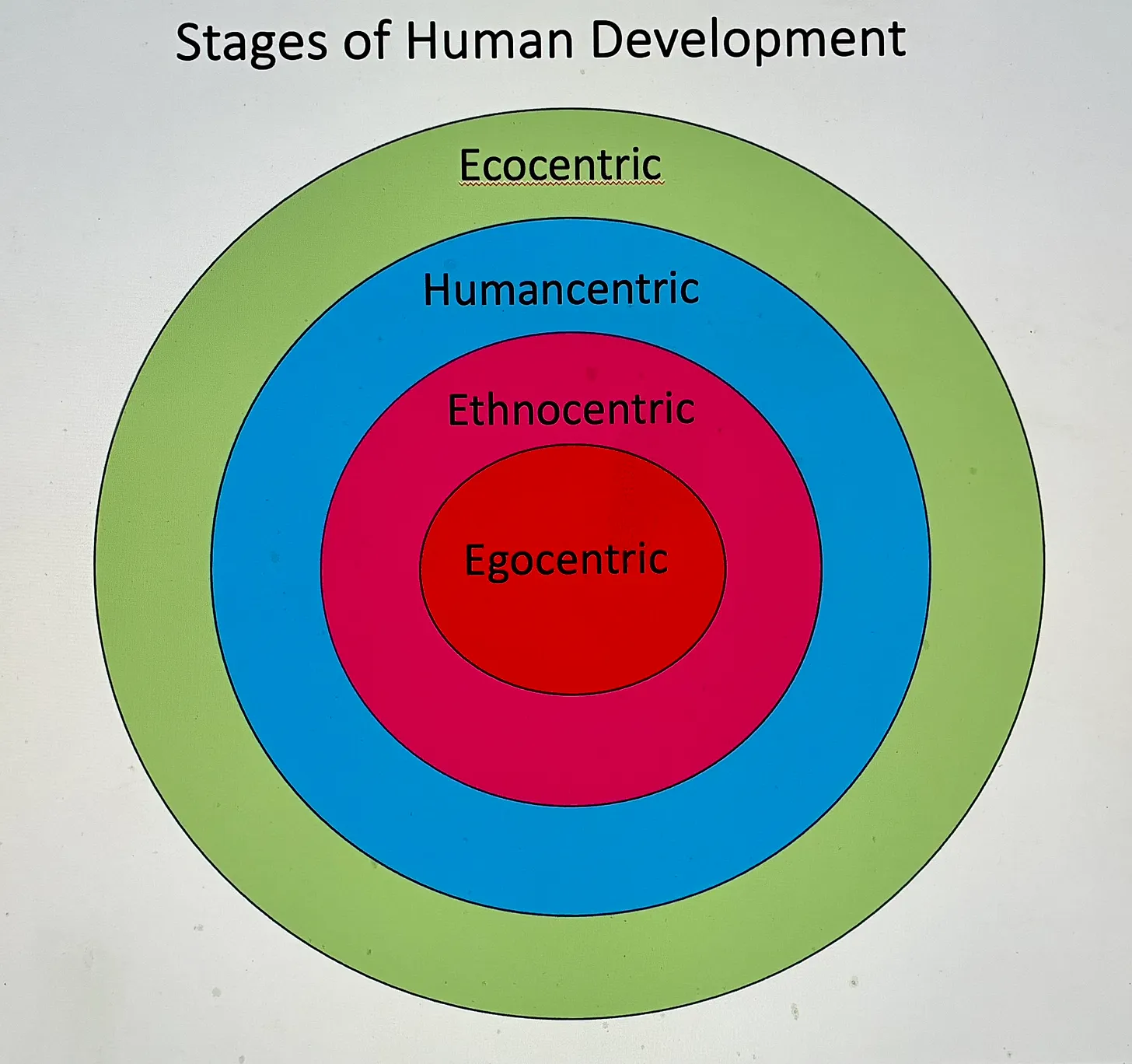
One substantial aspect of Integral Theory is a plausible explanation about how we evolve (mentally, emotionally, and spiritually) throughout a lifelong process that involves negotiating life in several stages. As a bottoms-up process, Integral Theory explains all stages of normal human development, beginning with childhood egocentricity and culminating in a highly-evolved stage. Although Wilber eventually identified eleven stages, I find it simpler to use his original four stages (plus a possible new one), all ranging from simple to complex.
First, it’s common knowledge that, at a psycho-emotional stage level, children view the world primarily through a self-centered, instant-gratification egocentric lens. Anyone having experienced the tantrums of a two-year-old child when not getting their way with something can recall similar egocentric responses that carry over into adulthood.
When children attain puberty and transition into adolescence, the growing influence of peers leads them to view life more through a tribal (ethnocentric or sociocentric) lens. Based on observable attitudes and behaviors, many adults continue exhibiting adolescent-level ethnocentric attributes, as illustrated by allegiance to their tribe’s established beliefs and behaviors, right or wrong. Based on the increasing rise of uncivil discourse and behavior, it seems hypothetically possible that at least 20-30 percent of the U.S. population may be largely embedded in the ethnocentric stage.
As people move into their mid-twenties and become fully mature as young adults, it’s likely that, depending on the breadth and depth of life experiences up to that point, they may begin questioning their acquired socio-cultural beliefs, practices, and customs. In using critical thinking processes to analyze and interpret the world more broadly and deeply, they may eventually begin viewing existence through a humancentric (homocentric) lens to experience a global-oriented transpersonal ethic that promotes a more meaningful and qualitative way of living.
Persons exhibiting a humancentric outlook typically exemplify such positive personal qualities as intellectual curiosity (truth), compassionate behavior (goodness), and creative interests (beauty). In short, they are globally oriented, and more concerned about the welfare of all humans beyond their family, friends, and special-interest groups.
Recently, I’ve begun viewing the humancentric stage-level as focused mainly on anthropocentric concerns, that is, as an extension beyond tribe and nation of such socio-cultural values as justice, equality, and equity to include a global all-humans perspective. Typically, although humancentric persons may be very concerned about all people’s rights, needs, and wants, they may not be as concerned about all lifeforms’ rights and needs. (Note: I’m not satisfied with the term used for this stage level. Humancentric is too similar to anthropocentric. If anyone has a term that fits the intended meaning, as described in this section, please let me know.)
I need to insert here that Wilber uses the term worldcentric for this category of human development. However, I’ve chosen instead to use the term humancentric because most people representing this worldview are mostly focused on human-centered issues, and fail to fully appreciate how much we humans depend on all other beings and entities for our survival and flourishing. I hope this explanation resonates with your thoughts. Moving on . . .
Finally, we consider ecocentrism, a more inclusively enlightened stage of development represented by a small but growing movement. Adherents may include members of existing indigenous cultures, academic and activist groups dedicated to deep ecology and biospheric egalitarianism, and Green parties. A rough estimate indicates this eco-centric population may represent no more than 5%-10% of the global population. Obviously, we have far to go in creating a larger representation of eco-centric activists.
Developing the capacity to view existence through an eco-centric lens can lead to a big-picture, deep-time worldview shaped by profound appreciation and love for all that exists, including all animate beings and inanimate matter. Conceived by eco-philosopher Aldo Leopold, promoter of a “land ethic” concept, ecocentrism acknowledges that all lifeforms are the products of interdependent ongoing evolutionary life processes.
It’s important to understand that the integral-theory principle connecting each subsequently evolving stage level is based on the concept of “transcend and include”. In other words, when a person has passed through childhood, the positive and negative qualities of egocentrism remain present at each subsequent stage level. This same inclusiveness of egocentric, ethnocentric, and humancentric stages applies for persons who have attained the ecocentric stage level.
This “transcend and include” developmental progression — from egocentric to ecocentric — helps explain why persons at any level who have developed beyond egocentrism have a greater capacity for understanding and empathizing with persons exhibiting characteristics associated with previous stages. Conversely, it also explains why persons existing mostly in egocentric and ethnocentric stages, are unable to fully understand and empathize with humancentric and ecocentric stages. In short, for the upper-level stages, it’s like a “been there, done that” awareness.
Additional Information Regarding Human Developmental Stages
Click on the image to enlarge.
Although it’s normal to think of the four developmental stages or phases in hierarchical terms, with ecocentricism being the highest stage, I prefer thinking of the four as nested concentrically, a general circle containing four or more expanding circles. Thus, egocentricism is the smallest center circle (” bull’s eye”), and the final fourth and largest circle represents ecocentrism. I prefer this Matryoshka Russian Doll concept because it emphasizes the holistic relationship that unites all stages or phases. The term holon is applicable here, as it describes a concept representing something that is simultaneously a whole and a part, existing within a larger system and also containing smaller parts.I decided to insert this section when recently reading Michael D.B. Harvey’s insightful book, The Age of the Humachine: Big Tech and the Battle for Humanity’s Future, inspiring me to think further about developmental stages. With the rapid increase of cyber technologies in modern society (notably artificial intelligence), several leading techno-optimists are gaining wide attention and influence. A key futurist, Ray Kurzweil, explains his sci-fi theories in his book, The Singularity is Nearer.
From what I can discern, a number of extremely wealthy techno-optimists (also extremely bright, creative nerds) evidence minimal regard for Nature and planetary sustainability. They project an euphoric adolescent vision of a sci-fi future, where technology solves humanity’s most challenging problems, beginning with extreme longevity, a “singularity” event where human genetics merge with nanotechnology and AI. Supposedly, they surmise that automating humans and machines will enable the widespread availability of clean energy and other advanced innovations.
For a better understanding, I recommend reading The Techno-Optimist Manifesto. I mention this recent movement because it forces a reconsideration of developmental stages. But I’m not sure where (or if) this group fits within the existing stages. Or could it be a new stage? From my vantage point, our expanding human economic superorganism will not be able continue on the current dead-end trajectory. In sum, given the laws of physics (physical limitations) and human wisdom, I find such techno-optimistic’ “pipe dreams” highly impractical, if not impossible to be realized. Yet, there are positive responses, perhaps even solutions available.
My preference is for humanity to cooperate with Nature in creating a long-term future era that can be given a name that replaces current popular references of our era as the Anthropocene or Technocene. Simon Hill has suggested using the names Symbiocene, which emphasizes mutual interdependence and cooperation with nature, or Synthocene, which suggests a future of sustainable innovation and regenerative practices. Both names propose a transition to a new era that moves beyond the techno-optimists’ limitless fanciful objectives toward a more sustainable relationship with the planet’s bio-ecosystems.
Human Development Stages – Reflections, Conceptions, and Interpretations
What does the above information suggest to you? From my perspective and opinion, the current U.S. administrative machine is populated with politicians who epitomize a preponderance of egocentric and ethnocentric developmental stages. There’s minimal evidence of exhibiting tolerance and respect for anyone who doesn’t support the revered concepts of despotic white supremacy, American superiority, anthropocentric arrogance, and a twisted concept of Christianity, a radical mix of simple-minded emotional evangelism and Christian nationalism.
Although no sure-fire solutions have actually been identified, there are individuals and groups laying claim to some. For my part, I can name a range of possible long-term goals with the potential of transforming society away from the current paradigm, which is based on maintaining outdated, overly simplified, short-term strategies to advance their individual egocentric and ethnocentric tribal interests.
Fundamentally, it seems important for us to realize that, contrary to any idealistic narratives, we are not born totally free. From birth, our thoughts and behaviors are molded and patterned primarily by inherited and acquired personality traits, characteristics, and qualities, all modeled by our parents (or childhood caregivers), including their socio-cultural affiliations, beliefs, and behaviors. Major influences typically involve extended family, friends, institutions, societal laws, mores, laws, services, and expectations.
In short, we have had no appreciable influence in determining our conception, gestation, or birth. Thus, who we have become as adults are largely the products of inherited genetic dispositions and acquired knowledge, skills, and experiences. As far as I can tell, there is no master plan, no destiny, no anthropocentrically conceived god-like controls over who we are or what we become as individuals. But we are beholden to the societal systems and institutions that determine the milieu in which we live and function.
As I ponder this topic, I’m leaning towards interpreting the human-centric stage level as being mainly focused on socio-cultural concerns, especially the virtues of justice, equality, and equity that extend beyond tribe and nation to form a global common-good perspective. Typically, while human-centric persons are very concerned about all human rights, needs, and wants, they may not be as concerned about the rights and needs of all other earthly lifeforms.
It should be obvious by now that I endorse ecocentrism as the goal for humanity to humanely pursue, with great urgency and determination. Persuading and working to promote eco-centric views in a society that capitalizes on constant economic growth and expansion seems daunting. But the alternative – the potential collapse of civilization and the bio-ecosphere – is unimaginably disastrous.
Wrap Up and Conclusion
We wind up this seven-post societal polarization series with more questions than answers, but that’s to be expected given the whirlwind of complex issues swirling about and needing appropriate responses. I don’t have all of the answers, but I think I understand the general direction society needs to take to attain a sustainable future existence.
For certain, making substantial progress will require an unpolarized, eco-centric populace, which means persuading more world citizens to transition from ego-centric and ethno-centric worldviews to human-centric and, ideally, eco-centric worldviews. It won’t be easy, but do we really have a viable option? I don’t think so.
As for future topics, I have some ideas. One series in mind involved looking at a four-part series devoted to the relevance of size, scope, scale, and speed in addressing serious socio-ecological issues. Please let me know if you have any special topics you’d like to have covered.
Clif (with appreciation to Bettye Ware, reader/editor)
P.S. Finally, here’s a bonus, a song addressing societal polarization that Bettye and I created in 2008:
Why Can’t We All Get Along?
ABOUT THE AUTHOR
Clifton Ware, D.M., emeritus professor (voice), professional singer and author of four published books and two unpublished works, retired in 2007 from the University of Minnesota-Twin Cities School of Music, where he taught for 37 years. Since retiring, as a self-described socio-ecological philosopher he has spent 15 years focusing on sustainability issues, in the process of acquiring an evidence-based, big-picture understanding of all principal societal and ecological systems, including the symbiotic interconnections and role of humans as an integral part of Nature. In 2013 he founded Citizens for Sustainability in St. Anthony Village, MN, produced Sustainability News + Views (2014-2019), a weekly newsletter featuring a variety of articles and a commentary, co-composed 13 Eco Songs with his wife, Bettye, organized Sustainability Forums, and performed eco-oriented programs and presentations for several organizations.
|
|Back to Title|
LINK TO THE CURRENT ISSUE
LINK TO THE HOME PAGE